HE DIDN’T HAVE TO TAKE IT! – Easter Monday

When the devil had finished tempting Jesus, he left him until the next opportunity came. [Luke 4:13 (NLT)]
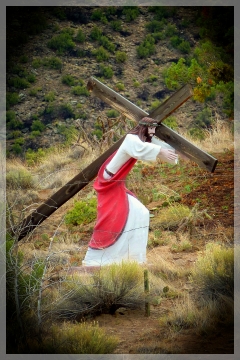
penitente morada Abiquiui NMWhen asked about the temptation of Christ, we probably think of Satan’s three temptations in the wilderness. Since the gospels don’t mention other specific temptations, it’s easy to think that Jesus, unlike the rest of us, was only tempted three times. “He left him until the next opportunity came,” wrote Luke and, while reading the four gospel accounts of the crucifixion during Holy Week, I know He had to have been sorely tempted that awful last day. Right up to the end, Satan must have been at His side, whispering into his ear and reminding Him that He didn’t have to take the abuse—after all, He was God!

Satan just was warming up with his temptations during Christ’s forty days in the wilderness. When Jesus prayed so hard He sweat blood in Gethsemane, that wasn’t because He was afraid to suffer and die. That was Jesus resisting Satan as the enemy made false promises, cast doubt on His mission, and tried to keep Him from the cross.

I can’t believe Satan went down without a fight and it was in the hours following Jesus’s arrest that he must have made a determined last ditch effort to thwart God’s plan of salvation. It may have been a man’s body suffering the unspeakable abuse that horrifying Friday but, inside the bruised and bloody flesh, it was God! He’d fed a multitude with a few scraps, turned water into wine, cast out demons, healed lepers, and stilled a storm. Jesus didn’t lose His power when He was arrested; He deliberately chose not to use it!

When Jesus was wrongly accused and false witnesses testified before the high court, when the people who’d hailed Him just a few days earlier called to crucify him, or when the crowd ridiculed Him as His tortured body hung on the cross, could the One capable of giving hearing to the deaf been tempted to strike them all mute? Jesus was there when an angel of the Lord killed 185,000 Assyrian soldiers outside of Jerusalem’s walls. As He was being spit on, slapped, beaten with fists, hit on the head with a reed stick, flogged with a lead-tipped whip, and mocked with a crown of sharp thorns, surely Satan invited Jesus to do something similar to His taunters and abusers. Could the One who gave sight to the blind have been tempted to take away the sight of the soldiers as they gambled for his robe or knelt in mock worship? As they nailed His hands to the cross, could the One who’d cast demons into swine been tempted to kill the men who were torturing Him? Jesus was God. He existed before time, space, matter and energy began and, up to His very last breath, the One who could walk on water could have freed Himself, stepped off that cross, healed his wounds, and destroyed every last one of the soldiers and onlookers with just a thought. But, He didn’t!

Perhaps it was my familiarity with the crucifixion story (and the fact that I know the good news that follows) but I don’t think I truly grasped the anguish of Christ until I read all four gospel accounts in one sitting. I knew He suffered a gruesome tortuous death but I didn’t see how tempting it would have been for Him not to do so! Perhaps resisting the temptation to quit and punish His abusers was even harder than enduring the pain of the cross.

How long would you hold your hand over a burning flame when all you had to do was pull it out of the fire? Would you do it for people who reviled and berated you? Jesus didn’t have to suffer and die for us; He chose to do so out of love. I, for one, can’t comprehend a love that great! Thank you, Jesus!

He personally carried our sins in his body on the cross so that we can be dead to sin and live for what is right. By his wounds you are healed. [1 Peter 2:24 (NLT)]

Now, most people would not be willing to die for an upright person, though someone might perhaps be willing to die for a person who is especially good. But God showed his great love for us by sending Christ to die for us while we were still sinners. [Romans 5:7-8 (NLT)]

Copyright ©2020 jsjdevotions. All rights reserved.

 

DON’T STOP AT FRIDAY – Good Friday 2020

Earthly people are like the man of earth; heavenly people are like the man from heaven. We have borne the image of the man made of earth; we shall also bear the image of the man from heaven. [1 Corinthians 15:48-49 (NLT)]

loretto - santa fe NMEaster will be a little different this year. Instead of getting up early for the sunrise service, we’ll have all day to go to online church and, rather than new Easter attire, we can attend church in sweats or jammies and our proverbial Easter bonnet can be a baseball cap. The kids won’t have brunch with the Easter Bunny, no family or friends will come for dinner, and, instead of hunting for Easter eggs, we’ll search for hand sanitizer or face masks on the Internet. Fortunately, we don’t need new clothes, eggs, brunch, jelly beans, Peeps, parades, Easter lilies, chocolate bunnies, beautiful hymns, or even a church service for Easter. All we really need is the Resurrection!

Nevertheless, some people are just Christmas through Good Friday believers. While they believe Jesus was born, walked the earth, and died on the cross, they doubt His resurrection and the promise of our resurrection. Their faith stops on Good Friday rather than going all of the way to Easter Sunday. Some of those in the church at Corinth were like that and, in 1 Corinthians 15, we find Paul’s response to those who couldn’t believe in the resurrection of the body. Without resurrection, he said, Jesus couldn’t have risen from the dead and, if Jesus didn’t rise from the dead, their faith was futile; they were merely false witnesses whose faith was grounded on a lie.

If we only believe from Christmas through Good Friday, we have a philosophy but not a faith and Jesus was just a godly, wise, and loving man. Paul suggests that, without the resurrection of Jesus and His followers, we might as well live with the attitude, “Let’s eat and drink, because tomorrow we’re going to die!” If our belief stops at Friday, we finish like a Looney Tunes cartoon with, “That’s all folks!” On the other hand, if we believe through Sunday, our lives are just beginning! That Jesus was raised from the dead means that even though all people die, all those in Christ will rise again! Instead of a philosopher who offered answers, the Resurrection means we have a Messiah who was the answer.

When we accept the resurrection of the dead, we’re bound to wonder how it’s done and what we’ll look like. Rather than putrefied remains, ashes or the broken bodies we had at death, Paul uses the analogy of a seed growing into a plant. Transformed, our resurrected bodies will be as different from our earthly ones as an oak is from an acorn, a chicken from an egg, a butterfly from a caterpillar, or a sunflower from its seed. Because imperfect finite bodies can’t inhabit a world that is infinite and perfect, Paul explains that God will take our perishable bodies and replace them with ones that are spiritual and imperishable. By spiritual, Paul doesn’t mean something ghostly or indistinct. There will be a body of some kind but, unlike our earthly one, it won’t be subject to decay, weakness, or death. Incapable of deterioration, it will be a beautiful and perfect vehicle for God’s Spirit.

I like C.S. Lewis’ explanation. Pointing out that, in this life, we tend to think of the soul as inhabiting the body, he suggests that, in the glorified body of the resurrection, the physical body will inhabit the soul and, rather than being less, we’ll be more. Of course, it’s all speculation. We don’t know what it will look like nor can we understand how it will be done because we’re not God. But, because we are Resurrection Sunday people, we know that it will happen!

The body that Jesus wore when he walked the earth—the one that fed a multitude, healed the sick, ate with the disciples, prayed in the garden, sweat blood, stood trial, was beaten, had nails driven into it, and hung on a cross—was a body like ours. Subject to pain, injury, disease and death, it was a body designed for an earthly life. But, Jesus’ story didn’t end on Friday and He rose on Sunday with a body suited for heaven!

One day, we will inherit His everlasting kingdom with everlasting bodies of our own. Yes, we will die in mortality, weakness, and infirmity but we will be resurrected in glory, strength, and power. We will be resurrected because we are Easter people!

On what does the Christian argument for Immortality really rest? It stands upon the pedestal on which the theologian rests the whole of historical Christianity—the Resurrection of Jesus Christ. [Henry Drummond]

‘I am the resurrection and the life,’ replied Jesus. ‘Anyone who believes in me will live, even if they die. And anyone who lives and believes in me will never, ever die.’ [John 11:25-26 (NTE)]

Copyright ©2020 jsjdevotions. All rights reserved.

NEVER A STRANGER

Keep on loving each other as brothers and sisters. Don’t forget to show hospitality to strangers, for some who have done this have entertained angels without realizing it! [Hebrews 13:1-2 (NLT)]

butterfly weedThe story has been told of a shoemaker who dreamt that Jesus would come to his shop the following day. His dream was so realistic that he washed his shop windows and dusted every shelf in preparation for his holy guest. The man patiently waited at his bench for the Lord to arrive but the only person to come through his door that morning was an old man seeking shelter from the icy winter rain. When the cobbler looked down at the man’s wet feet, he saw toes poking out of his beat-up shoes. Selecting a new pair of shoes, the shoemaker sat the old man down, dried off his feet, gave him a fresh pair of socks, and fitted him with the new shoes. When the rain stopped, the old man went on his way.

Just about lunchtime, a shabbily dressed woman came into the store and asked if she could stay just long enough to get warm. When the cobbler opened up his lunch box, he saw the woman hungrily eyeing his sandwiches. “I’m not really hungry,” he said as he offered her his lunch. After the woman had eaten, warmed up, and departed, the shoemaker continued to wait for Jesus but no one else came through the door. As the disheartened man closed up shop that evening, he heard a child crying. Looking down, he saw a small boy huddled in the doorway. The tearful child explained that he’d gotten hopelessly lost while running errands. He knew his address but he didn’t know how to get there. Although the cobbler wanted to get home for dinner, he wiped the youngster’s eyes and nose, took his hand, and escorted him home.

After returning the boy to his family, the disappointed man turned back toward his shop and said a silent prayer of despair. “Lord, I was so sure you’d come—so sure that I’d see your face at my door! Where were you?” It was then that He heard a gentle voice tell him, “Shoemaker, lift up your heart. I was right there at your door three times today. You clothed me, fed me, and comforted me! Don’t you know that when you did those things to my children, you did them to me?”

The Rule of St. Benedict, written in 516 by Benedict of Nursia, is a set of instructions for monastic living that has served as a guidebook to Christian discipleship for 1,500 years. Benedict opened chapter 53 with this statement, “All guests to the monastery should be welcomed as Christ, because He will say, ‘I was a stranger and you took me in.’” Just as Benedict directed the monks to see Christ in their guests, so we must see Christ in the people we encounter. Like the cobbler’s visitors, that person may look like an expense, interruption, or inconvenience; nevertheless, he is Christ. Our fictional cobbler welcomed three strangers at his door and received Christ as his guest. While becoming Jesus to others and seeing Jesus in others isn’t always easy, that’s what we’re called to do. Let us serve the Lord with gladness!

I see Jesus in every human being. I say to myself, this is hungry Jesus, I must feed him. This is sick Jesus. This one has leprosy or gangrene; I must wash him and tend to him. I serve because I love Jesus. [Mother Teresa]

For I was hungry, and you fed me. I was thirsty, and you gave me a drink. I was a stranger, and you invited me into your home. I was naked, and you gave me clothing. I was sick, and you cared for me. I was in prison, and you visited me. … I tell you the truth, when you did it to one of the least of these my brothers and sisters, you were doing it to me! [Matthew 25:35-36,40 (NLT)]

Copyright ©2020 jsjdevotions. All rights reserved.

BEYOND REPROACH

Elders must be blameless, the husband of only one wife. Their children must be believers, and must not be open to the accusation of loose living, or being rebellious. This is because an overseer, as one of God’s household managers, must be blameless. [Titus 1:6-7 (NTE)]

yellow-crowned night heronIn my granddaughter’s ethics class, the question was posed, “Should elected officials be held to a higher standard than the population that elected them?” She maintained that everyone should be held to the same high standard and I agreed. We have no right to hold anyone to a higher standard than the one we keep. I added, however, that having taken on the public’s trust, elected officials have an obligation to hold themselves to the highest standards possible.

In Jesus’ day, every community had a group of adult men known for wisdom and maturity called elders who gathered as a kind of village council. When Christian churches came into being, they borrowed this leadership model and elders were appointed for each congregation. Sometimes referred to as bishops or overseers, their duties were to teach and preach, direct the affairs of the church, shepherd the flock, and guard the church from error. The other church office was that of deacon. The deacons assisted the elders which enabled them to give their full attention to prayer and ministry. The qualifications for both elders and deacons were much the same.

Paul gave both Timothy and Titus a list of the qualities necessary for elders and deacons. It’s interesting that Paul wasn’t concerned with their skill sets, talents, or spiritual gifts. Whether they were competent writers, brilliant speakers, accomplished musicians, or wealthy businessmen wasn’t his concern; their personal character was!

The principal requirement was that an elder be anenklētos, often translated as blameless, not accused, above reproach, of unquestionable integrity, or of unimpeachable virtue. For the sake of the church’s good name, the elder’s impeccable reputation was as important as his good character. Perhaps this seems unfair but the early church was a minority and already misunderstood by many. It could easily be smeared by even the hint of a scandal. Those who represented it had to be irreproachable.

Paul then spelled out the characteristics necessary for an elder. In his personal life, the elder was to be discrete, self-controlled, clear-headed, fair-minded, and not arrogant, argumentative, violent, or quick-tempered. In their homes, elders were to have a well-ordered household and healthy family relationships. As for the elder’s social life—he was to be hospitable. This was an important aspect of his calling since churches often met in homes and travelling evangelists and teachers were housed and fed by members of the church. Moreover, an elder was not to indulge in riotous living. Financially, the elder was to be a good steward of God’s gifts, trustworthy with money, and not greedy. Spiritually, elders were to be mature in their faith, virtuous, and knowledgeable in the Word of God. Their lives were to be an example for others to follow.

These requirements bring me back to a slightly rephrased version of the question posed in my grand’s ethics class: should we hold those in authority (such as elected officials, pastors or church council members) to a higher standard than our own? Are our own standards as high as those Paul purposed for the elders and deacons of the early church? They should be. As representative of Jesus, we all should strive to be the sort of people Paul would want to serve as elders and deacons: people above reproach! Let us remember that public perception of Christ’s followers and the church is as important today as it was in the 1st century!

Since I recently was appointed to our church board, I also return to my addendum to the grand’s answer. As a board member and a representative of our church, I must hold myself to the highest possible standard. It is only through the power of the Holy Spirit that any of us can be the kind of people described by Paul: people who shine like stars in this dark and troubled world!

There must be no grumbling and disputing in anything you do. That way, nobody will be able to fault you, and you’ll be pure and spotless children of God in the middle of a twisted and depraved generation. You are to shine among them like lights in the world, clinging on to the word of life. [Philippians 2:14-16a (NTE)]

Copyright ©2020 jsjdevotions. All rights reserved.

ENTRANCE EXAMS

Another said, “Yes, Lord, I will follow you, but first let me say good-bye to my family.” But Jesus told him, “Anyone who puts a hand to the plow and then looks back is not fit for the Kingdom of God.” [Luke 9:61-62 (NLT)]

In Jesus’s time, rabbis weren’t the Jewish equivalent of a minister or employed by a synagogue. A rabbi simply was a teacher of the Torah—what we’d call a sage—and his students were called disciples. Jesus’s disciples often called him “rabbi” and there were more than just twelve of them. Although we know the identity of His inner circle, we don’t know the names of the seventy-two he sent out to prepare towns for his visit or the two with whom He spoke on the road to Emmaus that Sunday morning.

Disciples normally chose their rabbis and two of John the Baptist’s disciples (Andrew and probably John) left the Baptizer to follow Jesus. Sometimes a disciple was called by the rabbi, as were Simon Peter, Philip, and Matthew. In either case, the decision to follow any rabbi meant a total commitment. Hoping to become like their teacher, disciples left their employment, home, and family for an extended time to learn from him. Wanting only those he thought could fully live up to his standards, the rabbi would examine his potential students carefully. By accepting the rabbi’s invitation to follow him, the disciple was totally submitting to his authority in all things. In that context, Luke 9:57-62 and Jesus’s curt response to three would-be disciples makes more sense.

When the first potential disciple promised his willingness to follow Jesus anywhere, Jesus quickly warned him of the privation encountered by an itinerant rabbi. Although the proper response would have been that he’d follow Jesus in spite the hardships, we hear no more from the man.

When Jesus called another man to follow Him, he asked to return home and bury his father first. Responding that the dead can bury the dead seems harder to understand until we realize that a funeral was not imminent. If the man’s father had just died, rather than talking with a teacher, he would have been home in mourning. Perhaps wanting to collect his inheritance before leaving, the man wanted to postpone his discipleship until his father was dead and buried (which could have been years). By telling him the spiritually dead could bury their own dead, Jesus made it clear that proclaiming the Kingdom of God was not to be delayed; it should be a disciple’s first priority.

When the third follower said he wanted to say good-bye to his family first, Jesus had another abrupt response. Reminding him that a plowman who looked back couldn’t plow a straight furrow, Jesus made it clear that a man who looked back was unsuitable as a disciple and would be of little use to Him. Nothing in life, not even family, was to have greater priority than following Jesus. If Jesus had been an ordinary rabbi, those would have been harsh words, but He wasn’t ordinary. The only One who has a greater claim on us than family is God and Jesus was God! He had every right to make such demands upon those who wanted to be His followers. He expected absolute and immediate, not conditional and delayed, trust and obedience.

These somewhat harsh exchanges tell us in no uncertain terms that Jesus is not interested in half-hearted discipleship; He demands our undivided attention. What are we willing to sacrifice to be His disciple and grow more like Him?

But the soul renounced shall abide in the boundlessness of God’s life. This is liberty, this is prosperity. The more we lose, the more we gain. [Watchman Nee]

Then he said to the crowd, “If any of you wants to be my follower, you must give up your own way, take up your cross daily, and follow me. If you try to hang on to your life, you will lose it. But if you give up your life for my sake, you will save it. Luke 9:23-24 (NLT)]

Copyright ©2020 jsjdevotions. All rights reserved.

COMPOUND INTEREST

Plant the good seeds of righteousness, and you will harvest a crop of love. [Hosea 10:12 (NLT)]

sawtooth sunflowerIn a nutshell, compound interest is getting interest on interest; when it’s on money you have, your investment keeps growing. When it’s on money you owe, however, you pay interest on your interest and end up deeper in debt. The economics lesson is because of C.S. Lewis’s words that “Good and evil both increase at compound interest.” While Lewis then switches metaphors from the bank to the battlefield, Scripture often uses the metaphor of sowing and reaping for the same concept of the exponential growth of both good and evil.

After planting just one sunflower, for example, we’d get between 1,000 and 1,400 seeds per head. If each of those seeds were planted, we’d have between one and 1.96 million sunflower seeds the next year and, if we planted those, we’d have between one and 2.7 billion sunflower seeds the third year. If those were perennial sunflowers, we’d also get seeds from the previous years’ plants! Like compound interest, that’s exponential growth (which is what happens with good thoughts and actions).

Of course, if just one Canada thistle seed got planted in that field of sunflowers, it could produce as many as 5,300 seeds that first season! Those thistle seeds would get dispersed by the wind and sow themselves far and wide. Should those seeds take root, more than 28 million new thistle seeds could be blowing through our fields the second year, with the potential of more than 148 billion seeds the following one. With that kind of exponential growth, our beautiful field of sunflowers soon would be overrun by thistles. Worse, those thistles would have spread into our neighbors’ fields. Noxious weeds and evil have a way of doing that!

Since thistles also sprout from their roots, that one thistle could grow into a six-foot thistle patch in a year. Turning to Lewis’ battle metaphor, that loss of acreage is similar to a general losing an asset like a seaport. Worse, because thistle seeds can remain viable in the soil for up to twenty years, like an enemy who’s patiently waited for our troops to get careless, those weeds can spring up years later when least expected. Just as the farmer has to be vigilant in his fight to keep thistles from overtaking his fields, the general must keep his troops battle-ready.

The subject, however, is neither military science nor agriculture; it’s spiritual warfare. Generals and farmers don’t want to cede territory to their enemies, nor do we. Our battle isn’t against armed troops or thistles; it’s against evil. Rather than tanks or herbicides, we need obedience to God’s word and the power of the Holy Spirit! When we act as would Jesus, by sowing seeds of goodness, it’s like planting another sunflower in the garden of life. But, every time we follow our own sinful desires, instead of losing a field to thistles, we lose ground to Satan. In our every act, either a seed of good or evil is planted and, like a thistle seed, any seed of evil is one seed too many!

Good and evil both increase at compound interest. That is why the little decisions you and I make every day are of such infinite importance. The smallest good act today is the capture of a strategic point from which, a few months later, you may be able to go on to victories you never dreamed of. An apparently trivial indulgence in lust or anger today is the loss of a ridge or railway line or bridgehead from which the enemy may launch an attack otherwise impossible. [From “Mere Christianity” by C.S. Lewis]

Don’t be misled—you cannot mock the justice of God. You will always harvest what you plant. Those who live only to satisfy their own sinful nature will harvest decay and death from that sinful nature. But those who live to please the Spirit will harvest everlasting life from the Spirit. So let’s not get tired of doing what is good. At just the right time we will reap a harvest of blessing if we don’t give up. [Galatians 6:7-9 (NLT)]

Copyright ©2020 jsjdevotions. All rights reserved.