
You are the salt of the earth. But what good is salt if it has lost its flavor? Can you make it salty again? It will be thrown out and trampled underfoot as worthless. [Matthew 5:13 (NLT)]
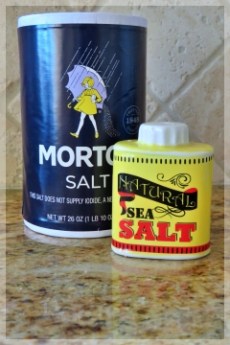 Today, when someone is called the “salt of the earth,” the speaker probably means he or she is a dependable, unpretentious and honest person—someone of moral integrity. That is well and good as far as it goes, but Jesus meant more than that when He called us to be “the salt of the earth.”
Nowadays, salt is inexpensive and a 26-ounce box of generic table salt cost less than 2 cents an ounce. Even if you wanted to go gourmet with some pink Himalayan table salt, you’d only pay about 25 cents per ounce. In ancient times, however, salt was so precious that Roman soldiers received their pay in it. When that became cumbersome, they received an allowance for its purchase. Called salarium argentum and meaning salt money, salarium remains in the English language as the word “salary.” Slave traders often bartered salt for slaves which gave rise to the expression that someone useless isn’t “worth his salt.” It was the preciousness of salt that made it so meaningful when making covenants or treaties in the ancient world. When Jesus said we are the “salt of the earth,” He meant we were as valuable as this precious commodity of the 1st century. But, aside from being valuable, what other qualities could Jesus have had in mind with His metaphor?
Salt is a flavor enhancer and we, as Christ’s disciples can add flavor and meaning to the lives of others. Salt makes people thirsty and we, as the salt of the earth, can make people thirst for and desire Christ. In ancient times, salt water was considered a natural antiseptic. Used to clean wounds and prevent infection, newborns were bathed in salt water. As salt of the earth, we can do our part in preventing sin’s infection.
Salt can lessen the pain of bee stings and bug bites and we, as salt, can lessen sin’s sting. On the other hand, salt rubbed into a wound stings and we, as salt, can rebuke and admonish the world with words that may sting. Salt can remove stains and, as Christ’s salt, we can remove the stain of sin with news of repentance and God’s forgiveness.
A paste of salt, flour and vinegar can remove rust and polish brass and copper; as salt in God’s service, we can certainly polish up this tarnished world of ours. Salt is used to stop food decay and we, acting as messengers of the Gospel, have the ability to keep people from perishing and rotting in Hell. Salt also has destructive properties and the term “salting the earth” refers to the ancient military practice of plowing fields of enemies with salt so that no crops could be grown. In the same way, we want to sow Satan’s fields with our salt to make them barren.
In spite of warnings from our cardiologists, a certain amount of salt is essential for life. Without it, our bodies become chemically unbalanced, our muscles and nervous system cease to function, and eventually we’ll die. Without a doubt, the message of Christ’s saving grace is essential for eternal life. Even though our body fluids (blood, sweat, tears) are salty, we cannot produce salt on our own nor can we obtain salvation on our own! Salvation comes by God’s grace through faith!
Finally, salt is white, the color of purity, and, as salt of the earth we should be pure, which brings us full circle to salt that has lost its saltiness or has become tainted. The salt used in Jesus’ time was obtained from salt marshes and salt lakes. Because it wasn’t refined, it always contained other minerals. If the sodium chloride was leached away by dampness or became fouled by dirt, what remained was without flavor and contaminated. Good for nothing, it was strewn on the roads like gravel. Like salt without flavor, disciples who don’t live out the values of the Kingdom cannot fulfill their purpose.
Moreover, no matter how valuable, pure, flavorful, or essential it is for life, salt that is kept in a sealed package is useless. Jesus wants us to get out of the box and into the world so we can spread our saltiness around in words and deeds as we share His Good News.
Salt, when dissolved in water, may disappear, but it does not cease to exist. We can be sure of its presence by tasting the water. Likewise, the indwelling Christ, though unseen, will be made evident to others from the love which he imparts to us. [Sadhu Sundar Singh]
 Since Nineveh was famous as the religious center for the worship of Ishtar (Astarte), the goddess of fertility, we might wonder why this pagan city repented after hearing Jonah’s prophecy? Jonah was an Israelite not an Assyrian—he believed in Jehovah and the people of Nineveh were pagans. Some speculate that the Ninevites had learned of Jonah’s miraculous delivery from the fish but Nineveh was about 500 miles from the sea and, since the fish delivered Jonah onto the beach, that seems highly unlikely! Was Jonah such an eloquent speaker that the heathen people of Nineveh would respond to him when, more often than not, the people of Judah and Israel ignored the words of warning they heard from the prophets who were their own countrymen? What caused the king and 120,000 of his subjects to make such an immediate turnaround?
 The story is told of a Sunday school teacher who was teaching her class about the Ten Commandments. “What is the commandment about parents?” she asked. “Honor thy father and mother,” was the quick reply. “Is there a commandment about brothers and sisters?” the teacher queried. One little boy shouted, “Thou shalt not kill!” While we know we’re not supposed to kill them, how should we treat them?
 Nowadays, we tend to think of “religion” as the institutionalized system of religious principles, beliefs, ceremonies, and practices to which we’re committed. The religion of which James spoke, however, isn’t limited to things like denomination or synod, liturgy, traditions, rituals, or special observances. Religion, as used by James, is the belief in, service to, and worship of God and encompasses our entire being. The ERV’s translation as “worship,” the NIRV’s as “beliefs and way of life,” the NTE’s and CEB’s of “devotion,” and even the Passion’s translation as “true spirituality” better capture James’ meaning. He is telling us that real religion is our way of life—the way we express our devotion to God hour after hour, day after day, in all that we think, speak, and do.
 When learning to walk, a toddler takes a lot of falls and is likely to get some bumps and bruises along the way. Yet, if we ever want the little guys to walk (let alone run or jump), we need to let them fall once in a while. That’s the only way they’ll ever learn how to how pick themselves up again. Blunders and mistakes are how children learn—they’ll spill milk before they can drink from a cup, scribble outside the lines (and on the table) with their first crayons, have several pairs of wet pants before they’re completely potty-trained, and put their shoes on the wrong feet several times before they know left from right! A few mishaps are all part of growing up.
 Devotions of the Heart