
I know that false teachers, like vicious wolves, will come in among you after I leave, not sparing the flock. Even some men from your own group will rise up and distort the truth in order to draw a following. Watch out! [Acts 20:29-31 (NLT)]
 A friend asked if I thought a popular evangelist was a “false teacher.” Like many popular preachers, the man’s message is appealing: love, joy, praise, prosperity and plenty of positive thinking. His words are as pleasant as a mockingbird’s song but, upon closer inspection, he seems to be as dangerous as Paul’s “vicious wolves.” Parts of his message are unsupported by Biblical truth while other essential truths are missing. Jesus certainly didn’t win a popularity contest in the 1st century and I’m a bit suspicious of those preachers who seem more concerned with entertainment, popularity, wealth, and fame than gospel truth.
Willing to preach a diluted or candy-coated version of Christianity, there are some who speak of adoption without mentioning obedience, forgiveness without bringing up confession, or escape from condemnation but not repentance. They preach about accepting Jesus without speaking of dying to self, God’s love but not His righteous anger, and promise blessings without addressing suffering or sacrifice. When preaching about the power of prayer, they imply God is like an overly-indulgent father who will give his children everything they want and, by promising a hundredfold return for our tithe, they turn God into our banker and our tithe into an investment. John MacArthur calls such a watered-down Gospel, “Biblically anemic preaching,” and Dietrich Bonhoeffer calls it “cheap grace.”
Some of today’s popular preachers could be likened to a math teacher who limits his curriculum to simple addition and subtraction. By not teaching carrying, borrowing, fractions, multiplication, or long division, he might be a popular teacher but his students’ inadequate knowledge of math doesn’t serve them well when confronted by more complex problems. The same can happen to us when we settle for effortless religion and messages designed to please rather than teach. Instead of remaining first graders, we would be what the Apostle Paul calls “infants in relation to Christ.”
Admittedly, most of us will never need to understand linear algebra, partial differential equations, or geometric topology. Nevertheless, even those of us who aren’t algorithmic engineers or statisticians need a good basic understanding of mathematics. Likewise, for a strong faith, we don’t need to know all the Bible’s genealogies, the 613 laws of the Torah, or the names of every Old Testament priest, judge, or king. We don’t have to understand every Biblical prophecy or be able to read Scripture in the original Hebrew, Aramaic, or Greek. Christians don’t need to be Bible scholars or theologians but we do need to know what the Bible says and how to apply God’s Word to our lives. Like long division, and fractions, it may not be fun but it is necessary. A firm faith requires a firm foundation which means knowing the whole story, not just a few choice parts.
At first hearing, many pastors and evangelists sound authentic but, upon closer inspection, we may find they are theological lightweights who are giving us a cheap imitation of Christianity. We need to carefully examine what we hear with the real thing—the Bible—before we get fooled by their song.
A whole new generation of Christians has come up believing that it is possible to “accept” Christ without forsaking the world. … Millions take for granted that it is possible to live for Christ without first having died with Christ. [A. W. Tozer]
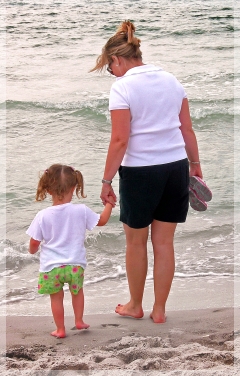 When a service group recently asked a young friend if she would serve on their board of directors, her response was that she’s not qualified since she’s “just a mother.” Her response reminded me of when I once thought of myself as “just” a mother. Many years ago, long before Facebook or LinkedIn, I received a questionnaire prepared by my high school’s reunion committee. Along with personal questions like marital status, it asked about my education, jobs, achievements, and awards. Once returned, the responses were Xeroxed, bound, and returned to us prior to our 25th reunion.
 And I will give you a new heart, and I will put a new spirit in you. I will take out your stony, stubborn heart and give you a tender, responsive heart. And I will put my Spirit in you so that you will follow my decrees and be careful to obey my regulations. [Ezekiel 36:26-27 (NLT)]
 In immersion baptism, a person is completely submerged in the water and, every time I witness a full immersion baptism done in the Gulf of Mexico, I think of what it must have been like when John baptized Jesus and the Holy Spirit descended on our Lord. Since the Greek word used to describe this event was baptizo, meaning to dip, sink, or submerge, we can safely assume His was a full immersion baptism.
 Jesus said to him, “For sure, I tell you, unless a man is born again, he cannot see the holy nation of God.” Nicodemus said to Him, “How can a man be born when he is old? How can he get into his mother’s body and be born the second time?” [John 3:3-4 (NLV)]
 “A children’s story which is enjoyed only by children is a bad children’s story,” said C.S. Lewis. I agree and admit to enjoying the seven books comprising Lewis’ The Chronicles of Narnia both as a child and an adult. Even though the Narnia books take place in a make-believe world filled with talking animals, mythical creatures, and magic, there are Christian overtones to the entire series. For example, the first book calls up images from Genesis when Aslan, the Great Lion, sings Narnia into existence and evil is introduced to the land. In the second, Aslan willingly dies so that the sins of one boy are forgiven but comes alive again. In another book, Eustace, who had “greedy, dragonish thoughts” becomes a dragon. When Aslan strips away the boy’s scales and throws him into the water, the repentant boy is transformed and images of rebirth and baptism come to mind. Resembling the last book of the Bible, the final story in the series tells of a beast, a false prophet, Narnia’s fall, and a Narnian paradise (where sadness and weariness do not exist).
 Devotions of the Heart