PEACE ON EARTH

Suddenly, the angel was joined by a vast host of others—the armies of heaven—praising God and saying, “Glory to God in highest heaven, and peace on earth to those with whom God is pleased.” [Luke 2:13-14 NLT)]
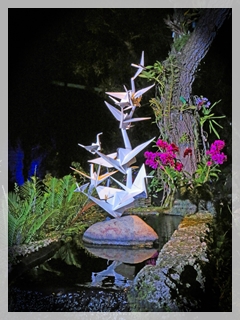
Naples botanic gardenWhile visiting a church recently, the pastor announced a new security precaution: ten minutes after the service started, the outside doors would be locked from the inside and no one could enter the building. Yesterday afternoon, another church offered a four hour class for their congregation. Led by a private security company, topics included ways to identify threats, how to develop layers of security, and techniques for conflict resolution. While talking with my daughter about a recent school shooting in her area, I learned that my grand’s school has regular “lock-down” drills in preparation for such an attack. Is no place safe from violence?

In 1947, the Bulletin of the Atomic Scientists created what is known at the Doomsday Clock. Designed to show the world how close it is to destroying itself with technology, the clock was originally set to 7 minutes before midnight with midnight being catastrophe—the end of the world as we know it. After the Soviet Union tested their first atomic bomb in 1949, it was reset to three minutes before the hour and, by 1953, it was down to two minutes. I was in first grade at the time; rather than “lock-down” drills, we had air-aid drills and practiced ducking under our desks in case a bomb was dropped. In 1991, with the end of the Cold War, the clock’s hands were set back to seventeen minutes before midnight. Since 2007, disruptions from climate change have figured into the calculations. This past year, the clock was set to only two and half minutes until midnight. Locking down a church or school, ducking under a desk, or building a bomb shelter won’t protect any of us if the minute hand reaches the twelve.

The world is in turmoil; we’re no closer to peace now than two thousand years ago. We live in a divided and troubled world and it grows more brutal daily. It’s no longer just atomic bombs that threaten us—cyber warfare, biologic weaponry, thoughtless rhetoric, fake news and catastrophic weather events all contribute to the danger. Where is this peace on earth we sang about these last several weeks?

Scripture tells us wars and violence will continue (and even get worse) until Jesus returns and establishes true lasting peace. Indeed, the end times appear to be on the horizon but what are we to do until then? I suppose we’ll continue having lock downs, going through metal detectors, getting luggage x-rayed and handbags searched, securing church doors, and meeting with security companies but that’s merely trying to stay safe. It’s not enough.

When we accepted Jesus, His Holy Spirit brought a fruit basket as a house-warming gift. In it we find peace along with several other qualities that will help us be peaceful: love, joy, patience, kindness, goodness, faithfulness, calmness and self-control. We all got the same beautiful basket and, as Christians, we’re all capable of letting His peace rule our hearts, actions and words. While our behavior may not move the hands of that clock backward, we might be able to make our little corner of the world a kinder, gentler, and better place.

Over two thousand years ago, the angels sang, “Peace on earth.” Let our lives continue that song as we move into this new year. Heavenly Father, let there be peace on earth, and let it begin with me.

And let the peace that comes from Christ rule in your hearts. For as members of one body you are called to live in peace. And always be thankful. [Colossians 3:15 (NLT)]

Copyright ©2018 jsjdevotions. All rights reserved.

INTERRUPTIONS

Zion Ntl ParkAnd now I have a word for you who brashly announce, “Today—at the latest, tomorrow—we’re off to such and such a city for the year. We’re going to start a business and make a lot of money.” You don’t know the first thing about tomorrow. You’re nothing but a wisp of fog, catching a brief bit of sun before disappearing. Instead, make it a habit to say, “If the Master wills it and we’re still alive, we’ll do this or that.” [James 4:13-15 (MSG)]

The woman sadly told me they’d come here for a three-month job sixteen years ago. The position became permanent and southwest Florida had been their home ever since. Unfortunately, she added, they’d be moving back north that week. Hurricane Irma had interrupted their lives when it destroyed their home and all of their belongings. Over three months later, they were no closer to rebuilding than on the day after the storm. They’d been moving from hotel to hotel but, with tourist season fast approaching, there literally is no room at the inns. “It’s time to pack up and go,” she said tearfully, adding, “We’re just blessed to have a place to go up north.”

In the Bible, many names are used for the Lord: God Almighty/El-Shaddai, The Lord Our Peace/Yahweh-Shalom, God of Seeing/El-Roi, The Lord Will Provide/ Yahweh-Jireh, The Lord Who Heals/Yahweh-Rapha, and The Lord is There/Yahweh-Shammah. There is another quite fitting but non-Biblical name for the Lord: God of Interruption!

That woman’s life was interrupted and she is in good company. Life’s interruptions aren’t always bad but they’re usually inconvenient. Moses wasn’t looking for another job while tending sheep in Midian but God interrupted his life with a burning bush and a forty-year assignment. Joseph, the favored son of Jacob, had his life rudely interrupted when he was sold into slavery. Elisha was plowing his fields when God had Elijah lay his cloak on the man’s shoulders and anoint him as the prophet’s replacement. Both Mary and Joseph’s lives and wedding plans were interrupted with the angelic announcement of a pregnancy. For that matter, consider Elizabeth and Zechariah. They wanted a child but that unexpected pregnancy certainly interrupted the elderly couple’s lives. Simon Peter and Andrew were throwing their nets into the water and James and John were repairing theirs when Jesus interrupted their lives. Consider Paul. The Jewish zealot was on the road to Damascus when God interrupted with a visit from Jesus and blindness. His interruptions continued throughout Paul’s ministry; when he wanted to go to Bithynia, God intervened by sending him to Troas and his journey to Rome was interrupted by a shipwreck. The God of Interruption was at work.

Health issues, the death of a loved one, job transfers, car accidents, job loss, a job offer, finances, divorces, pregnancies, fires, flood, hurricanes, and the needs of others are just some of the ways our lives are interrupted. Let us never lose sight of the fact that, just because a life has been interrupted, it is not over—it has simply changed. God has placed those interruptions there for us; they are opportunities to trust in God, believe that His grace is sufficient, and to grow more like Christ. Circumstances can take much from us—homes, people, health, jobs, and even our reputations—but they can’t take away our loving God.

When the God of Interruption disrupts our lives, let us always remember that He also is God Almighty and the Lord of our Peace. He is the God who sees, provides for and heals us. He is there for us now and forevermore.

Father in Heaven, help us to see your hand in life’s many interruptions and to offer thanks for the many surprises and disruptions in our lives.

“I don’t think the way you think. The way you work isn’t the way I work.” God’s Decree. “For as the sky soars high above earth, so the way I work surpasses the way you work, and the way I think is beyond the way you think. [Isaiah 55:8-9 (MSG)]

Copyright ©2017 jsjdevotions. All rights reserved.

SEASONS

For everything there is a season, a time for every activity under heaven. A time to be born and a time to die. A time to plant and a time to harvest [Ecclesiastes 3:1-2 (NLT)]

aspens and pines - Steamboat COWhile some might groan, others may cheer on this the first day of winter. I remember being asked my favorite season and, since we were skiing in the mountains at the time, I said it was winter. I loved it for the powder days on the slopes, pines laden with snow cookies, and aspens glistening with hoarfrost. Winter meant snuggling by the fire with a hot drink while watching the snow fall and the wind blow the trees. Then, I remembered that winter brings shoveling, cleaning off the car, cold toes, drippy noses, falling on the ice, and heating bills so I quickly changed my answer.

Perhaps spring was the favorite—the snow starts to melt, song birds reappear, snowbells and crocuses peek out of the ground, coats and boots are shed, and we again feel the sun’s warmth. Then I remembered the crowds and traffic jams of spring break, rain, mud, spring cleaning, and tax day! Summer was a possibility with its peonies, peaches, butterflies, sandals, tank tops and lazy days at the lake. Then again, summer brings mosquitoes, allergies, humidity, weeding, mowing, and tornadoes. When I remembered the autumn colors, the cranes and geese gathering before migration, Thanksgiving dinner, and the sound of leaves rustling while walking through the woods, I thought my answer should be autumn except for the box elder bugs, gloomy days, leaf raking, more allergies, and hurricanes.

Years later, I’m still unable to give a decisive answer to which is my favorite season; I hope to never see it as one of those problematic online security questions. Fortunately, with the passing of each year, we get to return to all the things we like about a season and, when we tire of that season’s challenges, we know a new season will arrive within a few months’ time.

Unlike the calendar’s seasons, we only get one spring, summer, fall and winter in life. Unfortunately, much of our time in any season often is spent trying to move into the next or return to the previous one. The four-year old proudly tells you she’ll be five at her next birthday and, the day she turns fifteen, she claims to be almost sixteen. She may be OK with being twenty-two but she drags her heels as thirty approaches. Trying to hold the next season at bay, she “recently turned forty” at forty-five and, when the invitation to join AARP arrives at fifty, she bursts into tears. By sixty, she looks longingly at the clothes she used to wear a decade earlier, hates having her picture taken, and refuses to share her age. It’s not until her nineties that she again brags about how old she’ll be at her next birthday.

While we know the date and length of the calendar’s seasons, we have no such knowledge of our own personal seasons. My mother-in-law, at 101, is enjoying a lengthy winter; my mother died at 47 and had none. In answer to that question about a favorite season, perhaps the wisest answer is that our favorite season is the one we’re in! We can’t recapture yesterday and tomorrow comes way too quickly so let us thankfully and joyfully accept our today.

It’s only when we truly know and understand that we have a limited time on earth – and that we have no way of knowing when our time is up – that we will begin to live each day to the fullest, as if it was the only one we had. [Elizabeth Kübler Ross]

This is the day the Lord has made. We will rejoice and be glad in it. [Psalm 118:24 (NLT)]

Teach us to realize the brevity of life, so that we may grow in wisdom. [Psalm 90:12 (NLT)]

Copyright ©2017 jsjdevotions. All rights reserved.

DISAPPOINTMENT

We are pressed on every side by troubles, but we are not crushed. We are perplexed, but not driven to despair. We are hunted down, but never abandoned by God. We get knocked down, but we are not destroyed. [2 Corinthians 4:8-9 (NLT)]

OrchidPeople disappoint. Consider Moses’ disappointment when, fresh off Mt. Sinai after a 40 day meeting with God, he returned to find the Israelites worshipping a golden calf. Can you imagine David’s disappointment when Saul, the man he’d comforted with his songs, plotted his death? Picture Nathan’s disappointment in David when he confronted him about his adultery with Bathsheba. Think of Joseph’s disappointment in the brothers he thought loved him as they callously sold him into slavery. Consider Jesus’ disappointment in the denying Peter, the betraying Judas, and His sleeping disciples. For that matter, consider the disappointment of the disciples as they saw their hope for the end of Rome’s tyranny die a criminal’s death on the cross.

People let us down. I remember back to 1974, when the Watergate cover-up began to unravel. My in-laws were deeply disappointed and saddened when the president they’d supported resigned in disgrace. Today, that sort of public betrayal doesn’t surprise us. Every day we learn of another betrayal of the public’s trust, abuse of power or lack of integrity. Manipulation, deception, and falsehoods are daily events. Nevertheless, when they’re done by someone we actually know—someone in whom we believed—we’re shocked and hurt. Recently, I’ve learned that people I thought I knew—people I trusted and respected—are not worthy of that trust or respect. That some others, knowing of their duplicity, have chosen to tolerate or gloss over it adds to my disappointment. Yes, people can let us down.

When efforts at rectification and reconciliation failed, my initial response was anger and indignation. That’s when the one most hurt by this betrayal of trust reminded me that I must always lead with love. Resolution is not possible, anger and retaliation are wrong, so forgiveness, prayer and grief are all that remain. With a forgiving heart, I will pray for both the betrayers and betrayed and grieve for what has been lost. Then, putting this disappointment behind me and trusting in God’s guidance, I will move forward into tomorrow.

It’s been said, “People will let us down but God never will.” Indeed, people let down Moses, David, Nathan, Joseph, and Jesus and they will continue to disappoint us. Jesus, however, never let down the disciples. Their hopes were briefly dashed when He was laid in a borrowed tomb but, with His resurrection three days later, they saw the end of sin’s tyranny and the beginning of life eternal. God will never let us down. As I lay my disappointment before Him in prayer, I know He will take my sad heart and restore it with strength, confidence, faith, and love. He will never disappoint!

We can rejoice, too, when we run into problems and trials, for we know that they help us develop endurance. And endurance develops strength of character, and character strengthens our confident hope of salvation. And this hope will not lead to disappointment. For we know how dearly God loves us, because he has given us the Holy Spirit to fill our hearts with his love. [Romans 5:3-5 (NLT)]

Copyright ©2017 jsjdevotions. All rights reserved.

PSALM 88

O Lord, God of my salvation, I cry out to you by day. I come to you at night. Now hear my prayer; listen to my cry. For my life is full of troubles, and death draws near. [Psalm 88:1-3 (NLT)]

zebra swallowtailI woke to yet another cold dreary winter day. Troubled by a variety of concerns and hoping to improve my glum mood, I turned to Psalms. Unfortunately, I made a bad choice in Psalm 88. Written by Heman the Ezrahite, I saw that originally it was to be sung to the tune “The Suffering of Affliction” (which should have been my clue to read no further).

During David’s time, Heman was one of three chief Levites appointed to conduct music in the tabernacle (the equivalent of today’s worship leader). Perhaps he wrote this psalm to console David in his sorrow after the loss of his son but there seems to be nothing consoling about it. The speaker’s life is full of troubles; he considers himself a lost cause and as good as dead. Repulsive and depressed, he’s been forgotten by his friends, feels God’s anger, and asks God why he’s been rejected. Typically, psalms of lament eventually turn from despair to hope and from misery to confidence but there’s not even a glimmer of hope in this one! “Darkness is my closest friend,” are the psalmist’s final words. Although the RSV Bible subtitles the psalm a “Prayer for Help in Despondency,” a far better title would be “Job’s Lament!”

Later that morning, we attended worship at our northern church. The service, an Advent tradition there, was a celebration of the beautiful music of the Christmas season. As I listened to the words of the carols, my spirits lifted. Unlike Heman, this was a worship leader who knew what songs would help the despondent.

With my improved outlook, I thought back to that mournful psalm and realized that, as miserable and depressed as the psalmist was, he hadn’t given up on God. His words were honest—he was wretched and desolate—and yet he knew God heard his complaint. Even though he felt abandoned, he continued to pray which means he knew he hadn’t been forsaken. In fact, knowing his words were not falling on deaf ears, he vowed to continue his prayers. He knew that tears and prayers go together—that his troubles were a reason to talk with God rather than a reason to stop praying

It was the words of John 3:16 that made me finally understand that the sorrowful psalm and the joyful carols were telling me the same thing. No matter how wretched we feel, no matter how distressing our situation, no matter how severe our suffering, we are loved. Unfortunately, faith is no protection from trouble and sometimes we will sink in sorrow. Nevertheless, like the psalmist, we can remain earnest in prayer. Knowing that God loved us enough to give us His only son, we can know He loves us enough to hear our prayers. Even when we feel abandoned, God is with us; Immanuel is His name.

Those who are in trouble of mind may sing this psalm [Psalm 88] feelingly; those that are not ought to sing it thankfully, blessing God that it is not their case. [Matthew Henry]

For this is how God loved the world: He gave his one and only Son, so that everyone who believes in him will not perish but have eternal life. [John 3:16 (NLT)]

Copyright ©2017 jsjdevotions. All rights reserved.


THE DASH

For everything there is a season, and a time for every matter under heaven. [Ecclesiastes 3:1 (ESV)]

I read of a man who stood to speak at the funeral of a friend.
He referred to the dates on the tombstone
from the beginning…to the end.
He noted that first came the date of birth
and spoke of the following date with tears,
but he said what mattered most of all
was the dash between those years. [Linda Ellis]

clock - ChicagoAfter scrutinizing the website for the umpteenth time in a futile search for the perfect gift for my daughter-in-law, I closed the iPad and announced, “What a waste of time! This is why God created checks and gift cards!” I remembered last Friday when both Linda Ellis’s poem “The Dash” was read and the recently deceased David Cassidy was mentioned. The former Partridge Family heartthrob’s last words were: “So much wasted time.” Indeed, too much time is wasted in unproductive activities or agonizing over what, in actuality, are trivial matters. Searching the same website, over and over, and expecting to find something different was certainly one of those.

Last Friday morning, I made better use of my time; after looking at a photo of a friend’s niece, I prayed for her. This two-year old, bald from undergoing chemotherapy for stage 4 cancer, was asleep in her mother’s arms and doesn’t understand that the chemicals making her so miserable are a last ditch effort to destroy the cancer that has ravaged her body. Later that day, I attended a Celebration of Life for a man who, less than a week earlier, set out for an afternoon ride on his motorcycle never knowing that would be his final ride in life. Absent from that memorial service were our senior pastor and his wife. They’d been in a car accident earlier in the day. Like the toddler and the motorcyclist, they never expected what came hurtling into their lives. One child is fighting for her life, one man lost his life, and one couple escaped with their lives.

Many of us might say we have too little time but the quantity of time granted us and our loved ones, whether just days or several decades, is exactly the right amount of time and has been determined by someone far greater than we are. The way we spend those precious moments, however, is our choice alone. Unfortunately, David Cassidy had it right: “so much wasted time.” When the book of Ecclesiastes tells us there is a season for everything, wasting time is never mentioned as one of them. We can fritter away our minutes in all sorts of futile ways—anger, nitpicking, regret, lethargy, worry, complaint, conflict and fretting are just a few—or we can use them generously, joyfully, thankfully and with love.

This week we celebrate my mother-in-law’s 101st birthday; her dash has been long and well spent. While she has been blessed with exceptional longevity, last Friday was a reminder that we all have expiration dates and none of us know that day. In many cases, it will be far sooner than expected. The dates we are here, however, are not as important as how we spend the time between those dates. How will we spend our dash?

So teach us to number our days that we may get a heart of wisdom. [Psalm 90:12 (ESV)]

Copyright ©2017 jsjdevotions. All rights reserved.