
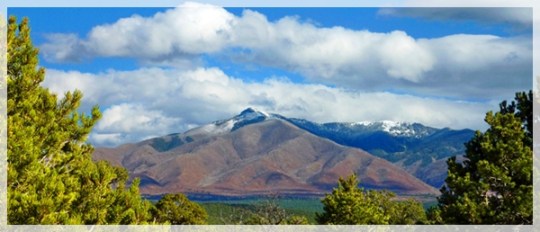
 The Lord said to Abram after Lot had parted from him, “Look around from where you are, to the north and south, to the east and west. All the land that you see I will give to you and your offspring forever. [Genesis 13:14-15 (NIV)]
We were visiting an area church when the pastor referred to the above verse from Genesis in which God tells Abram (Abraham) he can have all that he sees. As the sermon continued, the pastor recited a litany of God’s promises and he seemed to be preaching a “name it and claim it” theology only, in this case, it was more like a “see it and have it” one. Granted, it was the first sermon of the year and the pastor clearly wanted to start 2018 on a high note. Nevertheless, claiming God’s promises and thinking they mean He’ll give me everything I visualize isn’t Bible-based.
Our faith and thoughts do not create our reality. If they did, among other things, I would be two inches taller, a whole lot shapelier, and without a wrinkle or any arthritis. Our faith doesn’t promise to give us what we want; our faith allows us to trust in a loving God who will give us what we need.
It is God, not us, who chooses when and how to bless us or, as in the case of Job, afflict us with trials. Job didn’t suffer for lack of faith; the man was filled with faith and yet he endured the loss of everything but his life. As baffled as Job was by his troubles, he knew that blessings and misfortune are not a measure of faith; the faithful can suffer and the wicked can prosper.
Not every promise made by God in the Bible is a wholesale across-the-board promise to us. That promise to Abram was a specific promise about a particular piece of land. God said nothing about seeing and having boyfriends, better jobs, new businesses, babies, healing, bigger paychecks, larger houses, or freedom from debt. Jesus came to save us from our sins and not from bankruptcy, infertility, illness, bad marriages, poor choices, difficult in-laws, unemployment, demanding bosses, or a host of other life challenges. Moreover, He calls us to sacrifice and deny rather than want and get.
Although God wants our love, worship, faith and obedience, He doesn’t need any of those to operate the universe. As Christians, we believe in the power of faith and prayer but we must remember the real power lies in God and His plan. We’re not God’s customers who can order what they see; we’re His children who thankfully accept what He gives us. Much of what we envision never will be ours simply because it’s not in God’s plan. When we become so intent on seeing what we want, we may miss seeing the blessings we’ve been given or different ones waiting in another direction.
I will continue to have faith and claim God’s promises—the promises of His presence, unfailing love, strength, wisdom, comfort, forgiveness, salvation, eternal life, the power of Holy Spirit, and the peace of God. What He hasn’t promised me is that if I see it, believe it or name it, it will be mine.
Faith is not the belief that God will do what you want. It is the belief that God will do what is right. [Max Lucado]
 I woke to yet another cold dreary winter day. Troubled by a variety of concerns and hoping to improve my glum mood, I turned to Psalms. Unfortunately, I made a bad choice in Psalm 88. Written by Heman the Ezrahite, I saw that originally it was to be sung to the tune “The Suffering of Affliction” (which should have been my clue to read no further).
 When asked about her boys, a friend used to answer, “They’re doing their own thing.” Years later, I learned “their own thing” meant they were breaking her mama’s heart with their addictions and run-ins with the law. Because she kept her pain concealed, she carried the weight of that burden alone for many years. We often hear similar answers when we ask someone how they’re doing— brusque responses like, “I’m fine,” “It’s taken care of,” or “We don’t need a thing.” Maybe everything really is hunky dory but those answers are often used when life has gone seriously awry and things are anything but fine. Those vague but terse responses are conversation stoppers. Even best friends, who suspect something is amiss, won’t pry and the subject is politely changed.
 Most of us think of sloth as laziness: a dislike of work or any physical exertion. Having watched the local zoo’s sloth in action (or, rather, inaction), I think the sluggish animal is appropriately named. Spiritual sloth, however, is far different than being a couch potato. Originally, the sin of sloth was two sins: sadness and acedia. Compiled by Evagrius of Ponticus, a 4th century monk, these two “capitals sins” were part of a list of eight he believed to the greatest threats to devout monasticism.
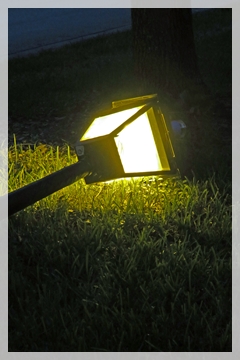 To avoid the southwest Florida heat, I waited until dusk to take my walk. Thanks to Hurricane Irma, most of the street lamps in my neighborhood don’t work. For a light to function, electrical energy has to be converted into light energy and both a source of electricity and a working connection are needed. For many of the lights, the connection was broken when blowing debris shattered their bulbs. For others, Irma’s 150 mph winds broke the connection when it blew off their tops, wrapped their poles around trees, or knocked them to the ground. Without a connection to their source of power, those street lights are useless—they’re just a tangle of wires and a pile of glass, plastic and metal. Even though they don’t work, people have been cautioned to remember that their exposed wires are live. It’s not the electricity that is missing; it’s the connection that is inoperative. Two poles, however, were down but not out. Even though they’d been flattened by the storm, neither wires nor bulb had broken. In spite of the storm’s violence, they remained connected and were beacons in the night’s darkness.
 As I viewed the picturesque waterfall, the tremendous amount of water pouring over the rock, and the deep gorge formed by the glacial river, I thought of H. Jackson Brown’s quote: “In the confrontation between the stream and the rock, the stream always wins, not through strength but by perseverance.” Thinking it a good start for a devotion about patience and determination, I looked forward to writing it when I got home. Having been out of town thirty out of the last seventy days, however, I’ve been playing “catch-up” since returning from Canada. Domestic chores, family obligations, paper work, commitments, appointments, assorted health issues, and then my mother-in-law’s hospitalization have eaten away at me and I’m physically and emotionally exhausted. Today, during prayers, it occurred to me that something else is as persistent (and effective) as that rushing water—Satan! While the enemy enjoys throwing major disasters our way, as he did with Job, he also likes to peck at us like a troublesome woodpecker or whittle away at us as water does to rock. Through persistence, water defeats rock; like that persistent water, the enemy is determined to defeat us.
 Devotions of the Heart