
And anyone who welcomes a little child like this on my behalf is welcoming me. But if you cause one of these little ones who trusts in me to fall into sin, it would be better for you to have a large millstone tied around your neck and be drowned in the depths of the sea. [Matthew 18:5-6 (NLT)]
 Earlier this week, the news broke that church leaders in six Pennsylvania Roman Catholic dioceses have protected more than 300 “predator priests.” More concerned with protecting the church and abusers than helping the more than 1,000 victims or preventing further abuse, they failed to report allegations, discouraged victims from reporting abusers, conducted their own biased and faulty inquiries, pressured law enforcement to delay or close investigations, and spun their own versions of the events. Earlier this summer, the Archdiocese of St. Paul and Minneapolis agreed to a $210 million settlement to 450 victims of clergy sexual abuse there. It’s not just the Roman Catholic Church that has failed in this arena. It was just revealed that Willow Creek, a non-denominational Protestant mega-church, paid $3.25 million to settle two lawsuits over sex abuse by a church volunteer. No amount of money, however, can remove the trauma of abuse.
This is neither a Catholic nor a Protestant problem; it is everyone’s problem and it certainly is not limited to churches. We’ve seen institution after institution put reputation before serving and protecting our children. A growing number of Olympic athletes have joined the U.S. women’s gymnastics team in allegations of sexual abuse in their sports. The Chicago Tribune recently reported that the Chicago Public Schools failed to protect their students from sexual abuse and assault. Among other things, ineffective background checks didn’t protect the children from offenders and abuse was not reported. Dozens of lawsuits have been filed against the Boy Scouts over sex abuse and they’ve paid out millions of dollars in settlements. Recently, I watched the news in horror as eleven malnourished children (and the remains of a twelfth) were discovered in a New Mexico compound. Earlier this year, a 17-year old escaped from her house of horrors to make the 911 call that rescued her twelve shackled and severely malnourished siblings from their California home. Sadly, these are but a few of the sickening tales of child abuse we find in the news.
If we ever questioned that we live in a fallen world, these horrifying examples leave us no doubt. Child abuse in any form is the work of Satan: the one who came to “steal and kill and destroy.” He is destroying our young people when he steals their innocence, their physical health, their emotional well-being or takes their lives. Made in God’s image, children are not meant to be used and abused; they are meant to be nurtured and loved.
Whether or not we know those who’ve been hurt and abused, they all are our children and this is our problem. As Christ’s body on earth, we must open our eyes to the children around us and never be silent bystanders. As His body, we can’t stand idly by when abuse of any kind is suspected and the church must never hide the ugly truth even when it occurs within our walls. Abuse can’t be swept under the rug nor can we send offenders off to another parish, school, gym, or scout troop with little more than a rap on the knuckles. Moreover, untrained in forensic interview techniques, we are not the ones to conduct internal investigations. Neither judge nor jury, it’s not our job to determine the validity of an accusation; abuse is both a sin and a crime and our job is to report suspected crimes! We have a God-ordained responsibility to protect and preserve all children (not just the ones in our homes).
We all are called to be shepherds. Father in Heaven, show us how to protect your lambs.
 Recently, a pastor shared a troubling experience while at the annual conference for his denomination. Along with other ordained ministers, he was to vote as to whether or not candidates for the ministry would be ordained. While usually a gratifying experience as this ministerial board accepts people into their vocation, on occasion the vote can be heartbreaking. If a candidate receives a negative recommendation from his supervisor, he or she is permitted to offer a defense before the vote is taken. At the last conference, such an instance occurred and, sadly, one individual did not receive an affirmative vote for ordination.
 After asking us how we protect our personal safety, the cyber-security specialist asked how we protect ourselves from cyber attacks. One woman proudly told how Microsoft had recently saved her from a hacking attempt. After a message popped up telling her to call them, she gave them remote access to her computer. The necessary patch and technical advice only cost $700 and now her computer was secure. Until the speaker told her, she didn’t know the hack was the $700 she’d spent, access to her credit card, and possible malware now active on her computer. While she never would have allowed a complete stranger into her home, she unwittingly opened the door to a criminal and welcomed him into her life.
 In spite of many states having legalized its use, countless studies suggest that marijuana is a “gateway drug” meaning that it may lead to the use of other stronger more addictive drugs. I’m not going to enter into that argument but I’d like to use the word “gateway” as it regards to sin. Just like marijuana (when compared to heroin or cocaine) seems innocuous, coveting (when compared to murder or stealing) seems like an insignificant sin. After all, who does it harm? No sin, however, is insignificant and every sin is an offense to God
 Jesus replied, “‘You must love the Lord your God with all your heart, all your soul, and all your mind.’ This is the first and greatest commandment. A second is equally important: ‘Love your neighbor as yourself.’ The entire law and all the demands of the prophets are based on these two commandments.” [Matthew 22:37-38 (NLT)]
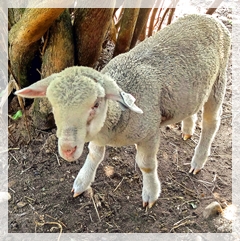 Throughout the Bible, there are many references to the Lord as our shepherd and mankind as His sheep. Sheep are not the brightest bulbs in the pasture and, considering the state of the world, it seems a fitting comparison! I came upon a true story that illustrates the need sheep have for a shepherd. In 2005, more than 400 sheep in Turkey died when they followed the lead sheep off a cliff and fell 15 meters. The death toll would have been greater except those first 400 cushioned the fall of the next 1,100 sheep that were stupid enough to follow them! Clearly, that herd of sheep needed someone to tell them when to stop. Unfortunately, mankind seems as willing to blindly follow the lead sheep wherever he leads us, only we call it belonging, accepting, keeping up, staying current, maintaining the status quo, or not rocking the boat, making waves or causing trouble.
 Devotions of the Heart