
 He said, “That’s what I mean: Risk your life and get more than you ever dreamed of. Play it safe and end up holding the bag.” [Luke 19:26 (MSG)]
If I am never tempted, and cannot even imagine myself being tempted, to gamble, this does not mean that I am better than those who are. The timidity and pessimism which exempt me from that temptation themselves tempt me to draw back from those risks and adventures which every man ought to take. [From “Reflections on the Psalms” by C.S. Lewis]
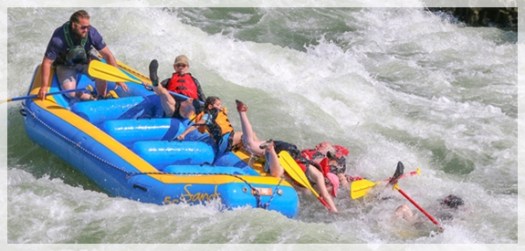
We were accompanied by two grandchildren, ages fifteen and eighteen, during part of our trip west. When my husband mentioned taking them on a raft trip, I pictured a scenic float down the Snake River and readily agreed. What got booked, however, was a white water adventure. Not a thrill seeker, adrenaline inducing adventures are not my thing. I was not happy about the scheduled activity and began thinking of ways to gracefully bow out of it. By coincidence (or what I call God-incidence), the above quote by C. S Lewis arrived in my email. I realized that my fear of stepping out of my rather narrow comfort zone was threatening to keep me from sharing this once-in-a-lifetime experience with my precious grands. Lewis’ words (and some much needed prayer) convinced me that this was one adventure I should not miss.
Prayer got me in the raft and I bravely paddled through the rapids. Even after we tipped and lost six of the eight passengers on the third set of rapids, witnessing the grins on the kids’ faces as they were pulled back into the raft made both the dunking and the adrenaline spike worth it. All’s well that ends well and, in spite of the soaking in the rapids, the rafting wasn’t nearly as terrifying as I’d imagined. When asked to name the highlight of their twelve days with us, our grands both mentioned the raft trip—and to think I nearly missed sharing that experience with them! The pictures taken from the photographer’s spot on shore would not have captured their smiles and whoops of delight at the rapids or the thrill of the ride!
While a certain amount of caution is wise, as C.S. Lewis pointed out, there are certain risks and adventures that none of us should miss. Timidity, pessimism, faint-heartedness, fear, and anxiety can keep us from unsafe behavior like drugs, gambling, or adultery but they shouldn’t make us retreat “from those risks and adventures which every man [and woman] ought to take.” Consider what they would have missed if Peter had allowed fear to keep him from stepping out of the boat onto the water, if David had allowed faint-heartedness to keep him from facing Goliath, or if Moses and Gideon had allowed their pessimism to prevent them from accepting the tasks given them by God.
God invites us to participate in world-changing adventures that probably have nothing to do with white water rafting. We mustn’t allow a reticence to step out of our comfort zones prevent us from accepting His invitation to go on that journey. While the adventure may involve an element of risk, the rewards will be well worth it!
 Psalm 139 is one of my favorites among the psalms. As I read it this morning, however, I got annoyed with David. Near the end of this beautiful song praising God for His omniscience, omnipresence, and intensely personal involvement in his life, David throws in a curse on his enemies. Granted, they’re God’s enemies, too, but sometimes David seems incredibly angry and vengeful. After comparing his enemies to deadly snakes, hungry lions, and vicious dogs, among others things, he wants them to dissolve into slime like snails, be cast into the fire, become palsied and blind, and for their wives to become widows and their children fatherless beggars. One Bible commentary said David had a “particularly vigorous attitude toward the enemy,” but wanting to wash his feet in the blood of the wicked sounds merciless and vindictive to me.
 Is virtue its own reward? An article in Psychology Today reporting the conclusions of seven studies found that virtue actually does bring rewards. The benefits of doing the right thing include less depression, better self-esteem, increased happiness, a “helper’s high,” and a good night’s sleep! That good night’s sleep might well be the result of the clean conscience that accompanies virtue. Given the momentum of the #MeToo movement, I suspect many prominent people are losing sleep nowadays. Unfortunately, it’s not just well-known producers, actors, newsmen, ministers and politicians who abandoned virtue for self-interest. Many everyday folk are losing sleep as people continue to step forward and break their silence about wrongs that have been committed.
 Richard Williams was watching TV when he saw a tennis player awarded a $40,000 check for winning a tournament. He decided then that his as yet unborn children would become tennis stars. Williams wrote a 78-page plan detailing their future, taught himself how to play tennis and, when his girls were four, started teaching them to play the game. Before they were even born, he’d planned the future for tennis greats Serena and Venus Williams.
 Take only what I’ve got on my back and the one pair of sandals on my feet? You’ve got to be kidding! Obviously, Jesus hasn’t looked in my suitcase! We’re taking the grands through the Tetons and Yellowstone and I need hikers, sneakers, and Tevas along with my sandals! In addition, I need my backpack, water bottles, hiking poles, shorts, hiking pants, jeans, tops, swim suit, jacket, fleece, cap, undies, toiletries, and assorted other essentials (like phone and iPad). While attempting to cram everything I want into my bags, I pondered this verse: take nothing. At least we have hotel reservations for our entire journey; the disciples didn’t even have that. They were expected to depend on the good will and hospitality of the towns they visited.
 A friend of ours has several jewelry stores in Colorado. When he opened a store in a posh resort town, he priced his goods as he always has: reasonably. To his chagrin, plenty of wealthy shoppers came into his shop but no purchases were made. After three days of disappointment, he re-tagged everything with higher prices. The following day, instead of leaving empty-handed, most shoppers left carrying pricy purchases (and they continue to do so today). Apparently, his rich customers believe affordable means second-rate or shoddy and that quality only comes with an exorbitant price tag.
 Devotions of the Heart