
 So now I am giving you a new commandment: Love each other. Just as I have loved you, you should love each other. Your love for one another will prove to the world that you are my disciples. [John 13:34-35 (NLT)]
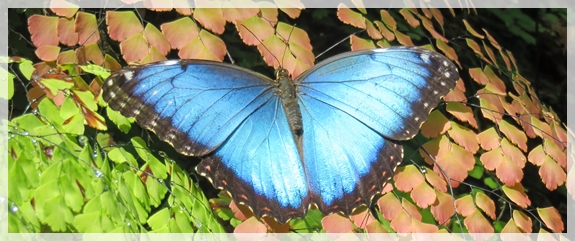
We recently visited a botanic garden that boasts a butterfly conservatory inhabited by a spectacular collection of tropical butterflies. There I was introduced to the shiny Blue Morpho. God outdid Himself with these enormous beauties so showy that pilots report seeing them from the air as they fly over the rainforest. When Adam and Eve were banished from Eden, I’m thankful God didn’t make them leave the butterflies behind.
Hoping to get a photo of one of these spectacular creatures that were flitting about, I searched through the conservatory for one that was still. Although the Morpho’s upper wings are a vivid blue color, their undersides are a dull brown. When its wings were folded, I mistook the Morpho for another large brown butterfly: the giant owl. It was only when it spread its wings in the sun’s light that I recognized the Morpho by its vibrant blue color.
As Christians, we are called to love and, just as its blue iridescence identifies the Blue Morpho, our love identifies us as Jesus’s disciples. But, if we just sit in the shade and never move out in the world, we’ll look like everyone else. Wings are meant to be spread and Christian love is meant to be shared. If pilots can spot a butterfly from the air, people should be able to see evidence of a Christian’s love wherever we are!
What I later learned is that while the dreary colors of these butterflies’ undersides are produced by pigments that absorb and reflect light, the brilliant blue of their upper wings has nothing to do with pigment. That color comes from the way light reflects off transparent microscopic scales on their upper wings. There’s an involved scientific explanation but (in layman’s terms), when light hits ridges on those scales, something called “constructive interference” happens which cancels out certain wavelengths of light. As a result, when light hits the upper wings of the Blue Morpho, our eyes perceive them as being a shimmering blue.
Looking at my pictures, it’s difficult to comprehend that the Blue Morpho’s dazzling iridescence isn’t real. The blue is merely an optical illusion resulting from the architecture and arrangement of transparent scales on its brown wings. I guess we could call it a fake since it doesn’t show us its true colors. It’s a little like the Pharisees: those men Jesus criticized because they did everything for show. Their faith and righteous were but an illusion because their hearts were filled with hypocrisy and evil. Unlike either Blue Morphos or Pharisees, however, there should be nothing illusory or deceptive about a Christian’s love; we are expected to be true blue to Jesus and His command to love one another.
 Having forgotten the Greek alphabet he learned as a fraternity pledge, my husband asked the meaning of the symbols on the lecterns in the church sanctuary. On the left was A for alpha and, on the right, was Ω for omega: the first and last letters of the Greek alphabet. In Hebrew, those letters would have been aleph and tau. Among Jewish rabbis, using the first and last letters of the alphabet was a common way to express the whole of something, from its beginning to its end. Today’s equivalent expression would be “from A to Z” or “from soup to nuts.” Those Greek letters refer to three verses in Revelation in which Jesus claims to be the Alpha and Omega. They tell us that that, as part of our Triune God, Jesus was there at the beginning and He will be there at the end.
 But the Lord said to Samuel, “Don’t judge by his appearance or height, for I have rejected him. The Lord doesn’t see things the way you see them. People judge by outward appearance, but the Lord looks at the heart.” [1 Samuel 16:7 (NLT)]
 Since he had a business meeting in Switzerland later in the week, my son went to London over the weekend to see his daughter who is in college there. Nearly every photo texted back to us showed my grand eating. Admittedly, she is a starving college student, living on a tight budget, who has grown tired of eating peanut butter, hummus with veggies, Raman noodles, and pasta in her apartment, so she took advantage of having access to her father and his credit card. With Dad paying the bill, she could again eat steak and lamb chops, indulge in gelato, and stock her pantry with fruit, meat, and cheese from Borough Market. As much as this starving coed needed food, what she really needed was a visit from home. Hugs from her father probably offered more nourishment than any amount of food. His visit did more than replenish her cupboards; it recharged her emotional batteries.
 We’re sure to notice God in the Grand Canyon, the multitude of stars in the night sky, or when watching two million wildebeest, zebra and gazelles migrate through the Serengeti. We sense Him in extraordinary or exotic things like the peacock’s splendid tail, Devil’s Tower, or spectacular sunsets and sunrises. But do we notice Him in the commonplace and unremarkable?
 Devotions of the Heart