
If you refuse to take up your cross and follow me, you are not worthy of being mine. If you cling to your life, you will lose it; but if you give up your life for me, you will find it. [Matthew 10:38-39 NLT]
 There’s probably no end of sermons and commentary on the swine that went plunging into the lake after Jesus saved the demoniac. “Why pigs?” some ask while others focus on the death of the animals rather than the salvation of a man. Non-believers criticize Jesus for his “wanton destruction” of other people’s property without realizing their criticism implies their belief in the miracle. Theologians respond that since Jesus is God, those pigs actually belonged to Him. I don’t know what the demons wanted when they asked to be sent into the pigs, why they plunged down the hillside to their death, or what happened to the demons after that. What I do know is that the value of 2,000 pigs does not exceed the value of one human soul.
Rather than the pigs, I’d rather consider the townspeople and their reaction to the demoniac’s miraculous healing. A crowd soon gathered around Jesus and the now obviously sane man. Rather than joy over his miraculous restoration, the people only saw their loss and they told Jesus to go away. Since much of their wealth had just perished in the lake, their initial reaction is understandable. Moreover, with the Gerasenes being a Gentile region, the people had no messianic expectations. Understandably, encountering a man so powerful that he could banish demons and send pigs over a cliff frightened them. Yet, there is no record of anyone asking Jesus who He was, why He’d come, what He wanted, or from where His power came. They just pled with Him to leave them alone!
Unfortunately, the people closed their minds and chose wealth and fear over the miraculous healing brought by Jesus. What Jesus could have given them far outweighed the loss of a herd of pigs. Surely, the demoniac wasn’t the only one in the region needing healing and yet no one else approached this amazing healer who’d arrived on their shores. Sadly, the people were so afraid of how Jesus would impact their lives that they rejected Him. I wonder if we, like the people of the Gerasenes, allow fear and materialism to keep us from welcoming Jesus into our lives. As theologian D.A. Carson says of the Gerasenes’ people, “They preferred pigs to persons, swine to Savior.” We must never do the same!
When Jesus steps into our lives, He radically changes us. He will restore us as He did for the demoniac but it will come at a cost, as it did for the townspeople. Jesus doesn’t want just a portion of us and what’s ours—He wants all of us and everything we possess. That means giving up a whole lot more than a herd of pigs. Rather than being afraid of Him and His power, as were the townspeople, we must trust Him and welcome Him with open arms. After all, is anything worth more than a soul?
 Mark and Luke tell of Jesus and the disciples crossing the Sea of Galilee to the region of the Gerasenes where they encountered a demon-possessed man. He’d been banished to live in the tombs and was so violent and strong that even shackles couldn’t restrain him. The demoniac would cut himself with sharp stones and his shrieks could be heard night and day. When Jesus restored the man, He sent the demons into a herd of swine that plunged down the steep hillside and drowned in the lake.
 Mark, Matthew, and Luke all tell the story of Jesus calming the sea. He and the disciples had started to sail the five miles across the Sea of Galilee when a fierce storm struck. Tired from a day of preaching, Jesus remained asleep in the stern while the storm raged. As the waves broke and the boat began to fill with water, the disciples were sure they would perish. After they woke Jesus by shouting, “Teacher, don’t you care that we’re going to drown?” He rebuked the wind and the storm ended.
 But when the right time came, God sent his Son, born of a woman, subject to the law. [Galatians 4:4 (NLT)]
 Richard Williams was watching TV when he saw a tennis player awarded a $40,000 check for winning a tournament. He decided then that his as yet unborn children would become tennis stars. Williams wrote a 78-page plan detailing their future, taught himself how to play tennis and, when his girls were four, started teaching them to play the game. Before they were even born, he’d planned the future for tennis greats Serena and Venus Williams.
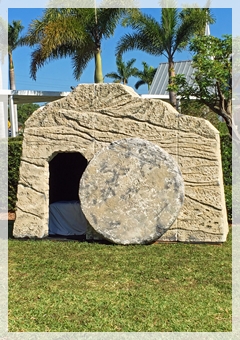 Yesterday I mentioned the wooden cross and rustic nail on my desk that serve as reminders of the terrible price Jesus paid for our salvation. Although early Christian symbols included a dove, ship, lyre, anchor, and fish, the cross has become the universal symbol for Christianity. While Coca-Cola’s logo, Nike’s swish and McDonald’s golden arches may come close, I doubt there is any so recognizable sign in the world. Nevertheless, a gruesome instrument of Roman torture seems an odd symbol for a faith that preaches such things as reconciliation, sacrifice, forgiveness, hope, love, and peace. While I’d never wear a miniature gallows, guillotine, or electric chair on a chain around my neck, I do wear a cross. Although it symbolizes everything that happened to Jesus on that dark Friday two thousand years ago, the cross would be meaningless if the tomb had not been empty Sunday morning.
 Devotions of the Heart