THE REASON FOR MORE THAN A SEASON

Because God’s children are human beings—made of flesh and blood—the Son also became flesh and blood. For only as a human being could he die, and only by dying could he break the power of the devil, who had the power of death. Only in this way could he set free all who have lived their lives as slaves to the fear of dying. [Hebrews 2:14-15 (NLT)]
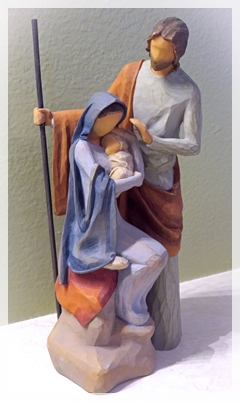
The Holy Family - Willow TreeAlthough Epiphany celebrates the magi’s visit to the Christ child, for many people it simply marks the official end to the holiday season. It’s the day the tree goes down, lights are removed, and nativity scenes get stowed for another year. British tradition holds that if you haven’t removed the holiday décor by January 6, you must leave it in place all year long to avoid misfortune. I don’t know about misfortune but, in our community, you’ll face a fine if holiday lights or decorations remain after this week!

This year, my five-year old grand helped me take down the tree and put away the Christmas decorations. Along with the ornaments, candle holders, stockings, and two Santas, we put away four nativity sets. As the little guy placed the Christ child in one of the boxes, he asked me why I had so many figures of baby Jesus. I reminded him that Jesus (not Santa) is the reason for the season and that we always want to keep Christ in Christmas.

After everything Christmas was packed up and put away, I realized a small resin figurine of the Holy Family remained on a shelf in the living room. The crates in the garage were filled to the brim and, just as on that first Christmas, there was no room anywhere for Mary, Joseph and the newborn King. Rather than having them spend the next eleven months in a high cabinet with assorted vases, I decided to keep them on my desk.

That figurine will serve as a reminder of how God deliberately chose to humble Himself: to be born of woman and live as a mortal man. That was God Himself who entered our world through a birth canal amidst blood and amniotic fluid. The baby who nursed at Mary’s breast and peed, pooped, spit up and drooled was God! He who created man was so helpless He couldn’t even roll over for the first few months of His life and had to learn to crawl and walk. The God who gave mankind the gift of speech had to learn to speak, the One who invented numbers had to learn to count, and He who spoke the law to Moses had to learn how to read His own words! The God who spoke light into existence had to light a candle at night and our omnipresent God had to walk to get from one place to another. The God who never gets tired, thirsty or hungry became a man who did. Jesus humbled Himself by living as a man and endured everything mankind does: blisters, bruises, colds, waiting, toothaches, bug bites, stubbed toes, hangnails, exhaustion, sunburn, skinned knees, and probably diarrhea. He even endured temptation but, unlike us, He remained sinless!

Sometimes, it’s easy to forget the human part of Jesus: that our infinite God chose to live in a finite world with all of its limitations. That figurine will remain on my desk this year as a reminder that our invincible and invulnerable God freely chose to live as a man so that He could die as a man in my place. Fully man and fully God at the same time, Jesus is more than just the reason for the Christmas season; He is the reason for our salvation. Christ belongs in far more than Christmas; He belongs in everything we think, say and do.

Therefore, it was necessary for him to be made in every respect like us, his brothers and sisters, so that he could be our merciful and faithful High Priest before God. Then he could offer a sacrifice that would take away the sins of the people.  Since he himself has gone through suffering and testing, he is able to help us when we are being tested. [Hebrews 2:17-18 (NLT)]

Copyright ©2019 jsjdevotions. All rights reserved.

THE STAR – Epiphany

But you, O Bethlehem Eph′rathah, who are little to be among the clans of Judah, from you shall come forth for me one who is to be ruler in Israel. [Micah 5:2a (RSV)]

star ornamentIn his gospel, Matthew writes of wise men from eastern lands who saw a ”star in the East.” This actually was a Greek term used in astrology at the time, en te Anatole, which meant “at the rising.” Now known as a heliacal rising, it describes a planet that rises above the eastern horizon shortly before dawn. Just moments after its appearance, it disappears in the sun’s glare. Better reflecting this astrological meaning, many Bibles translate the wise men seeing the star “as it rose.” While we’re not exactly sure what happened in the sky that drew the Magi to Judea, today’s astronomers have a pretty good idea.

To begin, we have to clarify a few of our misunderstandings about Christmas. While we think of Jesus’s birth as being in December, it probably occurred between March and October. Winters are cold and rainy in Judea; rather than sheep being in the fields in December, the shepherds would have sought shelter for their flocks. Moreover, the shepherds would have been keeping watch over their flocks at night only during lambing season (March and April). We also often think of Jesus’s birth as being the dividing line between B.C. and A.D. when, in fact, our calendar is about six years off.

Because there is nothing accidental or random about the universe, the movement patterns of the sun, moon, planets and stars can be observed and predicted. From what they’ve observed of these patterns, astronomers can also work backwards. Using a computer program to do just that, Rutgers University astronomer Michael Molnar found that, at twilight on March 20, 6 B.C., the moon eclipsed Jupiter. Then, on April 17, there was a heliacal rising of Jupiter and, at noon, the moon again eclipsed Jupiter. The heliacal rising continued until December 19 and, during that time, both Jupiter and Mars appeared in Aries, a constellation traditionally associated with Judea.

Picturing the magnificent star we often see depicted on Christmas cards, I’d wondered why the Magi were the only ones to take notice this stellar event. As Molnar explains it, these astronomical happenings were not spectacular because of their appearance but because of their rarity and would have had little significance to most people. The wise men, however, were not “most people.” Most likely astrologers from Babylon, they knew the prophecies that a king would be born to the house of David. Believing this king would be born when the moon eclipsed Jupiter, they probably had been searching the sky for years looking for signs like these.

While Molnar even offers a scientific explanation for the star appearing to stop, there also are other plausible explanations for this “star,” such as a close conjunction between Saturn and Jupiter. Whether it was an unexplainable miracle or an amazing natural phenomenon that miraculously coincided with Jesus’s birth, we know that these men saw something that made them believe a king had been born in Judea. Although we celebrate their visit to the Christ child on January 6 (often called Three Kings Day), they weren’t kings, we don’t know how many there were, and they probably arrived in Jerusalem anywhere from several months to two years after Jesus’s birth.

Although the events in the sky got them close to the new king, they had to stop and ask directions to actually find the child; it was only logical that they’d ask King Herod about this new king’s birth. Astrology was prohibited to the Jews and Herod had no astrologers but he did have priests and scribes. Knowing Micah’s prophecy, they directed the wise men to Bethlehem where they found Jesus.

Throughout Scripture we read that God speaks to us and reveals Himself in nature. It was through God’s amazing celestial creation that God revealed the birth of His son to these Gentile wise men. Yet, to find the king, nature wasn’t enough; they needed Scripture. The star told of His existence and got them close but it was the Word that got them there! Let us learn from these wise men. God reveals His power, majesty, and presence in nature but merely knowing that He exists is not enough. It is through Scripture that we actually will find and meet Him; it is though God’s word that we will come to know the King.

The Lord looks down from heaven upon the children of men, to see if there are any that act wisely, that seek after God. [Psalm 14:2 (RSV)]

Copyright ©2019 jsjdevotions. All rights reserved.

NINE MONTHS

Mary responded, “Oh, how my soul praises the Lord. How my spirit rejoices in God my Savior! For he took notice of his lowly servant girl, and from now on all generations will call me blessed. [Luke 1:46-48 (NLT)]

campionWe know that within a few days of the angel’s visit that Mary went to her cousin Elizabeth’s home, but what of those first few days after the annunciation? Did Mary tell anyone or did she wait until she’d seen proof of Elizabeth’s pregnancy before she truly believed that she, too, was with child? Did she tell Joseph immediately or wait until she returned to Nazareth three months later?

Have you ever wondered how that conversation went and about Joseph’s initial reaction to her unbelievable news? The couple’s betrothal was far more involved and serious than today’s engagements. In those days, betrothal wasn’t just an agreement between two people; it was an arrangement and commitment connecting two families. Joseph would have presented a ketubah, or marriage contract, to Mary and her father and paid a bride price, called a mohar, to compensate her father for the cost of raising the young woman. He then would have returned home to prepare a place for her and their engagement may have lasted as long as a year. Although the couple didn’t live together and certainly didn’t have sex, they were bound to one another as if married.

Though unconsummated, their betrothal was binding and could only be undone by a divorce with just cause (such as Mary not being a virgin). Knowing he wasn’t the father of her child, Joseph could have had her stoned for adultery. Matthew tells us he considered quietly divorcing her until he was visited by an angel who explained how the baby was conceived. But what of Mary’s parents? Worse, what about the reaction of Joseph’s family? How did Mary and Joseph explain this miraculous conception? Who would believe them? For that matter, what about the gossips of Nazareth? Mary had gone to visit her cousin and returned pregnant so it couldn’t be Joseph’s! There probably were whispers of scandal surrounding Mary all of her days.

After the angel Gabriel told Mary that she would conceive without virtue of a husband, he left. We can only hope that when the Holy Spirit came upon her and the Most High overshadowed her that Mary was given more than a baby—that she was given wisdom and strength beyond her years. I suppose any doubts Joseph had about the baby boy eventually were allayed by the unprecedented visits of shepherds and angels at the nativity, their encounters with Simeon and Anna at the temple, and the visit of the Magi with their extravagant gifts. Nevertheless, I’d like to think that the angel who visited him also gave him wisdom and strength for the challenges ahead.

The Christmas story actually begins nine months before that extraordinary night in Bethlehem. In celebration of the angel Gabriel’s visit to Mary, many churches celebrate the feast or festival of the annunciation on March 25 but it’s easily overlooked by many of us. Today, as I set out the figures for the nativity scene, I thought about Mary and Joseph and couldn’t help but wonder what happened in the nine months between Nazareth and Bethlehem.

All of this occurred to fulfill the Lord’s message through his prophet: Look! The virgin will conceive a child! She will give birth to a son, and they will call him Immanuel,  which means “God is with us.” [Matthew 1:22-23 (NLT)]

Copyright ©2018 jsjdevotions. All rights reserved

ONLY HE CAN MAKE A TREE FROG

For ever since the world was created, people have seen the earth and sky. Through everything God made, they can clearly see his invisible qualities—his eternal power and divine nature. So they have no excuse for not knowing God. [Romans 1:20 (NLT)]

A friend sent a link to some of the most beautiful landscapes in the world; you’ve probably gotten a similar one and been amazed by photos of the northern lights in Iceland, the red and orange pillars of Bryce Canyon, or the Glowworm caves in New Zealand. Awestruck by God’s amazing creation, I thought of how He makes Himself known through all that He’s made. Unfortunately, we tend to hear God better when He shouts with the exceptional and impressive than when He whispers with the small and familiar. obedient plant (false dragonhead) - green tree frogWe’re sure to notice God in the Grand Canyon, the multitude of stars in the night sky, or when watching two million wildebeest, zebra and gazelles migrate through the Serengeti. We sense Him in extraordinary or exotic things like the peacock’s splendid tail, Devil’s Tower, or spectacular sunsets and sunrises. But do we notice Him in the commonplace and unremarkable?

Yesterday, I watched, spellbound, as several bees visited the flowers I was photographing. A bee would enter one of the purple tubular blossoms and disappear as it inched its way deep into the corolla to gather pollen and nectar. After backing out, it would move on to another bloom. A perfect fit, it was as if bee and flower had been designed for one another (and they were). The flowers’ scent attracted the bees and, while the bees gathered food for their hive, they pollinated the plants. What was happening in these ordinary flowers growing wild by the road was truly extraordinary!

God’s grandeur is revealed in the giant trees of the redwood forest but His attention to detail is found in the one billion bacteria that live in just one gram of the forest’s soil. His greatness is made known in the 1,600 miles of the Great Barrier Reef but also in the 1,500 species of fish, 5,000 species of mollusks, 17 species of sea snakes and 6 species of turtles living there. We see our ingenious Creator in the enormous African elephant but also in the oxpeckers and cattle egrets that ride on its back and in the lice, ticks and parasites living on the elephant that are eaten by those birds. God’s artistry is revealed in the 28,000 species of orchids and but also in His amazing design of the wasps, bees, flies, moths, ants and gnats that pollinate them.

God teaches us, speaks to us, and provides for us through his creation. Let’s not fail to see His marvelous work in the everyday and mundane: wasps building a nest, mushrooms appearing on the lawn after a rain, maple leaves turning red in autumn, raindrops glistening on a flower petal, or a squirrel gathering nuts. You may remember the first line of Joyce Kilmer’s poem Trees: “I think that I shall never see A poem lovely as a tree.” The last line reads: “Poems are made by fools like me, But only God can make a tree.” Only God can make a tree, but He’s also the only one who can make the lichens and fungi living on its bark, the small tree frog hiding in its leaves, and the sparrow nesting in its branches.

Praise God, from whom all blessings flow!

Nature is the living, visible garment of God. [Johann Wolfgang Von Goethe]

All things bright and beautiful, All creatures, great and small, All things wise and wonderful, The Lord God made them all. [Cecil Francis Alexander]

O Lord, what a variety of things you have made! In wisdom you have made them all. The earth is full of your creatures. … I will sing to the Lord as long as I live. I will praise my God to my last breath! May all my thoughts be pleasing to him, for I rejoice in the Lord. [Psalm 104:24,33-34 (NLT)]

 Copyright ©2018 jsjdevotions. All rights reserved.

BEWARE THE YEAST

purple prairie clover“Watch out!” Jesus warned them. “Beware of the yeast of the Pharisees and Sadducees.” [Matthew 16:6 (NLT)]

In Biblical days, rather than using a packet of Fleishman’s yeast for leavening, people kneaded a small amount of old fermented dough called a starter or seor into fresh dough. When a yeast starter gets contaminated by bacteria, however, it gets a moldy odor of decay and, if mixed into new dough, its foulness will spread; the resulting bread will be unpleasant and inedible.

We’re all familiar with Jesus’ warning to the disciples to beware the yeast of the Pharisees. They weren’t bakers so what was their yeast? I’d always thought of it as the Pharisees’ hypocrisy and false teachings. And, while both of those can spread and spoil like bad leavening, I think there’s more to his caution.

The Pharisees and Sadducees, disregarding all of Jesus’ previous miracles, had demanded an impressive miraculous display from Him. Jesus wasn’t an entertainer and His miracles were never for show. Knowing nothing would convince the religious leaders, He refused and left. Shortly after that, Jesus and the disciples departed to the other side of the lake. It was when the disciples realized they’d failed to bring provisions that Jesus first warned them about the yeast of the Pharisees. Thinking He was talking about bread, they then started arguing with one another about not having anything to eat. Imagine their conversation as they pointed accusing fingers at one another for having no food—each man trying to shift the blame for the oversight to someone else. Totally misunderstanding Jesus’ warning, they were bickering about bread and worrying about their next meal when Jesus had just fed thousands with only a few loaves and fish. Our Lord was probably rolling His eyes at their blind foolishness. Like the Pharisees, what part of His many miracles didn’t they understand? Twice they’d ended up with several baskets of leftovers after feeding a multitude; certainly lack of bread shouldn’t pose a problem for just twelve men. Reminding them of His previous miracles of provision, Jesus told them He wasn’t speaking of bread. When He again told them to beware of the yeast of the Pharisees, they finally understood He was speaking of their unbelief.

Although Jesus warned them of this very thing before they’d started to argue, like the Pharisees, they ignored what they knew of Him and His miracles. Instead of allowing their belief to grow into trust, they allowed doubt to taint their faith and their relationship with one another in the same way that bad yeast contaminates bread. A little bit of uncertainty and skepticism swelled into fear, anger, and criticism. They were squabbling about bread for supper when they had the bread of life right beside them.

We all must beware the yeast of the Pharisees: not just false teaching and hypocrisy but also lack of trust!

Faith is not belief without proof, but trust without reservation. [D. Elton Trueblood]

Jesus replied, “I am the bread of life. Whoever comes to me will never be hungry again. Whoever believes in me will never be thirsty. But you haven’t believed in me even though you have seen me. [John 6:35-36 (NLT)]

Copyright ©2018 jsjdevotions. All rights reserved.

THEY SENT HIM AWAY (Mark 5:1-18 – Part 2)

If you refuse to take up your cross and follow me, you are not worthy of being mine. If you cling to your life, you will lose it; but if you give up your life for me, you will find it. [Matthew 10:38-39 NLT]

pansyThere’s probably no end of sermons and commentary on the swine that went plunging into the lake after Jesus saved the demoniac. “Why pigs?” some ask while others focus on the death of the animals rather than the salvation of a man. Non-believers criticize Jesus for his “wanton destruction” of other people’s property without realizing their criticism implies their belief in the miracle. Theologians respond that since Jesus is God, those pigs actually belonged to Him. I don’t know what the demons wanted when they asked to be sent into the pigs, why they plunged down the hillside to their death, or what happened to the demons after that. What I do know is that the value of 2,000 pigs does not exceed the value of one human soul.

Rather than the pigs, I’d rather consider the townspeople and their reaction to the demoniac’s miraculous healing. A crowd soon gathered around Jesus and the now obviously sane man. Rather than joy over his miraculous restoration, the people only saw their loss and they told Jesus to go away. Since much of their wealth had just perished in the lake, their initial reaction is understandable. Moreover, with the Gerasenes being a Gentile region, the people had no messianic expectations. Understandably, encountering a man so powerful that he could banish demons and send pigs over a cliff frightened them. Yet, there is no record of anyone asking Jesus who He was, why He’d come, what He wanted, or from where His power came. They just pled with Him to leave them alone!

Unfortunately, the people closed their minds and chose wealth and fear over the miraculous healing brought by Jesus. What Jesus could have given them far outweighed the loss of a herd of pigs. Surely, the demoniac wasn’t the only one in the region needing healing and yet no one else approached this amazing healer who’d arrived on their shores. Sadly, the people were so afraid of how Jesus would impact their lives that they rejected Him. I wonder if we, like the people of the Gerasenes, allow fear and materialism to keep us from welcoming Jesus into our lives. As theologian D.A. Carson says of the Gerasenes’ people, “They preferred pigs to persons, swine to Savior.” We must never do the same!

When Jesus steps into our lives, He radically changes us. He will restore us as He did for the demoniac but it will come at a cost, as it did for the townspeople. Jesus doesn’t want just a portion of us and what’s ours—He wants all of us and everything we possess. That means giving up a whole lot more than a herd of pigs. Rather than being afraid of Him and His power, as were the townspeople, we must trust Him and welcome Him with open arms. After all, is anything worth more than a soul?

Then Jesus said to his disciples, “If any of you wants to be my follower, you must give up your own way, take up your cross, and follow me. If you try to hang on to your life, you will lose it. But if you give up your life for my sake, you will save it. And what do you benefit if you gain the whole world but lose your own soul? Is anything worth more than your soul? [Matthew 16:24-26 (NLT)]

Copyright ©2018 jsjdevotions. All rights reserved.