RATINGS

Obviously, I’m not trying to win the approval of people, but of God. If pleasing people were my goal, I would not be Christ’s servant. [Galatians 1:10 (NLT)]

passion glower - pasqueflower“Over 1 million served,” was the sign Ray Kroc posted at his first McDonald’s franchise in 1955. That number became 100 million in 1958 and was 1 billion in 1963. When the number of burgers served surpassed the 99 billion mark in 1994, operators were told to change their signs to “Billions and Billions Served!” Executives at McDonald’s claim they no longer keep track of how many are served but I don’t believe it! Someone there knows exactly how many of those hamburgers have been sold, along with the number of Egg McMuffins and chocolate shakes.

People gauge their success with numbers and I’m no different. Before quitting my work for the day, I often check the stats for my web site. How many people visited and how many views did they take? Did I get any new subscribers? Worse, did I lose any? I doubt that I’m alone in checking stats; we all seek approval and use some sort of yardstick to measure our success. The restaurant measures sales, the YouTuber his subscribers, the author his place on the best seller list, the student his class rank, and the blogger her followers. We live our lives measuring and comparing: how many likes on the posting, hits on the website, orders taken, compliments on the outfit, friends on Facebook, or Christmas cards received.

Granted, publishing a blog is a little like speaking into a radio station microphone and not knowing if anyone is listening. Nevertheless, I had to ask myself, “Whose approval do I seek?” Like most people, I tend to seek tangible approval from people when the only approval that matters is that from God. It’s not who or how many people follow me; the only thing of importance is that I follow Him!

Our pastor shared the story of a successful evangelist who literally lost his voice. No longer able to preach, he asked God, “Don’t you care about my ministry?” The answer clearly given to him was, “No! I care about you!” I think of his story whenever I struggle with my writing ministry—when the words don’t come or I feel like I’m speaking to an empty auditorium. God cares about us—not about our triumphs and certainly not about how many people hear our voices or read our words. That pastor’s voice returned when he understood that God loved him rather than his accomplishments. Consider the Old Testament prophets: with Haggai (at whose urging the temple finally was rebuilt) being the exception, most of the prophets’ messages fell on deaf ears. Misunderstood, persecuted, ridiculed and ignored, by human standards they were failures. God, however, uses an entirely different kind of measuring stick. The prophets’ lives tell us that the success of our endeavors is not what matters; what matters is our obedience to God’s word and the doing of His will. It’s not about our glory; it’s about our bringing glory to God!

So, my dear brothers and sisters, be strong and immovable. Always work enthusiastically for the Lord, for you know that nothing you do for the Lord is ever useless. [1 Corinthians 15:58 (NLT)]

Copyright ©2018 jsjdevotions. All rights reserved.

FILL ME UP

Jesus replied, “I am the bread of life. Whoever comes to me will never be hungry again. Whoever believes in me will never be thirsty. [John 6:35 (NLT)]

moon at dawnSince he had a business meeting in Switzerland later in the week, my son went to London over the weekend to see his daughter who is in college there. Nearly every photo texted back to us showed my grand eating. Admittedly, she is a starving college student, living on a tight budget, who has grown tired of eating peanut butter, hummus with veggies, Raman noodles, and pasta in her apartment, so she took advantage of having access to her father and his credit card. With Dad paying the bill, she could again eat steak and lamb chops, indulge in gelato, and stock her pantry with fruit, meat, and cheese from Borough Market. As much as this starving coed needed food, what she really needed was a visit from home. Hugs from her father probably offered more nourishment than any amount of food. His visit did more than replenish her cupboards; it recharged her emotional batteries.

Sometimes, we have a hunger that won’t be satisfied by a trip to Whole Foods, Trader Joe’s, or Olive Garden; no amount of food can satisfy spiritual hunger. Rather than having our father visit, take us out to dinner, and fill our grocery bags, we need time with our Heavenly Father so He can fill our hearts and souls.

Last week, early in the morning, my husband asked if I had time for a walk at the beach. “No way!” was my first thought. Having spent several days in preparation for presenting a Bible study that evening, I was way behind in my writing, the bed linens needed changing, the laundry basket was full, and there were enough crumbs on the floor that you literally could eat off it! But, knowing how overwhelmed and spiritually empty I felt, I agreed. Being early risers, we arrived shortly before dawn and the full harvest moon in the west watched over us as the sun rose in the east. Feeling like I had yesterday, today, and tomorrow in the palm of my hand, I was reminded that God really does. In awe, as the moon’s light shimmered on the water while the sky grew pink with the sunrise, I walked in the beauty of God’s creation and felt His peace descend on me. Filled with His grace, I was renewed, refreshed, and restored. Remembering a lovely praise song, I silently sang: “Fill me up, God. Fill me up, God…” As the aroma of bacon wafted from a beach-side restaurant, my stomach reminded me that I hadn’t yet eaten breakfast. Nevertheless, that quiet time with my Heavenly Father sated my spiritual hunger and filled me up in a way that bacon, eggs, and toast never could.

God gave us a weekly Sabbath to rest, relax, restore, and replenish. The Hebrew word sabbat, which we know as Sabbath, comes from the verb sabat which means to stop or cease. The observance of the Sabbath every week was central to the Israelite’s life (and should be to ours) but, sometimes, in our fast-paced world, one day a week is not pause enough. There are times, like that Thursday morning, when we need what Terry Hershey calls a “Sabbath Moment” — a temporary cease-fire from the assault of busyness that so often bombards our lives. It’s a brief turning away from the day’s hustle and bustle to spend time with our Heavenly Father. The Sabbath moment does for us what her father’s visit did for my grand: it feeds and restores us. It fills us up!

More of your spirit is what we need,
More of your annointing,
More of your glory, fill me.
Fill me up God (fill me up God),
Fill me (that’s what I really want). [Will Reagan]

Let them praise the Lord for his great love and for the wonderful things he has done for them. For he satisfies the thirsty and fills the hungry with good things. [Psalm 107:8-9 (NLT)]

Copyright ©2018 jsjdevotions. All rights reserved.

KING OF KINGS

In my vision at night I looked, and there before me was one like a son of man, coming with the clouds of heaven. He approached the Ancient of Days and was led into his presence. He was given authority, glory and sovereign power; all nations and peoples of every language worshiped him. His dominion is an everlasting dominion that will not pass away, and his kingdom is one that will never be destroyed. [Daniel 7:13-14 (NIV)]

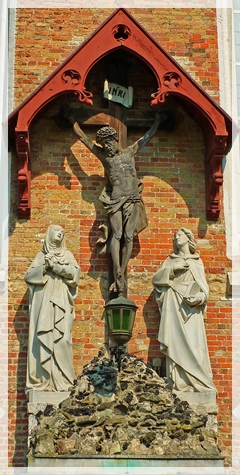
Church of our Lady - Netherlands

As we left the church, my friend asked “What do the letters INRI above the cross mean?” Unable to say it in Latin, I replied that it was an abbreviation of the words, “Jesus of Nazareth, the King of the Jews.” In Latin, these words would be Iesus Nazarenus Rex Iudaeorum. When someone was crucified, it was usual to affix a sign to the cross declaring the cause of execution. Since the official charge against Jesus seemed to be that he’d challenged Roman rule by proclaiming himself the king of the Jews, Pilate had those words written in Latin, Greek and Hebrew. As Pilate phrased it, however, the words seem more of a title rather than an accusation. When the high priests asked that the sign be changed to read “He said, I am the King of the Jews,” Pilate refused.

Other than that dark day when He was crucified and the title “king of the Jews” was used with scorn and mockery by the soldiers and crowd, Jesus was referred to as “king of the Jews” only one other time: at the visit of the Magi when they asked, “Where is the one who has been born king of the Jews?” [Matthew 2:2] While most of Jesus’s countrymen didn’t acknowledge His identity, it was foreigners who recognized his sovereignty at His birth and a Roman governor who acknowledged His kingship at death.

Was Jesus the king of the Jews? A king’s supremacy is limited to his domain. The ruler of a nation, a king’s power is limited by his lifetime and the borders of his kingdom. He must defend his government from enemy nations and his regime from revolution. A king of the Jews would reign only over Judah’s territory and the children of Israel. When asked if He was king of the Jews, Jesus told Pilate that His kingdom was not of this world. Indeed, Jesus’s kingdom wasn’t limited to Judah and the Jews. Unlike earthly kingships, His reign is absolute, unbreakable, sacred, and everlasting. When God raised Jesus from the dead, He was given power over all of creation and all people on earth, not just the Jews of Judah. Pilate’s sign was wrong. Jesus wasn’t the “king of the Jews;” He was and still is the King of kings and the Lord of lords.

They will wage war against the Lamb, but the Lamb will triumph over them because he is Lord of lords and King of kings—and with him will be his called, chosen and faithful followers. [Revelation 17:14 (NIV)]

Copyright ©2018 jsjdevotions. All rights reserved.

ONLY HE CAN MAKE A TREE FROG

For ever since the world was created, people have seen the earth and sky. Through everything God made, they can clearly see his invisible qualities—his eternal power and divine nature. So they have no excuse for not knowing God. [Romans 1:20 (NLT)]

A friend sent a link to some of the most beautiful landscapes in the world; you’ve probably gotten a similar one and been amazed by photos of the northern lights in Iceland, the red and orange pillars of Bryce Canyon, or the Glowworm caves in New Zealand. Awestruck by God’s amazing creation, I thought of how He makes Himself known through all that He’s made. Unfortunately, we tend to hear God better when He shouts with the exceptional and impressive than when He whispers with the small and familiar. obedient plant (false dragonhead) - green tree frogWe’re sure to notice God in the Grand Canyon, the multitude of stars in the night sky, or when watching two million wildebeest, zebra and gazelles migrate through the Serengeti. We sense Him in extraordinary or exotic things like the peacock’s splendid tail, Devil’s Tower, or spectacular sunsets and sunrises. But do we notice Him in the commonplace and unremarkable?

Yesterday, I watched, spellbound, as several bees visited the flowers I was photographing. A bee would enter one of the purple tubular blossoms and disappear as it inched its way deep into the corolla to gather pollen and nectar. After backing out, it would move on to another bloom. A perfect fit, it was as if bee and flower had been designed for one another (and they were). The flowers’ scent attracted the bees and, while the bees gathered food for their hive, they pollinated the plants. What was happening in these ordinary flowers growing wild by the road was truly extraordinary!

God’s grandeur is revealed in the giant trees of the redwood forest but His attention to detail is found in the one billion bacteria that live in just one gram of the forest’s soil. His greatness is made known in the 1,600 miles of the Great Barrier Reef but also in the 1,500 species of fish, 5,000 species of mollusks, 17 species of sea snakes and 6 species of turtles living there. We see our ingenious Creator in the enormous African elephant but also in the oxpeckers and cattle egrets that ride on its back and in the lice, ticks and parasites living on the elephant that are eaten by those birds. God’s artistry is revealed in the 28,000 species of orchids and but also in His amazing design of the wasps, bees, flies, moths, ants and gnats that pollinate them.

God teaches us, speaks to us, and provides for us through his creation. Let’s not fail to see His marvelous work in the everyday and mundane: wasps building a nest, mushrooms appearing on the lawn after a rain, maple leaves turning red in autumn, raindrops glistening on a flower petal, or a squirrel gathering nuts. You may remember the first line of Joyce Kilmer’s poem Trees: “I think that I shall never see A poem lovely as a tree.” The last line reads: “Poems are made by fools like me, But only God can make a tree.” Only God can make a tree, but He’s also the only one who can make the lichens and fungi living on its bark, the small tree frog hiding in its leaves, and the sparrow nesting in its branches.

Praise God, from whom all blessings flow!

Nature is the living, visible garment of God. [Johann Wolfgang Von Goethe]

All things bright and beautiful, All creatures, great and small, All things wise and wonderful, The Lord God made them all. [Cecil Francis Alexander]

O Lord, what a variety of things you have made! In wisdom you have made them all. The earth is full of your creatures. … I will sing to the Lord as long as I live. I will praise my God to my last breath! May all my thoughts be pleasing to him, for I rejoice in the Lord. [Psalm 104:24,33-34 (NLT)]

 Copyright ©2018 jsjdevotions. All rights reserved.

THE BARBER

This is what the Lord says: “Cursed are those who put their trust in mere humans, who rely on human strength and turn their hearts away from the Lord. They are like stunted shrubs in the desert, with no hope for the future. They will live in the barren wilderness, in an uninhabited salty land. [Jeremiah 17:5-6 (NLT)]

 If God is, why is there evil? But if God is not, why is there good? [Saint Augustine]

Kuchenhof Gardens netherlandsThe story is told of a barber who vehemently denied the existence of God while cutting his customer’s hair. “Look at this troubled world,” he said. “School shootings, terrorism, wars, genocide, pain, poverty, hatred, prejudice, and deceit: they all prove your so-called God doesn’t exist!” The customer tried to reason with him but the atheist would have nothing of it.

When the customer left the shop, he saw a man sitting on a nearby bench. His hair was long, filthy and matted; his eyebrows were so shaggy they nearly covered his eyes; his face was so dirty his skin color was undistinguishable; and his mustache and beard were long, mangy, and disgusting. Returning to the shop, the customer announced to the barber, “There are no barbers; you do not exist!” The shocked man replied, ”But, I do; I’m right here in my shop. Here’s my chair and sink, towels and wash cloths, shampoo and shaving cream, scissors and razors, combs and brushes. How can you say I don’t exist?” The customer then pointed to the unkempt man sitting outside on the bench. “Well, that’s what happens when people don’t come to me,” said the exasperated barber. “My point exactly,” replied his customer. “This troubled sinful world is what happens when people don’t go to God!”

It’s been said that someone once asked Billy Graham how Christianity could be valid when there is so much evil in the world. The famous preacher replied, “With so much soap, why are there so many dirty people in the world? Christianity, like soap, must be personally applied if it is to make a difference in our lives.”

 A Christian is nothing but a sinful man who has put himself to school for Christ for the honest purpose of becoming better. [Henry Ward Beecher]

But blessed are those who trust in the Lord and have made the Lord their hope and confidence. They are like trees planted along a riverbank, with roots that reach deep into the water. Such trees are not bothered by the heat or worried by long months of drought. Their leaves stay green, and they never stop producing fruit. [Jeremiah 17:7-8 (NLT)]

Copyright ©2018 jsjdevotions. All rights reserved.

DISCREPANCIES

Many people have set out to write accounts about the events that have been fulfilled among us. They used the eyewitness reports circulating among us from the early disciples. Having carefully investigated everything from the beginning, I also have decided to write an accurate account for you, most honorable Theophilus, so you can be certain of the truth of everything you were taught. [Luke 1:1-4 (NLT)]

tri-colored heron Skeptics often point to contradictions in the Bible when questioning its reliability. For example, Matthew, Mark and Luke tell of Jesus healing a demon-possessed man and casting the demons into swine but there are inconsistencies between their accounts. Mark and Luke say this occurred in the region of the Gerasenes but Matthew calls it the Gadarenes. In this region, however, there were at least three towns with similar names: Gergasa, Gerasa and Gadara. Adding to the confusion, once healed, the demoniac testified throughout what was called the Decapolis or Ten Towns and both Gadara and Gerasa were in this district. The area of the Gerasenes probably included that of the Gadarenes in the way someone living in Hammond, Indiana, also lives in Lake County, on the South Shore, in northeast Indiana, and within the Chicago metropolitan area. The same place can be described many ways.

Harder to reconcile is that Matthew writes about two demoniacs while Mark and Luke just mention one. Yet, where there are two, there is always at least one and Mark and Luke never say there was only one man. That they don’t mention a second doesn’t mean he wasn’t there; he just wasn’t essential to the story the way they told it. A similar inconsistency is found in the accounts of the woman at the tomb Easter morning. John names only Mary Magdalene. The other three gospels all name her but include other women. The “other Mary,” is mentioned in Matthew’s gospel and Mary (the mother of James) and Salome are in Mark’s. Luke says Joanna, Mary (the mother of James), and several other women told the apostles about the empty tomb. None of the writers, however, said that only the women they mentioned were there that day.

Differing accounts aren’t necessarily contradictory. If my husband and I were both to tell you about a wedding we attended, I would tell you it was near Cleveland, he would say Ashtabula, but the invitation would say Geneva-on-the-Lake. I would mention the bride’s gown, the wedding party’s attire, and the flowers but my husband would tell you about the terrific venue, food, and band. When recounting the people there, while our lists would overlap, they wouldn’t be identical. Our accounts would be different but truthful and certainly not incompatible.

While the message in the Bible is God-breathed, it was man-penned and the authors were writing for different audiences at different times. Matthew wrote specifically to the Jews, Mark wrote to the Christians in Rome, Luke wrote for the Gentiles (and specifically to Theophilus, a Gentile convert of high rank), and seekers and new Christians were John’s original audience. Paul was writing for the early church in places like Rome, Corinth, Galatia, Ephesus and Philippi. From different backgrounds, they were writing for different people, and emphasized different things. Let us never make the mistake of thinking that different means irreconcilable or false. As for me, I’m not about to throw out the baby with the bathwater over a few discrepancies in Scripture. I just pray for discernment and continue to seek the truth.

This Book (the Bible) had to be written by one of three people: good men, bad men or God. It couldn’t have been written by good men because they said it was inspired by the revelation of God. Good men don’t lie and deceive. It couldn’t have been written by bad men because bad men would not write something that would condemn themselves. It leaves only one conclusion. It was given by divine inspiration of God. [John Wesley]

All Scripture is inspired by God and is useful to teach us what is true and to make us realize what is wrong in our lives. It corrects us when we are wrong and teaches us to do what is right. [2 Timothy 3:16 (NLT)]

Above all, you must realize that no prophecy in Scripture ever came from the prophet’s own understanding, or from human initiative. No, those prophets were moved by the Holy Spirit, and they spoke from God. [2 Peter 1:20-21 (NLT)]

Copyright ©2018 jsjdevotions. All rights reserved.