
STARS

who would you be for a day?Call to me and I will answer you, and will tell you great and hidden things that you have not known. [Jeremiah 33:3 (ESV)]

The bulletin board outside the auditorium posed this question: “If you could be someone famous for a day, who would you be?” People had written their answers on paper stars and pinned them to the board. Including both living and dead, the answers ranged from entertainment, royalty and sports to technology, government, and the arts. They included Thomas Edison, Beyoncé, Georgia O’Keefe, Chrissie Evert, Isaac Newton, Thomas Jefferson, Maya Angelou, and Coco Chanel. Oprah received several stars as did Alexander Hamilton, Audrey Hepburn, and Michele Obama. Warren Buffet was the only entrepreneur listed but someone else was satisfied to be “any rich person;” one man wished to be Penélope Cruz’s husband.

I looked at the stars and pondered my answer. Although God had one star, He certainly wouldn’t be my choice. I have enough trouble running my life; running the universe, even for just a day, would be way too much responsibility for me. In the end, I had to agree with the one star that said “Me;” being me is all I can manage. This exercise, however, reminded me of a similar question asked in our small group: “If you could have a conversation with someone famous, who would it be?”

Even though I wouldn’t have much in common with sport stars like Joe DiMaggio or Bobby Orr and probably wouldn’t understand Giacomo Puccini or Leonardo DaVinci, I would enjoy being in the presence of nearly everyone whose star appeared on the board (with the exceptions of Christopher Hitchens, Hugh Hefner and whoever is Penelope Cruz’s husband). If I actually did have an opportunity to meet with one of those people, you can be sure I wouldn’t waste my time talking about me, my background, ambitions, needs and desires. A conversation with Bishop Desmond Tutu, Florence Nightingale, or even Lucille Ball would have no point if I never let them get a word in edgewise. I’d want to hear what they had to say: to ask about them, to know what was important to them, what made them tick, and what advice they’d pass on to me.

Alas, with one notable exception, most of us will never have the opportunity to converse with any of the people whose names were on that bulletin board. The exception, of course, is God, the greatest one of them all. Unlike all of those stars we’ll never meet, we can talk with God in prayer any time we want. Prayer gives us the opportunity not just to know about God but to actually know Him—to have a relationship with Him—and not just for a day, but forever!

I wonder why I’m so willing to jabber on when talking with God—the one who knows all things—when I’d quietly listen intently to a celebrity. The creator of the universe doesn’t require my guidance on world management any more than Ina Garten needs my cooking advice or Billie Jean King needs my tennis pointers. God doesn’t need me to tell Him what it is I need or want and He certainly doesn’t need me to list my concerns or register my complaints; He already knows all there is to know about me! In fact, He knows what I need before I know I even need it!

It is when we quiet our voices that we can hear the voice of God. Thomas Merton describes this listening or contemplative prayer as “not so much a way to find God as a way of resting in him whom we have found, who loves us, who is near to us, who comes to us to draw us to himself.” Let us bask in His presence; let us pray.

Prayer is not asking. Prayer is putting oneself in the hands of God, at His disposition, and listening to His voice in the depth of our hearts. [Mother Teresa]


Be still, and know that I am God. [Psalm 46:10a (ESV)]

And when you pray, do not heap up empty phrases as the Gentiles do, for they think that they will be heard for their many words. Do not be like them, for your Father knows what you need before you ask him [Matthew 6:7-8 (ESV)]

Copyright ©2019 jsjdevotions. All rights reserved. 

HIS PEDAGOGY

Dear brothers and sisters, when troubles of any kind come your way, consider it an opportunity for great joy. For you know that when your faith is tested, your endurance has a chance to grow. So let it grow, for when your endurance is fully developed, you will be perfect and complete, needing nothing. [James 1:2-4 (NLT)]

pink hibiscus

“May the Holy Spirit give us grace to not begrudge the pedagogy of God,” wrote John Piper. Pedagogy being a somewhat archaic word, I was unsure what Piper meant. Associating pedagogy with an old, boring, stodgy, and authoritarian teacher, I thought it wise to consult the dictionary. “Pedagogy” comes from two Greek words: pais, meaning child, and agogos, meaning leader. A paidagogos was a slave who led the boys to and from school, taught them manners, and tutored them after school. “Pedagogy” eventually came to mean the method and practice of teaching and “pedagogue” to mean teacher. While God is neither boring nor stodgy, He is older than time and an authoritarian (but loving) teacher with some unique, innovative and often challenging teaching methods or pedagogy.

I don’t know about boys in ancient Greece, but I imagine they were like boys today: often less than enthusiastic about learning their lessons, spending time in a classroom, and being taught restraint, civility, and good behavior. Like schoolboys, we are often less than enthusiastic about learning the lessons God is teaching us. Sometimes life seems bizarre or unreasonable and other times it’s downright difficult or heartbreaking; almost all of the time it’s hard to understand. It’s easy to begrudge the way God teaches us.

I think of a scene from the movie Peggy Sue Got Married in which the middle-aged Peggy Sue goes back in time to high school. When asked to solve a problem in algebra class, she responds, “I happen to know that, in the future, I will not have the slightest use for algebra, and I speak from experience.” I agree with Peggy Sue—once out of school, I had no need to know about coefficients, variables, constants or exponents. But, I didn’t know that when I took freshman algebra more than half a century ago.

We are finite beings and can only see what is right before us. God, however, is infinite and can see far into our future both here and in the hereafter. When He teaches us lessons about patience, humility, loss, conflict resolution, pain, worry, pride, fear, trust, obedience, persistence, and faith, we rarely know for what purpose we’re in His schoolroom or when we’re going to need the skill we’re being taught. God’s pedagogy only makes sense when we look back in time. It is then that we realize the benefit we’ve gained from His extraordinary and often bizarre teaching methods. Indeed, as John Piper said, “May the Holy Spirit give us grace to not begrudge the pedagogy of God.”

I never had a trial I wanted to have, but I never had trial I wasn’t glad I had. [Jack Hyles]

My suffering was good for me, for it taught me to pay attention to your decrees. Your instructions are more valuable to me than millions in gold and silver. You made me; you created me. Now give me the sense to follow your commands. [Psalm 119:71-73 (NLT)]

Copyright ©2019 jsjdevotions. All rights reserved.

UNANSWERED QUESTIONS

For my thoughts are not your thoughts, neither are your ways my ways, declares the Lord. For as the heavens are higher than the earth, so are my ways higher than your ways and my thoughts than your thoughts. [Isaiah 55:8-9 (ESV)]

violetsIt was the first night of a new small group study and, as we gathered our books to leave, one woman said she’d have to read more about the author since he sounded like a Calvinist. Believing that everyone has the God-given ability to choose God’s grace, she didn’t want to participate in the class if the book’s author believed that, in the past, God chose some among mankind for His own and that that Christ died only for those elect.

There is much in church doctrine that is disputed between denominations and the differences are often subtle, complicated, and confusing. Regarding Calvinism, there is five-point Calvinism, Amyraldism which holds to only four of Calvin’s points, Arminianism (the rejection of predestination and an affirmation of free will), and a host of other isms in between. There are differing views of Communion, as well: transubstantiation, consubstantiation, sacramental union, receptionism, and memorialism. Does the bread actually transform into the actual flesh and blood of Christ, is it spiritually the flesh and blood of Jesus, the spiritual presence of Christ, or a remembrance of Christ’s suffering? What about baptism? Is it a requirement for salvation or merely symbolic of the salvation process? All of these questions (and many more) arise out of several hard to reconcile passages in the Bible. Unable to clearly define many of these issues, I know I will never fully understand them.

Some things in Christianity are essential and non-negotiable: the deity of Christ, His substitutionary sacrifice for our sins, the resurrection, salvation by grace though faith, the Holy Trinity, the authority of Scripture, and life everlasting. Agreement on many other issues, however, is not necessary and those issues will remain unresolved this side of heaven. In A Grief Observed, C.S. Lewis opined that many of our great theological and metaphysical questions are probably as nonsensical and unanswerable as asking how many hours are in a mile or whether the color yellow is square or round. He wrote that when he laid his unanswered questions at God’s door, he got no answer. Lewis added that the silence was not a locked door/no one’s home kind of silence but more like that of a compassionate God, shaking his head and thinking, “Peace, child; you don’t understand.”

When the woman from class said, “I can’t believe in a God who would sacrifice His son for only a select group rather than all of mankind,” I said she didn’t have to. She and I may be wrong in our beliefs, but our salvation doesn’t depend on our knowing the right answer. Actually, our salvation doesn’t depend on having the right answer to most of the doctrinal controversies and isms that separate Christ’s Church. More important than understanding various theological or doctrinal issues is having the mind of Christ. Sooner or later, all the rest will make perfect sense.

Heaven will solve our problems, but not, I think, by showing us subtle reconciliations between all our apparently contradictory notions. The notions will all be knocked from under our feet. We shall see that there never really was any problem. [C.S. Lewis, from “A Grief Observed”]

When I was a child, I spoke like a child, I thought like a child, I reasoned like a child. When I became a man, I gave up childish ways. For now we see in a mirror dimly, but then face to face. Now I know in part; then I shall know fully, even as I have been fully known. [1 Corinthians 13:11-13 (ESV)]

Copyright ©2019 jsjdevotions. All rights reserved

NO APPOINTMENT NECESSARY

sanderlingsFor I am the Lord, your healer. [Exodus 15:26b (RSV)]
In that hour he cured many of diseases and plagues and evil spirits, and on many that were blind he bestowed sight. And he answered them, “Go and tell John what you have seen and heard: the blind receive their sight, the lame walk, lepers are cleansed, and the deaf hear, the dead are raised up, the poor have good news preached to them. [Luke 7:21-22 (RSV)]

Here in southwest Florida it’s “season,” which means that flocks of snowbirds have arrived (and I don’t mean the kind with wings). While they boost the economy, locals groan at the busy traffic, the difficulty of getting into their favorite restaurants or hair salons, and the scarcity of parking places. One of the biggest problems is seeing a doctor! If we can find a doctor (or dentist) who is taking new patients (a challenge in itself) and takes our insurance, we’ll find a two month or longer wait before getting an appointment. Then, if we’re referred to a specialist, the whole routine begins again. As for urgent care clinics; unless the situation is life threatening, there is nothing urgent about the care one eventually receives. My best advice during season is not to get sick!

Our God truly is the Great Physician but, unlike the doctors in our town, He’ll take new patients. He won’t make us fill out detailed medical history forms; rather than past illnesses, He’s concerned about our wellness in the present and future. Insured or uninsured, Medicare or Medicaid, co-pay or no pay, it makes no difference; Jesus already paid our fee. God will never turn us away as incurable or hopeless because there are no lost causes in His office and He’ll never refer us to someone else because He specializes in whatever is ailing us. Best of all: no appointment is ever needed. God operates a walk-in clinic where the waiting room aways is empty and the doctor always is in!

At first, God being available 24/7 and taking His time during an appointment sounds like the concierge medicine that has become so popular in our area. God, however, doesn’t limit the number of patients in His practice nor does He require a hefty retainer fee before He gives you His number or listens to your complaint. God never takes a vacation and always has enough time and energy to deal with everyone who calls Him. Like a concierge physician, however, God is strong on preventative medicine: regular prayer, Bible study, Christian fellowship, and eating frequently at His table.

Of course, as with any physician, if we don’t recognize our sickness and the need for healing, we won’t call Him. We must have faith in our doctor’s wisdom and skill and follow his directions completely and we must do the same with our Great Physician. While He won’t be prescribing Lipitor, a flu shot, or more exercise, He’ll probably prescribe a healthy dose of repentance, forgiveness, love and prayer. Instead of giving us medical brochures about our condition, He’s already provided us with something better than the Merck Manual: Holy Scripture. As for any sort of long-term therapy—among other things, God is sure to recommend Christian community and service.

Our Great Physician hears our painful cries and heals our troubled souls. Thank you, God.

And when Jesus heard it, he said to them, “Those who are well have no need of a physician, but those who are sick; I came not to call the righteous, but sinners.” [Mark 2:17 (RSV)]

As for me, I said, “O Lord, be gracious to me; heal me, for I have sinned against thee!” [Psalm 41:4 (RSV)]

Copyright ©2019 jsjdevotions. All rights reserved.

BE HOLY

Have the people of Israel build me a holy sanctuary so I can live among them. [Exodus 25:8 (NLT)]

And this is the basic law of the Temple: absolute holiness! The entire top of the mountain where the Temple is built is holy. Yes, this is the basic law of the Temple. [Ezekiel 43:12 (NLT)]

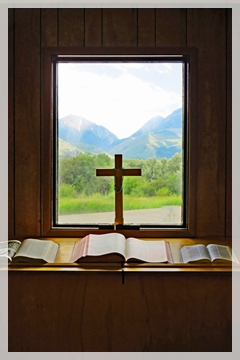
roadside chapelBefore the incarnation of Christ, God dwelt first in the tabernacle and then in the temple. The innermost room of the temple was called the “Most Holy Place” and it was in this inner room that God’s glory was said to dwell. This was where the Ark of the Covenant was kept and where the high priest came with a sacrifice to atone for his and the nation’s sins every year. With the incarnation of Jesus, God no longer dwelt in the temple but in the flesh of His son and, for a brief time, God actually walked among His people. Yet, when Jesus lived as a man, only a few people at a time could be in His presence. With His death, there is no yearly atonement ritual because Jesus atoned for our sins once and for all. Moreover, because of His resurrection, ascension, and the presence of the Holy Spirit, it is possible for countless people, everywhere, to be in His presence at the same time. Once we become believers, the Holy Spirit moves into our hearts and each one of us, as members of Christ’s church, become part of His body and the temple of God.

When Ezekiel spoke that the absolute rule of the temple was holiness, he was speaking of the temple building in Jerusalem, a place that had been defiled by idolatry and sin. While we no longer worship at a temple on a mount, the prophet’s words still hold true. The innermost room, the Most Holy Place, the dwelling of the Lord, still exists. That innermost room is now in our hearts and they must be kept holy. While we tend to think of holiness as moral purity, it is much more. It means to be dedicated or consecrated to God, to be set apart for Him, and not with just a small part of us. Holiness means that our entire being is His, our first love and loyalty are to Him, and that we are committed to God’s will and work.

In a sermon given in 1872, Victorian preacher Charles Spurgeon told of an unbeliever who ridiculed a Christian’s faith. The skeptic asked the believer whether his God was a great God or a little God. The devout man replied that his God was, “so great that the heaven of heavens cannot contain Him, and yet He condescends to be so little, that He dwells in broken and contrite hearts.” Indeed, our great God has chosen to dwell in our hearts. Although there was idolatry and sin in Jerusalem’s temple, let there be none in our hearts, the temple of the Lord.

For we are the temple of the living God. As God said: “I will live in them and walk among them. I will be their God, and they will be my people. Therefore, come out from among unbelievers, and separate yourselves from them, says the Lord. [2 Corinthians 6:16b-17 (NLT)]

But now you must be holy in everything you do, just as God who chose you is holy. For the Scriptures say, “You must be holy because I am holy.” [1 Peter 1:15-16 (NLT)]

Copyright ©2019 jsjdevotions. All rights reserved.

WHAT’S IN A NAME? (Daniel – part 1)

“But you are my witnesses, O Israel!” says the Lord. “You are my servant. You have been chosen to know me, believe in me, and understand that I alone am God. There is no other God—there never has been, and there never will be. [Isaiah 43:10 (NLT)]

black skimmerAfter Nebuchadnezzar’s first invasion of Judah, he returned to Babylon with the temple’s treasures and some of Judah’s nobility as captives. The best and brightest of the young men were to learn the literature and language of Babylon so they could serve the king. In spite of being captives, they were housed in the palace and given the king’s choice of food. While this would appear to be a pretty good gig for prisoners of war, the boys were probably castrated and made eunuchs as was typically done for palace officials (and prophesied by Isaiah in 2 Kings 20:18).

Among these captives were Daniel, Hananiah, Mishael, and Azariah, all of whom were given new Babylonian names. Daniel, whose name meant “God is my judge,” became Belteshazzar, meaning “Bel protects his life” (Bel was another name for the chief Babylonian god Marduke). Hananiah, whose name meant “The Lord shows grace,” became Shadrach, meaning “Under the command of Aku” (the Sumerian moon god). Mishael, whose name meant “Who is like God?” became Meshach, meaning “Who is what Aku is?” and Azariah, whose name meant “The Lord helps,” became Abednego, “Servant of Nebo” (the god of learning and writing).

“What’s in a name?” asked Juliet in Shakespeare’s Romeo and Juliet. “That which we call a rose by any other name would smell as sweet,” added the star-crossed lover. Romeo’s name made him an enemy to her family but his name was meaningless to Juliet. She knew a man’s name did not determine his value or character. Nebuchadnezzar, king of Babylon, thought otherwise. By changing the captive boys’ names, he wanted more than just their assimilation to Babylon; he wanted their allegiance. When he took their names from them, he also thought he took their God.

These young men lost their homes and families, their masculinity and their names. To further distance them from the God of Israel, as eunuchs, they wouldn’t be allowed to worship in the temple if they ever returned home. Nevertheless, they never lost their identity as children of the God of Israel and refused to defile themselves by partaking of the king’s food and wine.

Some think their decision was based solely on health and nutrition and now offer a wide variety of eating plans based on Daniel’s diet. Their refusal, however, probably had more to do with the youths’ attempt to regain some control over their lives and faith. The king’s meat would not have been butchered or prepared according to Jewish law and would have included prohibited foods like horseflesh and pork that had first been offered to the pagan god Marduk. The four friends refused it and, working out a compromise with the palace guard, agreed to eat nothing but vegetables and water for a trial period of ten days. Since they looked better nourished after that time, they were allowed to continue observing their food rules. Their fitness, however, had more to do with God’s promise of provision than their diet. God granted them not just health but special wisdom. In spite of their new names, they now knew that, by remaining faithful to God, He would be remain faithful to them. Found superior to all of the others in their group, they entered the king’s service in his court.

These four young men knew there was nothing in a name. What mattered was their character and their faith in God—a God who was judge, showed grace, and helped them in their troubles. They knew the Lord would honor those who honored Him and it was this knowledge that would carry them through their later trials in Babylon.

Praise the name of God forever and ever, for he has all wisdom and power. He controls the course of world events; he removes kings and sets up other kings. He gives wisdom to the wise and knowledge to the scholars. [Daniel 2:20-21 (NLT)]

Copyright ©2019 jsjdevotions. All rights reserved.