FEED THE FAITH  (Fear – Part 2)

Jesus said to his followers, “Why are you afraid? Do you still have no faith?” [Mark 4:40 (NCV)]

So don’t worry, because I am with you. Don’t be afraid, because I am your God. I will make you strong and will help you; I will support you with my right hand that saves you. [Isaiah 41:10 (NCV)]

dawn Yesterday, I wrote about unfounded fears. Although I’m a bit of a nervous flyer, I’d rather travel than stay home, so I pray and fly. While I’m a little nervous about heights, I’d rather ride than hike up the mountain, so I pray and ride the lifts. Since my little Ziggy-like guy can easily capture my irrational fears, they rarely plague me. It’s not fear of external things like plane crashes or gondola accidents, however, that disturb me. Instead, it’s the fear that happens when I focus on me instead of God. Will I be wounded, bothered, abandoned or tested? What if I don’t succeed, reach my goal, or make a good impression? Will I be welcome? What if I make a mistake?

Recently, during his message, our pastor asked us to call out our fears. People were afraid of being honest, rejected or criticized. They were afraid of apologizing, failing and even of succeeding. They were afraid of taking risks, moving ahead, standing up for themselves, or letting go of old habits. Those are the kinds of fear that damage our daily lives; unfortunately, they are much harder than those big unfounded ones to identify and capture.

Fears like these sneak up on us; instead of being easily spotted like a butterfly, they’re more like those no-see-ums that afflicted me last night on the beach. It was nearly impossible to see those teeny gnats but they surely made their presence known. They sucked my blood the same way those tiny niggling fears can suck the life from us. And, just like the itch from those bites annoys me today, those fears are equally irritating and troublesome. While a little cortisone and Benadryl relieve the itching, faith is the best medicine for fear.

Fear is about us and doubting our abilities; faith is about God and trusting His. Fear holds us back; faith moves us forward. Fear keeps us focused on our inabilities; faith acknowledges those inabilities and puts our focus on God. Fear restricts and faith releases. Fear prevents and becomes a self-fulfilling prophecy of failure. On the other hand, faith enables and empowers us to fulfill God’s purpose for us. Our destiny is shaped by our fears or our faith. Which will it be?

Too many of us are not living our dreams because we are living our fears. [Les Brown]

We can feed our faith with the Word, rather than feeding doubt with the devil’s lies. [Joyce Meyer]
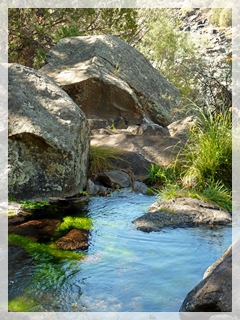
I asked the Lord for help, and he answered me. He saved me from all that I feared. … Examine and see how good the Lord is. Happy is the person who trusts him. [Psalm 34:4,8 (NCV)]

Copyright ©2016 jsjdevotions. All rights reserved.

THE LORD WHO HEALS

He said, “If you will listen carefully to the voice of the Lord your God and do what is right in his sight, obeying his commands and keeping all his decrees, then I will not make you suffer any of the diseases I sent on the Egyptians; for I am the Lord who heals you.” [Exodus 15:26 (NLT)]

TAOS, NMJehovah Rapha, the “Lord who Heals You,” was the name of God proclaimed to the Israelites through Moses at Marah. Indeed, a God who could make the blind see, the lame walk, the lepers clean and raise Lazarus from the dead can heal any physical ailment.
Jehovah Rapha, however, doesn’t limit His healing to physical ailments; He can heal our emotional and spiritual brokenness as well. God made known this name of His as the Israelites were camped at Marah. For three days, they’d traveled in the desert without finding any water. When they arrived at Marah, the exhausted and thirsty group was disappointed to find the water undrinkable because of its bitterness. When Moses cried out to the Lord, God had him throw a piece of wood into the water to make it sweet. The Lord who Heals took the bitter out of the Israelites’ water and made it palatable.

Our Christian creeds speak of the resurrection of the dead and, in this Easter season, we often speak of Christ’s resurrection. As we sang out the words to “Resurrecting” last Sunday, I realized we don’t have to physically die to be dead. Bitterness, anger, shame, fear, depression, loss of faith and guilt can poison our hearts and take away life. We still may be breathing but we’re dead inside. The God who Heals, Jehovah Rapha, can take our ailing embittered hearts and restore them to health. As He did with the water at Marah, He can take poison and make it palatable. The Lord who Heals can transform the bitter in our lives into something bearable.

Jehovah Rapha, thank you for your healing grace. Take my brokenness—the dead and bitter parts of my life—and make them sweet. Resurrect me, dear Lord.

By Your spirit I will rise From the ashes of defeat
The resurrected king Is resurrecting me
In Your name I come alive To declare your victory
The resurrected king Is resurrecting me.
[“Resurrecting” (Elevation Music- Brown, Brock, Ntlele, Furtick and Joye)]

Praise the Lord! … He heals the brokenhearted and bandages their wounds. [Psalm 47:1,3 (NLT)]

“My wayward children,” says the Lord, “come back to me, and I will heal your wayward hearts.” “Yes, we’re coming,” the people reply, “for you are the Lord our God. [Jeremiah 3:22 (NLT)]

Copyright ©2016 jsjdevotions. All rights reserved.

THE IMPOSSIBLE

He replied, “What is impossible for people is possible with God.” [Luke 18:27 (NLT)]

For we live by believing and not by seeing. [2 Corinthians 5:7 (NLT)]

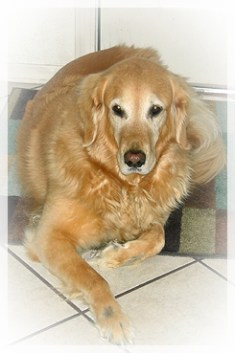
golden retriverWe’d taken my daughter and grand-daughter to a magic show and both my husband and grand had participated in two rather impressive illusions. On the way home, we three adults tried to figure out how each trick had been done. We explored various scenarios that might explain how the $50 bill with my husband’s signature on it ended up in the middle of an uncut orange, in a paper bag, and in a locked box that was in another locked box across the stage. We also tried to figure out how the magician used an elaborate series of mathematical calculations to know the age of our grand’s dog in dog years. (The dog, not there and being 105 in dog years, was most definitely not your average dog.) While we pondered various scenarios, my grand piped up, “Stop trying to figure it out. It was magic!”  While it was an entertaining show, we know it wasn’t magic; it was just a carefully orchestrated and well-executed series of tricks. Nevertheless, we continued to want to know how each had been done. There is something about us all that wants to make sense of that which makes no sense. Sometimes, however, that can’t be done.

While God doesn’t want unthinking believers, in the end, we finally come to him out of faith, not logic. We come without seeing the Holy Spirit descend like a dove from heaven, without seeing Him walk on water, and without seeing the scars or touching the wounded hands. A virgin giving birth to a God/man, an empty tomb, and a resurrected body that ascended into heaven all defy human logic. Sleight of hand, however, did not turn water into wine, raise Lazarus from the dead, heal lepers, or feed thousands. Sleight of hand did not hold back the Red Sea, multiply one widow’s food and another’s oil, cause the sun and moon to stand still, provide manna from heaven, or keep three men from burning in a fiery furnace. Sleight of hand did not place Esther in Xerxes’ palace exactly when she needed to be there, it did not cause both Elizabeth’s and Hannah’s wombs to open, nor did it cause Paul to become blind. Much in the Bible defies the rules of the world as we know it; we can’t fathom how it could have happened much less how it was done. There are some things in the Bible that simply make no sense in our limited world.

One of the greatest minds of our generation is Stephen Hawking, an English theoretical physicist, cosmologist and avowed atheist who believes the universe is governed by the laws of science. “One of the basic rules of the universe is that nothing is perfect. Perfection simply doesn’t exist,” he says. Well, Hawking is wrong. Perfection did exist, in the person of Jesus of Nazareth. A world limited by human understanding, however, can’t accept the reality of God incarnate. Just because it defies our logic, however, doesn’t mean it didn’t happen. Perhaps the fault lies in our inadequate reasoning and not our belief.

I will still try to figure out any magician’s tricks (out of earshot of my grand), but I won’t try to find human logic and reasoning in the way God works. He’s God; He has His own set of rules and those rules are unlimited—time can stand still, water can flow uphill, and what goes up does not necessarily come down. “There’s no way he can do that!” is only true when we are speaking of men. Remember, with God, all things are possible.

The basic laws of the universe are simple, but because our senses are limited, we can’t grasp them. There is a pattern in creation. If we look at this tree outside whose roots search beneath the pavement for water, or a flower which sends its sweet smell to the pollinating bees, or even our own selves and the inner forces that drive us to act, we can see that we all dance to a mysterious tune, and the piper who plays this melody from an inscrutable distance—whatever name we give him—Creative Force, or God—escapes all book knowledge. [Albert Einstein]

Oh, how great are God’s riches and wisdom and knowledge! How impossible it is for us to understand his decisions and his ways! [Romans 11:33 (NLT)]

Then Jesus told him, “You believe because you have seen me. Blessed are those who believe without seeing me.” [John 20:29 (NLT)]

Copyright © 2016 jsjdevotions. All rights reserved.

WHITER THAN SNOW

“Come now, let’s settle this,” says the Lord. “Though your sins are like scarlet, I will make them as white as snow. Though they are red like crimson, I will make them as white as wool. [Isaiah 1:18 (NLT)] 

The next day John saw Jesus coming toward him and said, “Look! The Lamb of God who takes away the sin of the world! [John 1:29 (NLT)]

Steamboat Ski AreaIt’s springtime in the mountains and I’m thrilled to see that it’s snowing. Although I was hoping for at least one more powder day on the mountain, that’s not why I’m pleased. I’m happy because, once again, everything looks pristine and clean. You see, March’s warmer temperatures and sunshine have been busy melting the nearly 300 inches of snow we’ve had this season. As that white stuff gradually disappears, ugliness is uncovered. Hidden under those mounds of snow is four months’ worth of unsightly litter, pollution, exhaust and smoke residue, scoria and gravel. That filthy accumulation is now making its appearance along the roadways. As the snow recedes along the footpaths, it’s not just lost mittens, discarded tissues and cigarette butts that emerge but also the dog dirt and moose and elk pellets from the animals who have ventured onto the trails. As beautiful as springtime in the mountains can be, this ugliness is part of what we call “mud season.” Today’s snow covers it all up again and I can briefly forget the filth hiding beneath it. It’s sort of like sweeping dirt under the carpet or painting over handprints on the wall; although the grime is still there, it doesn’t bother us because it can’t be seen.
As I look out at the snow falling, I think of God’s words in Isaiah that our sins will be “white as snow.” Although the snow falling outside merely conceals the dirt, God’s grace washes that filth away. With God’s forgiveness, when the snow melts, no grime will remain. Instead of hiding the dirt under the carpet, God vacuums it away and rather than concealing the handprints, He scrubs them until they disappear. Indeed, our sins will be white as new snow!

Thank you, dear Jesus, for the cleansing power of your blood; thank you for taking away the sins of the world.

Have you been to Jesus for the cleansing power?
Are you washed in the blood of the Lamb?
Are you fully trusting in His grace this hour?
Are you washed in the blood of the Lamb?
Lay aside your garments that are stained with sin
And be washed in the blood of the Lamb.
There’s a fountain flowing for the soul unclean.
O, be washed in the blood of the Lamb!
[Are You Washed in the Blood?” by Alan Jackson]

Purify me from my sins, and I will be clean; wash me, and I will be whiter than snow. [Psalm 51:7 (NLT)]

Copyright ©2016 jsjdevotions. All rights reserved.

BEATITUDES AND ATTITUDES

Blessed are the poor in spirit, for theirs is the kingdom of heaven. Blessed are those who mourn, for they will be comforted. Blessed are the meek, for they will inherit the earth.  Blessed are those who hunger and thirst for righteousness, for they will be filled. Blessed are the merciful, for they will be shown mercy. Blessed are the pure in heart, for they will see God. Blessed are the peacemakers, for they will be called children of God. [Matthew 5:3-9 (NIV)]

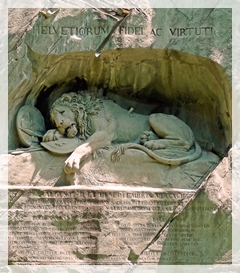
Lion Monument - Lucerne I don’t know about you, but I’m about ready to unplug the televisions until after the elections in November. It doesn’t matter which party or which candidate, the conduct and rhetoric has become nearly unbearable. Today’s Bible reading took me to Matthew 5 and the Beatitudes—those declarations of blessedness given by Jesus at the beginning of His Sermon on the Mount. I couldn’t help but contrast His words with the behavior of our politicians, their supporters and the news media. I then remembered A.W. Tozer’s observation that, if we were to take the Beatitudes and turn them inside out, we’d have the “very qualities which distinguish human life and conduct.”

Our society doesn’t seem to admire those who are modest and meek; we seem to prefer those filled with bombast and swagger. Rather than grief and heartache at our failures, we prefer witticisms, applause and celebration of our successes. Rather than meekness, humility and respectful behavior, we seem to favor assertiveness and pretentiousness. Instead of seeking justice, we pursue self-interest; instead of striving to rectify wrongs, intolerance seems to reign. Rather than compassion, there is indifference and vindictiveness instead of forgiveness. Deceit, guile and vulgarity are more prevalent than frankness, honesty, and morality and it appears that we admire instigators and agitators more than conciliators and negotiators.

Although there has been a large amount of condemnation, disparagement and attempts to discredit one another, I don’t think Jesus was thinking about that sort of mocking and persecution when he gave His message and I doubt that God is blessing anyone for their abysmal behavior just because it results in their disgrace or embarrassment. If we expect blessings for persecution, it should be for following Jesus and righteousness sake and not for pursuing power and self-righteousness.

Pride, greed, selfishness, arrogance, ruthlessness, dishonesty, bickering, and meanness—all of these are contrary to the Beatitudes. I admit that I need to remove the plank in my eye before criticizing the specks in the eyes of others and confess that much of my life is also spent on the opposite side of the Beatitudes. I imagine a part of your life is spent there as well. Let us never forget that Jesus’s words were neither His suggestions nor His opinions—they were and are God’s Truth.

Lord…Deliver me from the urge to compete with another for place or prestige or position. … Deliver me from pose and pretense. Forgive me for thinking of myself. Help me forget myself and find my true peace in beholding Thee. That Thou mayest answer this prayer I humble myself before Thee. Lay upon me Thy easy yoke of self-forgetfulness that through it I may find rest. [A.W. Tozer]

Blessed are those who are persecuted because of righteousness, for theirs is the kingdom of heaven. Blessed are you when people insult you, persecute you and falsely say all kinds of evil against you because of me. [Matthew 5:10-11 (NIV)]

Copyright ©2016 jsjdevotions. All rights reserved.

WINTER JOY

Can anything ever separate us from Christ’s love? Does it mean he no longer loves us if we have trouble or calamity, or are persecuted, or hungry, or destitute, or in danger, or threatened with death? [Romans 8:38 (NLT)]

Steamboat Ski Area

As I stepped off the plane into biting wind and blowing snow, the shock of the bitter cold took my breath away. Having started the day at a balmy 70 plus degrees, I wanted to turn around, get on the plane and go back to where I’d been. The plane, however, wasn’t returning that night so neither was I. As I trudged across the tarmac, I questioned my sanity in leaving the warmth of southwest Florida for a stay in our Colorado home.

That first night in the mountains, I just wanted to go back. Once I traded my t-shirt for layers of fleece, my shoes for insulated boots, and my light jacket for a heavy parka, however, things improved. Once I saw the beauty in the aspens’ glistening hoarfrost, strapped on my snowshoes and enjoyed the snow instead of cursing it, and once I’d taken my first ski run down the mountain and embraced the wintery world in which we’ll live for the next two months, my attitude changed. Once I’d accepted and adjusted to where I was, I found joy in my surroundings.

We made the deliberate choice to spend part of our winter in the cold and snow but, sometimes, life drops us off in cold dark places not of our choosing. We end up at the funeral home, principal’s office, police station, or in the ICU. We find ourselves in cardiac rehab, divorce court, an Al Anon meeting, or across from an unsympathetic loan officer or angry boss. Bills pile up, loved ones get sick, tornadoes hit, accidents happen, children get in trouble, and dreams disappear. When those times occur, we want to turn around and go back to the way it was before—before sickness, bankruptcy, death, betrayal, or unemployment. God, however, does not offer return tickets to the land of before.

Several years ago, it felt like God left me in a cold dark place and I longed for the time before—before any of the bad happened, a time when everyone seemed happy and life was good. There was no going back, however, and it was fruitless to yearn for what had been but was no more. By trusting in God and His purpose, I surrendered my circumstances to him. Along with my tears were prayers and, with His guidance, I eventually adjusted my behavior, changed my expectations, stopped yearning for the before and looked with hope to the after. As for the after—while different, it’s possibly even better than the before! Granted, it didn’t happen overnight and it took more than wearing wool socks and long johns to get to a place of acceptance. It happened when I stopped asking God “Why” and started asking Him “What do you want me to learn from this?” It happened when I managed to find reasons for gratitude in even the darkest place. Eventually, out of the pain came not just acceptance but joy.

At some time or another, we all end up in cold dark places and enter a winter time for our souls. We need to find a way, not just to survive them, but to thrive in them. To do that, we must trust in the Apostle Paul’s words that while not everything that happens is good, God will bring good out of whatever happens. As difficult as that sounds, God will open our eyes to the good in the bad and we’ll find a way to have joy in all circumstances.

Thank you, God, for taking the broken pieces of our lives and putting them back together so they are stronger. Thank you for taking the cold winters of our souls and shining your love and light upon them, warming our hearts and enabling us to once again face life with joy.

And we know that God causes everything to work together for the good of those who love God and are called according to his purpose for them. [Romans 8:28 (NLT)]

Whatever happens, my dear brothers and sisters, rejoice in the Lord. [Philippians 3:1a (NLT)]