WHAT IS ENOUGH?

After all, we brought nothing with us when we came into the world, and we can’t take anything with us when we leave it. So if we have enough food and clothing, let us be content. But people who long to be rich fall into temptation and are trapped by many foolish and harmful desires that plunge them into ruin and destruction.  [1 Timothy 6:7-9 (NLT)]

squirrel

The Bible is filled with stories of God’s provision for his people’s needs. In spite of their complaints about God’s provision, the Israelites never went hungry during their forty year journey. When Elijah was hiding from Jezebel during a time of drought and famine, he was fed by ravens. In Zarephath, God provided Elijah, the widow and her son with enough flour and oil to feed the three of them for three years! Later, God provided Elijah with food enough to sustain him during a forty day journey to Mt. Sinai. Sometimes, God even blesses us with even more than enough, as He did when thousands were fed with a boy’s lunch and several baskets of leftovers remained.

While we may receive more than we need, God doesn’t promise a surplus. Elijah and the widow didn’t have excess flour and oil with which to open a bakery and, if the Israelites tried to squirrel away their manna for anything but the Sabbath, it spoiled and got maggots. Just enough was exactly what God wanted them to have and what He gave them—no more and no less.

The problem for us is that mankind’s concept of “enough” isn’t the same as God’s; David is a perfect example of that weakness. Most of us would think David, the shepherd boy who became a hero and king, had more than enough. He possessed Saul’s entire kingdom and wealth, lived in a palace, and had seven wives along with an unknown number of concubines. Enough was no longer enough, however, once David laid eyes on Bathsheba. Solomon, with his 700 wives and 300 concubines and 25 tons of gold a year, never seemed to think he had enough either!

When is enough enough? God knows, but we don’t. Adam and Eve had all of Eden with the exception of the fruit of one tree, but that wasn’t enough for them! Whether it’s money, friends, time, status, opportunities, jewelry, health, strength, wisdom, or faith—we probably think we don’t have quite enough of something. Whatever it is, we’re sure that if God would just give us a smidgen more of it, then we’d be satisfied. Of course, we wouldn’t because, like Solomon, David, Adam and Eve, we’d want more than enough!

If we’re seeking the Kingdom of God and following God’s plan, He will make sure we have enough and all the resources we need. We may not see it but, if we dig deep enough, we’ll find that God has given us exactly what we need to do His work. If we’re seeking the Kingdom of Self, however, we’ll never be satisfied that we have enough.

Do you have enough?

And this same God who takes care of me will supply all your needs from his glorious riches, which have been given to us in Christ Jesus. [Philippians 4:19 (NLT)]

Seek the Kingdom of God above all else, and live righteously, and he will give you everything you need. [Matthew 6:33 (NLT)]

Copyright ©2020 jsjdevotions. All rights reserved.

PATIENCE

In that day the people will proclaim, “This is our God in whom we trust, for whom we waited. Now at last he is here.” What a day of rejoicing! [Isaiah 25:9 (TLB)]

Come, Thou long expected Jesus Born to set Thy people free;
From our fears and sins release us, Let us find our rest in Thee. [Charles Wesley]

giftMy daughter has become quite adept at hiding Christmas gifts from her husband. If she doesn’t, he will find the presents and open them early; patience is not one of his strong suits. It wasn’t one of Sarah and Abraham’s either. Although they’d been promised a son and many descendants, they grew impatient waiting and took matters into their own hands. Sarah gave Abraham her maidservant Hagar with whom to make a child. Although she made the offer, he didn’t have to accept—but he did. The boy Ishmael was the result of their rashness and the rivalry and strife that continue today in the Middle East came from that impatience. Like Sarah and Abraham, when my son-in-law knows a gift is coming, he just can’t wait until the correct time to receive it. Fortunately, while his wife may get annoyed when he takes matters into his own hands, his impulsiveness hasn’t resulted in centuries of international conflict.
Consider the people of Judah—they’d waited centuries for God’s promise to be fulfilled with the Messiah and most of them completely missed their gift. Tired of waiting, some lost faith and hope; they stopped looking for Him. Having anticipated royalty rather than an itinerant preacher, others didn’t recognize Him. Wanting someone to conquer Rome rather than sin, still others didn’t accept Him. Fortunately, my son-in-law isn’t like that. Even when he’s unsuccessful in his search for the gift, he never gives up. He knows it eventually will appear. Moreover, unlike the Judeans, he won’t ignore the package if it isn’t wrapped in fancy paper with an elaborate bow or reject it because it doesn’t fit his expectations.

David had to wait for God’s promise to materialize but, unlike Like Sarah, Abraham, and Judah, he waited patiently and never gave up hope. After being anointed by Samuel, he had to wait about fifteen years until being crowned king. He didn’t spend that time trying to force his kingship to happen nor did he sit idly and twiddle his thumbs impatiently. He wisely trusted God. The shepherd boy used his waiting time to prepare for the challenges of kingship by growing physically, intellectually, and spiritually so he was ready to receive his crown when God gave it to him.

Unlike David, Sarah, Abraham, and the Jews, my son-in-law knows exactly when his Christmas gifts will arrive—December 25! Unfortunately, when waiting on God to act, we rarely have a calendar marked with His delivery date and we certainly don’t know the date of Christ’s return. Needing patience, we can’t be like Sarah and Abraham who tried to make things happen before the appointed time. Needing faith, we can’t be like the Jews who stopped looking and believing in God’s promised provision. Instead, we must be like David who waited with patience and faith while readying himself for the receipt of God’s promised provision.

When He returns is not as important as the fact that we are ready for Him when He does return. [A.W. Tozer] 

Don’t be impatient. Wait for the Lord, and he will come and save you! Be brave, stouthearted, and courageous. Yes, wait and he will help you. [Psalm 27:14 (TLB)]

Copyright ©2020 jsjdevotions. All rights reserved.

WAITING WITH HOPE

Then everyone will see the Son of Man coming on the clouds with great power and glory. And he will send out his angels to gather his chosen ones from all over the world—from the farthest ends of the earth and heaven. [Mark 13:26-27 (NLT)]

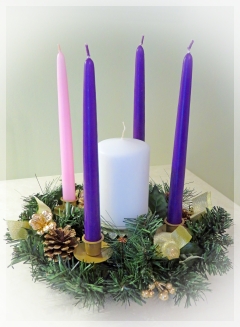
advent wreathIt’s less than a month until Christmas. This Christmas will be vastly different from past ones for us as I imagine it will be for you. Traditionally, our holiday season has been a busy and festive one of concerts, friends, church, fellowship activities, volunteering, entertaining, and family but being in the midst of a pandemic has changed all that. In an attempt to keep the spirit of Christmas alive in what has been a dreary and disappointing year, I’ve started decorating for the holiday and playing Christmas music. Christmas, however, is more than decorations, carols, presents, parties, and peppermint bark. Perhaps not having all of the fun-filled extras of this season will help us focus on its true meaning.

When I was young, I always had a special Advent calendar with a nativity scene and 24 little numbered “windows.” Starting December 1, I opened a window every day to find a special picture or Bible verse that helped tell the Christmas story. Advent, however, isn’t just a way to count down the days until Christmas. In the 4th and 5th centuries, the season of Advent wasn’t about Christmas at all. Lasting 40 days, it was a season of penance, prayer, and fasting in preparation for the baptism of new believers on the Feast of Epiphany (January 6). By the 6th century, Advent was tied to the coming of Jesus—but not His first arrival in Bethlehem. Coming from the Latin adventus, meaning “coming,” Advent was about Christ’s second coming—when the one who arrived as a lamb would return as a triumphant lion. It was not until the Middle Ages that four Sundays became Advent’s length and the season was linked to both Christ’s first and second comings along with His presence among us through the Holy Spirit.

Although the custom of an Advent wreath began with Lutheran and Roman Catholic families in 16th century Germany, it didn’t spread to churches until three centuries later. The wreath is a circle of evergreen branches; its circular shape, with no beginning or end, symbolizes the immortality of the soul and God’s promise of eternal life through Jesus Christ. Four candles, representing the four weeks of Advent, are arranged around the wreath; sometimes, a fifth candle is in its center. A new candle is lit on each of the four Sundays leading up to Christmas with the fifth candle lit on Christmas.

The season of Advent begins this Sunday and, while COVID-19 keeps us from our liturgical church and its Advent wreath ritual, it can’t prevent us from observing Advent at home. We will read the pleas for a savior found in Isaiah 60 and Psalm 80, Jesus’ words about His return in Mark 13, and Paul’s assurance that Jesus will return in 1 Corinthians 1. While it doesn’t seem Christmassy to read about Jesus’ return before He’s appeared in Bethlehem, these readings are reminders that ours is an in-between time—a time between Jesus’s first arrival and His final return. After the readings, we’ll light the first candle on our Advent wreath: the candle of hope, often called the “prophecy candle.” We’ll say a prayer of thanksgiving for the gift of hope that came with the Messiah. This first candle will remind us that we wait with hope for His return: for the time when Satan is defeated, God’s final judgment occurs, all things are made new, and all of God’s promises come true! May the candle of hope stay lit in our lives!

Let us be alert to the season in which we are living. It is the season of the Blessed Hope, calling for us to cut our ties with the world and build ourselves on this One who will soon appear. He is our hope—a Blessed Hope enabling us to rise above our times and fix our gaze upon Him. [A.W. Tozer]

However, no one knows the day or hour when these things will happen, not even the angels in heaven or the Son himself. Only the Father knows. And since you don’t know when that time will come, be on guard! Stay alert! … Don’t let him find you sleeping when he arrives without warning. I say to you what I say to everyone: “Watch for him!” [Mark 13:32-33,36-37 (NLT)]

Copyright ©2020 jsjdevotions. All rights reserved.

MAYIM CHAIM

On that day life-giving waters will flow out from Jerusalem, half toward the Dead Sea and half toward the Mediterranean, flowing continuously in both summer and winter. And the Lord will be king over all the earth. On that day there will be one Lord—his name alone will be worshiped. [Zechariah 14:8-9 (NLT)]

Is anyone thirsty? Come and drink—even if you have no money! Come, take your choice of wine or milk—it’s all free! … Seek the Lord while you can find him. Call on him now while he is near. [Isaiah 55:1,6 (NLT)]

from hanging lake, coloradoLiving in a country where clean water readily flows out of a faucet, we don’t fully understand the concept of “living water” or mayim chaim. Ancient Israel was an arid land where fresh water was precious. Because it only rained a few months of the year, rain was stored in cisterns and grew stagnant. In contrast, living water came directly from God either by rain or a natural spring. Unlike sea water and the hypersaline Dead Sea, which looked refreshing but were poisonous and made the surrounding land barren, mayim chaim brought life. Throughout Scripture, “living water” was associated with God.

During the harvest festival of the Feast of Booths (Hag Sukkot), the Jews were called to remember God’s providential care for them during the forty years of wandering in the wilderness before coming to the Promised Land. God commanded Israel to observe this festival by leaving their homes and living in temporary shelters (sukkot) as they had done during the exodus.

By the time of Jesus, several rituals had been added to enrich the celebration. As a way of remembering the water God supplied when Moses struck the rock with his staff, the Hoshana Rabbah (meaning “please save”) was performed on the last day of the feast. With great ceremony, the priests filled a golden container with water from the pool of Siloam, brought it to the Temple, and circled the altar seven times. Prophecies from Ezekiel 47 and Zechariah 14 were read and, after three trumpet blasts, the priests poured out the water.  The water spilling onto the ground signified God’s salvation through water and the prophets’ promises that, in the time of restoration, rivers of living water would flow from the temple and Jerusalem. As the water poured down, words from Psalm 18:25-26 were chanted: “Please Lord, save us …. Bless the one who comes in the name of the Lord.”

It was on the last day of Sukkot, when the courts of the Temple would have been packed with people, that Jesus stood and shouted to the crowds: “Anyone who is thirsty may come to me! Anyone who believes in me may come and drink! For the Scriptures declare, ‘Rivers of living water will flow from his heart.’”[John 7:37-38] Whether Jesus spoke while the priests poured out the water, during the chanting of “Save Us,” or while people dismantled their shelters, we don’t know but the connection between this ceremony and Jesus’ declaration that He was the living water caused a tremendous disturbance. Referring to the Spirit and eternal life rather than drinking water, Jesus was claiming to be the Messiah.

Some of those who heard Jesus’s words thought Him to be the Messiah. Others, knowing the prophecies but not knowing His birthplace, argued Jesus couldn’t be the Messiah since He wasn’t born in Bethlehem. Some believed Him to be a prophet and others wanted Him arrested for blasphemy. Indeed, if Jesus hadn’t been the Messiah, His words would have been blasphemous.

When Jesus spoke that day, He was repeating God’s invitation to salvation found in Isaiah 55. By saying that rivers of living water flowed from Him, Jesus’ words fulfilled all that the Festival of Booths signified. As the mayim chaim, Jesus would satisfy people’s thirst for God.

Jesus replied, “Anyone who drinks this water will soon become thirsty again. But those who drink the water I give will never be thirsty again. It becomes a fresh, bubbling spring within them, giving them eternal life. [John 4:13 (NLT)]

With joy you will drink deeply from the fountain of salvation! [Isaiah 12:3 (NLT)]

Copyright ©2020 jsjdevotions. All rights reserved.

RICH AND HEALED

For I know the plans I have for you,” declares the Lord, “plans to prosper you and not to harm you, plans to give you hope and a future. [Jeremiah 29:11 (NIV)]

And everyone who has left houses or brothers or sisters or father or mother or wife or children or fields for my sake will receive a hundred times as much and will inherit eternal life. [Matthew 19:29 (NIV)]

white peacock butterflySo, since God wants us to be prosperous, we’ll get 100 acres of land for every acre we give up or a return of $10,000 for every $100? Sounds too good to be true and it is. Logic tells us Matthew 19:29 can’t be taken literally—we can’t have one hundred fathers and none of us want one hundred children or wives! To make sure the disciples understood, Jesus made it clear that God is not our heavenly banker who dispenses gifts (especially monetary ones) to the most deserving with His parable of the Gracious Landowner. “Do I not have the right to do what I want to do with my own money? Does your eye make you want more because I am good?” asked the landowner. Jesus explained: “So those who are last will be first and the first will be last.” [Matthew 20:15-16] His message was clear: God’s grace can’t be earned or controlled. Moreover, the word often translated as “prosper” in Jeremiah 29:11 is shalom, meaning completeness, soundness, welfare, and peace rather than wealth. Biblical prosperity and prosperity theology are not the same!

Nevertheless, the health and wealth/name it and claim it/prosperity gospel movement would have us believe otherwise. Their distorted version of the gospel asserts that our words and actions can influence God with some sort of faith force so that we’ll get the health and wealth supposedly promised in today’s verses and others like it. Things like illness and financial troubles result from a lack of faith. If we just picture what we want, have enough faith, and ask for it in Jesus’ name, it’s ours! Thinking that we can somehow manipulate God to do our bidding, however, denies His sovereignty and God becomes more a heavenly vending machine than the ruler of the universe. Our hope is not in the power of our words or size of our faith; our hope is in the power of God alone!

 While we’d like the think that all we need for health and wealth is faith, Scripture tells us otherwise. Not everyone who deserved healing got it while some who didn’t deserve it did! Out of all the sick, blind, and lame people by the pool at Bethesda, Jesus asked just one man if he wanted to get well. Instead of answering the question, the man complained. Nevertheless, when Jesus told him to get up, pick up his pallet, and walk, the man was healed instantly. Censured by the Jewish leaders for carrying his mat on the Sabbath, he explained that he’d been told to do so by the man who healed him—a man whose identity he didn’t know! This sinner, who didn’t know Jesus, have faith in Him, and never asked for healing, was restored to health while the “thorn” in Paul’s flesh remained in spite of his faith, service, and devout prayers!

The gospels and epistles give us more guarantees of suffering and persecution than promises of health or wealth. Rather than a get rich plan, our sovereign God offers a plan for salvation. Our relationship with God is not a business transaction and giving us stuff or taking away our illness is not what makes Him good. God is good because He alone is God. He’s good whether we’re sick or healthy, in debt or flush with money, out of work or gainfully employed, infertile or pregnant, struggling in school or on the honor roll, have a child in rehab or one in seminary. God is good because, in Jesus, we are both rich and healed!

If you have everything but you don’t have Jesus. You have nothing. If you have nothing but you have Jesus, you have everything. He’s worth it. [Costi Hinn]

For you know the grace of our Lord Jesus Christ, that though he was rich, yet for your sake he became poor, so that you through his poverty might become rich. [2 Corinthians 8:9 (NIV)]

And my God will meet all your needs according to the riches of his glory in Christ Jesus. [Philippians 4:19 (NIV)]

Copyright ©2020 jsjdevotions. All rights reserved.

ABIDE

Abide in me, and I in you. As the branch cannot bear fruit by itself, unless it abides in the vine, neither can you, unless you abide in me. I am the vine, you are the branches. He who abides in me, and I in him, he it is that bears much fruit, for apart from me you can do nothing. [John 15:4-5 (RSV)]

cardinal - maleThe Apostle John used the word menó 53 times in his gospel and epistles. Frequently translated as abide, menó originally referred to the staying power of an army that is not driven from the battlefield. Meaning “to stay, remain, reside or stand fast,” menó came to imply an unbroken friendship or a continuous fellowship.

When guests come to visit, I often welcome them by saying, “My home is your home!” but I really don’t mean it. Even with the best guests, there are boundaries. While I want them to be comfortable, I don’t want them rearranging my kitchen cabinets, going through my closets, looking in my junk drawer, reading my files, or borrowing my shoes. Although my guests stay with me for a while, they don’t abide with me the way John or Jesus used the word. Abiding isn’t coming for a long weekend or spring break; it is moving right in and becoming part of the household permanently. Recalling the battlefield origins of menó, abiding is staying together even in difficult conditions: standing fast in the face of an assault.

When Jesus abides in us, He permanently moves right into our hearts and lives. No room is off limits, no drawer or cupboard is locked, no habits concealed, and no secrets remain buried. Unlike a guest who might stay too long or leave at the first sign of trouble, Jesus never wears out His welcome. Moreover, He remains in times of distress, danger, temptation, and discord as well as times of joy, triumph, and cheer.

In Scripture we find a reciprocal nature to this kind of abiding. If Jesus and His word abide in us, we also abide in Him and, if we abide in Him, He abides in us. Early in His ministry, Jesus told the disciples to follow Him but, as he approached the end of His life here on earth, He told them to abide in Him. Instead of trailing behind or imitating Him, He invited his followers to have an intimate relationship with Him. In turn, Jesus promised to abide in them: to make His home in their hearts. Abiding in Jesus means having a continuous fellowship with Him.

Recently, a pastor asked if Jesus was my hotel or home. Do I abide in him or do I come and go? Abiding is a 24/7 relationship as Christ lives out His life through us and we live out our lives through Him! Paul said it this way: “I have been crucified with Christ; it is no longer I who live, but Christ who lives in me; and the life I now live in the flesh I live by faith in the Son of God, who loved me and gave himself for me.” [Galatians 2:20]

Is Jesus welcome only in your guest room or does He run your house? Do you live in Him or is He just where you go when you need a break? Who abides in you and where do you abide?

Abide in Me says Jesus. Cling to Me. Stick fast to Me. Live the life of close and intimate communion with Me. Get nearer to Me. Roll every burden on Me. Cast your whole weight on Me. Never let go your hold on Me for a moment. Be, as it were, rooted and planted in Me. Do this and I will never fail you. I will ever abide in you. [J.C. Ryle]

Whoever confesses that Jesus is the Son of God, God abides in him, and he in God. [1 John 4:15 (RSV)]

Let what you heard from the beginning abide in you. If what you heard from the beginning abides in you, then you will abide in the Son and in the Father. And this is what he has promised us, eternal life. [1 John 2:24-25 (RSV)]

Copyright ©2020 jsjdevotions. All rights reserved.