THE ALARM

Even Gentiles, who do not have God’s written law, show that they know his law when they instinctively obey it, even without having heard it. They demonstrate that God’s law is written in their hearts, for their own conscience and thoughts either accuse them or tell them they are doing right. [Romans 2:14-15 (NLT)]

robinLooking back, I realize we’d heard a chirp once or twice earlier that day but had ignored it. Busy running errands, we’d given the odd sound no thought. At 12:22 AM, however, the source became obvious and could no longer be ignored. The bedroom smoke alarm was chirping loudly every minute or so. I looked at my husband with envy—without his hearing aids, he was oblivious to the annoying noise above our heads. Since there was no way I was going to return to slumber, I woke him and we replaced the battery. Two nights later, when the same thing happened with the brand new battery, we simply took it out and went back to bed. I’m embarrassed to admit we had no battery in that alarm for the next several months. Since 60% of home fire deaths occur in properties without a working smoke alarm, we were foolish to ignore the problem.

Rather than replacing the battery, we actually needed to replace our 15-year old smoke alarms. The U.S. Fire Administration (part of FEMA), suggests replacing smoke alarms every ten years. After a decade, alarm sensors are compromised by dust, insects, contaminants and circuitry corrosion and their failure rate is 30%.

The smoke alarm got me thinking about another alarm we have—conscience. Made in the image of God, we all have an innate understanding of right and wrong, good and evil. Like a smoke alarm, however, its sensors can fail to work properly. Rather than dust or spider webs, things like pride, selfishness, prejudice, materialism, envy, and jealousy can corrode its circuits. Fallible, it can be convinced to condone, excuse, or justify the indefensible, inexcusable, and sinful. By themselves, consciences can be as unreliable as thirty year old smoke alarms (nearly all of which fail).

Fortunately, as Christians, we have something in addition to a conscience—the voice of the Holy Spirit. It is His voice that points us to God’s ways. His presence renews and reshapes our conscience into a much bigger and better alarm—one based on God’s word rather than convenience or objectives. While we can manipulate our conscience into seeing things our way, we can’t sway the Holy Spirit; God’s standards don’t change with the situation or our desires. Moreover, the Spirit’s voice doesn’t stop at determining right from wrong; it convicts us of the need for repentance and change. It’s like the new smoke alarms we now have that interconnect, inform us of the type and location of the danger, and tell us to evacuate. Fortunately, instead of a seven year warranty, the Holy Spirit can last a lifetime!

Our new improved Holy Spirit-powered conscience won’t do us much good if we don’t recognize and heed it. Unless we read God’s word, it’s easy to mistake which voice we’re hearing (ours or the Spirit’s). While gentle and loving, the Spirit’s voice can be brutally honest and, like a smoke alarm, it demands action. When the Psalmist asked God to point out anything He found offensive, he had to expect a truthful answer and one that he might not like. Although we can’t remove the Spirit’s batteries, we can ignore His words of conviction. Like those people without functioning smoke alarms, however, we do so at our own risk.

Let us therefore not deceive ourselves. In walking according to the spirit we shall hear the direction of conscience. Do not try to escape any inward reproach; rather, be attentive to its voice. [Watchman Nee]

Search me, O God, and know my heart; test me and know my anxious thoughts. Point out anything in me that offends you, and lead me along the path of everlasting life. [Psalm 139:23-24 (NLT)]

My conscience is clear, but that doesn’t prove I’m right. It is the Lord himself who will examine me and decide. [1 Corinthians 4: 4 (NLT)]

Copyright ©2018 jsjdevotions. All rights reserved.

FILL ME UP

Jesus replied, “I am the bread of life. Whoever comes to me will never be hungry again. Whoever believes in me will never be thirsty. [John 6:35 (NLT)]

moon at dawnSince he had a business meeting in Switzerland later in the week, my son went to London over the weekend to see his daughter who is in college there. Nearly every photo texted back to us showed my grand eating. Admittedly, she is a starving college student, living on a tight budget, who has grown tired of eating peanut butter, hummus with veggies, Raman noodles, and pasta in her apartment, so she took advantage of having access to her father and his credit card. With Dad paying the bill, she could again eat steak and lamb chops, indulge in gelato, and stock her pantry with fruit, meat, and cheese from Borough Market. As much as this starving coed needed food, what she really needed was a visit from home. Hugs from her father probably offered more nourishment than any amount of food. His visit did more than replenish her cupboards; it recharged her emotional batteries.

Sometimes, we have a hunger that won’t be satisfied by a trip to Whole Foods, Trader Joe’s, or Olive Garden; no amount of food can satisfy spiritual hunger. Rather than having our father visit, take us out to dinner, and fill our grocery bags, we need time with our Heavenly Father so He can fill our hearts and souls.

Last week, early in the morning, my husband asked if I had time for a walk at the beach. “No way!” was my first thought. Having spent several days in preparation for presenting a Bible study that evening, I was way behind in my writing, the bed linens needed changing, the laundry basket was full, and there were enough crumbs on the floor that you literally could eat off it! But, knowing how overwhelmed and spiritually empty I felt, I agreed. Being early risers, we arrived shortly before dawn and the full harvest moon in the west watched over us as the sun rose in the east. Feeling like I had yesterday, today, and tomorrow in the palm of my hand, I was reminded that God really does. In awe, as the moon’s light shimmered on the water while the sky grew pink with the sunrise, I walked in the beauty of God’s creation and felt His peace descend on me. Filled with His grace, I was renewed, refreshed, and restored. Remembering a lovely praise song, I silently sang: “Fill me up, God. Fill me up, God…” As the aroma of bacon wafted from a beach-side restaurant, my stomach reminded me that I hadn’t yet eaten breakfast. Nevertheless, that quiet time with my Heavenly Father sated my spiritual hunger and filled me up in a way that bacon, eggs, and toast never could.

God gave us a weekly Sabbath to rest, relax, restore, and replenish. The Hebrew word sabbat, which we know as Sabbath, comes from the verb sabat which means to stop or cease. The observance of the Sabbath every week was central to the Israelite’s life (and should be to ours) but, sometimes, in our fast-paced world, one day a week is not pause enough. There are times, like that Thursday morning, when we need what Terry Hershey calls a “Sabbath Moment” — a temporary cease-fire from the assault of busyness that so often bombards our lives. It’s a brief turning away from the day’s hustle and bustle to spend time with our Heavenly Father. The Sabbath moment does for us what her father’s visit did for my grand: it feeds and restores us. It fills us up!

More of your spirit is what we need,
More of your annointing,
More of your glory, fill me.
Fill me up God (fill me up God),
Fill me (that’s what I really want). [Will Reagan]

Let them praise the Lord for his great love and for the wonderful things he has done for them. For he satisfies the thirsty and fills the hungry with good things. [Psalm 107:8-9 (NLT)]

Copyright ©2018 jsjdevotions. All rights reserved.

KING OF KINGS

In my vision at night I looked, and there before me was one like a son of man, coming with the clouds of heaven. He approached the Ancient of Days and was led into his presence. He was given authority, glory and sovereign power; all nations and peoples of every language worshiped him. His dominion is an everlasting dominion that will not pass away, and his kingdom is one that will never be destroyed. [Daniel 7:13-14 (NIV)]

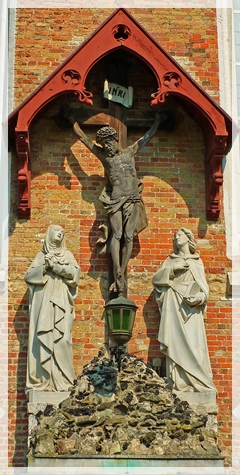
Church of our Lady - Netherlands

As we left the church, my friend asked “What do the letters INRI above the cross mean?” Unable to say it in Latin, I replied that it was an abbreviation of the words, “Jesus of Nazareth, the King of the Jews.” In Latin, these words would be Iesus Nazarenus Rex Iudaeorum. When someone was crucified, it was usual to affix a sign to the cross declaring the cause of execution. Since the official charge against Jesus seemed to be that he’d challenged Roman rule by proclaiming himself the king of the Jews, Pilate had those words written in Latin, Greek and Hebrew. As Pilate phrased it, however, the words seem more of a title rather than an accusation. When the high priests asked that the sign be changed to read “He said, I am the King of the Jews,” Pilate refused.

Other than that dark day when He was crucified and the title “king of the Jews” was used with scorn and mockery by the soldiers and crowd, Jesus was referred to as “king of the Jews” only one other time: at the visit of the Magi when they asked, “Where is the one who has been born king of the Jews?” [Matthew 2:2] While most of Jesus’s countrymen didn’t acknowledge His identity, it was foreigners who recognized his sovereignty at His birth and a Roman governor who acknowledged His kingship at death.

Was Jesus the king of the Jews? A king’s supremacy is limited to his domain. The ruler of a nation, a king’s power is limited by his lifetime and the borders of his kingdom. He must defend his government from enemy nations and his regime from revolution. A king of the Jews would reign only over Judah’s territory and the children of Israel. When asked if He was king of the Jews, Jesus told Pilate that His kingdom was not of this world. Indeed, Jesus’s kingdom wasn’t limited to Judah and the Jews. Unlike earthly kingships, His reign is absolute, unbreakable, sacred, and everlasting. When God raised Jesus from the dead, He was given power over all of creation and all people on earth, not just the Jews of Judah. Pilate’s sign was wrong. Jesus wasn’t the “king of the Jews;” He was and still is the King of kings and the Lord of lords.

They will wage war against the Lamb, but the Lamb will triumph over them because he is Lord of lords and King of kings—and with him will be his called, chosen and faithful followers. [Revelation 17:14 (NIV)]

Copyright ©2018 jsjdevotions. All rights reserved.

IT’S NOT OURS TO KEEP

When the poor and needy search for water and there is none, and their tongues are parched from thirst, then I, the Lord, will answer them. I, the God of Israel, will never abandon them. I will open up rivers for them on the high plateaus. I will give them fountains of water in the valleys. I will fill the desert with pools of water. Rivers fed by springs will flow across the parched ground. [Isaiah 41:17-18 (NLT)]

giant swallowtail butterflyYesterday, I wrote of God’s provision, yet I can’t help but wonder. If God promises His divine provision, why are there still people in need?

There was to be no permanent poverty in Israel. In the Old Testament, we find complex laws and social practices that were meant to ensure that no one lived in need. To eliminate food scarcity, every third year there was to be a special tithe of crops for the Levites and those at risk like foreigners, widows and orphans. The Israelites were to leave the edges of their fields unharvested and anything dropped during the harvest ungathered; this portion could be gleaned by the poor. There were laws against exploiting the vulnerable through usury or by demanding unreasonable collateral. Every seventh year was to be a Sabbath year when loans were forgiven and Hebrew slaves were released from servitude. The land would lay fallow and any produce that grew by itself was free to all. Additionally, in the Year of Jubilee, celebrated every fifty years, economic disparity was further minimized by returning all real estate (whether sold, mortgaged or leased) to its original owner.

The poor in the Bible were not much different than today’s poverty-stricken: the people without land or the economic, legal, or political resources to be self-sustaining. A diverse group of the marginalized, they were day laborers, subsistence farmers, indentured slaves, beggars, prostitutes, widows, resident aliens, the disabled and infirm. God’s vision wasn’t a welfare state but rather one that allowed families to have the opportunity to provide for themselves. The Sabbath and Jubilee years were a fresh start for those who found themselves in poverty. Unfortunately, the reproachful words of the prophets to Judah and Israel tell us that God’s laws were not obeyed.

The story is told of two businessmen. Like me, the first was troubled by the abject poverty that exists in the world today and wondered about God’s promise of provision. He said, “Someday, I hope to ask God why He allows poverty, famine, and injustice when He could do something about it.” The other man replied, “I’m afraid that God might ask me that very same question.”

Perhaps God has fulfilled His promise to provide by filling our wells with blessings. The problem is that we haven’t done our part by passing along His provision. Instead of letting His gifts flow through us to others, we’ve plugged the pipeline and are keeping His gifts for ourselves. We’ve been freed from the Old Testament laws but we haven’t been freed from the obligation to love our neighbors. Could we be holding the provision that God has promised? Could we be the answer to someone’s prayer? For those of us with water in our wells, perhaps it’s time turn on the faucet and let His blessings flow.

We are not cisterns made for hoarding, we are channels made for sharing. [Billy Graham]

We know what real love is because Jesus gave up his life for us. So we also ought to give up our lives for our brothers and sisters. If someone has enough money to live well and sees a brother or sister in need but shows no compassion—how can God’s love be in that person? Dear children, let’s not merely say that we love each other; let us show the truth by our actions. [1 John 3:16-18 (NLT)]

Copyright ©2018 jsjdevotions. All rights reserved.

FREE TO BE…

I form the light, and create darkness: I make peace, and create evil: I the Lord do all these things. [Isaiah 45:7 (KJV)]

sunflowerWow! Now there’s a troubling verse. God creates evil? Since evil is anything that contradicts God’s holy nature, it’s hard to understand how that could happen. Even other translations like the NLT’s, “I send good times and bad times,” the ESV’s, “I make well-being and create calamity,” and the NIV’s, “I bring prosperity and create disaster,” don’t make this verse sound much better. How do we reconcile a God who is good, a God who is love, with a God who says he creates evil?

There’s certainly no mention of God creating evil in Genesis. We are told that He created the world and everything in it, that man was made in His own image, and when God was finished, He looked over everything and saw that it was good. This is where we again see the flexible nature of Hebrew verbs in Scripture. As discussed yesterday, many verbs such as create, harden, send, blind, or deceive are used in a permissive sense as well as a causative one. As a result, we frequently find God represented as doing something when, in actuality, He is only permitting it or predicting that it will be done. Reading it that way, God didn’t create evil but He does allow it. Nevertheless, how can a righteous, just, and loving God even allow evil?

Our being made in God’s image means that, like Him, we have intelligence, reason and the ability to make conscious choices. Personal volition means that we have a choice as to whether or not we love and obey God. When God gave us the ability to choose, He also gave us the responsibility to choose well. Adam and Eve didn’t choose wisely when they ate the forbidden fruit and we’re not much better. While we can choose obedience over rebellion or love over hate, we also can choose deception instead of truth or vindictiveness rather than forgiveness. Because God allows us to choose, we can abandon good for evil as easily as we can close our eyes to His light, shut our ears to His truth, and harden our hearts to His love. C.S. Lewis pointed out that “If a thing is free to be good it’s free to be bad. And free will is what made evil possible.”

Knowing we’d mess up by the third chapter in Genesis, why did our omniscient God allow us freedom to go against His will? Yet, if He compelled us to be obedient, wouldn’t He be more a puppet master than a God of love? Without freedom of choice, would we be unique individuals, made in His image, or marionettes moving only when He pulled the strings? A relationship must be voluntary to be authentic and love must be freely given to be genuine. God didn’t create evil but He did create a people who can rebel and turn from righteousness and it is that rebellion that creates evil.

I don’t understand it completely; someday, I will. I do know that our good and loving God has a good reason for allowing evil to exist. I also know that God can use evil for our good and His glory; after all, from man’s rejection and murder of His only Son, came our salvation!

If a thing is free to be good it is also free to be bad. And free will is what has made evil possible. Why, then, did God give them free will? Because free will, though it makes evil possible, is also the only thing that makes possible any love or goodness or joy worth having. [C. S. Lewis]

For God so loved the world, that he gave his only begotten Son, that whosoever believeth in him should not perish, but have everlasting life. For God sent not his Son into the world to condemn the world; but that the world through him might be saved. … And this is the condemnation, that light is come into the world, and men loved darkness rather than light, because their deeds were evil. [John 3:16-17,19 (KJV)]

Copyright ©2018 jsjdevotions. All rights reserved.


BLOOD AND GUTS

For the life of the body is in its blood. I have given you the blood on the altar to purify you, making you right with the Lord. It is the blood, given in exchange for a life, that makes purification possible. [Leviticus 17:11-12 (NLT)]

sacred daturaFor most of us, the meat we purchase arrives at the grocery store prepackaged. We’re not used to seeing animals slaughtered, skinned or butchered and, unless we’re phlebotomists, rarely see large amounts of blood. As a result, much of Leviticus makes for rather gory reading since the temple, a place of worship, also served as a ritual slaughterhouse. Perhaps it’s my vegetarian sensibilities but, when the Bible refers to the pleasing aroma of sacrifice, I wince when thinking of the stench of dried blood and burnt meat.

Biblical sacrifices go as far back as Cain and Abel but it is in Leviticus that we read of the sacrifices God required of the Israelites. The book gives complicated instructions for each of the sacrificial rituals: everything from the kind of animal offered and the draining of its blood to splashing that blood around the altar and what to do with the meat. Nowadays, these bizarre rites seem sickening and gruesome. Then again, perhaps that is exactly what they were supposed to be even back then. Watching one’s best lamb have its throat slit and seeing its blood pour out was probably as awful 3,400 years ago as it seems today. Seeing the animal’s life offered as a substitute for the sinner’s symbolized the high cost of sin and could not have been taken lightly. Moreover, as offensive as all that blood and butchering seems, think of how offended God is by our sins! Sin is far uglier and more repugnant than any abattoir.

My 21st century self has difficulty understanding why blood had to be shed in the first place and how blood—something that stains—could ever be considered cleansing. Caught up in picturing all of that blood, gore and smell, it’s easy to forget that the reason for those sacrifices was atonement. The Israelites sacrificed what was precious to them to satisfy God as atonement for their sins. A price had to be paid for mankind’s sins and, without blood, there could be no forgiveness. For God, the aroma was not that of blood and seared meat but of repentance. Those bloody offerings, however, were temporary substitutes. Even though the animal died rather than the sinner, the sacrifice had to be repeated again and again. It is those sacrifices, however, that foreshadowed the one true and everlasting sacrifice that took place on Calvary. Our sins against a holy and infinite God required a holy and infinite sacrifice: the flawless lamb, Jesus Christ. Our atonement is now found in our faith in Christ—the one perfect and final sacrifice.

With his own blood—not the blood of goats and calves—he entered the Most Holy Place once for all time and secured our redemption forever. Under the old system, the blood of goats and bulls and the ashes of a heifer could cleanse people’s bodies from ceremonial impurity. Just think how much more the blood of Christ will purify our consciences from sinful deeds so that we can worship the living God. For by the power of the eternal Spirit, Christ offered himself to God as a perfect sacrifice for our sins. [Hebrews 9:12-14 (NLT)]

Copyright ©2018 jsjdevotions. All rights reserved.