
“This cup is the new covenant between God and his people—an agreement confirmed with my blood. Do this in remembrance of me as often as you drink it.” … Anyone who eats this bread or drinks this cup of the Lord unworthily is guilty of sinning against the body and blood of the Lord. That is why you should examine yourself before eating the bread and drinking the cup. [1 Corinthians 11:25b, 27-28 (NLT)]
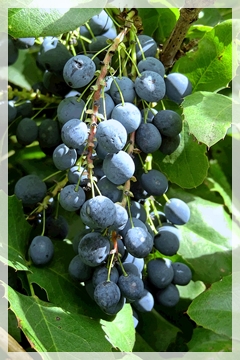 In 2009, the United Methodist Church and the Evangelical Lutheran Church of America became full Communion partners. This agreement, while showing respect for each other’s differences, created a relationship based on a common confession of faith and a mutual recognition of Baptism and the sharing of Holy Communion. That the partnership included a mutual recognition of ordained ministers of both denominations meant that a local Methodist church could hire a soon-to-be ordained Lutheran minister. Her ordination, done by the Lutheran bishop, was held in the Methodist church she would be serving. The only sticking point for the rite was the Lutheran Bishop’s insistence that actual wine be used for Communion. Methodists have a strong temperance tradition and this church uses only grape juice. The senior Methodist pastor managed to find an excellent compromise when he obtained a non-alcoholic wine that satisfied both Methodist and Lutheran sensibilities; the ordination went off without a hitch.
A week later, Lutheran and Methodist clergy from around the state attended an ecumenical service to celebrate their new partnership. After numerous speeches and prayers about Christian unity, the service culminated in Communion. There were, however, two cups of purple liquid on opposite sides of the sanctuary. The Methodists were instructed to go left to dip their wafers in grape juice while the Lutherans were directed to the right for the wine! Surely, with all of the great minds who’d put together the celebratory service of unanimity, a better solution (such as non-alcoholic wine) could have been found. Sadly, it wasn’t! The pastor who shared this story still shakes his head at the absurdity of it.
How silly are we? When we come to the Lord’s Table, we don’t come as individuals—as Bob, Mary, Marty, or Deb—nor do we come as Lutherans, Methodists, Episcopalians, or Baptists. We come as brothers and sisters—members of Jesus’s family—members of the body of Christ. Communion is a sign of Christian unity and, in the early church, it was part of a communal dinner—a 1st century version of a potluck supper.
Potlucks, shared meals, covered dish dinners—whatever your church calls them—they’re pretty much the same across the denominations: at least one macaroni casserole, something made with gelatin, deviled eggs, and more desserts than vegetables. Meeting as friends and putting aside our differences, the commonality at a potluck is our love of food! That same sort of unity should happen whenever we eat at the Lord’s Table where the commonality is our love of Jesus.
Transubstantiation, divine mystery, consubstantiation, receptionism, or memorialism; wine or juice; wafers, crackers, or Wonder Bread; intinction, common cup, individual cups, or sealed cups with juice and wafer; taken separately or together, in the pews or at the altar rail—the Bible is rather silent on the “correct” way to take Communion. There really are only two commands: do this in remembrance of Him and examine ourselves before we partake of His meal. He is the Bread of Life; let us always welcome others to His table and celebrate our unity in Christ.
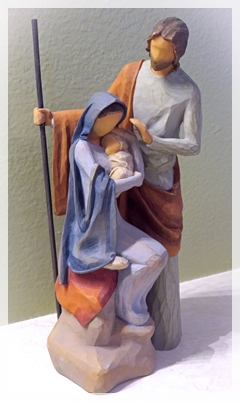 Although Epiphany celebrates the magi’s visit to the Christ child, for many people it simply marks the official end to the holiday season. It’s the day the tree goes down, lights are removed, and nativity scenes get stowed for another year. British tradition holds that if you haven’t removed the holiday décor by January 6, you must leave it in place all year long to avoid misfortune. I don’t know about misfortune but, in our community, you’ll face a fine if holiday lights or decorations remain after this week!
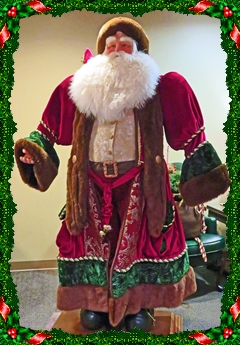 Everyone loves Christmas—in fact, in our extended family it is our Hindu relatives who seem to make the most of this holiday with copious gifts, family get-togethers, peppermint bark, visits to and from Santa, cards, lights festooned around the yard, a beautifully decorated tree, wreaths, candles, and holiday attire. While driving through a nearby neighborhood famed for its decorations, I couldn’t help but wonder what sleighs, Rudolph, reindeer, trains, inflatable snowmen, igloos, teddy bears, toy soldiers, Disney characters, candy cane arches, icicle lights, meteor shower light shows and blow mold Snoopys and Grinches have to do with Jesus. Yes, there were a few blow mold nativities but even they were surrounded by gingerbread men and polar bears.
 As she sang, “Will you let me be your servant, let me be as Christ to you; pray that I may have the grace to let you be my servant too,” I reached over to take my husband’s hand. I contemplated the road we’ve traveled together for over half a century as the soloist continued: “We are pilgrims on a journey, we are trav’lers on the road; We are here to help each other walk the mile and bear the load.” As I listened to the rest of Richard Guillard’s beautiful song, I thought it was the perfect choice for a wedding.
 Our family business makes products used in skateboards and many boarders are familiar with our name. After skiing one day, as my husband got on the bus, he was greeted by a boarder who spotted our company logo on his cap. “Yo, dude!” he called. Pointing to the cap, he asked, “You know those people?” When my husband replied he was “those people,” the fellow responded as if he’d met a celebrity and excitedly introduced my spouse to his pals. Soon they all were in an animated discussion of trucks, decks, wheels, and grip tape. The woman next to me, curious about the commotion in the back of the bus and not wanting to miss a celebrity sighting asked, “Is that someone famous? Is he important?” I replied, “He’s no one,” adding, “It’s just a skateboard thing.”
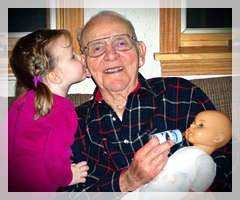 I actually thought the prayer’s words that Sunday asked God to show us what children can teach us about love. Looking through old photos of my children and grands later that day, I thought about the ways children love. Unconcerned with decorum (or potential lawsuits), they’re demonstrative: touching freely and unabashedly. They cuddle and climb on laps, hold hands, and spontaneously give hugs and kisses. They burrow under the covers with us and aren’t bothered by morning breath or bed head. It doesn’t matter if they’re soaking wet from the sprinkler or their faces are covered with jelly or chocolate nor do they care if we’re sweaty and dirty from working in the garden or dressed in our finest for a night on the town. Children know that touch, whether a high-five or hug, is an important part of love.
 Devotions of the Heart