WHAT’S IN A NAME? (Daniel – part 1)

“But you are my witnesses, O Israel!” says the Lord. “You are my servant. You have been chosen to know me, believe in me, and understand that I alone am God. There is no other God—there never has been, and there never will be. [Isaiah 43:10 (NLT)]

black skimmerAfter Nebuchadnezzar’s first invasion of Judah, he returned to Babylon with the temple’s treasures and some of Judah’s nobility as captives. The best and brightest of the young men were to learn the literature and language of Babylon so they could serve the king. In spite of being captives, they were housed in the palace and given the king’s choice of food. While this would appear to be a pretty good gig for prisoners of war, the boys were probably castrated and made eunuchs as was typically done for palace officials (and prophesied by Isaiah in 2 Kings 20:18).

Among these captives were Daniel, Hananiah, Mishael, and Azariah, all of whom were given new Babylonian names. Daniel, whose name meant “God is my judge,” became Belteshazzar, meaning “Bel protects his life” (Bel was another name for the chief Babylonian god Marduke). Hananiah, whose name meant “The Lord shows grace,” became Shadrach, meaning “Under the command of Aku” (the Sumerian moon god). Mishael, whose name meant “Who is like God?” became Meshach, meaning “Who is what Aku is?” and Azariah, whose name meant “The Lord helps,” became Abednego, “Servant of Nebo” (the god of learning and writing).

“What’s in a name?” asked Juliet in Shakespeare’s Romeo and Juliet. “That which we call a rose by any other name would smell as sweet,” added the star-crossed lover. Romeo’s name made him an enemy to her family but his name was meaningless to Juliet. She knew a man’s name did not determine his value or character. Nebuchadnezzar, king of Babylon, thought otherwise. By changing the captive boys’ names, he wanted more than just their assimilation to Babylon; he wanted their allegiance. When he took their names from them, he also thought he took their God.

These young men lost their homes and families, their masculinity and their names. To further distance them from the God of Israel, as eunuchs, they wouldn’t be allowed to worship in the temple if they ever returned home. Nevertheless, they never lost their identity as children of the God of Israel and refused to defile themselves by partaking of the king’s food and wine.

Some think their decision was based solely on health and nutrition and now offer a wide variety of eating plans based on Daniel’s diet. Their refusal, however, probably had more to do with the youths’ attempt to regain some control over their lives and faith. The king’s meat would not have been butchered or prepared according to Jewish law and would have included prohibited foods like horseflesh and pork that had first been offered to the pagan god Marduk. The four friends refused it and, working out a compromise with the palace guard, agreed to eat nothing but vegetables and water for a trial period of ten days. Since they looked better nourished after that time, they were allowed to continue observing their food rules. Their fitness, however, had more to do with God’s promise of provision than their diet. God granted them not just health but special wisdom. In spite of their new names, they now knew that, by remaining faithful to God, He would be remain faithful to them. Found superior to all of the others in their group, they entered the king’s service in his court.

These four young men knew there was nothing in a name. What mattered was their character and their faith in God—a God who was judge, showed grace, and helped them in their troubles. They knew the Lord would honor those who honored Him and it was this knowledge that would carry them through their later trials in Babylon.
Praise the name of God forever and ever, for he has all wisdom and power. He controls the course of world events; he removes kings and sets up other kings. He gives wisdom to the wise and knowledge to the scholars. [Daniel 2:20-21 (NLT)]

Copyright ©2019 jsjdevotions. All rights reserved.

MARKED AND SEALED

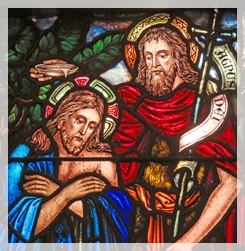
One day when the crowds were being baptized, Jesus himself was baptized. As he was praying, the heavens opened, and the Holy Spirit, in bodily form, descended on him like a dove. And a voice from heaven said, “You are my dearly loved Son, and you bring me great joy.” [Luke 3:21-22 (NLT)]

Baptism of JesusAlthough I don’t remember my Baptism as an infant, I do have a picture that tells me I wore a long white dress and a bonnet. Another picture tells me that I wore a shorter white dress, a hat instead of a bonnet and my first pair of nylon stockings and heels at my Confirmation thirteen years later. That, however, is about all I remember of making a public reaffirmation of my faith and recommitting to the baptismal promises made for me when I was a baby. Although I knew a lot about Jesus at the time, I’m not sure that I truly knew Him. I know Him now and, in a much simpler ceremony, I recently reaffirmed my Baptism in a way I will never forget.

The first Sunday after Epiphany is when many churches celebrate the Baptism of our Lord which is the case at one of the churches we attend. The hymns (When Jesus Came to Jordan, O Come and Dwell in Me, and On the Wings of a Snow White Dove) set the stage. The readings from Isaiah, Acts, and Luke kept our focus on Baptism and the pastor’s sermon continued the theme as she told of her visit to the Holy Land, standing where John may have baptized Jesus, and collecting water from the Jordan River. After the sermon, she offered us the opportunity to reaffirm our Baptisms when we came to the altar to receive Communion.

The Pastor held a chalice filled with water and, when we approached her, she dipped her finger in it, made the sign of the cross on our foreheads and said, “In Baptism you were marked with the cross of Christ and sealed with the Holy Spirit forever.” That she’d collected the water from the Jordan River made it even more meaningful. If there could be frosting on this cake, it is that we then received the bread and wine of the Lord’s Supper. With just two steps, I passed from the beginning of Jesus’s ministry—His Baptism when the Holy Spirit descended upon Him—to the night He was betrayed and instituted Communion. I accepted the wafer from a second person, dipped it in a chalice of wine held by a third and ate it while remembering the body that was given and the blood that was shed, not just for me, but for all of us.

It’s rare that we celebrate the two New Testament ordinances (what many call sacraments) together and I found it a moving experience. Baptism and the Lord’s Supper are the two rituals or practices that Jesus commanded (or ordained) the assembly of believers to observe. Baptism is not what a person does to be saved; our salvation is by grace through faith in Jesus Christ. Nevertheless, Baptism is something a saved person does. It symbolizes the death of the old life and our resurrection as a new person in Christ. While it’s only done once, it can be reaffirmed, as I did last weekend. Participating in Communion is another thing the saved person does. Unlike Baptism, however, taking Communion is something the saved person does throughout his life. When we partake of the Lord’s Supper, we walk as that new person in Him and connect not just with our Lord but with all with all believers, both past and present.

No matter how long ago we became Christians or the age at which we were baptized, let us always remember that we have been marked with the cross of Christ and sealed with His Holy Spirit forever.

Those who believed what Peter said were baptized and added to the church that day—about 3,000 in all. All the believers devoted themselves to the apostles’ teaching, and to fellowship, and to sharing in meals (including the Lord’s Supper), and to prayer. [Acts 2:41-42 (NLT)]

Copyright ©2019 jsjdevotions. All rights reserved.

AT HIS TABLE

“This cup is the new covenant between God and his people—an agreement confirmed with my blood. Do this in remembrance of me as often as you drink it.” … Anyone who eats this bread or drinks this cup of the Lord unworthily is guilty of sinning against the body and blood of the Lord. That is why you should examine yourself before eating the bread and drinking the cup. [1 Corinthians 11:25b, 27-28 (NLT)]

oregon grapeIn 2009, the United Methodist Church and the Evangelical Lutheran Church of America became full Communion partners. This agreement, while showing respect for each other’s differences, created a relationship based on a common confession of faith and a mutual recognition of Baptism and the sharing of Holy Communion. That the partnership included a mutual recognition of ordained ministers of both denominations meant that a local Methodist church could hire a soon-to-be ordained Lutheran minister. Her ordination, done by the Lutheran bishop, was held in the Methodist church she would be serving. The only sticking point for the rite was the Lutheran Bishop’s insistence that actual wine be used for Communion. Methodists have a strong temperance tradition and this church uses only grape juice. The senior Methodist pastor managed to find an excellent compromise when he obtained a non-alcoholic wine that satisfied both Methodist and Lutheran sensibilities; the ordination went off without a hitch.
A week later, Lutheran and Methodist clergy from around the state attended an ecumenical service to celebrate their new partnership. After numerous speeches and prayers about Christian unity, the service culminated in Communion. There were, however, two cups of purple liquid on opposite sides of the sanctuary. The Methodists were instructed to go left to dip their wafers in grape juice while the Lutherans were directed to the right for the wine! Surely, with all of the great minds who’d put together the celebratory service of unanimity, a better solution (such as non-alcoholic wine) could have been found. Sadly, it wasn’t! The pastor who shared this story still shakes his head at the absurdity of it.

How silly are we? When we come to the Lord’s Table, we don’t come as individuals—as Bob, Mary, Marty, or Deb—nor do we come as Lutherans, Methodists, Episcopalians, or Baptists. We come as brothers and sisters—members of Jesus’s family—members of the body of Christ. Communion is a sign of Christian unity and, in the early church, it was part of a communal dinner—a 1st century version of a potluck supper.

Potlucks, shared meals, covered dish dinners—whatever your church calls them—they’re pretty much the same across the denominations: at least one macaroni casserole, something made with gelatin, deviled eggs, and more desserts than vegetables. Meeting as friends and putting aside our differences, the commonality at a potluck is our love of food! That same sort of unity should happen whenever we eat at the Lord’s Table where the commonality is our love of Jesus.

Transubstantiation, divine mystery, consubstantiation, receptionism, or memorialism; wine or juice; wafers, crackers, or Wonder Bread; intinction, common cup, individual cups, or sealed cups with juice and wafer; taken separately or together, in the pews or at the altar rail—the Bible is rather silent on the “correct” way to take Communion. There really are only two commands: do this in remembrance of Him and examine ourselves before we partake of His meal. He is the Bread of Life; let us always welcome others to His table and celebrate our unity in Christ.

They worshiped together at the Temple each day, met in homes for the Lord’s Supper, and shared their meals with great joy and generosity—all the while praising God and enjoying the goodwill of all the people. [Acts 2:46-47 (NLT)]

When we bless the cup at the Lord’s Table, aren’t we sharing in the blood of Christ? And when we break the bread, aren’t we sharing in the body of Christ? And though we are many, we all eat from one loaf of bread, showing that we are one body. [Corinthians 10:16-17 (NLT)]

Copyright ©2019 jsjdevotions. All rights reserved.

THE REASON FOR MORE THAN A SEASON

Because God’s children are human beings—made of flesh and blood—the Son also became flesh and blood. For only as a human being could he die, and only by dying could he break the power of the devil, who had the power of death. Only in this way could he set free all who have lived their lives as slaves to the fear of dying. [Hebrews 2:14-15 (NLT)]

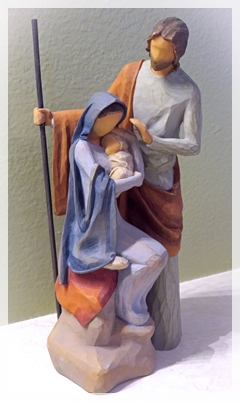
The Holy Family - Willow TreeAlthough Epiphany celebrates the magi’s visit to the Christ child, for many people it simply marks the official end to the holiday season. It’s the day the tree goes down, lights are removed, and nativity scenes get stowed for another year. British tradition holds that if you haven’t removed the holiday décor by January 6, you must leave it in place all year long to avoid misfortune. I don’t know about misfortune but, in our community, you’ll face a fine if holiday lights or decorations remain after this week!

This year, my five-year old grand helped me take down the tree and put away the Christmas decorations. Along with the ornaments, candle holders, stockings, and two Santas, we put away four nativity sets. As the little guy placed the Christ child in one of the boxes, he asked me why I had so many figures of baby Jesus. I reminded him that Jesus (not Santa) is the reason for the season and that we always want to keep Christ in Christmas.

After everything Christmas was packed up and put away, I realized a small resin figurine of the Holy Family remained on a shelf in the living room. The crates in the garage were filled to the brim and, just as on that first Christmas, there was no room anywhere for Mary, Joseph and the newborn King. Rather than having them spend the next eleven months in a high cabinet with assorted vases, I decided to keep them on my desk.

That figurine will serve as a reminder of how God deliberately chose to humble Himself: to be born of woman and live as a mortal man. That was God Himself who entered our world through a birth canal amidst blood and amniotic fluid. The baby who nursed at Mary’s breast and peed, pooped, spit up and drooled was God! He who created man was so helpless He couldn’t even roll over for the first few months of His life and had to learn to crawl and walk. The God who gave mankind the gift of speech had to learn to speak, the One who invented numbers had to learn to count, and He who spoke the law to Moses had to learn how to read His own words! The God who spoke light into existence had to light a candle at night and our omnipresent God had to walk to get from one place to another. The God who never gets tired, thirsty or hungry became a man who did. Jesus humbled Himself by living as a man and endured everything mankind does: blisters, bruises, colds, waiting, toothaches, bug bites, stubbed toes, hangnails, exhaustion, sunburn, skinned knees, and probably diarrhea. He even endured temptation but, unlike us, He remained sinless!

Sometimes, it’s easy to forget the human part of Jesus: that our infinite God chose to live in a finite world with all of its limitations. That figurine will remain on my desk this year as a reminder that our invincible and invulnerable God freely chose to live as a man so that He could die as a man in my place. Fully man and fully God at the same time, Jesus is more than just the reason for the Christmas season; He is the reason for our salvation. Christ belongs in far more than Christmas; He belongs in everything we think, say and do.

Therefore, it was necessary for him to be made in every respect like us, his brothers and sisters, so that he could be our merciful and faithful High Priest before God. Then he could offer a sacrifice that would take away the sins of the people.  Since he himself has gone through suffering and testing, he is able to help us when we are being tested. [Hebrews 2:17-18 (NLT)]

Copyright ©2019 jsjdevotions. All rights reserved.

WITHOUT THE CROSS, THERE IS NO CHRISTMAS

For the Son of Man came to seek and save those who are lost. [Luke 19:10 (NLT)]

For even the Son of Man came not to be served but to serve others and to give his life as a ransom for many. [Matthew 20:28 (NLT)]

I have come as a light to shine in this dark world, so that all who put their trust in me will no longer remain in the dark. [John 12:46 (NLT)]

St. NicholasEveryone loves Christmas—in fact, in our extended family it is our Hindu relatives who seem to make the most of this holiday with copious gifts, family get-togethers, peppermint bark, visits to and from Santa, cards, lights festooned around the yard, a beautifully decorated tree, wreaths, candles, and holiday attire. While driving through a nearby neighborhood famed for its decorations, I couldn’t help but wonder what sleighs, Rudolph, reindeer, trains, inflatable snowmen, igloos, teddy bears, toy soldiers, Disney characters, candy cane arches, icicle lights, meteor shower light shows and blow mold Snoopys and Grinches have to do with Jesus. Yes, there were a few blow mold nativities but even they were surrounded by gingerbread men and polar bears.

In our secular world, Christianity has little or nothing to do with many of today’s holiday traditions yet Christmas means nothing without the cross. Unfortunately, we’ve become so accustomed to the holiday stories, traditions, and decor that surround this day that many people have forgotten its true meaning. Sadly, like my Hindu extended family, some people neither know nor care about it

Christmas isn’t about presents, tinsel, ornaments, or even family and it certainly isn’t about the birthday of a great moral teacher. Jesus was not a righteous man who came to make the world a better place. He was God incarnate and He came to seek and save the lost. He came not to be served but to serve. He came to give His life as a ransom for all mankind. He came to bring light into the dark world and save it. Jesus said nothing about jingle bells, stockings hung by the chimney with care, or elves on shelves. As the Apostle Paul said: “Christ Jesus came into the world to save sinners.” [1 Timothy 1:15] That would not have happened without the cross.

We are in the season of Advent: a season of both remembrance and anticipation. During these weeks, we prepare for the celebration of Christ’s first coming over 2000 years ago but we also prepare ourselves for His second coming, when He’ll return, not as a baby, but as a King. The first time, Jesus Christ came to save us; the second time, He will come to judge us. One of my little grands lost the Jesus from her nativity set. With all of the hoopla surrounding Christmas, let’s not make the same mistake with our lives. Just as there is no Christmas without that baby in the manger, there is no reason for the season without the cross.

Born that man no more may die; Born to raise the sons of earth;
Born to give them second birth. Hark! The herald angels sing,
“Glory to the newborn King!” [Charles Wesley]

I will not judge those who hear me but don’t obey me, for I have come to save the world and not to judge it. But all who reject me and my message will be judged on the day of judgment by the truth I have spoken. [John 12:47-48 (NLT)]

Copyright ©2018 jsjdevotions. All rights reserved.

LET ME BE YOUR SERVANT

And since I, your Lord and Teacher, have washed your feet, you ought to wash each other’s feet. [John 13:14 (NLT)]

Whoever wants to be a leader among you must be your servant, and whoever wants to be first among you must be the slave of everyone else. [Mark 10:43-44 (NLT)]

crab appleAs she sang, “Will you let me be your servant, let me be as Christ to you; pray that I may have the grace to let you be my servant too,” I reached over to take my husband’s hand. I contemplated the road we’ve traveled together for over half a century as the soloist continued: “We are pilgrims on a journey, we are trav’lers on the road; We are here to help each other walk the mile and bear the load.” As I listened to the rest of Richard Guillard’s beautiful song, I thought it was the perfect choice for a wedding.

I will hold the Christ light for you, In the night time of your fear;
I will hold my hand out to you, Speak the peace you long to hear.
I will weep when you are weeping. When you laugh, I’ll laugh with you;
I will share your joy and sorrow, Till we’ve seen this journey through.
[“The Servant Song” by Richard Guillard]

During last week’s worship, however, I realized Guillard’s song applies to Christian fellowship as much as it does to marriage. His words describe the church or, at least, what the church is supposed to be. We comfort and support, encourage and enlighten, pray for and serve one another. We share good times and bad, walk together, go the extra mile, and help carry one another’s burdens.

“Will you let me be your servant?” That’s what Jesus was asking when he stripped off his robe, wrapped a towel around his waist, and knelt to wash the disciples’ feet. That servant, on his hands and knees and holding a wash rag, was God! When Jesus came to Peter, the man protested and only relented when told, “Unless I wash you, you won’t belong to me.” Whether Jesus meant that Peter’s sins had to be washed away by the cross or that Peter needed to humbly submit to Jesus, I’m not sure. Either way, Jesus taught a valuable lesson both about servanthood and accepting God’s grace.

It’s important to serve but equally important to graciously accept the gift of service that comes with Christian love. Jesus washed the disciples’ feet but He also allowed a woman to wash his feet with her tears and wipe them with her hair. Servanthood in Christ’s church involves both the giving and accepting of grace but, for many of us, giving comes far easier than accepting.

How can we wash one another’s feet if we won’t take off our shoes because someone might know we have athlete’s foot or see the ugly bunion, corn, bruised toe, or blister? Let’s not be afraid to share our vulnerability, expose our failings, acknowledge our doubts, admit our fear, or disclose our needs. Let us love and serve one another as did Christ and let us accept that love and kindness as did His disciples.

Will you let me be your servant, let me be as Christ to you;
Pray that I may have the grace to let you be my servant too.
[“The Servant Song” by Richard Guillard]

Don’t just pretend to love others. Really love them. Hate what is wrong. Hold tightly to what is good. Love each other with genuine affection, and take delight in honoring each other. … When God’s people are in need, be ready to help them. Always be eager to practice hospitality. … Be happy with those who are happy, and weep with those who weep. [Romans 12:9-10,13,15 (NLT)]

Copyright ©2018 jsjdevotions. All rights reserved.