PERMANENT RECORDS

He has removed our sins as far from us as the east is from the west. [Psalm 103:12 (NLT)]

I—yes, I alone—will blot out your sins for my own sake and will never think of them again. [Isaiah 43:25 (NLT)]

great southern white butterfly

When I was a girl in elementary school, the teachers would speak ominously of our permanent records. While the threat that Santa knowing if we’re good or bad only worked during December, a teacher’s threat of, “This is going on your permanent record!” scared us into obedience the entire year! Perhaps elementary schoolers in the 1950s were more naïve than today’s youngsters, but my friends and I were convinced that each of us had a permanent record that logged test scores, grades, and attendance records along with every infraction or disciplinary action. Every time we used our outside voices inside, chewed gum in class, forgot the hall pass, passed notes, got in a spat, lost our lunch money, or were sent to the office, the transgression was documented for posterity. Passed from teacher to teacher and school to school, that record might even follow us from job to job.

Nowadays, the dreaded permanent record no longer may be a threat and yet, with social media postings, today’s youngsters are far more likely to have a real permanent record of their assorted transgressions than I ever was!

Fortunately, God doesn’t keep a permanent record of our transgressions. When Jesus died on the cross, He paid for our sins (past, present and future) once and for all. Once we repent and accept Jesus, our sins are both forgiven and removed. Erasing them from our permanent record, God chooses not to remember them. His forgiveness, however, doesn’t mean we’ll never sin; just as we didn’t get 100% on every test in school, we won’t do life perfectly. But, because of Christ’s sacrifice and our faith, our sins no longer have any bearing on our salvation. When we repent and ask forgiveness, God’s loving grace forgives us and yesterday’s mistakes have no bearing on today. God gets out his holy eraser again and again and wipes them away. Along with the Apostle Paul, we can forget what is behind us and look forward to what lies ahead.

If seven times a day we offend him and repent, does he forgive? Ay, that he does. This is to be unfeignedly believed, and I do believe it: I believe that, often as I transgress, God is more ready to forgive me than I am ready to offend, though, alas, I am all too ready to transgress. Hast thou right thoughts of God, dear hearer? If so, then thou knowest that he is a tender father, willing to wipe the tear of penitence away, and press his offending child to his bosom, and kiss him with the kisses of his forgiving love. [Charles Spurgeon]

No, dear brothers and sisters, I have not achieved it, but I focus on this one thing: Forgetting the past and looking forward to what lies ahead, I press on to reach the end of the race and receive the heavenly prize for which God, through Christ Jesus, is calling us. [Philippians 3:13-14 (NLT)]

For God made Christ, who never sinned, to be the offering for our sin, so that we could be made right with God through Christ. [2 Corinthians 5:21 (NLT)]

Copyright ©2019 jsjdevotions. All rights reserved.

GETTING IT JUST RIGHT

Pride ends in humiliation, while humility brings honor. [Proverbs 29:23 (NLT)]

brown bear - montana

In the story of The Three Bears, Goldilocks tasted porridge, sat in chairs, and climbed on beds in an attempt to find what was “just right” on the continuum between hot and cold, big and small, and hard and soft. When editing photos I do much the same thing as I adjust the brightness to find the setting where it’s neither too dark nor too light. As parents (and parents-in-law), we often struggle to find the right position between the extremes of meddling and total detachment. As Christians, we must find a proper balance between two other extremes: pride and humility.

Thinking either too much or too little of ourselves is equally wrong. Pride is insidious and can creep into our lives but so can false humility. When we’re prideful, we deprecate the gifts, talents and achievements of others but, when we’re falsely modest, we deprecate our God-given gifts, talents and achievements; both are dishonest. Healthy pride is a feeling of self-respect and confidence that acknowledges God’s gifts and isn’t threatened by the success of others. Healthy humility also acknowledges God’s gifts but with an attitude of genuine modesty and unpretentiousness. Both pride and humility exhibit delight in and gratitude for the blessings God has bestowed both on ourselves and others.

We need to know and recognize both our assets and our deficits. While our gifts vary from person to person, we are neither superior nor inferior to one another; we all are God’s children. It’s not just in the marketplace that God hates dishonest scales and deceit; He expects us to weigh and measure ourselves with honesty. Like Goldilocks, we must find the place that is “just right” between pride and humility: the place where we can both own our strengths and acknowledge our weaknesses. When we’re at that “just right” point, we can honestly give and take both praise and correction. Acknowledging the virtues and gifts of others as well as any with which we’ve been blessed, we can take joy in both our accomplishments and the accomplishments of others.

Humility is not thinking less of yourself, it’s thinking of yourself less. [Rick Warren]

Too much humility is pride. [German proverb]

The Lord detests the use of dishonest scales, but he delights in accurate weights. Pride leads to disgrace, but with humility comes wisdom. Honesty guides good people; dishonesty destroys treacherous people. [Proverbs 11:1-3 (NLT)]

Copyright ©2019 jsjdevotions. All rights reserved.

PUTTING IT IN PERSPECTIVE

I tell you the truth, you will weep and mourn over what is going to happen to me, but the world will rejoice. You will grieve, but your grief will suddenly turn to wonderful joy. It will be like a woman suffering the pains of labor. When her child is born, her anguish gives way to joy because she has brought a new baby into the world. [John 16:20-21 (NLT)]

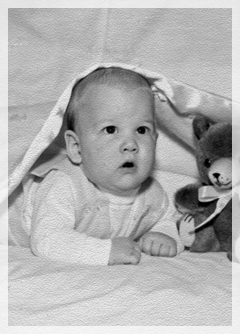
baby boyOn the night He was betrayed, Jesus forewarned the disciples of the grief and fear they’d encounter in the days ahead. In his short parable about labor and delivery, Jesus prepared the remaining eleven disciples for the emotions they would encounter over the next three days: their anguish and despair as He hung upon the cross, died, and was buried. For His followers, those three days would feel like an eternity of hopelessness. But, as happens when a woman beholds her newborn baby after hours of painful labor, their despair would turn to joy when they saw the resurrected Christ!

At the time, no one could have convinced me that I would forget the pain of my long labor and medication-free delivery but, when I held my first-born, I did. All women do (or every baby would be an only child)! Those first six months of sleepless nights spent comforting that colicky boy seemed endless; I didn’t know how I’d endure them but I did. Yesterday, he celebrated his 50th birthday and the 24-hours he spent making his way into this world make up only 1/18,251th of his life and just 1/26,406th of mine! Even the six exhausting months he spent crying in my arms every night are only 1% of his life and less than .7% of mine! While putting my labor and sleepless nights into perspective, I realized my fractions are wrong because I can’t determine the true length of my life; rather than ending here on earth, it will continue forever in God’s heavenly Kingdom.

Jesus’s parable applies to more than those three days the disciples hid in a room following his crucifixion. It applies to the suffering and pain endured by all of His children (which often lasts far longer than 24 hours, 3 days, or even six months). Anguish of any kind seems interminable and unbearable but, when put in perspective, it is but a blip on our eternal lifeline. For now, we live in a world of tears, weariness, frustration, anxiety, confusion, disappointment, loss, fear, and affliction but, on the other side of this earthly life, there is a place without pain, sorrow, grief or tragedy! Although it’s of little comfort to those hurting, our present suffering must be viewed in the light of eternity. As heavy as the weight of our present pain may be, when put on a scale and weighed against the eternal joys of heaven, it is no more than a feather. That doesn’t mean anyone’s pain is small; it simply means that eternity is absolutely enormous! Let us remember—all that’s wrong in this fallen world is temporary and will be forgotten when we joyfully behold His face in eternity!

The best we can hope for in this life is a knothole peek at the shining realities ahead. Yet a glimpse is enough. It’s enough to convince our hearts that whatever sufferings and sorrows currently assail us aren’t worthy of comparison to that which waits over the horizon. [Joni Eareckson Tada]

For our present troubles are small and won’t last very long. Yet they produce for us a glory that vastly outweighs them and will last forever! So we don’t look at the troubles we can see now; rather, we fix our gaze on things that cannot be seen. For the things we see now will soon be gone, but the things we cannot see will last forever. [1 Corinthians 4:17-18 (NLT)]

Copyright ©2019 jsjdevotions. All rights reserved.


TWO IN ONE

For in Christ lives all the fullness of God in a human body. [Colossians 2:9 (NLT)]

So the Word became human and made his home among us. He was full of unfailing love and faithfulness. And we have seen his glory, the glory of the Father’s one and only Son. [John 1:14 (NLT)]

white ibisThe early church encountered difficulty in trying to reconcile the humanity and divinity of Jesus. In the 5th century, one group, from Alexandria, referred to the Virgin Mary as Theotokos, the one who gave birth to God, while the group from Antioch insisted that she was merely Anthropotokos, the one who gave birth to the human nature. Trying to bring about a compromise but pleasing no one, the bishop Nestorius suggested that the term Christotokos, the one who gave birth to Christ. The controversy, however, wasn’t about Mary; it was about the nature of Jesus. Did Mary give birth to a man who also was God or did Mary give birth to a man who later became God? The debate continued until 451 when the Chalcedonian Creed was adopted which confirmed the two natures of Christ (human and divine) in one person.

Creed or not, two natures in one being is a difficult concept to grasp. Infinite, God always has been and always will be, but the man Jesus had a beginning in Bethlehem and an end in Jerusalem. God is omnipresent but, when the boy Jesus was at the Temple, He couldn’t also be with his family on the way back to Nazareth, let alone everywhere at once. God is omnipotent but Jesus wasn’t all-powerful. He grew tired, thirsty and hungry, had to walk from village to village, and was cruelly crucified. God is immutable, meaning He never changes, but Jesus started as an embryo and matured into a grown man. He went from babbling to talking and from crawling to walking. His features changed as He lost his baby teeth and got molars and His voice deepened during adolescence. Self-sufficient, God has no needs but we know that baby Jesus needed to be fed, bathed, rocked and dressed. God never sleeps but we know Jesus did. God is omniscient; He sees and knows all but Jesus didn’t know the date of the End Times and, when the woman with the blood disorder touched his robe, He had to ask who touched him. Surely, as a little boy He asked Mary, “Why?”

Nevertheless, Jesus wasn’t two people; from the moment of His conception, He had two distinct natures perfectly united into one being. Inseparable, neither nature was diluted by the other. Jesus was fully man and, at the same time, fully God. Because our thinking is limited by the rules of this world as we know them, we can’t truly comprehend how He could be neither one nor the other but fully both in one body. How can finite man ever understand an infinite God? Nevertheless, we’re called to believe what we can neither imagine nor comprehend.

Can you conceive of anything more awesome than a God who chose to become man, who combined His divinity with our humanity, who connected with man by becoming one of us and yet remained God, who loved us so much that He took on our nature and died for our salvation? Thank you, Jesus!

Though he was God, he did not think of equality with God as something to cling to. Instead, he gave up his divine privileges; he took the humble position of a slave and was born as a human being. When he appeared in human form, he humbled himself in obedience to God and died a criminal’s death on a cross. [Philippians 2:6-8 (NLT)]

We all with one accord teach men to acknowledge one and the same Son, our Lord Jesus Christ, at once complete in Godhead and complete in manhood, truly God and truly man, consisting also of a reasonable soul and body; of one substance with the Father as regards his Godhead, and at the same time of one substance with us as regards his manhood;… [Chalcedonian Creed]

Copyright ©2019 jsjdevotions. All rights reserved.


THE POTTERY SHOP

“Go down to the potter’s shop, and I will speak to you there.” So I did as he told me and found the potter working at his wheel. But the jar he was making did not turn out as he had hoped, so he crushed it into a lump of clay again and started over. Then the Lord gave me this message: “O Israel, can I not do to you as this potter has done to his clay? As the clay is in the potter’s hand, so are you in my hand.” [Jeremiah 18:2-6 (NLT)]

hibiscusIn January, there will be an Empty Bowls event in our town. Attendees will purchase a bowl and then fill it with soup and bread donated by local restaurants. The money raised will help feed the more than 36,000 food insecure people in our county. To make that event possible, 4,500 one-of-a-kind bowls are made by local potters. Then, with the help of local volunteers, the bowls are painted and fired. Recently, several of us from church gathered to decorate some of those bowls. While we painted, I thought about the potters who made our bowls—how they formed and reformed their creations until they were just right. Varying in shape and size, no two bowls were exactly the same and, by the time they are painted, each will have a personality of its own. When their purchasers are done eating soup from them, they will be put to different uses. The ones embellished with paw prints or bones probably will be used by pets, and the others may be used for popcorn, nuts, cereal, loose change, or even soup!

In words found in Jeremiah and Isaiah, we see God portrayed as the potter and mankind as His clay (rather fitting since Adam was made from dust on the ground and clay comes from the ground). Picture God forming us in His heavenly pottery shop. As with the bowls we painted, each of His creations would be carefully crafted and one-of-a-kind. While our bowls were made of the same kind of clay, God would choose the best type of clay for each one of us. For those who will be severely tested in life, He would chose a clay that withstands high heat but, for those who will have to be especially adaptable, He would chose a clay that is more easily worked.

Once He’d selected the type of clay, God would knead and shape us. While the bowls we painted were all thrown on a potter’s wheel, God might choose to pinch us into shape, or roll long threads of clay and layer them. For one person, He’d combine flat slabs of clay but, for another, He might select a unique mold or use His wheel. No matter the technique chosen, God would continue shaping and re-shaping us until we were formed the way He wanted us. If we got lopsided, He’d prop us up and, if we tore, He’d put us back together. Because clay is malleable and capable of change, God can continue to fine-tune His creations. We might not enjoy all of that pinching, squeezing, molding and scraping, but it is for our own good.

The parallel ends here because the bowls we painted, having been dried and fired, couldn’t be reshaped. God, however, is never done working on us and we continue to be a work in progress until our dying day. Nevertheless, I picture Him with a paintbrush, making each of us beautiful in our own unique way. Moreover, just as the bowls we painted couldn’t complain that, rather than being painted with flowers they wanted polka dots or preferred candy apple red to sour apple green, we really have no voice in how our potter formed and embellished us. God is sovereign over his people; the creation doesn’t get to argue with the Creator!

How foolish can you be? He is the Potter, and he is certainly greater than you, the clay! Should the created thing say of the one who made it, “He didn’t make me”? Does a jar ever say, “The potter who made me is stupid”? [Isaiah 29: 16 (NLT)]

And yet, O Lord, you are our Father. We are the clay, and you are the potter. We all are formed by your hand. [Isaiah 64:8 (NLT)]

Copyright ©2019 jsjdevotions. All rights reserved.

HATTIE’S ADVICE

Instead, be kind to each other, tenderhearted, forgiving one another, just as God through Christ has forgiven you. [Ephesians 4:32 (NLT)]

As I sorted through the papers that my mother-in-law had saved through the years, I came to a letter written to her in 1936 by her soon to be mother-in-law, Hattie. Hoping the young couple liked the mixer she’d given them, Hattie sent best wishes for a “long happy wedded life.” Wondering why such a mundane letter had been saved for 83 years, I read on. “May there be lots of love, joy and contentment in your home,” she continued, “forgiving each other as God forgives you.” Praying that my in-laws would have a long and “sweet contented life,” Hattie signed the letter “One who wishes you well in everything, Mother.”

Hattie’s prayers were answered; my in-laws were together for 68 years and, at least from my view-point, they did, indeed, live a “sweet contented” life. Could the secret to their marriage be hidden in Hattie’s advice to be forgiving? Is that why my mother-in-law had saved the letter?

I think of the story of a man who, when told by the doctor that he had an incurable case of rabies and but a few days to live, immediately got out paper and pen and started writing. When asked if he was composing his last will and testament, the man said he was making a list of everyone he wanted to bite! With an attitude like that, if the rabid man were married, I doubt that his was a happy marriage or that he lived a “sweet contented life.”

As I pondered my ability to forgive, I began to wonder how willing I was, not just to offer forgiveness, but also to ask for it. I’m not one to serve “cold shoulder and hot tongue” for dinner, give the “silent treatment,” or bring up past offenses but (and that’s a really big “but”), I also am not one who readily admits her failings. When I’ve committed the relationship sins of sharpness, impatience, pettiness, or indifference, I tend to assume forgiveness rather than apologize. Although my husband and I readily forgive one another, I think our relationship suffers if one or the other of us falls short and doesn’t admit it and apologize.

When we accept Jesus, all of our sins (past, present and future) are forgiven on a judicial or “positional” basis which means we will not suffer eternal damnation. Nevertheless, we should never take God’s forgiveness for granted or treat it as something we deserve. We must confess our sins for what could be called “relational” forgiveness in order to restore our relationship with Him.

Author and theologian Frederick Buechner calls unconfessed sins an abyss between us and God, adding that, once confessed, they become the bridge. I think Buechner’s abyss/bridge metaphor applies to our earthly relationships, as well. The prodigal’s father had already forgiven his son before the boy’s return but it was not until his son admitted the error of his ways that their relationship was restored. A certain amount of forgiveness is assumed in a family—husbands and wives forgive one another as do parents and children simply because love forgives. But, we must never take either the grace of God or the gift of forgiveness lightly.

Lord, give us forgiving and humble hearts. May we always be as willing to apologize and admit our errors as we are to accept both your forgiveness and that of others.

Few things accelerate the peace process as much as humbly admitting our own wrongdoing and asking forgiveness. [Lee Strobel]

If we claim we have no sin, we are only fooling ourselves and not living in the truth. But if we confess our sins to him, he is faithful and just to forgive us our sins and to cleanse us from all wickedness. If we claim we have not sinned, we are calling God a liar and showing that his word has no place in our hearts. [1 John 1:8-10 (NLT)]

Copyright ©2019 jsjdevotions. All rights reserved.