LEARNING TO WALK

So put away all malice and all guile and insincerity and envy and all slander. Like newborn babes, long for the pure spiritual milk, that by it you may grow up to salvation; for you have tasted the kindness of the Lord. [1 Peter 2:1-3 (RSV)]

toddlerWatching a friend’s video of her grandbaby’s first steps, I thought back to my children’s first faltering steps. They teetered and tottered, often fell, got up, and fell again. Eventually, the wobbly legs of my eldest became the confident legs that take him down mountain slopes on a snowboard, the awkward steps of my daughter became the graceful ones of a dancer in toe shoes, and the child who took forever to walk now runs marathons. It took time and maturity, however, before they could carry themselves with such strength and assurance.

A pastor friend told me of a young woman, Anne, who recently joined his church. Tuesday mornings, a group meets in the sanctuary to pray over the weekend’s prayer requests. Although Anne is a brand new Christian and self-conscious about offering prayers in a group, she feels called to come on Tuesdays and be a part of this ministry. One morning, she arrived late. With Bible in one hand and a cup of coffee in the other, Anne rushed down the aisle only to stumble. As the coffee spilled over her blouse and onto the floor, what came out of Anne’s mouth definitely was not a nice church lady, “Oops!” Having uttered words not typically heard in church, her face turned red with embarrassment. Mortified at her misstep, I imagine she would have given anything to rewind the previous sixty seconds. Instead of gasps of horror and scornful frowns, however, the prayer warriors in the sanctuary chuckled and reassured her. Like Anne, they once were baby Christians and experienced their share of missteps and lapses. They didn’t approve of her language but, having “been there and done that” (and probably much worse), they understood and reacted with love rather than judgment.

When we first accept Christ, we’re really just baby Christians. Babies aren’t born with all the knowledge and skills they need and we’re not reborn with all the knowledge and skills we need either. There will be stumbles and missteps as we learn to how to walk the Christian way. Like Anne, the new Christian is often torn between the old way of thinking, speaking and acting and the new Spirit-led way of living. Sometimes old habits and attitudes are hard to break. Nevertheless, the baby Christian welcomes the Holy Spirit, follows His lead, listens to His conviction, prays, studies Scripture, and gradually grows more like Christ. Like a toddler, when she falls, she just gets back up and keeps going and growing.

Babies don’t remain babies forever nor would we want them to. We want our children to mature and become all they’re meant to be. That doesn’t happen by being critical, judgmental and unforgiving whenever a child falls. Growth happens with encouragement, patience, love, and through example. While the prayer warriors at my friend’s church understood that, not everyone does.

When our Bible study leader announced that we’d be discussing Nicodemus the following week, the woman beside me asked who he was. I saw her shrink in embarrassment when another woman condescendingly replied, “How could you not know who Nicodemus is?” I quickly looked in my Bible’s index and, reassuring her that she wasn’t alone in her question, told her she’d find his story in John 3. I can only hope she’ll return next week.

Not everyone who attends a Bible study or church is a mature believer; some are brand new disciples while others are seekers or just testing the water. Let’s always be as reassuring, forgiving, and welcoming to baby Christians as we are to our little children and grands!

Above all hold unfailing your love for one another, since love covers a multitude of sins. Practice hospitality ungrudgingly to one another. [1 Peter 4:8-9 (RSV)]

For by grace you have been saved through faith; and this is not your own doing, it is the gift of God—not because of works, lest any man should boast. [Ephesians 2:8-9 (RSV)]

Copyright ©2019 jsjdevotions. All rights reserved.

SACRIFICES

And so, dear brothers and sisters, I plead with you to give your bodies to God because of all he has done for you. Let them be a living and holy sacrifice—the kind he will find acceptable. This is truly the way to worship him. [Romans 12:1-2 (NLT)]

monarch butterfly - butterfly weedIf you ever visited the Mayan ruins near Cancun, Mexico, chances are you saw the remains of a stone ball court with sloping walls. Nowhere near as impressive as the Mayan pyramids, I didn’t even take a picture when I saw one. Two stone rings hang about 20 feet up the walls. A ball game called pok-ta-pok was played there. As in volleyball, players passed a solid rubber ball around by hitting it with various parts of their bodies. Unlike volleyball, however, they could not touch the ball with their hands. The goal was to get the ball through one of the rings.
This game was a reenactment of the Mayan creation story and had ritual significance. When prisoners of war were forced to play the game, it became a prelude to their sacrifice by decapitation, heart removal, or disembowelment. Since blood was considered nourishment for the gods, the sacrifice of a living creature was a powerful one and the sacrifice of a human was the most powerful.

When we hear the word sacrifice, we tend to picture something as brutal and gruesome as the Mayans, satanic cults, King Manasseh sacrificing his son to Molech, or even Abraham placing his son on an altar and bringing a knife to his throat. We think of sacrifice as suffering terrible loss: the destruction or surrender of something precious to us. Having a negative connotation, we tend to see sacrifice as unpleasant, involuntary, or punishing.

There was, however, another scenario to that Mayan ball game. In some cases, it was the winners who were sacrificed. Teams willingly played in the hopes of winning and being sacrificed to the gods. This sacrifice was a privilege that gave great honor to the player and his family. Although the game’s losers lived, they were disgraced and may have become slaves. While it still seems barbaric to us, rather than a giving up of something, that sacrifice was seen as a gain.

God clearly prohibited human sacrifice when he gave the law to the Israelites, yet Paul tells the Romans to be living sacrifices! This is neither a forced sacrifice nor one of punishment; we are not defeated warriors being sacrificed in shame. This is an enthusiastic sacrifice, like that of the Mayan warriors who chose to compete in that sacrificial game. Like them, we are victors but, unlike them, ours is not a one-time sacrifice resulting in death but rather a constant placement of our lives at God’s disposal. It is a joyful and willing sacrifice of worship—a consecration of our lives to Him.

Sunday, we sang these words from Frances Havergal’s hymn: “Take my life and let it be consecrated, Lord, to Thee.” As we sang, we offered Him our time, hands, feet, voices, lips, money, intellect, will, heart, and love. That is what it means to be a living sacrifice to God. Four years after writing her hymn, Havergal responded to her own words, “Take my silver and my gold,” by giving away all of her jewelry (nearly fifty items) to a missionary society. About this sacrifice, she wrote a friend of her “extreme delight” and said, “I don’t think I ever packed a box with such pleasure.” Her words, actions, and joyful attitude are an example of what it means to be a living and holy sacrifice,

Take my love, my Lord, I pour at thy feet its treasure store.
Take myself and I will be ever, only, all for Thee.
[Frances R. Havergal (1874)]

Give yourselves completely to God, for you were dead, but now you have new life. So use your whole body as an instrument to do what is right for the glory of God. [Romans 6:13b (NLT)]

Copyright ©2019 jsjdevotions. All rights reserved

AT HIS TABLE

“This cup is the new covenant between God and his people—an agreement confirmed with my blood. Do this in remembrance of me as often as you drink it.” … Anyone who eats this bread or drinks this cup of the Lord unworthily is guilty of sinning against the body and blood of the Lord. That is why you should examine yourself before eating the bread and drinking the cup. [1 Corinthians 11:25b, 27-28 (NLT)]

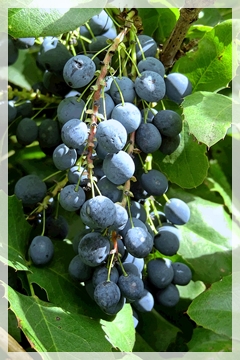
oregon grapeIn 2009, the United Methodist Church and the Evangelical Lutheran Church of America became full Communion partners. This agreement, while showing respect for each other’s differences, created a relationship based on a common confession of faith and a mutual recognition of Baptism and the sharing of Holy Communion. That the partnership included a mutual recognition of ordained ministers of both denominations meant that a local Methodist church could hire a soon-to-be ordained Lutheran minister. Her ordination, done by the Lutheran bishop, was held in the Methodist church she would be serving. The only sticking point for the rite was the Lutheran Bishop’s insistence that actual wine be used for Communion. Methodists have a strong temperance tradition and this church uses only grape juice. The senior Methodist pastor managed to find an excellent compromise when he obtained a non-alcoholic wine that satisfied both Methodist and Lutheran sensibilities; the ordination went off without a hitch.

A week later, Lutheran and Methodist clergy from around the state attended an ecumenical service to celebrate their new partnership. After numerous speeches and prayers about Christian unity, the service culminated in Communion. There were, however, two cups of purple liquid on opposite sides of the sanctuary. The Methodists were instructed to go left to dip their wafers in grape juice while the Lutherans were directed to the right for the wine! Surely, with all of the great minds who’d put together the celebratory service of unanimity, a better solution (such as non-alcoholic wine) could have been found. Sadly, it wasn’t! The pastor who shared this story still shakes his head at the absurdity of it.

How silly are we? When we come to the Lord’s Table, we don’t come as individuals—as Bob, Mary, Marty, or Deb—nor do we come as Lutherans, Methodists, Episcopalians, or Baptists. We come as brothers and sisters—members of Jesus’s family—members of the body of Christ. Communion is a sign of Christian unity and, in the early church, it was part of a communal dinner—a 1st century version of a potluck supper.

Potlucks, shared meals, covered dish dinners—whatever your church calls them—they’re pretty much the same across the denominations: at least one macaroni casserole, something made with gelatin, deviled eggs, and more desserts than vegetables. Meeting as friends and putting aside our differences, the commonality at a potluck is our love of food! That same sort of unity should happen whenever we eat at the Lord’s Table where the commonality is our love of Jesus.

Transubstantiation, divine mystery, consubstantiation, receptionism, or memorialism; wine or juice; wafers, crackers, or Wonder Bread; intinction, common cup, individual cups, or sealed cups with juice and wafer; taken separately or together, in the pews or at the altar rail—the Bible is rather silent on the “correct” way to take Communion. There really are only two commands: do this in remembrance of Him and examine ourselves before we partake of His meal. He is the Bread of Life; let us always welcome others to His table and celebrate our unity in Christ.

They worshiped together at the Temple each day, met in homes for the Lord’s Supper, and shared their meals with great joy and generosity—all the while praising God and enjoying the goodwill of all the people. [Acts 2:46-47 (NLT)]

When we bless the cup at the Lord’s Table, aren’t we sharing in the blood of Christ? And when we break the bread, aren’t we sharing in the body of Christ? And though we are many, we all eat from one loaf of bread, showing that we are one body. [Corinthians 10:16-17 (NLT)]

Copyright ©2019 jsjdevotions. All rights reserved.

LET’S PRAY

I urge you, first of all, to pray for all people. Ask God to help them; intercede on their behalf, and give thanks for them. [1 Timothy 2:1 (NLT)]

snowy egretsThe eight of us were brainstorming a difficult and heartbreaking situation facing a family we know. We had plenty of ideas about getting them the assistance and guidance they needed but we could only direct them to the resources. They were the ones who needed to take action. Unfortunately, people often want the easy way out of their problems and desire money rather than counsel. Money, however, is usually only a stop gap measure and it frequently enables a bad situation to continue or get worse. The problem we were discussing required change, compromise, work and sacrifice far more than money. These people had to take action and, truth be told, I’m not so sure they wanted to step forward and act.

Those of us sitting around the table that day are people of action. Asking “What can I do? How can I help?” we wanted to roll up our sleeves, get to work, and make things right. This was one of those times, however, when there was nothing more we could do and no way we could make things right. There always will be hurts that we can’t heal, needs that we can’t satisfy, situations we can’t fix, and wrongs that we can’t make right. Sadly, this was one of them.

I learned something important that day, something even more important than understanding when it is time to step back from someone else’s problem. Our discussion had reached a dead end and we started repeating ourselves. At that point, we had a choice. We could beat a dead horse and keep talking which probably would have turned our constructive discussion into gossip and censure. On the other hand, we could stop and pray. Fortunately, understanding we were helpless onlookers and seeing we were dangerously close to becoming judge and jury, someone suggested prayer! Knowing we can’t fix everything but that we can love and pray for everyone, we prayed and handed the situation to God.

The thing I learned that day? While I’ve always believed in the power of prayer, I hadn’t realized the power of just saying, “Let’s pray!” Pausing for prayer changed the entire tenor of the discussion. The next time I’m in one of those conversations that starts to go downhill into the territory of gossip, disapproval, or scorn, I know to say, “Let’s pray!” Prayer can change more than situations and other people; it can change the people doing the praying!

If you claim to be religious but don’t control your tongue, you are fooling yourself, and your religion is worthless. [James 1:26 (NLT)]

Since God chose you to be the holy people he loves, you must clothe yourselves with tenderhearted mercy, kindness, humility, gentleness, and patience. Make allowance for each other’s faults, and forgive anyone who offends you. Remember, the Lord forgave you, so you must forgive others. Above all, clothe yourselves with love, which binds us all together in perfect harmony. And let the peace that comes from Christ rule in your hearts. For as members of one body you are called to live in peace. And always be thankful. [Colossians 3:12-15 (NLT)]

Copyright ©2019 jsjdevotions. All rights reserved.

PERFECTION

He is the Rock; his deeds are perfect. Everything he does is just and fair. He is a faithful God who does no wrong; how just and upright he is! [Deuteronomy 32:4 (NLT)]

But you are to be perfect, even as your Father in heaven is perfect. [Matthew 5:48 (NLT)]

water lilyAlthough humanity started out as a perfect creation, we quickly lost that perfection in the Garden of Eden; Jesus was the only sinless perfect man. If He’s telling us to be perfectly sinless when He calls us to be perfect, we’re in trouble. I suppose we should be able to resist all sin (as did Jesus) but, in reality, no one else (not even the Apostle Paul) has managed to do that. Perfection is God’s alone and we flawed mortals will never be His equals. If Jesus means things like spotless kitchens, beds made with hospital corners, and clean mirrors when He says to be perfect, even without having guests, I’m still in serious trouble. Yet, Jesus’s answer to the rich young man that, to be perfect, he should sell his possessions and give to the poor tells us that possessions and how neatly they’re arranged have no importance to Him. So, what does it mean to be perfect?

Of course, Jesus wants us to be as flawless as humanly possible. Nevertheless, He isn’t expecting us to be completely faultless. By telling us to be perfect, He’s telling us to reflect the moral excellence of God, something God told people to do centuries earlier when He said, “Be holy because I am holy.” [Leviticus 19:2] Jesus is asking us to imitate God, just as children imitate their parents. The original Hebrew word used in this verse was tamim. Rather than perfect (meaning without fault, flaw or defect), it might better be translated as complete in all its parts, full grown or mature. Jesus is the standard by which we set our goal and He wants us become mature in our faith by growing more like Him.

The Pharisees tried to achieve perfection through exacting obedience to the law but, while they looked good on the outside, they were soiled inside (and Jesus took them to task for that). Our perfection will never be found their way. By telling us to be perfect, our words and actions are to match up with our faith. Jesus wants us to be resolute, wholehearted and completely committed to walking with Him and living His way. We’ll become perfect by living through the power of the Holy Spirit: by letting God’s glory shine through our imperfect and flawed lives into the world. Our call is not to have spotless mirrors but to mirror the spotless character of God.

Imitate God, therefore, in everything you do, because you are his dear children. Live a life filled with love, following the example of Christ. [Ephesians 5:1-2 (NLT)]

Don’t copy the behavior and customs of this world, but let God transform you into a new person by changing the way you think. Then you will learn to know God’s will for you, which is good and pleasing and perfect. [Romans 12:2 (NLT)]

And as we live in God, our love grows more perfect. So we will not be afraid on the day of judgment, but we can face him with confidence because we live like Jesus here in this world. [1 John 4:17 (NLT)]

Copyright ©2019 jsjdevotions. All rights reserved.

MY TREASURE

But Martha was distracted with much serving. And she went up to him and said, “Lord, do you not care that my sister has left me to serve alone? Tell her then to help me.” But the Lord answered her, “Martha, Martha, you are anxious and troubled about many things, but one thing is necessary. Mary has chosen the good portion, which will not be taken away from her.” [Luke 10:40-42 (ESV)]

As we sang carols at the beach Christmas Eve, Sarah’s grand sat on her lap while finishing off a holiday cookie. By the time the little one was done with the cookie and cuddling her gram, Sarah’s shirt was a wrinkled mess of frosting, crumbs and cookie drool. I couldn’t help but think of the gospel story of parents bringing their children to Jesus for a blessing. Even in the first century, I imagine little children meant grubby hands, sticky fingers, and runny noses. From what we know of Jesus, though, I picture him welcoming those children onto His lap along with all of the mess that came with them. Perhaps some even left drool on his robe.

A few days later, I tiptoed into the kitchen for my early morning latte only to be greeted by dirty dishes in the sink, an open box of crackers on the counter, crumbs on the floor, and phones, sunglasses, and crayons strewn across the breakfast bar. “Why can’t they put anything away?” I silently grumbled. As an empty nester, I’m used to having things my version of perfect and it’s an adjustment when children and grands visit bringing their noise, toys, and disorder with them.

Jesus rebuked Martha for being overly concerned with the preparation and formalities that come with guests. He reminded her that those things were trivial when compared to having a relationship with Him. That having a relationship is more important than being the perfect host and having everything flawless is true when it comes to other guests, as well. Before voicing more complaint, I remembered how happy I was to have family visiting for the holidays and asked myself which I treasured more: a quiet neat house or a noisy, messy, energetic and happy family.

Again, I thought about Jesus and the small children He blessed. The One who was born in a manger, welcomed shepherds and sheep into His nursery, touched lepers, wrote in the dirt, put a mud poultice on a blind man’s eyes, washed the feet of the disciples and held sticky-fingered children on his lap wouldn’t be concerned about a disorderly house – a disordered life, yes – but a disorderly house, no!

Thinking of the many Bible verses that remind us how fleeting life is, I asked myself how I want to be remembered. I’ve never heard a eulogy that extols someone’s spick-and-span kitchen, perfectly set table, immaculate cars, spotless windows, or neatly folded towels. As I straightened up the kitchen, I understood that fingerprints on every mirror, Legos on the floor, and endless laundry are just the price we pay for family and I’m more than willing to pay it! In fact, I treasure the opportunity to do it!

Thank you, God, for children of all ages and the beautiful mess that comes with them!

For where your treasure is, there will your heart be also. [Luke 12:34 (ESV)]

Finally, brothers, whatever is true, whatever is honorable, whatever is just, whatever is pure, whatever is lovely, whatever is commendable, if there is any excellence, if there is anything worthy of praise, think about these things. [Philippians 4:8 (ESV)]

Copyright ©2019 jsjdevotions. All rights reserved.