
And the King will say, “I tell you the truth, when you did it to one of the least of these my brothers and sisters, you were doing it to me!” [Matthew 25:37-40 (NLT)]
 My friend called to make sure I’d be at an event and then asked, “Do you have a minute?” When people ask that, we all know they really mean twenty minutes. With a to-do list as long as my arm, I had a minute to spare but not twenty. Nevertheless, I’ve been praying for this woman and her family for several years. I knew she needed to unburden her heavy heart, so I said, “Yes.” Twenty minutes later, she asked to meet for lunch the following day. Again, I really didn’t have the time, but I knew she needed guidance, encouraging words and reassurance about some difficult decisions she’d made. She needed a friend!
When we read the parable in Matthew 25, we’re told not to ignore “the least of these.” When reading that verse, we are likely to think about those who are homeless, infirm, disadvantaged, impoverished, disabled, hungry or abused. But, there are suffering people everywhere and they can be suburban grandmas, wealthy businessmen, co-workers, neighbors, or in our book club, Bible study or yoga class. Sometimes, one of “the least of these” lives right next door or just down the street. While their needs are vastly different from those who are indigent or disabled, they often are just as pressing. Moreover, their needs won’t be eased by donating food, clothing or money. Serving the least doesn’t always mean providing necessities for the indigent, visiting prisoners, or even welcoming strangers. It means being present when you’re needed; giving someone an opportunity to share their loneliness, sorrow, fear, or distress; sitting silently and listening; encouraging and supporting; and praying both for and with someone. While we can schedule the day we work at the resale shop or pack groceries at the food bank, times like these are rarely on our busy calendars. Nevertheless, they are just as important.
Writing a check to a good cause would have taken far less time than the time I spent with my friend, but it would have done nothing to lift her spirits or help her find her way. Do I still have the long “to do” list? Yes. I know, however, that the time I spent with her was time spent sharing God’s love and compassion; it was time doing for Him. Moreover, I’m confident that God will somehow provide me with the time I need to complete my other tasks. He always does!
To be glad instruments of God’s love in this imperfect world is the service to which man is called. [Albert Schweitzer]
 James warns of the dangers of an untamed tongue and the damage that can be done with ill-considered words. Although he was speaking of speech, the same goes for the written word. Whether we’re holding a pen, our fingers are speeding across a keyboard, or our thumbs are tapping out a text, our words are powerful. Whether we use them to build or destroy is our choice.
 Years ago, we were acquainted with “Henry, dear” and “Mary, darling.” We called them that because we never heard them refer to one another any other way. They always were so sweet and charming in public that halos seemed to hover over their heads. My husband and I often wondered what they called one another behind closed doors and, as we got to know them better, we realized our wariness was well-founded. As noble as they appeared in public, there always seemed to be an ulterior motive behind their kindness and, while “Henry, dear” was patting your back, his other hand probably was reaching into your back pocket. While we never knew what they called one another in private, we knew that what the public saw was not what they actually got.
 There was a bit of a kerfuffle behind us during church last week; it started during the Old Testament reading and continued to the Gospel. As best as I can figure, a bottle of water had leaked onto the pew. The women behind me sat on the damp cushion and made quite a production of detecting, discussing, and complaining about it first to her husband and then to her neighbor (whose water it had been). There was room enough to move down in that pew and plenty of other pews (with dry cushions) available, but the couple never moved. Nevertheless, throughout the rest of the service, I felt the woman’s breath on my neck every time she exhaled another loud sigh of misery.
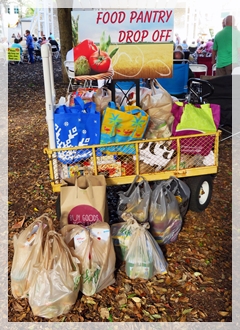 While tucking toothbrushes, dental floss, Band-Aids, and soap into shoeboxes already filled with pencils, notebooks, markers, tee-shirts, and toys, I thanked God, not just for the privilege of giving, but also that basic items like these are not a luxury in my world. In many parts of the world, however, they are! For example, our pastor just returned from Cuba where a sample-size tube of toothpaste costs the equivalent of $5 and is so sparingly squeezed that it lasts a family of four one month. The gifts he’d packed in his suitcase were simple drugstore items such as toothpaste, feminine hygiene products, and pain relievers, but the people who received those basics were as appreciative as if he’d delivered a treasure chest of gold and diamonds.
 In writing about change yesterday, I couldn’t help but think of the Apostle Paul. He knew firsthand of God’s transforming power. When we first meet Paul, he’s going by his Hebrew name of Saul and looking on as Stephen (the first of Christ’s followers to give his life for the gospel) is stoned to death.
 Devotions of the Heart