
 Listen, O heavens, and I will speak! Hear, O earth, the words that I say! Let my teaching fall on you like rain; let my speech settle like dew. Let my words fall like rain on tender grass, like gentle showers on young plants. I will proclaim the name of the Lord; how glorious is our God! [Deuteronomy 32:1-3 (NLT)]
My granddaughter recently received a summons to jury duty. Although she attended law camp last summer and just might do better than some jurors, at fourteen, she’s not qualified to serve. Trying to get her out of jury duty, however, appears to be easier said than done. Because the grand’s birth date is “invalid,” the on-line juror qualification questionnaire cannot be completed. Her mother’s call to the clerk resulted in being told that the youngster must come to the court house to prove her age by presenting them with her driver’s license. When it was politely pointed out that at fourteen she has no license, the clerk irately asked why she got the summons. “I don’t know; you’re the ones who sent it to her!” was all her mother could reply. Let’s hope jury duty is an excused absence from junior high because it appears that the district court does not want to take “No!” for an answer.
When God summons us, He doesn’t take “No” for an answer either. Moses was sure it was a mistake when God called to him from that burning bush. He protested by listing all of his inadequacies and God countered with His assurances and provision. In his final objection, Moses claimed to be an inarticulate tongue-tied speaker so God gave him Aaron to act as his spokesman.
Aaron, however, died before the Israelites reached Canaan and, in the book of Deuteronomy, we finally hear Moses speak. In his first speech (lasting four chapters), Moses gives an historical review of what brought the people to be standing on the plains of Moab across the Jordan River from Jericho. An articulate powerful account, it’s as inspiring as one of Billy Graham’s sermons. The next thirty chapters are equally moving as Moses summarizes the Israelites’ covenant obligations and blessings.
To the county clerk, my grand was merely a name and address but, as the one who made us, God knows everything about us. He knows our weaknesses and capabilities and, unlike government bureaucracy, His summons is never in error. God knew what He was doing when he called Moses and He knows what He’s doing when He summons us. Where we see liabilities, inability, inadequacy and failure He sees assets, possibility, ability, and promise.
I can’t help but think of A.A. Milne’s Christopher Robin and the words he spoke to his bear, Winnie-the-Pooh: ”There is something you must always remember. You are braver than you believe, stronger than you seem, and smarter than you think. But the most important thing is, even if we’re apart… I’ll always be with you.” Indeed, we are braver, stronger and smarter than we think and more capable than we can imagine. Moreover, like Christopher Robin, God is always with us. It is His faithfulness to us that empowers us to do His work.
When God puts a calling in our hearts, He won’t leave us stranded. He equipped and enabled Moses with wisdom and oratory skills and He’ll equip us. Moses’s final speech in Deuteronomy (ending with both a song and a blessing) rivals any motivational message given by Tony Robbins, Dave Ramsey, or Bear Grylls. When you doubt your abilities, remember that those eloquent words in Deuteronomy were spoken by a man who, because of his stammer and ineptitude at oration, considered himself unqualified. God knew better!
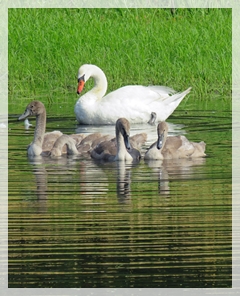 In his Small Catechism, Martin Luther instructs people to say the following prayer as soon they get out of bed: “God the Father, Son, and Holy Spirit watch over me. Amen.” When I watch my grands, it’s not just keeping the baby dry and fed, getting the toddler to use the potty and take his nap, getting the kids to school, preparing their lunch, or making sure that homework gets done. Watching over them is more than just supervising them and keeping them from destroying the house. It means protecting them—from dangerous objects, people, and activities. It’s keeping them from getting hurt or hurting anyone else. Sometimes it means stopping them in their tracks and other times it’s removing something from their reach. Watching them is wiping their tears, laughing at their jokes, and kissing their ouchies; yet, it is still more. It is leading by example, introducing them to new things, encouraging them and challenging them to become stronger and better. It is walking and talking with them and opening their eyes to the world around them. It is correcting, helping, comforting, loving, teaching and nurturing them.
 Several years ago, Pastor John, the youth pastor at our mountain church, shared his experiences while on a mission trip to Malawi, Africa. Here in the states, we expect our pastors to keep their messages to thirty-minutes so we can get a table at the Pancake House or arrive home in time for the game. In Monkey Bay, however, the pastor is likely to speak nonstop for two hours or more. Shortly before the day’s service began, the host minister, Pastor Paul, informed our young pastor that he would be speaking that morning. John quickly declined saying he hadn’t prepared a sermon. He usually worked several hours to prepare a Sunday message and was sure, without notes, he couldn’t possibly wing it for thirty minutes, let alone two hours. Pastor Paul was not to be rebuffed and insisted that John could and would do it. Paul assured him the words would come and, indeed, they did! Pastor John reported that he was still going strong two hours later! In spite of John’s fears, the words kept coming because he tapped into the power of the Holy Spirit.
 “You intended to harm me, but God intended it all for good. He brought me to this position so I could save the lives of many people. No, don’t be afraid. I will continue to take care of you and your children.” So he reassured them by speaking kindly to them. [Genesis 50:20-21 (NLT)]
 While visiting a church recently, the pastor announced a new security precaution: ten minutes after the service started, the outside doors would be locked from the inside and no one could enter the building. Yesterday afternoon, another church offered a four hour class for their congregation. Led by a private security company, topics included ways to identify threats, how to develop layers of security, and techniques for conflict resolution. While talking with my daughter about a recent school shooting in her area, I learned that my grand’s school has regular “lock-down” drills in preparation for such an attack. Is no place safe from violence?
 And now I have a word for you who brashly announce, “Today—at the latest, tomorrow—we’re off to such and such a city for the year. We’re going to start a business and make a lot of money.” You don’t know the first thing about tomorrow. You’re nothing but a wisp of fog, catching a brief bit of sun before disappearing. Instead, make it a habit to say, “If the Master wills it and we’re still alive, we’ll do this or that.” [James 4:13-15 (MSG)]
 Devotions of the Heart