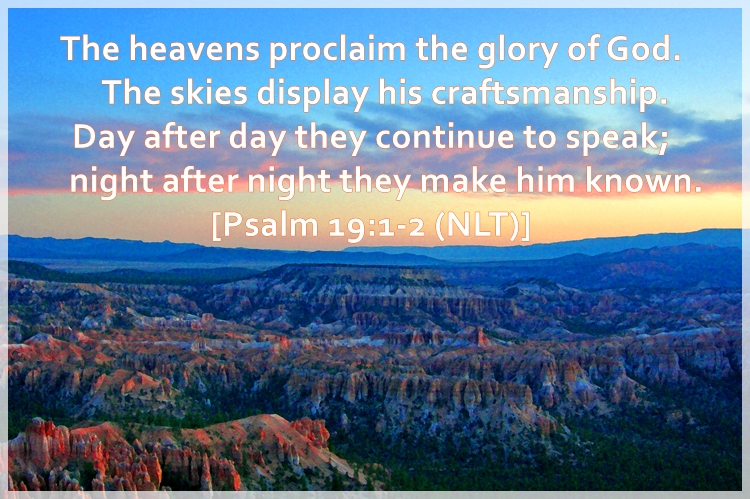
Bryce Canyon Sunrise

Bryce Canyon Sunrise
 If I told you that 88% of Americans own four or five of these, you’d probably think of televisions until I told you that less than a fifth of Americans actually use them regularly. It’s the Bible—almost all of us have more than one and yet few of us ever open it more than a few times a year.
It’s estimated that over six billion Bibles have been printed since Gutenberg printed the first one in 1454. Since then, the entire Bible has been translated into 554 languages and some portion of the Bible has been translated into 2,932 languages. Within our language, we can choose from a vast array of translations—from word for word versions such as the King James to thought for thought ones like the New Living Translation to paraphrase versions such as the Message. There are large print, study, chronological, life application, and even journaling Bibles (“Journibles”) that allow us to express our creativity with doodles and sketches on the page margins. For the younger generation, the Bible has entered the 21st Century with both the Kingstone Bible, which presents the Bible in graphic novel form, and the Emoji Bible – Scripture 4 Millennials, with its Unicode-approved emojis and internet slang and contractions. We have Bibles enough for every preference and faith—we just need Bible readers.
The Bible is the foundation of our faith—it’s our history, God’s love letter to us and our ode to Him. It’s our Lord’s biography, the Church’s handbook and our instruction manual for life. Today is the International Day of the Bible. At noon, local time, people of all ages are invited to celebrate the Bible, in public or online, by reading or creatively expressing their love of God’s word. While hoping that people will share favorite Bible verses with family and friends, the event’s sponsor, The National Bible Association, hopes for more creativity such as flash mobs, singing or dancing to Scripture, and artwork or photography that capture God’s glory and add a few lines of verse.
I don’t hold out much hope for a massive demonstration of Bible lovers because, according to a recent study by the Barna Group, only 37% of those who consider themselves “practicing Christians” regularly read the Bible and more than half read it only four times a year. If we love it so much, I wonder why we don’t read it more. Two-thirds of Americans say they would like to do just that but they just can’t find the time. Somehow, I think we can all find at least five minutes a day in our busy lives for God! Today, if you don’t share your love of the Bible with someone else, perhaps you will observe this day by pausing for a few minutes to open and read your Bible and to thank God for the privilege of reading His word. And, maybe, if you don’t already do so, you’ll commit to reading God’s word regularly.
When we open the Bible, it does not say to us, “Listen: God is there!” Instead, the voice of the Spirit whispers through each line, “Look: I am here!” [Chris Webb]
 Also, the Spirit helps us with our weakness. We do not know how to pray as we should. But the Spirit himself speaks to God for us, even begs God for us with deep feelings that words cannot explain. God can see what is in people’s hearts. And he knows what is in the mind of the Spirit, because the Spirit speaks to God for his people in the way God wants. [Romans 8:26-27 (NCV)]
In yesterday’s message, I wrote that a friend prays and yet I’m amazed how rarely that actually happens. Yes, a friend may pray for someone but how often do we, as friends, pray with that someone? Twice when visiting someone in hospital, a chaplain has dropped in to visit. Twice, the chaplain spoke briefly with us and then turned to leave without offering a prayer. Twice, I was the one who asked for prayer—one time for a prayer of thanksgiving and the other for one of strength and healing. Afterwards, I wondered why these hospital chaplains didn’t offer to pray with us. Isn’t prayer part of their job? As I started to point my finger, I saw three fingers pointing back at me and had to admit that I’m not one for offering spur-of-the-moment prayers either. I asked God not to allow me to leave a prayer unoffered or unsaid.
Last month, shortly after the second hospital incident, I was talking with a recently widowed friend. A trip with flowers to the cemetery had left her sad and teary-eyed. We hugged as I departed. I’d only taken a few steps toward my car when the Holy Spirit convicted me: “Here’s your opportunity—pray with her!” I turned back to my friend, held her hands and lifted her needs up to the Lord. I wasn’t eloquent and couldn’t remember any Bible verses; whatever I said was unremarkable, but that didn’t matter. The Holy Spirit knew my friend’s needs and lifted our prayers heavenward.
I’m a writer, not a prayer warrior, and offering prayer is way out of my comfort zone. My comfort, however, is not high on God’s priority list. Last week, while taking pictures in the park before worship service, I stopped to chat with a young woman who’s started attending our church. I know little about her except that she’s new to the area, belongs to a friendly Dalmatian, and is job hunting. As I stooped to get a photo of her dog, I asked how the job search was going. Answering that she’d not gotten the job for which she applied, I replied with a few encouraging words. When I stepped away to continue taking pictures, I realized my work was not done. Turning back, I asked, “Can we pray?” We held hands and I offered a quick prayer that God would lead this lovely woman to the right job opening. There was nothing memorable or eloquent about my words; they were, however, heartfelt and sincere.
It’s easy to say, “I’ll pray for you,” but a bit harder to actually do it. For many of us, it’s even harder to pray with someone right then and there, but isn’t that what all Christians (not just hospital chaplains) should do? The sincere agreement of two believers in prayer is powerful and effective because the Holy Spirit is with them, guiding their requests. Our prayers don’t have to be eloquent or deeply profound; they just have to be said.
Rich is the person who has a praying friend. [Janice Hughes]
 I admit to having left some church services feeling like I just “mailed it in” and that’s not the way to worship our wonderful glorious God. It’s been said that familiarity breeds contempt. In the case of familiar gospels, epistles, songs and liturgy, while familiarity may not breed contempt it may breed boredom. We’ve listened to the Benediction, Consecration or Absolution so often that we don’t even hear them and we’ve said the Lord’s Prayer, recited the Apostle’s Creed, or sung certain hymns so many times that the words exit our mouths without needing to pass through our hearts or minds.
When I studied theater, my instructors spoke about the “illusion of the first time.” Although the lines had been memorized, rehearsed and performed countless times, the audience was to feel that the actors were saying and hearing those words for the very first time. I’ve watched a young man at our mountain church who always sits in the front row. New to Christ, he worships with fervor and joy. Of course, it really may be the first time he’s heard that verse or sung that song. For those of us who may have heard, said and sung the same words thousands of times, sometimes it’s harder to stir up that sort of passion in our church experience. Perhaps we need to think about recreating that “illusion of the first time” during services so that our worship is as passionate today as it was when we first knew our Lord.
Knowing we have little choice over the service itself, how do we reignite the passion in our worship? Just like good acting, it takes a fair amount of effort and begins with our mindset before the show begins. Instead of getting into the inner workings of our character, we need to set our hearts and minds on God before the service starts. Most of us, upon settling into our seats, probably peruse the program, visit with our neighbors, or check out the attire and hairdos of our fellow worshipers. Although I was taught to pray as soon as I sat down, I often don’t (nor do the people around me). But, when I start with a prayer of thanksgiving for the opportunity to be at church and then ask God to clear my mind of the day’s concerns and open me to His presence, my worship is more enthusiastic and meaningful. Instead of chatting or checking our email before service, perhaps we should prepare the way of the Lord with prayer and by reading the words of the day’s hymns, part of the day’s liturgy, or a few Psalms from the Bible.
The audience is cheated when an actor just walks through his role and God is cheated when we wearily listen to or repeat words rather than putting our heart into His worship. Every time we worship Him, He should experience the “illusion of the first time.” To do that, we must listen, speak and sing with such passion, excitement and joy that it seems as if it is the first time we’ve ever heard, said or sung those words! The more we give Him, the more we’ll get from our worship!

In The Book of Common Prayer, Psalm 100 begins with the words, “O be joyful in the Lord, all ye lands; serve the Lord with gladness, and come before his presence with a song.” As a girl, I frequently read those words in my prayer book before worship began. I thought of them again last Sunday. Following the recessional, the visiting pastor exclaimed, “Our worship has ended, let our service begin!” During worship, I’d made a joyful noise and come before the Lord with a song. The minister’s words reminded me that now was the time to serve Him with gladness. The hour or so spent in worship on Sundays is just a small part of a Christian’s life. God blesses us with another 167 hours in the week. How will we choose to serve Him in that time?
Heavenly Father, thank you for the reminder that when our worship ends, the real work of furthering your Kingdom begins. May we not just hear your word, but comprehend it. May we not just say your word, but live it. Let your word turn into our works and cause our faith to turn into action. May we always serve you with gladness.
The greatest single cause of atheism in the world today is Christians: who acknowledge Jesus with their lips, walk out the door, and deny Him by their lifestyle. That is what an unbelieving world simply finds unbelievable. [Kevin Max]
I slept and dreamt that life was joy. I awoke and saw that life was service. I acted and behold, service was joy. [Rabindranath Tagore]
 I watched the snowy egret at the beach and couldn’t quite decide if he was an exceptionally smart bird, just plain lazy, or a little of both. Egrets are excellent fishermen and will wade in the shallows stirring up the water with their feet to flush out delicacies like fish, frogs, and crayfish. Other times, they exhibit great patience as they stand nearly immobile for several minutes just waiting for their prey to come near enough for them to strike and catch dinner.
This egret, however, wasn’t wading in the water; he was cruising the beach and visiting various fishermen. Cast netting for bait, the anglers were hurling their nets into the surf. While pulling in the bait-filled nets and dumping the contents in a bucket, a few of the minnows always fall out and that’s what this bird was awaiting. Apparently, he prefers carry-out to hunting and may even prefer shop-lifting if he snatches minnows out of the buckets. Clearly, he wants others to do the work while he reaps the benefits. I look at our churches and think we have a lot of people who are like that egret—people who are willing to let the other guys do most or even all of the work.
The early church devoted itself to learning from the Apostles, eating together, prayers, and fellowship. They didn’t just have fellowship, they dedicated themselves to it. Today, many church-goers would define Christian fellowship as having coffee with other parishioners before or after church. Fellowship in the first century, however, meant much more than that and continues to mean more today. Christian fellowship is concern and commitment to one another; it is caring for and sharing with one another. Moreover, we need to share more than our beliefs, activities, interests, communion or coffee. For true Christian fellowship, we need to share our responsibilities and work, especially if we are to fulfill the call to care for one another.
The volunteers at our church were recently recognized while the rest of the congregation stood and gave them a round of applause. Remembering that we don’t just attend a church but are part of one, rather than giving our church volunteers a hand, we need to think about giving them both of our hands, sharing in their responsibilities, and enjoying true Christian fellowship with our brothers and sisters in Christ!

