OUR PRAYERS

Sing praises to God, sing praises; sing praises to our King, sing praises! For God is the King over all the earth. Praise him with a psalm. [Psalm 47:6-7 (NLT)]

O what peace we often forfeit, O what needless pain we bear, All because we do not carry Everything to God in prayer! Have we trials and temptations? Is there trouble anywhere? We should never be discouraged, Take it to the Lord in prayer. [“What a Friend We Have in Jesus” by Joseph Scriven]

ZINNIA“That’s more like it!” I thought as I read Psalm 47; I certainly preferred it to the curses of the previous set of Psalms I’d read. I’m reading the Bible in chronological rather than in canonical order which means that the various books and chapters have been divided and rearranged. As a result, the psalms of lament and complaint were grouped together during David’s trials and the praise psalms were placed after the chapters outlining the duties in the Temple. These psalms of worship, adoration and thanksgiving seem more appropriate for Israel’s book of hymns than the earlier ones about wickedness, treachery, calamity and vengeance.

Although I prefer the joyful psalms, there is a reason Israel’s prayer book has lasted over 3,000 years and continues to be our prayer book today. Rather than a sappy feel-good book of poetry, Psalms reflects the gamut of human experience and emotions. When the disciples asked Jesus how to pray, I’m surprised He didn’t tell them they already knew and direct them to the Psalms for guidance. The Psalms’ words are intense, raw and honest; they conceal nothing. If the Psalmist is suffering, fearful, angry, depressed, or exhausted, he says so as readily as when he expresses his elation, adoration and thanksgiving. Never pretending that all is well when it isn’t, he fearlessly lays out his emotions before God. Wretchedness and joy, pain and jubilation, wickedness and virtue, despair and hope, grief and thanksgiving, fear and confidence: all are articulated. It is in that depth of personal expression and experience that we find words of consolation, faith, trust, and hope.

When I seriously evaluate my own prayer life, I’m nowhere near as honest and bold as the psalmists. Of course, God knows my personal struggles but, unlike David and the rest of the psalmists, I’m not as willing to lay them so passionately or openly at His feet. When Joseph Scriven wrote the words, “Take it to the Lord in prayer,” he meant all of it, not just the pretty stuff. I’m sure God would prefer honest words of grievance to false words of praise any day.

A human heart is like a ship on a wild sea, driven by the storm-winds from the four quarters of the world. Here it is struck with fear, and worry about coming disaster; there comes grief and sadness because of present evil. Here breathes a breeze of hope and of expectation of happiness to come; there blows security and joy in present blessings. These storm-winds teach us to speak with earnestness, and open the heart, and pour out what lies at the bottom of it. … What is the greatest thing in the Psalter but this earnest speaking amid these storm-winds of every kind? Where does one find such words of joy as in the psalms of praise and thanksgiving? … On the other hand, where do you find deeper, more sorrowful, more pitiful words of sadness than in the psalms of lamentation? … And, as was said, it is the best thing of all that they speak these words to God and with God. [Martin Luther, Preface to the Psalter]

The Lord is close to all who call on him, yes, to all who call on him in truth. [Psalm 145:18 (NLT)]

Copyright ©2018 jsjdevotions. All rights reserved.

SACRIFICES

I want you to show love, not offer sacrifices. I want you to know me more than I want burnt offerings. [Hosea 6:6 (NLT)]

And the King will say, “I tell you the truth, when you did it to one of the least of these my brothers and sisters, you were doing it to me!” [Matthew 25:40 (NLT)]

little blue heronA 2013 United Healthcare Group study found that volunteering is linked to better physical, mental and emotional health. Apparently it reduces stress, brings people together, promotes personal growth and self-esteem, strengthens our sense of community, and helps us learn new skills. Something their study did not mention is that volunteering is an act of worship and sacrifice. A sacrifice is an offering to God and every time we sacrifice time, talents, or resources by doing for His Kingdom, we are worshipping Him.
Because Jesus was the perfect and final sacrifice when He died for our sins, we no longer bring pigeons or sheep to God’s altar. Rather than dead animal sacrifices, we offer ourselves as living sacrifices, not to atone for sins but to worship our Lord. When we drop that envelope in the offering plate, give a dollar to a street person, write a check to a charity, or bring groceries to the food pantry, we’re really not giving to the church, homeless, Red Cross, or the hungry; we’re giving to God. When we lift a hammer at a Habitat home, sort clothes at the charity resale shop, pack lunches for the migrant workers, give someone a ride to church, visit the ill or assist at Sunday school, we are worshipping God with our service. Our sacrifice of resources, time, and talent is as much an act of worship as singing hymns or offering prayers of praise and thanksgiving.

The Old Testament often spoke of God being pleased with the aroma of a sacrifice. While our New Testament sacrifices are not burned on an altar and have no aroma, I think God finds them just as pleasing to His senses. When those ancient sacrifices were not the first and best or were accompanied by a bad attitude, God found a stench to them. It would seem to follow that when our Christian sacrifices are offered begrudgingly or we fail to give the best we can, our hypocrisy will cause them to stink, as well.

Let us worship the Lord with our hearts and hands as well as our voices! Let us joyfully worship Him with service as well as with song!

And so, dear brothers and sisters, I plead with you to give your bodies to God because of all he has done for you. Let them be a living and holy sacrifice—the kind he will find acceptable. This is truly the way to worship him. [Romans 12:1 (NLT)]

Therefore, let us offer through Jesus a continual sacrifice of praise to God, proclaiming our allegiance to his name. And don’t forget to do good and to share with those in need. These are the sacrifices that please God. [Hebrews 13:15-16 (NLT)]

Copyright ©2018 jsjdevotions. All rights reserved.

THE TITHE

One-tenth of the produce of the land, whether grain from the fields or fruit from the trees, belongs to the Lord and must be set apart to him as holy. [Leviticus 27:30 (NLT)]

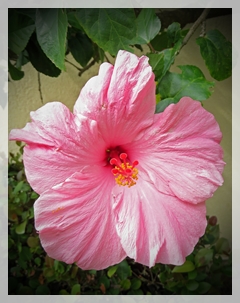
HibiscusTithe means ten percent and the Jews were required to give ten percent of all they earned or grew as part of their worship. Because there were three required tithes, the actual percentage given was more like 23%. One tithe went to the Levites, another was for the use of the temple and religious festivals, and a third one, required every third year, was for the poor. Although no tithes were collected from the land on the seventh (Sabbath) and 50th (Jubilee) years or when there was drought or famine, tithing was mandatory at any other time and the Israelites got in trouble with God when they didn’t fulfill this obligation.

With His sacrifice on the cross, Jesus fulfilled all of the requirements of the old law. As Christians, we’re no longer obliged to visit Jerusalem for the festivals of Passover, Shavuot, or Sukkot nor do we observe Yom Kippur. We don’t keep the Jewish dietary and butchering regulations, light Shabbat candles, refrain from work on the Sabbath, or require circumcision. Like tithing, those are the laws of the Old Covenant and Jesus brought us a New Covenant. Nevertheless, there are some Christian pastors who think that one specific Old Testament law remains: tithing.

In effect, the Old Testament tithe was an involuntary tax and no one I know cheerfully pays his or her taxes. Searching for every loophole, they may even employ some “creative accounting” to lessen their payment. When we think “tithe,” we can easily start nit picking and hair splitting like the Pharisees. Are we talking before or after income taxes? Can we take off tuition for a Christian school, medical expenses, property taxes or business expenditures? What about mileage to and from church? Is the tithe for our parish or the church at large? What about faith-based causes like World Vision, the Gideons or Samaritan’s Purse—are they part of the tithe? Can good causes that aren’t faith based, like the local food pantry or homeless shelter, qualify? Perhaps the greatest problem with tithing is that we begin to think that only 10% of our money is God’s when, in fact, it all belongs to Him! Moreover, He also owns our time and talents and how do we measure ten percent of those? The tithe can become what Randy Alcorn calls the “finish line” instead of the “starting block” for our giving.

If we don’t tithe, how do we decide how much to give? A pastor friend gives the perfect answer: we pray! We simply ask God exactly how much He wants us to give and how and where He wants us to give it. In obedience to Him, we then commit our resources—our finances, time, and talent—as He directs. What we don’t do is base our giving on feelings, recognition we may be given, or the entertainment value of the pastor’s sermons. Offering our first fruits rather than our leftovers, we don’t give thoughtlessly, randomly, or grudgingly. We base our giving on God’s principles of stewardship and use His gifts wisely to expand His kingdom. Whatever He tells us to give, we give joyfully and with thanks—remember, it’s all His!

You must each decide in your heart how much to give. And don’t give reluctantly or in response to pressure. “For God loves a person who gives cheerfully.” [2 Corinthians 9:7 (NLT)]

Wherever your treasure is, there the desires of your heart will also be. [Matthew 6:21 (NLT)]

Copyright ©2018 jsjdevotions. All rights reserved.

PICTURING GOD

sunriseAfter his baptism, as Jesus came up out of the water, the heavens were opened and he saw the Spirit of God descending like a dove and settling on him. And a voice from heaven said, “This is my dearly loved Son, who brings me great joy.” [Matthew 3:16-17 (NLT)]

 A little boy was busy with his crayons and a large sheet of paper. When his mother asked what he was drawing, he proudly answered, “I’m drawing a picture of God.” The mother tried to explain: “But sweetie, no one has seen God so we don’t know how he looks.” Smiling proudly, the boy continued coloring and reassured his mom. “Well, they will when I get done!”

That story reminded me of last Sunday’s sermon. In honor of Trinity Sunday, our pastor asked us how we picture God the Father, God the Son, and God the Holy Spirit. Had there been any children present, I wouldn’t have been surprised if one had described him as an old gentleman with a flowing beard, wearing a white robe, and sitting on a golden throne. Actually, I was a little surprised that no one said they picture God as Morgan Freeman, George Burns, or even Octavia Spencer. Instead, people shared how they saw or felt God’s presence in things like babies, sunrises, rainbows, and sunsets.

When asked about Jesus, no one described the man who walked the dusty roads of Judea, wept at the tomb of Lazarus, or reassured the doubting Thomas. Instead, they spoke of seeing Jesus in actions like love, sharing, forgiveness, service, and sacrifice. As for the Holy Spirit, people described hearing His still small voice in things like insight, inner conviction or experiencing a compelling force.

Our assignment for the week was to become more aware of our triune God’s presence in our lives. Early Tuesday morning, my husband called to me while I was reading Scripture in my windowless office. When I looked out the east facing window I understood his urgent call: the sunrise was absolutely majestic. As our Creator God announced Himself, remembering Sunday’s sermon, I responded to God’s proclamation by finishing my prayers on the deck while watching the sun rise. The show in the sky was accompanied by a heavenly chorus of robins, wrens, sparrows and cardinals. Our Triune God made His presence known and felt.

I had a pastor who used to start her morning prayer with, “Good morning, Lord. It’s so nice to see your face.” I hadn’t thought about the fact that she was looking out at the congregation when she said those words. Indeed, she was seeing God the Father, God the Son, and God the Holy Spirit in the sea of faces before her. We are, after all, made in His image, saved by His blood, and filled with His Spirit.

As for that little boy’s picture: I don’t know if he drew a grandfather, a sunset, a long-haired man in robe and sandals, a hospice volunteer, a breeze, or a dove descending from the sky. Perhaps he drew Jesus’ baptism when all three of the Godhead were present. The youngster is probably too young to understand the Trinity but I hope, in his own unique way, he found a way to incorporate three beautiful images into one. Praise Father, Son and Holy Spirit!

May the grace of the Lord Jesus Christ, the love of God, and the fellowship of the Holy Spirit be with you all. [2 Corinthians 13:14 (NLT)]

May the grace of the Lord Jesus Christ, the love of God, and the fellowship of the Holy Spirit be with you all. [Matthew 28:19 (NLT)]

Copyright ©2018 jsjdevotions. All rights reserved.


NOT A DRY EYE

You learn more at a funeral than at a feast – After all, that’s where we’ll end up. We might discover something from it. [Ecclesiastes 7:2 (MSG)]

black swallowtail - butterflyAt my age, I’ve attended a fair share of funerals and they’ve run the gamut from full-blown productions complete with video presentations and choirs to a few mourners on a windy ski slope with a bag of ashes. Some ministers knew the deceased well and others couldn’t even pronounce the name correctly. There have been inspiring prayers and eulogies and some with no prayer at all. They’ve taken place in jam-packed churches and nearly empty mortuary chapels. Solomon was correct; there is a lot we can learn at funerals.

I’ve learned how much we miss when we don’t take the time to truly know someone. I discovered more about one woman from her obituary and eulogy than I did from 30 years of socializing with her. Her funeral showed me how little we really know about people we call “friends” and how superficial our friendships can be.

I’ve learned how empty some lives have been. When asked to do the eulogy for a distant family member, I was given a list of the five things of which he was most proud, the high point being a 4-H trophy awarded some seventy years earlier. He made no mention of family, friends, faith, or love. As I looked out over the mourners, there were no friends and only a few family members who attended out of a sense of obligation.

As we released butterflies following the joyous and love-filled celebration of life of another family member, I learned about courage and how much faith, love, family and friends can guide someone in life and through the dark valley of death.

I’ve learned how much a parent’s love and guidance can influence his children after hearing a son speak eloquently at his father’s funeral. I was reminded of how fragile life can be and, upon returning home, called every family member just to tell them I loved them.

I’ve learned that communities can come together with offerings of food, comfort and support and that families can be torn apart by resentment, jealousy, and greed. A funeral not only reminds us all of the inevitability of death, it can teach us how to live. If nothing else, we return home appreciating each day just a little more.

Good and brave men buried Stephen, giving him a solemn funeral—not many dry eyes that day! [Acts 8:2 (MSG)]

Copyright ©2018 jsjdevotions. All rights reserved.

DORMANCY

God, make a fresh start in me, shape a Genesis week from the chaos of my life. Don’t throw me out with the trash, or fail to breathe holiness in me. Bring me back from gray exile, put a fresh wind in my sails! [Psalm 51:10-12 (MSG)]

Corkscrew swamp - cypress - dormantEarlier this year, upon seeing the browning and nearly naked cypress trees at the bird sanctuary, the visitor asked if Hurricane Irma had killed them. I explained that the bald and pond cypress weren’t dead, just dormant. Being deciduous, they shed their leaves annually and were just enjoying a much needed rest during the shorter days and dryer conditions of winter. I reassured her that, in a month or so, their bright green needles would return and new growth would sprout from their branches. Today, the forest is verdant throughout the swamp.

While it is possible to force trees to evade dormancy by keeping them inside and controlling the light, temperature and water conditions, it would greatly shorten the plant’s lifespan; they’re not meant to leaf and branch continually. Dormancy is vital for the survival of deciduous trees and the way they withstand unfavorable growing conditions. When better conditions return, the trees wake up and start to bud and blossom again.

While dormancy is good for trees, dormancy is not usually considered a good thing when applied to Christians. A study in Great Britain found that 55 percent of those who identify themselves as Christian never read the Bible, 29 percent never pray, and a third of them don’t even attend church; it called these people “dormant Christians.” When God’s word isn’t growing in our hearts or we fail to bear the Fruit of the Spirit, some people say we’re in “spiritual dormancy.” Superficial, uncommitted, wilting or dying faith like this seems more a case of failure to thrive than dormancy. Just because growth isn’t obvious when a tree is dormant doesn’t mean nothing is happening. Dormancy is when the tree gathers strength, prepares for leafing and branching, and is the best time for pruning in preparation for new growth!

I’ve seen too many people lose their zeal for Christ because they haven’t taken a rest from their busyness for Him to spend time abiding in Him. It’s often when they’ve forgotten to spend time in His rest that their spiritual lives go dead. Sometimes, like trees, we need to retreat into dormancy to rest, do some pruning, and prepare ourselves to take our next steps in God’s ministry. Even Jesus took time away from His ministry for prayer and guidance.

During these next few months, my husband and I will be travelling a great deal. While I remain committed to prayer, worship, study, and journaling, there will be times when writing and posting will be difficult, if not impossible. Last year, I solved this problem with some “summer re-runs.” Knowing how refreshed and enthusiastic I felt upon my return to writing, I think dormancy is a far better term. So, like the cypress trees that go dormant in adverse conditions, I will take a break when circumstances are not conducive to writing. Unlike the trees, however, I won’t change color or shed my needles in preparation for dormancy. Instead, I’ve selected a few old devotions to repost and, with over 1,500 devotions from the last four years, I have plenty from which to choose. Throughout the next few months, they will be scattered in among new ones. So, if you see a devotion you’ve read before, don’t worry; I’m not dead, I’ve just gone dormant!

God, my shepherd! I don’t need a thing. You have bedded me down in lush meadows, you find me quiet pools to drink from. True to your word, you let me catch my breath and send me in the right direction. [Psalm 23:1-3 (MSG)]

I’ll refresh tired bodies; I’ll restore tired souls. [Jeremiah 31:25 (MSG)]

Copyright ©2018 jsjdevotions. All rights reserved.