
If you love those who love you, what credit is that to you? Even sinners love those who love them. And if you do good to those who are good to you, what credit is that to you? Even sinners do that. And if you lend to those from whom you expect repayment, what credit is that to you? Even sinners lend to sinners, expecting to be repaid in full. But love your enemies, do good to them, and lend to them without expecting to get anything back. … Be merciful, just as your Father is merciful. [Luke 6:32-35a,36 (NLT)]
 One of the hymns at our Easter Eve service was Christ is Alive and we sang, “In every insult, rift and war, where color, scorn or wealth divide, Christ suffers still, yet loves the more, and lives, where even hope has died.” I thought of how hate must be like another nail in His hands and intolerance another scourging on His skin. The text of the hymn was written by Brian Wren in April of 1968, just two weeks after the assassination of Martin Luther King, Jr. “I could not let Easter go by without speaking of this tragic event which was on all our minds, “ he explained. “The hymn tries to see God’s love winning over tragedy and suffering in the world.”
Little did I know while singing those words that, just a few hours later, there would be tragedy and suffering half-way around the world in Sri Lanka. Coordinated bombings at three churches and four hotels turned Easter Sunday into a blood bath leaving more than 300 people dead and 500 injured. A Sri Lankan Sunday school class at Zion Church met before the service that morning. When their teacher asked, “How many of you are willing to die for Christ?” all of the children raised their hands. As they rededicated themselves to Jesus by lighting candles, little did they know that half of them actually would die for Christ that very morning. As they crossed a courtyard to enter the sanctuary, a stranger exploded the bomb he was carrying in his backpack.
Last week, bullets ripped through a peaceful Passover service at a synagogue outside of San Diego, leaving one dead and three inured. Exactly six months earlier, 11 people were killed at a Pittsburgh synagogue. In March, at least 50 were killed and 20 injured in shootings at two mosques in Christchurch, New Zealand. In January, two suicide bombers detonated their bombs in a Catholic church in the Philippines, leaving 20 dead and more than 100 injured. Last October, a gunman attacked a Sabbath service in a Pittsburgh synagogue, leaving 11 dead. The heart of God must be filled with grief at these horrific acts of terror and hate.
We live in a fallen world—a world where war, pain, injustice, violence, anger, and prejudice abound. As we mourn the loss of innocent lives, we must resist the temptation to return hate with even more hostility. Just as we pray for their victims, we must also pray for the extremists who perpetuate these terrible attacks. The war on terror isn’t just a political battle; it’s a spiritual battle against the Prince of Darkness.
Let us remember that Christ’s message is one of love and love is more powerful than hate. As a nation, we must work to resolve the social and political issues that encourage terrorism but, as Christians, peace must begin with us. We are called to love everyone—not just the people with whom we agree. Rather than living in fear, as Christians, we must live in hope. Let us be people of prayer against the ungodly hatred and violence of our world. We must extend the hand of friendship and love to all people, not just the ones who think, look, speak, and worship like us.
“Christ is alive!” we sang at that Easter service. “The cross stands empty to the sky. Let streets and homes with praises ring. Love, drowned in death, shall never die.” Let us answer the hate of the world with His love!
At some ideas you stand perplexed, especially at the sight of human sins, uncertain whether to combat it by force or by humble love. Always decide, “I will combat it with humble love.” If you make up your mind about that once and for all, you can conquer the whole world. Loving humility is a terrible force; it is the strongest of all things and there is nothing like it. [Fyodor Dostoyevsky from “The Brothers Karamazov”]
 Last Thursday night’s Bible study had been as inspiring as Easter Sunday’s sermon. As we walked out of the building, I confided to my friend that there was no way I could follow such brilliant preaching. You see, our pastor was taking a much needed vacation and I would be doing the preaching for the next two Sundays. Afraid I couldn’t possibly fill his shoes or touch people’s hearts the way he does, I asked, “How can I possibly compare to him?” My friend wisely answered, “You don’t!” He reminded me to be myself and let the Holy Spirit do the rest.
 When I was a little girl, I once went to mass with my Roman Catholic cousins. Before leaving for church, my mother pressed two shiny quarters into my hand. “For the offering,” she reminded me. Part way through the service, long-handled offering baskets were extended down each row and people dropped their offering envelopes and money into them. “Who will know?” I thought as I reached into my pocket and pulled out just one quarter for the offering. Almost immediately, another basket came down our row. “God saw me!” I thought in a panic. “God knows I was holding out on Him and now the priest has sent the basket back.” I quickly reached into my pocket for the second quarter. As I dropped it into the basket, I heaved a great sigh of relief; I was safe from Hell for at least one more day. My only consolation was that I clearly wasn’t the only sinner; other people had dropped money into that second basket. Looking back, I think the second basket probably was for a special offering of some kind. To my child’s mind, however, that second basket was for those of us who hadn’t given God what belonged to Him.
 Yesterday, I wrote about Cyrus Teed, the Koreshan Unity, their strange theology, and Cellular Cosmogony: the belief that the earth is a hollow shell and the entire universe exists inside that shell. Whether he was a charlatan or insane fanatic, Cyrus Teed claimed to be immortal. When he died in 1908, his followers kept his body in a bathtub for five days and waited for his resurrection. Rather than rising, Teed began to stink and authorities forced his corpse to be buried. Nevertheless, many of his followers faithfully waited another thirteen years for his return.
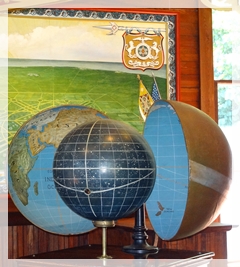 Just north of us is a state park that once was home to a group called the Koreshan Unity. In 1894, Dr. Cyrus Teed, known as the Prophet Koresh, brought about 250 of his followers to the banks of the Estero River where they hoped to establish a “New Jerusalem.” The Koreshans believed that the Bible needed prophets to interpret it and that Teed was the seventh in a line of biblical prophets. As the designated prophet, Teed would reveal everything about the universe that Jesus failed to explain. Taking verses out of context from both testaments of the Bible, the Koreshans believed in reincarnation, communal living, heaven and hell, immortality, and celibacy.
 In the denominational church we attend Saturday nights, we celebrate Communion every week. As part of the liturgy, the congregation is invited to join in a corporate general confession. The pastor then tells the congregation that, in the name of Jesus Christ, they are forgiven. The congregation responds with the words, “In the name of Jesus Christ, you are forgiven!” New to this denomination, at first I wondered, “Does the pastor need the entire congregation’s forgiveness?”
 Devotions of the Heart