
Preach the word of God. Be prepared, whether the time is favorable or not. Patiently correct, rebuke, and encourage your people with good teaching. [2 Timothy 4:2 (NLT)]
 When writing about dance yesterday, Footloose came to mind. This 1984 movie was about a small Midwestern town that had banned dancing and rock music. A pivotal scene in the movie occurs when the young hero, played by Kevin Bacon, reads off several Bible verses in an attempt to convince the city council that God approved of dance. I used some of the same references in yesterday’s devotion. The young man, however, was way off base because the verses he cited were about sacred dance rather than social dancing. He didn’t want to worship the Lord; he wanted to have a senior prom!
Kevin Bacon’s character did something almost all of us do at one time or another: misinterpreted scripture by taking it out of context. We usually do this for one of two reasons. Either we come to the Bible with a preconceived notion of what it says or we come wanting to find a verse to support our viewpoint. In either case, we’ve drawn a conclusion before looking at all of the evidence.
For example, to support existing prejudice, rather than the sacred mark of protection it was, racists have interpreted the “mark of Cain” as the curse of black skin. To justify slavery of blacks, they wrongly interpreted Noah’s curse on Ham’s son Canaan as that of blackness and servitude. If we wanted to justify drunken revelry, I suppose we could cite Jesus turning all those jugs of water into wine at Cana. We wouldn’t mention the length of the feast, the number of people present, or that He was saving the groom’s honor. Jesus wasn’t promoting drunkenness at Cana any more than he was promoting gluttony when he turned a few fish and loaves into an excess of food for 5,000. Nevertheless, we could make it sound that way!
One of the most frequently misinterpreted verses is Jeremiah 29:11: “For I know the plans I have for you, declares the Lord, plans for welfare and not for evil, to give you a future and a hope.” The Hebrew word translated here as welfare was shalom, meaning peace, completeness, and soundness. While most updated translations use “welfare” or “peace” for shalom, some Bibles still render it as “prosper” and those are the translations used by prosperity gospel proponents. The completeness of the word shalom, however, wasn’t found in possessions or wealth; it was found in a relationship with God—the one who makes us complete. Moreover, a quick look at the context tells us this was not a promise made to everyone. It was made specifically to the Jewish people who had been exiled to Babylon and would remain there for seventy years. Rather than a promise of wealth and health for all, this was God’s promise to Judah that, at the end of their judgment, He would bring them back to their land where they would have a future and a hope.
We must be cautious of reading our own presuppositions into the text or of cherry-picking verses out of context to support our opinions. It comes down to two fancy words: exigesis and eisegesis. Exigesis is drawing the meaning out of the text through careful reading (which is good) but eisegesis is reading meaning into the text (which is bad)! The first is objective and seeks to find the true meaning while the second is subjective and seeks to make a point. Although he didn’t know it, Kevin Bacon’s character in Footloose committed eisegesis. While it made for a good story, his was faulty reasoning and bad theology. God has entrusted us with His truth; let us be good workers and handle His word wisely, honestly, and carefully.
 My day’s reading brought me to 2 Samuel 6 when David, accompanied by the blowing of ram’s horn trumpets and shouts of joy, brought the Ark back to Jerusalem. Having stripped himself of his kingly robes, he wore a linen ephod and unabashedly spun, leapt, and danced his way into the city. After observing her husband’s uninhibited dancing, Michal chided him for his un-kingly attire and undignified behavior. David replied that he was dancing for God, not her and his goal was not to please people. He was dancing to please God.
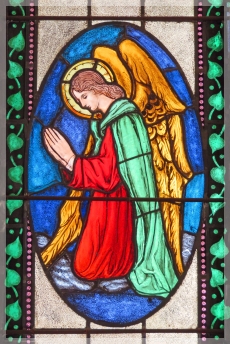 Sunday, we will light our Advent wreath’s fourth candle—the purple one known as the angel or love candle. We’ll read Nathan’s prophecy in 2 Samuel that David’s kingdom would continue forever. Although we know that David’s earthly dynasty ended some 400 years after Nathan’s words, God’s promise was fulfilled in Jesus—David’s direct descendant who now reigns forever. Jesus is tied to the Old Testament prophecies in two selections from Luke 1 in the angel’s words to Mary that her son, a descendant of David, would reign over Israel and His kingdom would never end and Mary’s beautiful song of praise known as the Magnificat in which she expresses her understanding that God is fulfilling His promises with the birth of her son.
 When we moved to southwest Florida several years ago, everything was new and strange—we didn’t know which farmer’s market had the finest produce, the best routes to avoid traffic, the amenities of each beach, the fun activities available, or where to hike or bike. Rather than be confused and discouraged, we got out the guidebooks and maps and enthusiastically started exploring—churches, parks, theaters, markets, beaches, and museums. Every day became an adventure and, as we got to know our community, we came to love it.
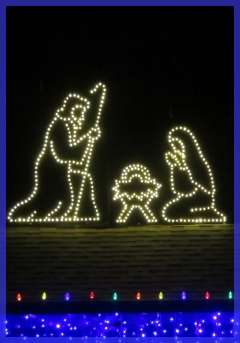 Two nights ago, we joined a long line of vehicles slowly wending their way through a nearby neighborhood famed for its over-the-top holiday light display. Each street follows a theme and over 300 homes are brightly decorated. The streets were aglow with meteor shower, icicle, garland, fairy, net, star, blinking, ball and laser lights along with illuminated blow molds, inflatables, and cut-outs of everything from Santa exiting an outhouse to the Grinch, igloos to elves, and candy canes to Olaf and the Minions. As bright as that neighborhood’s display was, it pales in comparison to one done by the Gay family in Lagrangeville, NY. Holders of the Guinness world record for holiday lights on a residential property, their 2020 display uses more than 670,000 lights that are choreographed to 256 songs.
 Colors have been used to differentiate liturgical seasons since the 4th century and, by the 12th century, Pope Innocent systemized their use in the church. Originally Advent was about penance, prayer and fasting in preparation for baptism so purple (the color associated with sacrifice and repentance from sin) was its liturgical color. Like the Advent wreath, however, liturgical colors are merely traditions and have no basis in Scripture. Most denominations have added more colors to the original five.
 Devotions of the Heart