
 Just as our bodies have many parts and each part has a special function, so it is with Christ’s body. We are many parts of one body, and we all belong to each other. [Romans 12:4-5 (NLT)]
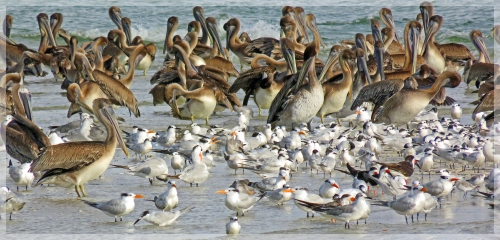
Even though we now live in the land of forever summer, I know autumn is upon us—and not just because nearly everything from lattes, tea, and donuts to English muffins, gelato, and Cheerios comes in pumpkin spice! The migratory birds (both feathered and human) have begun to arrive. Birds of a feather really do flock together as evidenced by the number of brown pelicans and terns gathering by the hundreds on the beach. Soon other birds like belted kingfishers, sandpipers, and grebes will arrive en masse.
Flocks of birds also signaled autumn when we lived in the north—only they were leaving rather than arriving! A nearby park served as a “staging area” for Canada Geese and Sandhill Cranes, which means that the normal bird population swelled as hundreds of geese and cranes congregated there to gorge themselves in preparation for their challenging flight south. Once they’d eaten their fill, it was a magnificent sight to watch as these beautiful birds took to the sky in unison to continue their journey south.
Without knowing a thing about aerodynamics, wingtip vortices, updrafts, or reducing drag, those birds know enough to conserve their energy by flying in a V-formation that reduces wind resistance and takes advantage of wind currents. The lead bird does most of the work and, when he tires, he moves back and lets others take their turns. The V-formation also allows the birds to see the rest of the flock, preventing them from crashing into one another and enabling them to spot a bird in trouble. It’s been said that when a goose gets injured or falls behind the group, at least two others from the flock will join it. These beautiful creatures instinctively know there is strength in unity and safety in numbers.
As it is for those birds, the journey we are on is not a solo one. As Christians, we also are members of a flock. Unlike the birds, we don’t look like one another or sing the same song, but we all are on a journey that is not meant to be a solo one. Church is more than the place we meet for Sunday services; it’s the Christian’s version of a “staging area.” It’s where we meet others in the flock, gain strength by feeding on God’s word, and help one another as we move forward.
As part of Jesus’ flock, we depend on one another as much as do those migratory birds. We need our flock to reduce the drag when we encounter a head wind, refresh us when we grow tired, urge us on when we lag behind, and lift us when we’ve fallen. We break bread together, share resources and responsibilities, and teach and learn from one another. Our brothers and sisters in Christ not only encourage, comfort, and pray with and for us, but they also hold us accountable for our behavior. Like those migrating birds, we need the flock as much as it needs us.
Some Christians try to go to heaven alone, in solitude. But believers are not compared to bears or lions or other animals that wander alone. Those who belong to Christ are sheep in this respect, that they love to get together. Sheep go in flocks, and so do God’s people. [Charles Spurgeon]
 We’d gathered for coffee when the conversation turned to tipping. Several who had been servers at one time or another mentioned what notoriously bad tippers church people seem to be. Rather than a tip, some only leave a religious tract. A barista admitted removing any she finds in the tip jar because her fellow workers find them incredibly offensive. Rather than bringing anyone to Jesus, they serve to further distance non-believers from any church!
 And I will ask the Father, and he will give you another Advocate, who will never leave you. He is the Holy Spirit, who leads into all truth. The world cannot receive him, because it isn’t looking for him and doesn’t recognize him. But you will know him, because he lives with you now and later will be in you. [John 14:16-17 (NLT)]
 “To whom should we pray?” is a common question. People wonder, “If we pray to God the Father, are we leaving out His Son? But if we pray to Jesus, are we leaving out God? And where does the Holy Spirit fit in?”
 Along with proclaiming the Word of God, the young Church was committed to ensuring that there were no needy among them. As a result, many of the early believers voluntarily sold their property and shared their wealth with the rest of the church community. Barnabas, for example, sold a field he owned and generously brought the money to the apostles for those in need.
 A popular mystery writer, frequently on the best seller list, now writes most of his books in collaboration with another author. Several years ago, after reading one of his joint efforts, I stopped reading his work entirely. While I never expected a literary masterpiece, the mystery was unrealistic, implausible, and the chapters unconnected. Although it’s said that he sets the plot line and there is an intense back-and-forth between the authors, it didn’t seem that way to me. It was as if the two authors alternated chapters and, at the end of their chapter, each deliberately threw in some farfetched character or event as a way of challenging the other to make sense of it. Having a plot outline certainly didn’t mean continuity or structure in their book.
