
The stone that the builders rejected has now become the cornerstone. This is the Lord’s doing, and it is wonderful to see. [Psalm 118:22-23 (NLT)]
 After telling the Parable of the Two Sons, Jesus told one about the Evil Farmers. As parables go, it’s pretty easy to follow. The landowner (God) builds a vineyard (Israel), sets up a protective wall (the Law), and leases it to tenant farmers (religious leaders). When he sends his emissaries (faithful priests and prophets) to collect his rent, the farmers ignored, mistreated and even killed them. The landowner, thinking the farmers would respect his son (Jesus), sends him to the vineyard. Wanting the estate for themselves, the farmers murder him. When Jesus asked his listeners (who were the chief priest and elders) what the landowner would do to the famers when he returns to his land, they responded that he’d kill the tenants and lease the vineyard to new farmers who would honor him with his share of the crop.
It was then that Jesus asked his audience if they were familiar with today’s verse from Psalm 118: “The stone that the builders rejected has now become the cornerstone.” When we encounter the word cornerstone in the Bible, there is some disagreement as to whether it is referring to a cornerstone—the first stone in a building and part of the foundation—or a capstone—the last stone that completes a building. The Hebrew literally means head of a corner so the exact meaning is unclear. Since Jesus is the Alpha and Omega—the first and last—perhaps both meanings apply. He is both the foundation upon which the church is built and the capstone which crowns the whole.
Regardless, in this context, the transition from a metaphor about a vineyard and evil farmers to one of architecture seems odd. Then again, we’re not first century Jews who would have been familiar both with Psalm 118 and the ancient rabbinic legend about the stone the builders rejected. When the first temple was being built, the stones were carefully cut at a quarry several miles away from Jerusalem. Although each stone was shaped to fit perfectly into place at the temple, the story is that the first stone to arrive didn’t seem to fit anywhere. Oddly shaped, the builders tossed it aside where people stumbled over it and weeds grew around it. When construction was nearly complete, it was time to place the final stone, the great lintel, in place over the doorway to the inner sanctuary of the tabernacle. Supported by scaffolding until then, once the capstone was placed, it would stand by itself. The builders, however, could not find the necessary stone. When they sent to the quarry for it, they were told they’d already received it. It was only then that they remembered the stone the builders had rejected. Retrieved from the weeds, it slid perfectly into place. As the capstone of the Temple, it held all the other stones in their proper position.
Just in case the religious leaders missed His point, Jesus told them that, like the vineyard, the Kingdom of God would be given to a new nation who would produce proper fruit. Changing metaphors back to the stone, He warned, “Anyone who stumbles over that stone will be broken to pieces, and it will crush anyone it falls on.” [Matthew 21:44] Until I learned the legend of the rejected stone, this verse troubled me—how could someone trip over a stone that also could fall on him? That rejected stone, however, could do both!
In this exchange, Jesus was telling the religious leaders that He was both the landowner’s son and the stone rejected by the builders—the very ones who should have recognized Him. His final words were a clear warning that the Kingdom of God could not be built without Him. Those who didn’t build on His truth would stumble over it and break while those who tried to pull it down would be crushed by it and destroyed!
 “It’s all about getting a second chance!” said the back of the man’s T-shirt. I then saw the dog paws printed on both sides of the message and realized his shirt was advertising a dog rescue organization. Nevertheless, the shirt’s words made me think of the parable Jesus told the Pharisees about two sons. The vineyard owner told his sons to go work in the vineyard. The first son rudely refused but the second son respectfully promised he’d do the work. As it turned out, the defiant son had a change of heart and went to work in the vineyard while the second seemingly dutiful son never did. Jesus then asked the Pharisees which of the two sons had done his father’s will. Of course, they had to say that the first son, in spite of his initial rebellion, was the obedient one.
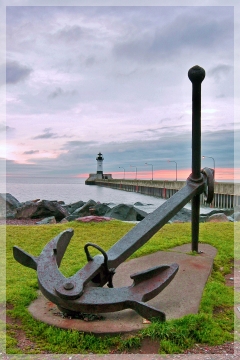 The sign in front of a nearby church read, “Our hope is anchored in the Lord,” which got me thinking about anchors. I’d never given them much thought until we took a Windjammer cruise off the coast of Maine many years ago. Accompanied by four friends and a crew of two, we sailed for a week. At dusk, we’d lower the sails and anchor in a harbor for the night. After breakfast, we’d pull up anchor for another relaxing day of sailing by lighthouses, granite cliffs, fishing villages, and even a few seals. One day, however, gale force winds replaced the gentle breeze and the calm sea turned violent. The sky darkened as rain and hail poured down on us. We immediately pulled into the nearest inlet, lowered the sails, and dropped two anchors to keep from being blown into the rocks! If we’d had two more anchors (as did the sailors in Acts 27), I suspect we would have dropped them, as well. After donning my life jacket and slicker, all I could do was pray and hope those anchors held. You really don’t appreciate the worth of an anchor until you’ve needed one in a storm!
 In all three accounts of Jesus healing the paralytic whose friends carried him to the Lord, Jesus forgave the man before healing him. While the combination of both forgiveness and healing demonstrated Jesus’ power over both sin and disease, His offer of forgiveness before healing might lead us to think there is a causal relationship between sin and sickness or forgiveness and physical healing.
 When Jesus forgave the unnamed woman’s sins, he caused quite a stir among the Pharisees and religious leaders who were His fellow dinner guests. People can forgive an offense against them, but they can’t forgive an offense against someone else or God! While I can forgive your $10 debt to me, I have neither the right nor the power to say you don’t have to pay the $150,000 you also owe the Bank of America, Sallie Mae, Capital One and Chase for your mortgage, college loan, car financing, and credit card purchases. A person can’t do that but God can! Because only God has the authority to forgive people’s sins, implied in Jesus’ forgiveness of the woman’s sins, is a claim that He is God.
 When entering someone’s home, while we might be offered some hand sanitizer or asked to remove our shoes, none of us expect the host to provide us with water to wash our feet. Back in Biblical times, however, hospitality was quite different. No one wore socks and the shoes and sandals bore little resemblance to the Nikes, Tevas, and Keens of today. Between the dusty roads and the oxen, horse, donkey and camel droppings on them, people’s feet were filthy. Foot washing was an expected sign of hospitality and a good host always offered water so a guest could wash his own feet. If the host were rich enough, his servant did the washing and, if the guests were honored enough, the host might do the washing. For example, both Abraham and Lot offered foot washing to their heavenly visitors and, before feeding them, Laban provided Abraham’s servant and men water for foot washing. On the last night of His life, Jesus took on the role of a servant and washed the feet of His disciples.
