EXPECT TO SEE HIM

“Don’t be afraid,” he said. “Take courage! I am here!” [Mark 6:50 (NLT)]

Faith expects God to be there and isn’t surprised by His presence or what He can do for us.

6-19-155andelier10-10 037webAfter Jesus had miraculously fed the 5,000, He went up to the hills to pray while the disciples headed across the lake to Bethsaida. A sudden windstorm occurred and gale force winds and rough seas pummeled their boat. The frightened disciples were rowing hard, struggling against the wind and waves, when they saw Jesus walking on the water toward them. Instead of being comforted by this sight, however, they became terrified and thought they were seeing a ghost.

We can understand the disciples not expecting Jesus to be walking on the water, but it’s difficult to understand why they didn’t even pray during their frightening voyage. They just kept struggling on by themselves, trusting in their own power instead of putting their faith in God. After the all of the miracles Jesus had performed and the messages he’d preached, one would think the disciples would have known that He would be there when they needed him. Unfortunately, they still didn’t recognize Jesus for who He was.

Our God is an awesome God, capable of more than we can possibly imagine. He is with us always so we should never be surprised when we find him standing right at our side. After all, he told us, “Don’t be afraid. Take courage! I am here!”

As you walk through the valley of the unknown, you will find the footprints of Jesus both in front of you and beside you. [Charles Stanley]

Look! The virgin will conceive a child! She will give birth to a son, and they will call him Immanuel, which means “God is with us.” [Matthew 1:23 (NLT)]

IDOLS

You shall have no other gods before me. [Exodus 20:3 (RSV)]

You shall make for yourselves no idols and erect no graven image or pillar, and you shall not set up a figured stone in your land, to bow down to them; for I am the Lord your God. [Leviticus 26:1 (RSV)]

6-18-15IMG_1012webWhile Moses was on the mountain receiving the Ten Commandments from God, the Israelites grew restless and impatient with his long absence. Faith in both God and Moses flew out the window (or tents, in this case) and the people convinced Aaron they needed an idol who could lead them in their journey to the Promised Land. Gold earrings were gathered, melted down, and molded into the shape of a calf. As soon as the Israelites saw the image, they proclaimed it to be the God that led them out of Egypt. It was easier to believe in a piece of gold they could see than a real god they couldn’t. As usually happens with disobedience and idolatry, immorality soon followed. In spite of the many miracles God had already performed that allowed them to leave Egyptian captivity, the Israelites chose their golden calf over the true giver of gifts.

Like the Israelites, we often forget our blessings and the one responsible for those blessings. While we may not deify a golden calf, in spite of God’s command, we often worship other gods. Many of us tend to be more concerned about wealth, appearances, or fame than we are about God; that’s worshipping an idol. When we care more about obtaining or maintaining our possessions than we care about God, that’s worshipping an idol. When we give more attention to ourselves and our interests than we do to God, we are worshipping idols. When our standard of living is more important than our standard of giving, we are worshipping idols. These may not be graven images and we may not be worshipping them at an altar, nonetheless, they are idols. The Lord God is the only one to whom we should bow down and the only one to whom we should look up to with adoration.

When you cry out, let your collection of idols deliver you! The wind will carry them off, a breath will take them away. But he who takes refuge in me shall possess the land, and shall inherit my holy mountain. [Isaiah 57:13 (RSV)]

For great is the Lord, and greatly to be praised, and he is to be held in awe above all gods. For all the gods of the peoples are idols; but the Lord made the heavens. Honor and majesty are before him; strength and joy are in his place. [1 Chronicles 16:25-27 (RSV)]

HAVE PLENTY OF FRUIT (Family Reunions)

food-farmersmarketCNY3a-cropweb
But Martha was busy with all the work to be done. She went in and said, “Lord, don’t you care that my sister has left me alone to do all the work? Tell her to help me.” [Luke 10:40 (NCV)]

Thank you, God, for blessings received: no injuries, not a drop of rain fell, nothing broke that couldn’t be fixed, and I never ran out of fruit. It’s summer and, for me, that means family and friends gather at our lake house, cousins run wild, and havoc reigns. The last holiday weekend found eleven of us (five being children under ten) gathered under one roof. It was chaotic and noisy and wonderful. Thank you, God, for family and for showing me that people, not perfection, are what’s important.

At the end of the weekend, my daughter-in-law remarked that I’m different from when she first visited the lake over twelve years ago. Of course I am—I’m twelve years older and four more grandchildren wiser! Those additional years and family members finally convinced me that I don’t run a five-star bed and breakfast and I am neither Martha Stewart nor God. I’ve accepted that our house is not a luxury lodge and my guests will have to pick up their own damp towels, serve themselves, clear the table, and prepare some of the food. Recognizing that I’ll never be Martha, we use paper plates, plastic silverware, disposable cups, and a vinyl tablecloth. Most important, I’ve stopped thinking I can be God. Oh, I knew I wasn’t God twelve years ago, but that didn’t keep me from striving for a godlike perfection nor did it keep me from exhausting myself and those around me as I tried to orchestrate events so everything was flawless and everyone content. I no longer feel responsible for other people’s happiness. I can’t read minds and anticipate every need; I can’t solve every argument; I can’t comfort every crying child; and I’m not responsible for the weather.

Twelve years ago, I was like Martha, not Stewart but the Bible’s Martha: always busy with arrangements for my guests. My guess is that Martha’s preparations didn’t need to be as elaborate as they were; I know mine didn’t. The overburdened Martha was annoyed that her sister Mary was enjoying time sitting at the feet of Jesus. If Martha was anything like me, she probably wouldn’t have let Mary do much of anything in the kitchen anyway. I know I didn’t share my domestic duties well but, like Martha, resented it when I missed out on time with my guests.

I’ve learned that catching fireflies is more important than laundry and a walk with a grand has priority over washed dishes. I wonder if Martha, after Jesus chided her for misplaced priorities, put down the dish towel and joined her sister. Some things can wait—dirty dishes and crumbs on the counter are just two of them. Other things, like time with Jesus or time with family and friends, are precious and must be treasured whenever the opportunity arises.

It was more than just years and additional family members that changed me from a Martha into a Mary—it was prayer and the presence of the Holy Spirit in my life. While God didn’t miraculously start doing my chores, He did teach me to accept my limitations and to stop striving for perfection. Life is so much easier when I share the everyday tasks with others and leave the important stuff to Him. I’ve really changed because of my never-ending basket of fruit. Not the one on the kitchen counter—that one was empty in no time. I mean the one I have in my heart—the one the Holy Spirit keeps filled with an endless supply of His fruit: love, joy, peace, patience, kindness, goodness, faithfulness, gentleness, and self-control.

Action expresses priorities. [Mahatma Gandhi]

But the Lord answered her, “Martha, Martha, you are worried and upset about many things. Only one thing is important. Mary has chosen the better thing, and it will never be taken away from her.” [Luke 10:41-42 (NCV)]

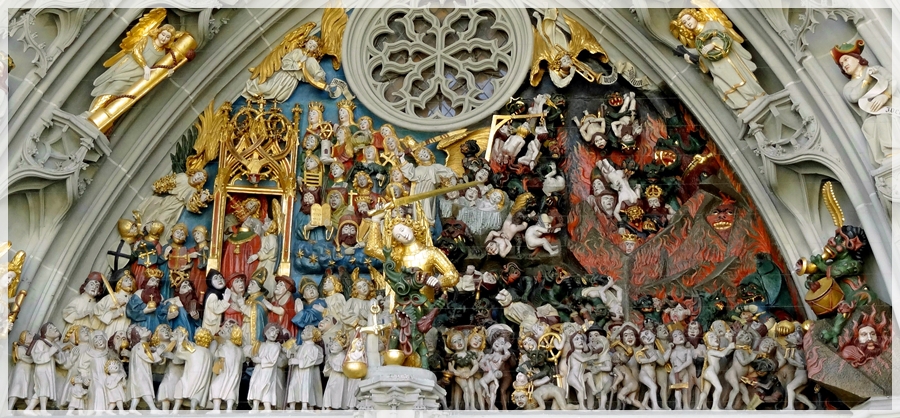
WICKEDNESS BRINGS PUNISHMENT

DSC02558-Bern (Cathedral-Munster-Last Judgement)3-cropWEB

“The Last Judgment” – Munster Cathedral, Bern, Switzerland


Yahweh! The Lord! The God of compassion and mercy! I am slow to anger and filled with unfailing love and faithfulness. I lavish unfailing love to a thousand generations. I forgive iniquity, rebellion and sin. But I do not excuse the guilty. [Exodus 43:6-7 (NLT)]

If asked to draw a picture of God, many would probably draw a pleasant old gentleman with a gentle smile. Looking a bit like Santa Claus, he’d be dressed in a long white robe instead of a fur-trimmed red coat and hat. This kind-looking grandfatherly man would be seated on a throne with several little children in his lap. Reading the Old Testament, however, makes one rethink this picture. While we meet a loving and forgiving God, we also encounter a judgmental and destructive God: a God who sends plagues to his people, destroys whole towns, and sends his people into slavery. This is not the “warm and fuzzy” God about whom we want to think. He’s certainly not the good-natured God of my Sunday school classes.

It certainly is more comforting for us to think of God as loving and merciful and, indeed, He is. But, as the Old Testament reminds us and the New Testament warns us, God can get angry with his people. He hates sin and he is ready to hand out punishment to those who defy him. Fortunately, we also have a loving and forgiving Heavenly Father who hasn’t lost faith in his children. He saved Noah and his family from the flood. He rescued Lot and his family from the destruction of Sodom and Gomorrah. He saved Jonah from the whale after Jonah said he’d obey God’s directions. After telling Nineveh they would be destroyed in forty days, God relented when they repented their sinful ways. After punishing the Israelites for their disobedience, God finally led them to the Promised Land. Later, He rescued them from their exile in Babylon. Although we continually disappoint God with our disobedience, He mercifully gave us his only son as a sacrifice for our sins.

The righteous character of God includes both his anger and judgment along with his love and mercy. It is not enough to read and hear only God’s comforting words. We must remember that His justice goes hand in hand with His love.

Your wickedness will bring its own punishment. Your turning from me will shame you. You will see what an evil, bitter thing it is to abandon the Lord your God and not to fear him. I, the Lord, the Lord of Heaven’s Armies, have spoken! [Jeremiah 2:19 (NLT)]

WEEDS

He [Jesus] answered, “The one who plants the good seeds is the Son of Man. The field is the world. The good seeds are those who belong to the kingdom. The weeds are those who belong to the evil one. The enemy who planted them is the devil.” [Matthew 13: 37-39 (NLT)]

7-1-15thistle (Canadian)-LGenWI572-cropwebI love thistles—when I’m taking their pictures in the woods. I discovered I don’t much care for them when they’re in my garden. But, there they were, along with dandelions, knotweed, clover, sorrel, mint, chives, prickly lettuce and other unidentified weeds in what used to be my rose garden. Months of neglect had taken its toll on our plant beds and only a few pink rose petals were even visible in the tangled mess. At one time, this had been a well-established and properly tended garden, but our more than nine month absence for two years in a row allowed the weeds to prevail.

My husband and I were faced with a dilemma similar to the one God faced with Sodom: in ours, far too many weeds and in His, far too many sinners. Because Abraham pled with God, the righteous Lot and his family were saved from destruction but the rest of the sinful city was destroyed. In the case of our garden, however, the two remaining stunted rose bushes had no one to plead for them and were pulled up along with the weeds. Unlike God, we swept away the innocent with the guilty! After thoroughly removing every plant, we started fresh, only this time with zebra grass that, hopefully, will better survive our neglectful gardening.

As we worked, I thought of Jesus’ parables about the farmers who sowed their seeds. One farmer planted seeds on different kinds of ground. The seeds sown on the quality soil produced a good harvest and represented those who heard and understood God’s word—people of faith. In another parable, Jesus told of a farmer who had planted good seeds in quality soil only to learn that his field had weeds. The weeds, planted by the enemy, were scheduled for future destruction. Looking at my garden, I knew it wasn’t Satan, but rather neglect, that had caused my weeds. It suffered from lack of attention; there had been no cultivating, watering, pruning, fertilizer, or weed pulling.

We can have a firmly established faith but, like our garden, faith can’t be ignored or neglected; it must be nurtured. Without cultivating our faith with church and fellowship, watering it with His word, pruning it with prayer, fertilizing it with service, and vigorous weed pulling with confession and repentance, our faith can’t thrive. The enemy will be able to take over and destroy the garden of our lives. Without consistent care, our faith won’t flourish; it will be weak or die like my roses.

As for me, now that I’m done with the house garden, I plan on doing some serious work in the garden of my faith. I don’t want to give the enemy a foothold and end up being swept away with the wicked or burnt with the weeds. How about you? Do you have any gardening that needs to be done?

The Lord remained with Abraham. Abraham approached him and said, “Will you sweep away both the righteous and the wicked? [Genesis 18:22b-23 (NLT)]

When the ground soaks up the falling rain and bears a good crop for the farmer, it has God’s blessing. But if a field bears thorns and thistles, it is useless. The farmer will soon condemn that field and burn it. [Hebrews 6:7-8 (NLT)]

JOB’S FRIENDS

In trouble like this I need loyal friends – whether I’ve forsaken God or not. But you, my friends, you deceive me like streams that go dry when no rain comes. [Job 6:14-15 (GNT)]

My closest friends look at me with disgust; those I loved most have turned against me. [Job 19:19 (GNT)]

6-30-15IMG_5094aweb
Job was enduring unbearable suffering; surely he could count on his friends for some support! His friends came to him but, instead of the compassion and encouragement that Job needed, they opened their mouths and began to criticize the poor man. They immediately assumed the worst of their friend. It was all Job’s fault; God was angry with him and punishing him for his sins! Surely, Job’s past behavior hadn’t given his friends reason to suspect him of sinfulness; in fact, Job is described as a “blameless” man—a man of “complete integrity.” His friends, however, were quick to believe the worst of him. They became accusers instead of comforters and judges instead of supportive friends. Granted, there are a few nuggets of Biblical truth hidden in their long accusing speeches but Job needed sympathy and reassurance rather than theological arguments.

Friends like Job’s aren’t the kind we need in a crisis. They are the people in the basements of our lives: the ones who jeer and yell catcalls. Instead of helping us up, they kick us when we’re down and may even delight in our failings. Nevertheless, we tend to keep basement friends around, probably because they often praise us when we don’t live up to our potential and offer encouragement when we’re on the wrong path. They frequently tempt us or distract us from God’s plan. They may be interesting and fun, but they’re of little use when trouble hits.

Job needed a cheering section, not a jeering section. He needed friends who would lift him when he was down and strengthen him in his weakness. We all need friends in the bleachers of our lives who will cheer for us. Good friends, however, do more than encourage us. While they see our potential for greatness and offer praise, they also tell us the truth. They can be trusted to give us an honest critique of our conduct. Tactfully (and with love), they will tell us when our behavior is inadequate or unacceptable and they’ll hold us accountable. Most important, unlike Job’s friends, good friends know how to sit silently with us in our sorrow, affliction and even shame. They’ll hold our hands, wipe our tears, and pray with and for us. A good friend will help us find strength in our weakness and hope in our despair.

Lord, guide us in our friendships. Lead us to befriend the people who will make us better and show us how to be the kind of friends who, in turn, will bring out the best in others.

When we honestly ask ourselves which person in our lives means the most to us, we often find that it is those who, instead of giving advice, solutions, or cures, have chosen rather to share our pain and touch our wounds with a warm and tender hand. The friend who can be silent with us in a moment of despair or confusion, who can stay with us in an hour of grief and bereavement, who can tolerate not knowing, not curing, not healing and face with us the reality of our powerlessness, that is a friend who cares. [Henri Nouwen]

There are “friends” who destroy each other, but a real friend sticks closer than a brother. [Proverbs 18:24 (NLT)]