FREE TO BE…

I form the light, and create darkness: I make peace, and create evil: I the Lord do all these things. [Isaiah 45:7 (KJV)]

sunflowerWow! Now there’s a troubling verse. God creates evil? Since evil is anything that contradicts God’s holy nature, it’s hard to understand how that could happen. Even other translations like the NLT’s, “I send good times and bad times,” the ESV’s, “I make well-being and create calamity,” and the NIV’s, “I bring prosperity and create disaster,” don’t make this verse sound much better. How do we reconcile a God who is good, a God who is love, with a God who says he creates evil?

There’s certainly no mention of God creating evil in Genesis. We are told that He created the world and everything in it, that man was made in His own image, and when God was finished, He looked over everything and saw that it was good. This is where we again see the flexible nature of Hebrew verbs in Scripture. As discussed yesterday, many verbs such as create, harden, send, blind, or deceive are used in a permissive sense as well as a causative one. As a result, we frequently find God represented as doing something when, in actuality, He is only permitting it or predicting that it will be done. Reading it that way, God didn’t create evil but He does allow it. Nevertheless, how can a righteous, just, and loving God even allow evil?

Our being made in God’s image means that, like Him, we have intelligence, reason and the ability to make conscious choices. Personal volition means that we have a choice as to whether or not we love and obey God. When God gave us the ability to choose, He also gave us the responsibility to choose well. Adam and Eve didn’t choose wisely when they ate the forbidden fruit and we’re not much better. While we can choose obedience over rebellion or love over hate, we also can choose deception instead of truth or vindictiveness rather than forgiveness. Because God allows us to choose, we can abandon good for evil as easily as we can close our eyes to His light, shut our ears to His truth, and harden our hearts to His love. C.S. Lewis pointed out that “If a thing is free to be good it’s free to be bad. And free will is what made evil possible.”

Knowing we’d mess up by the third chapter in Genesis, why did our omniscient God allow us freedom to go against His will? Yet, if He compelled us to be obedient, wouldn’t He be more a puppet master than a God of love? Without freedom of choice, would we be unique individuals, made in His image, or marionettes moving only when He pulled the strings? A relationship must be voluntary to be authentic and love must be freely given to be genuine. God didn’t create evil but He did create a people who can rebel and turn from righteousness and it is that rebellion that creates evil.

I don’t understand it completely; someday, I will. I do know that our good and loving God has a good reason for allowing evil to exist. I also know that God can use evil for our good and His glory; after all, from man’s rejection and murder of His only Son, came our salvation!

If a thing is free to be good it is also free to be bad. And free will is what has made evil possible. Why, then, did God give them free will? Because free will, though it makes evil possible, is also the only thing that makes possible any love or goodness or joy worth having. [C. S. Lewis]

For God so loved the world, that he gave his only begotten Son, that whosoever believeth in him should not perish, but have everlasting life. For God sent not his Son into the world to condemn the world; but that the world through him might be saved. … And this is the condemnation, that light is come into the world, and men loved darkness rather than light, because their deeds were evil. [John 3:16-17,19 (KJV)]

Copyright ©2018 jsjdevotions. All rights reserved.

 

BLOOD AND GUTS

For the life of the body is in its blood. I have given you the blood on the altar to purify you, making you right with the Lord. It is the blood, given in exchange for a life, that makes purification possible. [Leviticus 17:11-12 (NLT)]

sacred daturaFor most of us, the meat we purchase arrives at the grocery store prepackaged. We’re not used to seeing animals slaughtered, skinned or butchered and, unless we’re phlebotomists, rarely see large amounts of blood. As a result, much of Leviticus makes for rather gory reading since the temple, a place of worship, also served as a ritual slaughterhouse. Perhaps it’s my vegetarian sensibilities but, when the Bible refers to the pleasing aroma of sacrifice, I wince when thinking of the stench of dried blood and burnt meat.

Biblical sacrifices go as far back as Cain and Abel but it is in Leviticus that we read of the sacrifices God required of the Israelites. The book gives complicated instructions for each of the sacrificial rituals: everything from the kind of animal offered and the draining of its blood to splashing that blood around the altar and what to do with the meat. Nowadays, these bizarre rites seem sickening and gruesome. Then again, perhaps that is exactly what they were supposed to be even back then. Watching one’s best lamb have its throat slit and seeing its blood pour out was probably as awful 3,400 years ago as it seems today. Seeing the animal’s life offered as a substitute for the sinner’s symbolized the high cost of sin and could not have been taken lightly. Moreover, as offensive as all that blood and butchering seems, think of how offended God is by our sins! Sin is far uglier and more repugnant than any abattoir.

My 21st century self has difficulty understanding why blood had to be shed in the first place and how blood—something that stains—could ever be considered cleansing. Caught up in picturing all of that blood, gore and smell, it’s easy to forget that the reason for those sacrifices was atonement. The Israelites sacrificed what was precious to them to satisfy God as atonement for their sins. A price had to be paid for mankind’s sins and, without blood, there could be no forgiveness. For God, the aroma was not that of blood and seared meat but of repentance. Those bloody offerings, however, were temporary substitutes. Even though the animal died rather than the sinner, the sacrifice had to be repeated again and again. It is those sacrifices, however, that foreshadowed the one true and everlasting sacrifice that took place on Calvary. Our sins against a holy and infinite God required a holy and infinite sacrifice: the flawless lamb, Jesus Christ. Our atonement is now found in our faith in Christ—the one perfect and final sacrifice.

With his own blood—not the blood of goats and calves—he entered the Most Holy Place once for all time and secured our redemption forever. Under the old system, the blood of goats and bulls and the ashes of a heifer could cleanse people’s bodies from ceremonial impurity. Just think how much more the blood of Christ will purify our consciences from sinful deeds so that we can worship the living God. For by the power of the eternal Spirit, Christ offered himself to God as a perfect sacrifice for our sins. [Hebrews 9:12-14 (NLT)]

Copyright ©2018 jsjdevotions. All rights reserved.

THERE BUT FOR THE GRACE OF GOD…

The human heart is the most deceitful of all things, and desperately wicked. Who really knows how bad it is? [Jeremiah 17:9 (NLT)]

For from within, out of a person’s heart, come evil thoughts, sexual immorality, theft, murder, adultery, greed, wickedness, deceit, lustful desires, envy, slander, pride, and foolishness. [Mark 7:21-22 (NLT)]

Grand Canyon of YellowstoneI recently saw a play in which the only character, Lisa, presents a monologue about her life and family. The audience learns that her father, Walter, a German-born Jew, escaped to the U.S. as part of the kindertransport effort but that the rest of his family perished at Auschwitz. During her monologue, Lisa tells of taking her then 75-year old father to visit the Auschwitz Memorial. While touring the concentration camp, Walter tells his daughter about attending school with members of the Hitler Youth. Being a Jew, he couldn’t wear one of their uniforms but another boy in his school, a Gentile, refused to wear one. Her father then tells her that, in spite of the horror of Auschwitz and the loss of his family, he is glad he was born a Jew—because he didn’t have the option of becoming a Nazi! Unlike the Gentile boy who refused to join (and suffered because of it), Walter realized that, had he not been Jewish, he might have joined the Nazis. He knew that part of him could have been as merciless and evil as the men who rounded up and exterminated his family.
After the war, Walter returned to Germany as an interrogator of German personnel. In her soliloquy, Lisa tells how he admitted to callously browbeating one prisoner into confessing that he’d rounded up Jews from the Ghetto. Rather than turn the prisoner over to the allies for trial, Walter handed him over to the Russians, men he knew would summarily execute the German in the woods. Perhaps Walter was right; in other circumstances, he might have joined the Hitler Youth.

Hearing this story made me wonder what darkness lurks in my heart. In other circumstances, could I spew hate, inflict pain, ignore my conscience, turn my back on my brothers and sisters, or close my eyes to evil? Could I ever be like Haman (who plotted to exterminate the Jews) or Abimelech (who killed his 70 brothers)? Could I have worn a Hitler Youth uniform? Sadly, in another time, in another place, perhaps my heart could have deceived me to do just that.

Just because I’m capable of evil, however, doesn’t mean I have to be evil. Rather than betray Jesus as did Judas, I could be as faithful as John. Rather than the closed minds and murdering hearts of those who stoned Stephen, I could be as holy and forgiving as the martyred man. While I could be as scheming and immoral as Herodias, I also could be as obedient and fearless as her victim John the Baptist. Yes, I could have joined the Hitler Youth, but I also could have refused to be part of such evil and willingly suffered the consequences.

There is something terribly wrong with our hearts that, if allowed to grow, can become horrendous and unthinkably evil, but there also is something beautifully right with them. We are made in the image of God; deep inside us there is something of Him and He has written his law in our hearts. He gave us the gift of free will and, with every choice, we either become more or less like the person God made us to be. Because our hearts can be deceitful, corrupt, and self-serving they can lead us astray but they don’t have to! When led by the Holy Spirit, our hearts can be so filled with good that there is no room left for evil.

For I was born a sinner—yes, from the moment my mother conceived me. … Create in me a clean heart, O God. Renew a loyal spirit within me. Do not banish me from your presence, and don’t take your Holy Spirit from me. [Psalm 51:5,10-11 (NLT)]

But the Holy Spirit produces this kind of fruit in our lives: love, joy, peace, patience, kindness, goodness, faithfulness, gentleness, and self-control. There is no law against these things! Those who belong to Christ Jesus have nailed the passions and desires of their sinful nature to his cross and crucified them there. [Galatians 5:22-24 (NLT)]

Copyright ©2018 jsjdevotions. All rights reserved.

SPINNING

Finally, I confessed all my sins to you and stopped trying to hide my guilt. I said to myself, “I will confess my rebellion to the Lord.” And you forgave me! All my guilt is gone. [Psalm 32:5 (NLT)]

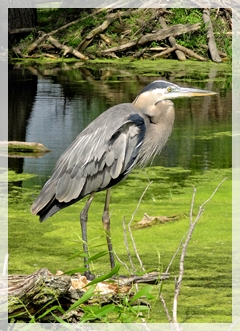
great blue heronHaving just returned from the East Coast, I had a lengthy “to do” list and thought I could fit in a few errands before picking up my mother-in-law for her doctor’s appointment. As I pushed the cart through the store, I glanced down at my watch to check the time and gasped. To my dismay, I’d lost an hour! I should have been picking her up right then; there was no way we would make it to the doctor’s on time. Leaving the cart in the aisle, I rushed to my car. Rather than think how to save the situation, my first thought was how to spin it! Other than my own carelessness and stupidity, what valid excuse could I have for my tardiness? As I started the car, I glanced at the clock on the dash and realized that hour hadn’t disappeared; I’d left it back East. While my watch was still on EST, my car, mother-in-law, the doctor and I were in CST and there was still plenty of time.;

Rather than a complete fabrication, spinning is selectively gathering facts, omitting relevant truths, and then shaping them to support our version of the story. Spinning reshapes people and events with half-truths, diversions, exaggeration, inaccuracies, emotion-laden words, attacks and euphemisms. Spinning gives us “alternative facts.” It calls bombs “lethal defensive weapons,” cheating on emissions tests “possible non-compliance,” adultery an “inappropriate relationship,” embezzlement a “personal failing,” and information we don’t like “fake news.”

Although spinning is just a nicer way of saying deceiving, we all do it. Sometimes, we spin to save someone’s feelings but, far more often, we do it to save ourselves from a reprimand, consequences, embarrassment, or humiliation. The first spinners, of course, were Eve and Adam who spun the apple story to shift the blame. Eve said it was the serpent’s fault and Adam placed the blame on both Eve and God (for giving him the woman in the first place)! Detouring around a troublesome question, Cain spun when he answered God’s question as to the whereabouts of his brother with a question of his own. We spin so we don’t have to admit our failings. Aaron spun the golden calf incident by blaming the evil Israelites rather than his weak leadership.

When we can’t make an accusation disappear, we spin it to explain that what we did wasn’t really that wrong. Told to completely destroy everything in the Amalekite nation, Saul disobeyed by sparing the king’s life. His troops destroyed only what was worthless and took the rest for themselves. When confronted by Samuel, rather than admitting his greed and disobedience, Saul spun the story. Making no mention of the monument he’d set up for himself, he claimed the prohibited plunder was to be a sacrifice to God. Sometimes, we spin when it isn’t even necessary. When Jesus asked the crippled man at Bethesda if he wanted to get well, rather than a simple yes or no, the man blamed his disability on those who wouldn’t help him to the pool.

David had a perfect opportunity to put a spin on his adultery with Bathsheba. When confronted by Nathan, the king easily could have blamed the beauty for seducing him or Joab for misunderstanding his directions regarding Uriah’s fate. Instead, David did what all of us are expected to do: confessed and said, “I have sinned against the Lord.” Although we prefer making excuses and laying the blame for our failures elsewhere, let us never forget that we, like David, must always take full responsibility for our actions.

But the tax collector stood at a distance and dared not even lift his eyes to heaven as he prayed. Instead, he beat his chest in sorrow, saying, “O God, be merciful to me, for I am a sinner.” I tell you, this sinner, not the Pharisee, returned home justified before God. For those who exalt themselves will be humbled, and those who humble themselves will be exalted. [Luke 18:13-14 (NLT)]

Copyright ©2018 jsjdevotions. All rights reserved.

BEWARE THE YEAST

purple prairie clover“Watch out!” Jesus warned them. “Beware of the yeast of the Pharisees and Sadducees.” [Matthew 16:6 (NLT)]

In Biblical days, rather than using a packet of Fleishman’s yeast for leavening, people kneaded a small amount of old fermented dough called a starter or seor into fresh dough. When a yeast starter gets contaminated by bacteria, however, it gets a moldy odor of decay and, if mixed into new dough, its foulness will spread; the resulting bread will be unpleasant and inedible.

We’re all familiar with Jesus’ warning to the disciples to beware the yeast of the Pharisees. They weren’t bakers so what was their yeast? I’d always thought of it as the Pharisees’ hypocrisy and false teachings. And, while both of those can spread and spoil like bad leavening, I think there’s more to his caution.

The Pharisees and Sadducees, disregarding all of Jesus’ previous miracles, had demanded an impressive miraculous display from Him. Jesus wasn’t an entertainer and His miracles were never for show. Knowing nothing would convince the religious leaders, He refused and left. Shortly after that, Jesus and the disciples departed to the other side of the lake. It was when the disciples realized they’d failed to bring provisions that Jesus first warned them about the yeast of the Pharisees. Thinking He was talking about bread, they then started arguing with one another about not having anything to eat. Imagine their conversation as they pointed accusing fingers at one another for having no food—each man trying to shift the blame for the oversight to someone else. Totally misunderstanding Jesus’ warning, they were bickering about bread and worrying about their next meal when Jesus had just fed thousands with only a few loaves and fish. Our Lord was probably rolling His eyes at their blind foolishness. Like the Pharisees, what part of His many miracles didn’t they understand? Twice they’d ended up with several baskets of leftovers after feeding a multitude; certainly lack of bread shouldn’t pose a problem for just twelve men. Reminding them of His previous miracles of provision, Jesus told them He wasn’t speaking of bread. When He again told them to beware of the yeast of the Pharisees, they finally understood He was speaking of their unbelief.

Although Jesus warned them of this very thing before they’d started to argue, like the Pharisees, they ignored what they knew of Him and His miracles. Instead of allowing their belief to grow into trust, they allowed doubt to taint their faith and their relationship with one another in the same way that bad yeast contaminates bread. A little bit of uncertainty and skepticism swelled into fear, anger, and criticism. They were squabbling about bread for supper when they had the bread of life right beside them.

We all must beware the yeast of the Pharisees: not just false teaching and hypocrisy but also lack of trust!

Faith is not belief without proof, but trust without reservation. [D. Elton Trueblood]

Jesus replied, “I am the bread of life. Whoever comes to me will never be hungry again. Whoever believes in me will never be thirsty. But you haven’t believed in me even though you have seen me. [John 6:35-36 (NLT)]

Copyright ©2018 jsjdevotions. All rights reserved.

HIS EYES AND EARS

Sandhill Crane FamilyAgain a message came to me from the Lord: “Son of man, you live among rebels who have eyes but refuse to see. They have ears but refuse to hear. For they are a rebellious people. [Ezekiel 12:1-2 (NLT)]

Don’t you know or understand even yet? Are your hearts too hard to take it in? “You have eyes—can’t you see? You have ears—can’t you hear?” Don’t you remember anything at all? [Mark 8:17b-18 (NLT)]

While walking at the park yesterday, my husband pointed at something in the brush. As I zoomed in with my camera, I realized he’d spotted a sandhill crane foraging in the deep grass. They mate for life and, where there’s one, there usually are two so I kept looking until I spotted Mrs. Crane just before they disappeared into a thicket. A few minutes later, we turned a corner, looked hopefully toward the open meadow, and spotted the pair again, along with junior. These elegant long-necked birds are among my favorites in the park but, with their grey-brown bodies that blend into the colors of the prairie, they’re easy to miss. This morning, when I heard their unique rattle-like call, we stopped and scanned the meadow and finally spotted the distinctive red cap that meant a crane was in the grass. As I whispered a prayer of thanks for another sighting of these beautiful birds, I realized how easy it is to miss God’s blessings because we haven’t looked for them.

sandhill craneThinking of the maxim that blessings are hidden in every trial if only we’d open our hearts to them, I initially thought I’d write about hidden blessings. I then realized that we miss more than beautiful birds and blessings when we fail to look and listen; we miss God-given opportunities to be true disciples of Christ.

The gospels tell of when Jesus and the apostles, tired and hungry, just wanted to go off to a quiet place and rest but an enormous crowd pursued them. Rather than send away the people, Jesus had compassion on them. He healed the sick, spoke about the Kingdom of God, and fed the hungry with a picnic of massive proportions. Another time, Jesus was on his way to Jerusalem and, like other rabbis, He was probably teaching as He walked. Anxious to hear everything the rabbi said, people crowded around as they followed Him. When a blind beggar shouted out to Jesus, they yelled at the man to be quiet. Jesus, however, heard the cry for mercy, stopped what he was doing, and compassionately restored the blind man’s sight.

Blessings and sandhill cranes often go unnoticed; I only spotted those cranes because I wanted to see them. I’m rarely that anxious to see the needs and hear the cries of my fellow man and they are far more obvious. Compassion, witness, and service can be inconvenient. We justify our failure to act by turning a deaf ear and blind eye to what’s right in front of us. Jesus never failed to see those who needed to be fed spiritually or physically and He always heard their cries for mercy. As His disciples, we are called to serve those who hunger and thirst, welcome the lonely, clothe the naked, tend the sick, and visit the prisoner. We can’t be the hands and feet of Jesus unless we also act as His eyes and ears.

Now you, my brothers and sisters, are the eyes through which Christ’s compassion is to look out upon this world, and yours are the lips through which His love is to speak; yours are the hands with which He is to bless men, and yours the feet with which He is to go about doing good—through His Church, which is His body. [Mark Guy Pearce (Evangelical Christendom, 1881)]

For I was hungry, and you fed me. I was thirsty, and you gave me a drink. I was a stranger, and you invited me into your home. I was naked, and you gave me clothing. I was sick, and you cared for me. I was in prison, and you visited me. … And the King will say, “I tell you the truth, when you did it to one of the least of these my brothers and sisters, you were doing it to me!” [Matthew 25:35-36,40 (NLT)

Copyright ©2018 jsjdevotions. All rights reserved.