HE ALWAYS ANSWERS

Keep on asking, and you will receive what you ask for. Keep on seeking, and you will find. Keep on knocking, and the door will be opened to you. For everyone who asks, receives. Everyone who seeks, finds. And to everyone who knocks, the door will be opened. You parents—if your children ask for a loaf of bread, do you give them a stone instead? Or if they ask for a fish, do you give them a snake? Of course not! So if you sinful people know how to give good gifts to your children, how much more will your heavenly Father give good gifts to those who ask him. [Matthew 7:7-11 (NLT)]
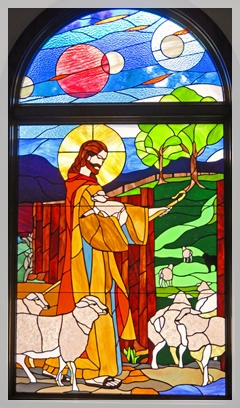
Holy Name Catholic church - Steamboat Spgs.Thrilled at the result of her biopsy, Mary joyfully announced, “God is good and God always answers prayers!” Indeed, He is and does but we must remember that God does not always answer prayers the way we want Him to. I recently wrote that God is not a miser and our prayers should not be puny half-hearted ones. Nevertheless, regardless of the size of our petitions, we must remember that it is God’s will, not ours, that will be done. In spite of fervent prayers, some biopsies will say “malignant,” some prodigals will never return, some marriages will fail, and some people will not recover.

People often claim that Jesus’s words in Matthew 7 are a promise that God will give us anything we ask. But, seen in context, this verse is about seeking and finding God rather than having all of our wishes fulfilled. If we ask for things like His wisdom, discernment, patience, love, compassion, peace, and understanding, He will give them to us. That promise, however, does not mean God will answer all of our prayers with a “Yes!”

Just as loving parents wouldn’t give their children something bad when they ask for something good, Jesus tells us neither will God. But, what if, in his naiveté, the child unwittingly asks for something that isn’t what’s best? When my son was a teenager, he pled for a shiny new sports car; we answered with a second-hand Ford Tempo. Older and wiser, we knew a sixteen-year old boy didn’t belong behind the wheel of a Corvette. Now that he has a sixteen-year-old boy of his own, our son understands. A loving parent, like God, knows how to say “No!”

God is God and we are not. It is His will that reigns and our prayers are answered according to His plan rather than our wants. Both Elijah and Jonah asked God to take their lives, but He refused. God denied King Zedekiah’s prayer for help in defeating Nebuchadnezzar. When Jesus prayed in the garden, Paul prayed to be rid of the thorn in his flesh and David wanted to build the temple, God said “No” to them. When the disciples wanted Jesus to go back and heal in Capernaum, when a man asked Him to intervene in a family dispute, and when James and John wanted places of honor in heaven, our Lord answered them all with, “No!”

God always answers prayers but frequently not the way we expect or desire. Just because we don’t get what we want, however, doesn’t mean we get nothing. Although God’s answers often are mysterious and even heart-breaking, they always are purposeful. God’s “No!” is His “Yes!” for a far greater end, be it protection, teaching, spiritual growth, or guidance. Let us be thankful that God keeps us from what we thought we wanted and blesses us with what we didn’t know we needed!

When God says no, we are sometimes tempted to wonder if He loves us. In reality, it’s because He loves us, He sometimes says no. [Lysa TerKeurst]

Father, if you are willing, please take this cup of suffering away from me. Yet I want your will to be done, not mine. [Luke 22:42 (NLT)]

Copyright ©2019 jsjdevotions. All rights reserved.

HE’S NOT A MISER

zebras - great migration -serengetiWhat shall we say about such wonderful things as these? If God is for us, who can ever be against us? Since he did not spare even his own Son but gave him up for us all, won’t he also give us everything else? Romans 8:31-32 (NLT)]

Yet you don’t have what you want because you don’t ask God for it. [James 4:2b (NLT)]

Yesterday, when writing about Malala Yousafzai, the Pakistani girl who was shot in the head by the Taliban in 2012, I thought of an exchange between her parents while the girl was being operated on for the removal of the near fatal bullet. The words “the patient may die,” had been on the papers consenting to her surgery and Malala’s father was deep in prayer. Making bargains with God, he prayed aloud, “Even if she is injured, just let her survive.” Malala’s mother, a devout Muslim, stopped him in his prayers with these words, “God is not a miser!” She confidently added, “He will give me back my daughter as she was,” and then returned to her non-stop prayers for a full recovery.

Her dissatisfaction with her husband’s prayers and her confidence in God’s ability to do great things reminded me of something said by C.S. Lewis in The Weight of Glory. Calling us “half-hearted creatures,” he compared us to “an ignorant child who wants to go on making mud pies in a slum because he cannot imagine what is meant by the offer of a holiday at the sea. We are far too easily pleased.” While Lewis was writing about wanting things of the world when the splendor of God could be ours, I think his words apply to prayer, as well. Our prayers often are half-hearted and, like Malala’s father, we are far too easily pleased. We forget that, rather than a miser, God is our generous loving Father.

Pint-sized prayers suggest that we doubt God’s love for us and yet God is love; He loved us enough to give His only son to die for us! Small prayers imply that we think God is puny. A 97-pound weakling God could not have created man from dust and woman from man, made walls collapse and the sun stand still for Joshua, provided both drought and rain to Elijah, or given sight to the blind and raised Lazarus from the dead. Nothing is impossible for Him.

Perhaps we ask far too little of God because we’re afraid that He will think we are asking too much. Yet, without asking, we won’t receive. Malala’s mother said that God isn’t a miser and, with 100 thousand million stars in the Milky Way alone, creation tells us that’s true. A miserly God wouldn’t have given us nearly 10,000 different species of birds, 950,000 species of insects, and even 16,000 species of mushrooms. He’s a “more than enough” God who loves to give gifts to His children. Why are we so easily pleased asking for a little bite when He’s waiting to give us the whole cake?

Mark’s gospel tells of a man who brought his demon-possessed, deaf and mute son to Jesus. He didn’t ask Jesus just to stop the convulsions or only to give the boy hearing or speech; he asked Jesus to heal him, but added, “if you can.” Assuring him that, “Anything is possible if a person believes,” the father’s reply was, “I do believe, but help me overcome my unbelief!” [9:23-24]

Knowing that nothing is impossible with God, and remembering that God is not a miser, let our prayers be bold ones. Let us also pray that He helps us overcome our unbelief!

And we are confident that he hears us whenever we ask for anything that pleases him. [1 John 5:14 (NLT)]

So let us come boldly to the throne of our gracious God. There we will receive his mercy, and we will find grace to help us when we need it most. [Hebrews 4:16 (NLT)]

Copyright ©2019 jsjdevotions. All rights reserved.

GUARD YOUR GATES [THE HOLY WAR – Part 1]

He burned down the Temple of the Lord, the royal palace, and all the houses of Jerusalem. He destroyed all the important buildings in the city. Then he supervised the entire Babylonian army as they tore down the walls of Jerusalem on every side. [2 Kings 25:9-10 (NLT)]

Schoonhoven - city gate

Jerusalem was heavily fortified and completely protected by walls over thirty-nine feet high and eight feet thick. In 586 BC, the Babylonian forces of King Nebuchadnezzar breached those seemingly impregnable walls and Jerusalem was burned, the city’s walls torn down, and the people taken captive. The city’s walls were rebuilt by Nehemiah 141 years later but they were again breached in 70 AD by the Romans who destroyed the city, demolished the second Temple, and massacred much of the population.

Published in 1682, John Bunyan’s allegory The Holy War tells of another fortified city’s fall. Bunyan’s walled city of Mansoul had five gates: Eye-gate, Ear-gate, Mouth-gate, Nose-gate and Feel-gate. Rather than Babylonians or Romans, Mansoul’s enemy was Diabolus. Unlike Jerusalem’s, Mansoul’s gates could not be breached or opened from the outside. They could only be forced if someone within the city allowed it. In short, sin could only enter if someone permitted its entrance. Diabolus and his then invisible army sat down in front of Ear-gate and assaulted it with fraud, guile, and hypocrisy. With the deaths of Captain Resistance and Lord Innocence, the townspeople looked at the tree of forbidden fruit, tasted it, forgot their good King Shaddai, opened both Ear and Eye-gate, and Mansoul came under the rule of Diabolus.

The Holy War is a none too subtle allegory that makes its point: walled cities can fall and city gates can be breached, if not from the outside, then from within. Like the city of Mansoul, sin will tempt and try to seduce us but it can’t force its way into our lives; it only enters by invitation. We alone are the ones who determine what we look at, hear, touch, feel, smell, say and do. Satan didn’t force Eve to eat that fruit, Cain to kill Abel, Jacob to deceive his father, the Israelites to worship a golden calf, Samson to dally with Delilah, David to take Bathsheba, Jonah to run away from Nineveh, King Ahaz to sacrifice his son, Herod to decapitate John, Judas to betray Jesus, or Peter to deny Him. These people freely opened their gates to temptation and allowed sin entrance into their lives.

An inevitable part of life, temptation is not a sin; it is a trial of faith. Mansoul’s sin was not in hearing the lies of Diabolous—it lay in believing and acting upon them. Sin happens when we drop our guard, open our gates, and allow it into our lives. God has given us a conscience, self-discipline, His word, and the Holy Spirit to defend our gates; whether or not we open ourselves to sin always remains our choice. Let us be cautious as to who and what enters our gates!

Temptation is the devil looking through the keyhole. Yielding is opening the door and inviting him in. [Billy Sunday]

But let us who live in the light be clearheaded, protected by the armor of faith and love, and wearing as our helmet the confidence of our salvation. [1 Thessalonians 5:8 (NLT)]

Copyright ©2019 jsjdevotions. All rights reserved.

DESPAIR AND DOUBT

Around midnight Paul and Silas were praying and singing hymns to God, and the other prisoners were listening. Suddenly, there was a massive earthquake, and the prison was shaken to its foundations. All the doors immediately flew open, and the chains of every prisoner fell off! [Acts 16:25-26 (NLT)]

By 1658 in England, it had become illegal to conduct a religious service differing from the Church of England’s official liturgy or for “one not in Episcopal orders” to address a congregation. A Puritan, John Bunyan, was arrested for preaching the gospel without a license. After three months in the Bedford jail, he was offered his freedom if he’d agree not to preach publicly. He refused saying, “If I was out of prison today, I would preach the gospel again tomorrow by the help of God.” Bunyan spent twelve years imprisoned. During that time, he wrote The Pilgrim’s Progress. No country cub prison, the Bedford jail was overcrowded, unsanitary, unheated, and the plague of 1665 claimed forty prisoners as victims. Years later, Bunyan wrote: “Satan can make a jail to look like hell itself.” Although all looked hopeless for the man, he found strength in prayer and in his writing.

In The Pilgrim’s Progress, Christian and Hopeful accidentally step out of the Way. Having trespassed on the grounds of Giant Despair, they are captured and taken to Doubting Castle. The Pilgrims are imprisoned in a dark dungeon, without bread or water, for nearly four days. The first day, Despair mercilessly beats the men with a club. The second day, telling them there is no escape, the giant urges the suffering men to kill themselves. Realizing that others have managed to escape, the men retain hope, refuse to end their suffering, and vow to battle Despair. The third day, to further destroy their spirits, the giant takes them into the castle yard, shows them the remains of those he’s destroyed, and pitilessly beats them again.

Around midnight Sunday morning, just as Paul and Silas did in their prison cell, Christian and Hopeful begin to pray. A little before dawn, Christian realizes what a fool he’s been. In his coat, next to his heart, is a Key called Promise and Christian is sure it will unlock the doors of Doubting Castle. Although Doubt and Despair caused them to forget the promises of God, prayer reminded the two men to recall and trust in God’s promises. The Key easily opens both the door to their cell and the one into the castle yard but the last lock, the one out of Doubting Castle opens hard. It’s not easy to escape from the depths of Doubt and Despair and I imagine that, during those twelve years he sat behind bars in abysmal conditions, Bunyan had many moments of doubt and despair.

Let us remember to keep the Key of Promise close to our hearts.  It’s unlikely that doubt and despair will come in the form of a giant or a castle dungeon, but they will come and they are capable of imprisoning us. While not using a club, despair will attack us mercilessly, try to strip us of hope, and imprison us in doubt. May we always hold tight the key to our freedom: the promises of God.

Lord, we pray for those imprisoned By Despair, who lie in grief;
Locked in Doubting Castle’s dungeon, Stripped of hope and its relief.
Father help them to remember In Your promise is the key;
Now unlock the door that bars them, In the Gospel, set them free.
[From “A Prayer for Pilgrims” by Ken Puls]

For all of God’s promises have been fulfilled in Christ with a resounding “Yes!” And through Christ, our “Amen” (which means “Yes”) ascends to God for his glory. It is God who enables us, along with you, to stand firm for Christ. He has commissioned us, and he has identified us as his own by placing the Holy Spirit in our hearts as the first installment that guarantees everything he has promised us. [2 Corinthians 1:20-22 (NLT)]

Copyright ©2019 jsjdevotions. All rights reserved.

FRESH STARTS

When God our Savior revealed his kindness and love, he saved us, not because of the righteous things we had done, but because of his mercy. He washed away our sins, giving us a new birth and new life through the Holy Spirit. [Titus 3:5 (NLT)]

This means that anyone who belongs to Christ has become a new person. The old life is gone; a new life has begun! [2 Corinthians 5:17 (NLT)]

desert paintbrushSent by God to warn the people of Nineveh of God’s judgment, Jonah went in the opposite direction. After he survived three days in the belly of a fish, God gave Jonah another chance to deliver His message to the people of Nineveh. This time, Jonah delivered the news that God intended to destroy the city in forty days. When Nineveh’s king heard Jonah’s warning, he called for fasting, praying, and repenting their evil ways. People and animals were to cover themselves with sackcloth (a coarse fabric of goat’s hair) as a sign of grief, submission, and contrition.  Seeing their repentance, God was merciful and gave them another chance.

Barnabas and his cousin John Mark accompanied Paul to Cyprus but, for some unknown reason, John Mark deserted the other two in Pamphylia. Paul initially refused to give the man another chance but both God and Barnabas did. The cousins went to Cyprus and Paul and Silas went to Syria and Cilicia. Eventually, however, Paul gave the one-time deserter another chance and, twelve years later, John Mark was with the Apostle during his first imprisonment in Rome. When Paul was approaching the end of his life, he requested John Mark’s presence during his second Roman imprisonment. What became of John Mark? Because he was given another chance, the man who once abandoned Barnabas and Paul became the man we know as the gospel writer Mark!

Peter failed Jesus by denying Him; when given another chance he became “the rock” and leader of the disciples. Saul failed Jesus by persecuting His followers; given another chance, he became Paul and carried the gospel message throughout the Roman Empire to Jews and Gentiles alike. While we don’t know what happened to the woman caught in adultery, we know Jesus gave her another chance with the admonition to, “Go and sin no more.” One look at the history of the Israelites tells us that God is not a God of second chances; He’s the God of many chances!

We are not our poor choices and our failures should never haunt, confine, or define us. Our God is one of both forgiveness and transformation. Because He gives us another chance, who we were yesterday does not have to be who we are today. Unfortunately for Nineveh, their repentance didn’t last for long. Instead of leaving their past behind, they returned to their sinful ways. The second chance God gave them was wasted and the city of “murder and lies” was destroyed 148 years after Jonah’s first warning. Our God specializes in renewal and fresh starts. The people of Nineveh wasted theirs; let’s not make the same mistake!

And I am certain that God, who began the good work within you, will continue his work until it is finally finished on the day when Christ Jesus returns. [Philippians 1:6 (NLT)]

Don’t copy the behavior and customs of this world, but let God transform you into a new person by changing the way you think. Then you will learn to know God’s will for you, which is good and pleasing and perfect. [Romans 12:2 (NLT)]

Copyright ©2019 jsjdevotions. All rights reserved.

LEADING WITH LOVE

For the law was given through Moses, but God’s unfailing love and faithfulness came through Jesus Christ. [John 1:17 (NLT)]

mouse-ear hawkweedLegend had it that an angel of the Lord occasionally would come into the pool at Bethesda, stir up the water, and that the first person to enter the pool would then be healed. Jesus, however, simply said to the crippled man lying there: “Stand up, pick up your mat, and walk!” and the man did just that. Since it was the Sabbath, the man later was stopped by the Jewish leaders and condemned for carrying his mat and working on the day of rest. According to the law, either he should have stayed and watched his mat or left it behind and walked away. When he explained that the man who’d healed him told him otherwise, they wanted him to identify his healer. Their curiosity, however, had nothing to do with knowing who had performed this amazing miracle; they wanted to know who’d broken the law!

It was on the Sabbath that Jesus gave sight to a man born blind. Out Lord spit on the ground, made mud with his saliva, applied the muck over the man’s eyes, and told him to wash himself in the pool of Siloam. After the man did as directed, he could see. Stunned by the change in him, people who’d known him as a blind beggar took him to be questioned by the Pharisees. Again, Mosaic Law had been broken, not just by the healing, but also by the spitting (considered digging or plowing) and mud making (combining wet and dry was kneading). Sure that a healer who so flagrantly broke the Sabbath could not be from God, the Pharisees wanted to know who it was.

On another Sabbath, Jesus was teaching in the temple when He saw a woman so misshapen by her disease that she couldn’t even stand up straight. After calling her over, He touched her and told her that she was healed. Instantly, the woman stood erect and praised God. The synagogue leaders didn’t have to question the woman as to who healed her that time; they saw it for themselves.

In all these instances, the synagogue leaders believed Jesus had broken the law by healing on the Sabbath. Unless it was a critical life-or-death situation, healing was considered work and was to be delayed until after the Sabbath. Since the crippled man had been that way for thirty-eight years, the blind man sightless since birth, and the woman’s body bent and broken for eighteen years, there was nothing urgent about their conditions. After Jesus healed the woman, the Pharisees indignantly told Him to come some other day to do His healing! Another day meant nothing to the Pharisees. Of course, they weren’t the ones suffering! When in pain or distress, even an hour can feel like an eternity.

When questioned by the Pharisees, Jesus reminded them that the main principle behind the treatment of animals in Jewish law was tza’ar ba’alei chayim: preventing the suffering of living creatures. Even though a donkey or ox could not be untied to go out to work, it could be untied and taken out to be fed and watered so that it wouldn’t suffer all day. Moreover, an animal was to be relieved if it was suffering from carrying too heavy a load. The load those hurting people were carrying was exceedingly heavy and stopping the suffering of God’s creatures was all Jesus was doing when He healed! In their obsession with keeping to the letter of the law, the Pharisees seemed to forget the spirit of God’s law: that we are to love the Lord and love our neighbor. That wasn’t a legendary healing angel of the Lord standing right in front of the Pharisees, it was the Lord himself! Sadly, instead of recognizing Him, they persecuted Him.

So the Jewish leaders began harassing Jesus for breaking the Sabbath rules. But Jesus replied, “My Father is always working, and so am I.” So the Jewish leaders tried all the harder to find a way to kill him. For he not only broke the Sabbath, he called God his Father, thereby making himself equal with God. [John 5:16-18 (NLT)]

Copyright ©2019 jsjdevotions. All rights reserved.