THE FORERUNNER

God sent a man, John the Baptist, to tell about the light so that everyone might believe because of his testimony. John himself was not the light; he was simply a witness to tell about the light. The one who is the true light, who gives light to everyone, was coming into the world. [John 1:6-9 (NLT)]

Steamboat Ski“I didn’t know Van was racing,” I said as he skied through the gates and sped across the finish line. “He isn’t,” explained his wife. “He’s just a forerunner.” While the focus is on the racers at a ski race, there wouldn’t be any race without the forerunners. Before the race begins, forerunners ski the course, set the line, allow the officials to test their systems, and assess course conditions. While proficient enough to race the course well, they are not in the competition. Although it’s an honor to be a forerunner, forerunners don’t get a number, nobody knows their names, and only the judges care about their times. It’s the races’ winners who get the accolades. Understanding that the race is not theirs to run, forerunners are happy just to prepare the way!

After 400 years of silence from God’s prophets, John the Baptist appeared as the forerunner for Jesus. Like prophets before him, he called for the people to repent and turn back to God. Linking the Old Testament and the New, John also prepared the way for the coming Messiah. Denying that he was the Messiah, John quoted the words of Isaiah 40:3 saying, “I am a voice shouting in the wilderness, ‘Clear the way for the Lord’s coming!’” John knew his qualifications were to prepare the way, not to be the Way. When he saw the Holy Spirit descend upon Jesus after His baptism, John knew whose way he’d been preparing and testified that Jesus was “the chosen One of God.” [John 1:34]

After acting as forerunner, John condemned Herod for marrying his brother’s wife which resulted in his imprisonment. Having heard about all that Jesus was doing, John sent his disciples to openly ask if He were the Messiah. Had John started to doubt? Let’s not forget the expectations people (even John) had of the Messiah: a political and military prince who would slay Israel’s enemies, not a Prince of Peace. Having prophesied that the Messiah would inflict punishment upon the wicked, did John wonder why, if Jesus were the Messiah, he’d done nothing to punish the Romans or free him from Herod’s prison?

At first glance, Jesus’ answer to John’s disciples seems evasive: “Tell them what you have seen—the blind see, the lame walk, the lepers are cured, the deaf hear, the dead are raised to life, and the Good News is being preached to the poor.” [Matthew 11:4-5] But, to anyone as familiar with Isaiah’s prophecies as John would have been, it was a straightforward answer in the affirmative. Isaiah had prophesied that the Messiah would do those very things [Isaiah 35:5-6,61:1-2] and Jesus had done them all. I have no doubt that, upon hearing that answer, John no longer questioned the identity of Jesus. Having prepared the way for the one true Messiah, His task as forerunner was over; it was up to Jesus to complete the race!

Listen! It’s the voice of someone shouting, “Clear the way through the wilderness for the Lord! Make a straight highway through the wasteland for our God! Fill in the valleys, and level the mountains and hills. Straighten the curves, and smooth out the rough places. Then the glory of the Lord will be revealed, and all people will see it together. The Lord has spoken!” [Is. 40:3-5 (NLT)]

Copyright ©2019 jsjdevotions. All rights reserved.

A RIGHTEOUS MAN

Joseph, to whom she was engaged, was a righteous man and did not want to disgrace her publicly, so he decided to break the engagement quietly. [Matthew 1:19 (NLT)]

Joseph Yesterday’s devotion about Mary made me wonder about Joseph. Other than having the right lineage, why did God chose this carpenter to raise His one and only Son? Mary and Joseph were betrothed and engagement in 1st century Palestine was a serious commitment. A legally binding relationship, betrothal usually lasted ten to twelve months. Although the bride continued to live at home and the couple did not have marital relations, their engagement ended only through death or a divorce-like proceeding.
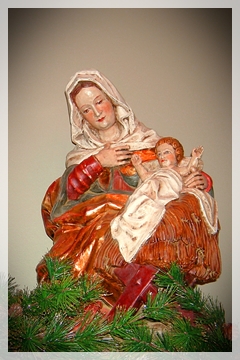
We have no idea when or how Mary told Joseph she was pregnant. Having gone to stay with Elizabeth just a few days after the annunciation, we assume she told him of her pregnancy after returning to Nazareth. The conversation couldn’t have been pleasant. We’re never told that Joseph was angry but it’s hard to think he wasn’t upset and perplexed by this turn of events. His fiancée went away for three months and returned pregnant! No matter how Mary explained it, there was no way she could prove its truth. Her story made no sense so Joseph assumed Mary had been unfaithful to him.

Betrothal was a sacred relationship and the law required a man to divorce an unfaithful fiancée. Joseph was a righteous man, a man who abided by the law; he was obligated to end the engagement by divorcing Mary. Although the Torah demanded stoning an adulterous woman, people couldn’t be executed without Roman permission. Instead, Jewish tradition called for any divorce on adulterous grounds to take place publicly. Mary would have stood in the public square to answer questions about her unfaithfulness while the townspeople watched and judged. Making Mary’s pregnancy public knowledge would have been a fitting punishment for her suspected betrayal, preserved Joseph’s reputation as a righteous man, and freed him of any responsibility for Mary’s child.

It would have been easy for Joseph to wreak revenge on his unfaithful bride, but he didn’t. While he wanted to do the right thing, which was divorce the woman he believed adulterous, he wanted to do it so that she wouldn’t suffer. Joseph decided on a “writ of divorcement” which could be done quietly in the presence of a few witnesses. The equivalent of “irreconcilable differences” or no-fault divorce, it would have allowed Mary the freedom to marry someone else. Once her pregnancy became public knowledge, however, Joseph’s reputation would suffer since he would be suspected of being the father. Nevertheless, because he loved Mary more than he wanted revenge or people’s respect, Joseph put her needs first.

Not a rash man, Joseph took no action immediately. While considering his plan of action, an angel appeared to him and reaffirmed Mary’s story that the child she was carrying was conceived by the Holy Spirit. Joseph now had a third option: marry the girl! But, by marrying her, Joseph assumed responsibility for the pregnancy, shared in Mary’s shame, gave the village fodder for gossip, became the legal father of Jesus, and accepted responsibility for a child who wasn’t his.

Although we don’t know much about Joseph, we know all we need to know: he was a man of integrity who valued God more than other people’s opinions of him. In spite of the consequences, he immediately obeyed God and took Mary as his wife. What kind of man was Joseph? A godly man is my answer. He displayed the character of God we find in Exodus 34 when the Lord passed in front of Moses: “merciful and gracious, slow to anger, and abounding in steadfast love and faithfulness.” That’s the sort of man God chose to act as father to his boy!

“Joseph, son of David,” the angel said, “do not be afraid to take Mary as your wife. For the child within her was conceived by the Holy Spirit. And she will have a son, and you are to name him Jesus, for he will save his people from their sins.” All of this occurred to fulfill the Lord’s message through his prophet:  “Look! The virgin will conceive a child! She will give birth to a son, and they will call him Immanuel, which means ‘God is with us.’” When Joseph woke up, he did as the angel of the Lord commanded and took Mary as his wife. [Matthew 1:20-24 (NLT)]

Copyright ©2019 jsjdevotions. All rights reserved.

A HANDMAID’S HEART

And Mary said, “Behold, I am the handmaid of the Lord; let it be to me according to your word.” And the angel departed from her. [Luke 1:38 (RSV)]

Mary - ChristmasIgnoring the fact that most of us in the room couldn’t qualify as virgins, are well-past child-bearing age, and our genealogies don’t link us to the tribe of Judah and the line of David, the pastor leading our women’s Bible study asked if we were the kind of women God would chose to give birth to His son.

Aside from being young, virginal, and of the right lineage, what kind of woman was Mary? At first glance, she seems little different than any other young girl in the obscure village of Nazareth. There is no mention of her having wealth, exceptional beauty, or social status. Looking like any other peasant girl, she seems unsuitable for a job as mother of God. What about Mary set her apart from every other girl in Palestine who met the lineage and virtue requirements?

Rather than looking at outward appearance, God looks into hearts; while we don’t know about Mary’s physical beauty, her character must have been exceptionally beautiful. Faithful, obedient and humble, she was filled with love for God. She risked her entire future when she submitted to Him. In many translations, Mary calls herself the “Lord’s servant.” The original Greek, however, was doule, which means bondmaid, female slave or handmaid. A doule wasn’t hired help who could quit when she wanted. She was someone who surrendered completely to her Master’s will.

I thought about the pastor’s question. Had I fit the physical and lineage requirements, would God have chosen me to bear His son? He wouldn’t have given me a second look when I was Mary’s age—I was far too willful, rebellious, selfish and unsure of myself to ever call myself a servant to anyone, even God! Even if the woman I am today fit the physical and lineage requirements, God wouldn’t consider me. It’s not that He wouldn’t trust me to feed, comfort, teach, love, guide, encourage, and protect His Son; I’d qualify in the mothering department. It’s that submission thing; I don’t think I’d freely surrender my will to His and God will not force Himself upon anyone. Mary had enough faith to yield her will to God but, even with 72 years of experiencing God’s faithfulness under my belt, I’m not sure I have the heart of a handmaiden. Humble and complete submission to the Master’s will does not come easily. “Thy will be done,” are some of the hardest words to pray and truly mean.

Both Mary and Jesus submitted to God’s divine will; should we do anything less? Father, forgive us for choosing our will over Yours. Give us a handmaid’s heart.

And he withdrew from them about a stone’s throw, and knelt down and prayed, “Father, if thou art willing, remove this cup from me; nevertheless not my will, but thine, be done.” [Luke 22:41-42 (RSV)]

Pray then like this: Our Father who art in heaven, Hallowed be thy name. Thy kingdom come, Thy will be done, On earth as it is in heaven. [Matthew 6:9-10 (RSV)]

Copyright ©2019 jsjdevotions. All rights reserved.

HIS FAMILY

mallard familyYou must have the same attitude that Christ Jesus had. Though he was God, he did not think of equality with God as something to cling to. Instead, he gave up his divine privileges; he took the humble position of a slave and was born as a human being. [Philippians 2:5-7 (NLT)]

Jesus may have been the Son of God but, for most of His life, He chose to live as the son of a man. Luke’s words that Jesus “grew in wisdom and in stature” [2:52] lead us to believe that Jesus was bound, both physically and mentally, by the normal course of human development. He didn’t arrive as an infant who could speak in full sentences, recite the Torah, discuss Scripture with the rabbis, turn water into wine, or walk (let alone walk on water). Like other human children, Jesus had to grow, mature, and obey His earthly parents. While fully God, Jesus also was fully man, with a human nature and will; when He overcame mankind’s sinful nature by never sinning, He did that as a man.

Even though Mary and Joseph knew Jesus was conceived by the Holy Spirit and would reign over Israel, they didn’t know the details of God’s plan or the magnitude of His power. Although they knew their son was special, they had no idea how special He really was! I can’t help but wonder what Jesus was like as a child, what was it like for Joseph and Mary to raise the Son of God, and what it was like to have God for a brother.

The gospels specifically mention Jesus’ sisters and four brothers: James, Joses, Simon, and Judas. [Matthew 13:55; Mark 6:3] Some say that these siblings weren’t the children of Joseph and Mary but were cousins or distant relatives. The Greek words used, however, were specific: adelphos (brothers) and adelphe (sisters). After the wedding at Cana, John tells us that Jesus went to Capernaum with Mary, the disciples and “his brothers.” [John 2:12] Matthew, Mark, and Luke all mention that ”Jesus’ mother and brothers” came to see Him and John tells us that our Lord’s brothers had doubts about Him being the Messiah. That they eventually came to believe in Jesus is clear; they were united in prayer with the disciples after the resurrection prior to Pentecost. Paul refers to James as “the Lord’s brother” and both James and his brother Jude wrote epistles we find in the New Testament. That Jesus had siblings is clear; how they came to be is less clear.

There are many who hold that Mary remained a perpetual virgin: that she and Joseph never consummated their union. The Bible, however, does not support that assertion. Matthew wrote that Joseph did not “know” Mary (a polite euphemism for having sexual relations) until the baby was born, clearly implying that he did “know” her later. Both Matthew and Luke refer to Jesus as Mary’s “firstborn” rather than her “only” son. God ordained marriage and sex before sin entered the world and there is no reason to think Joseph and Mary did not follow His command to “become one flesh” and “be fruitful and multiply.” The sin would have been if Mary had refused to have relations with her husband. For those who want to think of Mary as a perpetual virgin, however, an alternate explanation is that Joseph was a widower and those six or more siblings were from his earlier marriage. In that case, Joseph would have been quite a bit older than Mary and, while he is described as being a righteous man, nothing indicates he’d been previously married. In this scenario, unless those children were all grown and out of his house, where were they that Christmas night in Bethlehem? No mention of a family is made.

Although He was God, Jesus came to earth to live and die as a man. I can’t imagine God wanting Jesus to grow up without experiencing the mayhem, noise, tears, conflict, teasing, and laughter that come with brothers and sisters in the house. As part of a family, Jesus learned how to play, share, wait His turn, tolerate annoying siblings, and help the little ones. The lessons He taught us about love, patience, forgiveness, generosity, and turning the other cheek were all lessons Jesus had to learn as part of a family unit. As Jesus “grew in wisdom and in stature,” he learned how to live peacefully with others, lessons that were invaluable when dealing with the petty rivalries and disputes of His disciples. As we approach the holiday season and the stress of large family gatherings, let us remember that we’re not encountering any challenges that Jesus didn’t face. He managed to do it without sin; can we?

This High Priest of ours understands our weaknesses, for he faced all of the same testings we do, yet he did not sin. So let us come boldly to the throne of our gracious God. There we will receive his mercy, and we will find grace to help us when we need it most. [Hebrews 4:15-16 (NLT)]

Copyright ©2019 jsjdevotions. All rights reserved.

THE BIBLE SAYS!

So I say to you: Ask and it will be given to you; seek and you will find; knock and the door will be opened to you. For everyone who asks receives; the one who seeks finds; and to the one who knocks, the door will be opened. [Luke 11:9-10 (NIV)]

loveIn the comic strip Peanuts, drawn by Charles Schultz, Linus and Lucy van Pelt are brother and sister who, like many siblings, often fight. For several days last week, Lucy tried to convince Linus to give her a Christmas gift. When she insisted the giving of Christmas presents is in the Bible, he called her bluff saying, “You can’t fool an old theologian.” Two days later, while Lucy searched in the Bible, she exclaimed, “I found it!…The word ‘sister’ in the Bible!…That proves you have to give me a Christmas present!” Her little brother merely sighed, “Oh, good grief.” While not as blatant as Lucy, we often find people taking Scripture out of context to justify their own meaning.

Luke 11:9-10 may be the most misinterpreted verse, especially by those who preach a “prosperity gospel” version of Christianity. At first glance, “ask and it will be given” sounds like God runs an Amazon wish fulfillment center in Heaven. Mercedes, check…winning lottery ticket, check…40-foot boat, check! By ignoring the verse’s context, people miss its meaning. Jesus’s reassurance of answered prayers follows the prayer model given to His disciples in what we know as “The Lord’s Prayer.” The requests in this perfect prayer are that God’s name be kept holy, His Kingdom will soon come, for the day’s food, for forgiveness, and not yielding to temptation. Jesus didn’t ask for a new robe, a purse full of money, or a chariot to transport him on His travels! He asked for what was needed to serve God. Following His prayer, Jesus told a parable about a persistent man who boldly begged his neighbor for bread because he had a visitor and no food for him to give him. Jewish culture demanded that hospitality be offered to travelers and the entire village’s reputation was a stake if kindness was not extended. The man didn’t ask for a jug of vintage wine or a newly slaughtered lamb. He asked for the bare minimum: 3 loaves (each about the size of a pita) for a hungry guest so he could abide by the law of hospitality. Looking at Luke 11:9 in context makes it clear that Jesus’s words were not an invitation to “name it and claim it” from God’s vending machine. We wouldn’t open a novel and read a few random sentences and think we know what the story is saying but, like Lucy, we tend to do that with Scripture.

As it turns out, having forgotten about forgiveness, Linus was no better a theologian than his sister. Had Lucy read that Bible more carefully, she could have made an excellent argument for receiving a gift (and even used a verse that included the word “sister”). Linus’ refusal to give Lucy a Christmas present was because she punched him in the face several days earlier. After putting the verse in context, Lucy should have quoted Matthew 18:34-35. When Peter asked if he should forgive someone up to seven times, Jesus replied seventy times seven times and told the parable of the unmerciful servant. After the king forgave his servant’s enormous debt, the man refused to forgive a small debt owed to him and threw the debtor in prison. Upon discovering his servant’s lack of mercy, “In anger his master handed him over to the jailers to be tortured, until he should pay back all he owed. This is how my heavenly Father will treat each of you unless you forgive your brother or sister from your heart.” [Matthew 18:34-35] Using Scripture properly might have gotten Linus to rethink his position and Lucy her present!

George Bernard Shaw said that, “No man ever believes that the Bible means what it says: He is always convinced that it says what he means.” That should never be true of a Christian. We’re not trying to convince a little brother to give us a Christmas gift; we’re sharing the Gospel message. Let’s make sure we do it right!

Do your best to present yourself to God as one approved, a worker who does not need to be ashamed and who correctly handles the word of truth. [2 Timothy 2:15 (NIV)]

Copyright ©2019 jsjdevotions. All rights reserved.

CHANGE OF ATTITUDE

If possible, so far as it depends on you, live peaceably with all. [Romans 12:18 (ESV)]

dilophosaurusThere was a bit of a kerfuffle behind us during church last week; it started during the Old Testament reading and continued to the Gospel. As best as I can figure, a bottle of water had leaked onto the pew. The women behind me sat on the damp cushion and made quite a production of detecting, discussing, and complaining about it first to her husband and then to her neighbor (whose water it had been). There was room enough to move down in that pew and plenty of other pews (with dry cushions) available, but the couple never moved. Nevertheless, throughout the rest of the service, I felt the woman’s breath on my neck every time she exhaled another loud sigh of misery.

Upon returning to our pews after receiving Communion, I realized she’d left church rather than go forward for the bread and wine. When her husband returned to the pew, I heard the woman whose water had spilled whisper her heartfelt apology once again. She asked what she could do to make it right. He casually said, “Nothing. Life happens; it was an accident and she has to get over it.” He then confided, “I’m sorry; she doesn’t handle things well.”

I thought of the story of David, Nabal, and Abigail in 1 Samuel 25. David and his men were hiding from King Saul in the wilderness of Maon when they came across Nabal’s shepherds tending his 3,000 sheep and 1,000 goats. Rather than stealing any animals for themselves, David’s men formed a line of protection around the shepherds and animals so that no harm came to them. At sheep shearing time, a time of celebration when the shepherds would get paid, David sent wishes of peace and prosperity to the wealthy Nabal. Explaining that he and his men had warded off both Bedouin raiders and predators, David asked Nabal to share some provisions with his men as payment for their protection. While their services had been unsolicited, David’s request was not unreasonable.

Nabal’s name meant “fool,” and the man lived up to his name; he not only refused but did so by insulting the slayer of Goliath. Upon hearing Nabal’s rude response, the angry David and his army headed out with the intention of killing every man in Nabal’s household. Fortunately, a servant told Nabal’s wife, Abigail, of David’s service and Nabal’s rashness in offending him. The wise woman quickly packed a large quantity of food and wine and went to David. Humbly apologizing for Nabal’s bad manners and offering the provisions to David and his men, she assuaged David’s anger and defused a dangerous situation.

I imagine Abigail frequently had to make amends for her husband’s churlish and stingy behavior and, from the way that husband handled the situation at church, I suspect that he is no stranger to apologizing for his wife’s peevish conduct. Living with someone who makes mountains from molehills, overreacts to minor annoyances, or takes every slight as a personal insult can’t be easy and I immediately prayed for him.

It was not until later that I thought to pray for his wife. It’s easy to pray for the Abigails and Abners—the long-suffering spouses—in situations like that. They have both our admiration and sympathy as they regularly repair any damage left behind by their spouse. After giving it more thought, however, I also prayed for his wife and others like her—the Nabals and Mabels of life. How sad it must be to go through life choosing misery over joy, tightfistedness over generosity, resentment over forgiveness, turmoil over peace, and complaint over praise. May we all be wary of behaving as a Nabal; it didn’t end well for him. When he discovered what his wife had done, Nabal had a stroke and died!

If you don’t like something, change it. If you can’t change it, change your attitude. [Maya Angelou]

The vexation of a fool is known at once, but the prudent ignores an insult. …The beginning of strife is like letting out water, so quit before the quarrel breaks out. …Good sense makes one slow to anger, and it is his glory to overlook an offense. [Proverbs 12:16,17:14,19:11 (ESV)]

Copyright ©2019 jsjdevotions. All rights reserved.