
Carry each other’s burden; that’s the way to fulfill the Messiah’s law. [Galatians 6:2 (NTE)]
 Since we tend to think of burdens as demanding and often unwelcome duties or responsibilities, we’re certainly not anxious to take on a burden, especially one that actually belongs to someone else! Yet, that is exactly what we’re told we must do if we are going to fulfill Christ’s mandate. And what is that command? To love one another in the way God loves us.
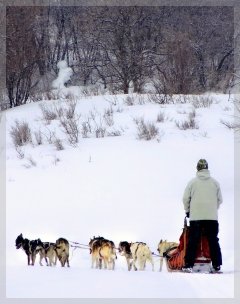
Nevertheless, the concept of carrying someone’s burden makes me think of beasts of burden like mules, donkeys, or oxen. I find it hard to associate the joy of Christianity with an image of myself as a pack animal lugging a heavy load for miles on rough terrain or an ox being poked with an ox goad while plowing a rocky field. Then again, recalling the Alaskan huskies kenneled just west of our favorite Colorado mountain town, I realize I might be thinking of the wrong beasts of burden.
For thousands of years, dogs like them have pulled people and goods long distances. Experienced mushers say that sled dogs are born loving to pull and it certainly seemed that way whenever we went dog sledding. When we arrived at their kennel, the dogs were quietly resting by their shelters or enjoying attention from their future passengers. Once the sleds and harnesses were taken from the storage shed, it was another story. The noise was nearly deafening as the dogs pulled at their chains and barked excitedly as if calling, “Take me!” While the teams were being harnessed and hooked up, the sleds had to be chained to posts to keep the eager dogs from pulling them out on the trail prematurely.
Mushers say teaching one of these dogs to pull is unnecessary—just put on a harness, hook him up, and the dog will do the rest! We barely needed to say “mush” to get them moving and it’s almost impossible to hold them back once they get started. For sled dogs, carrying a burden is joy rather than a chore; carrying one another’s burdens should be that way for a Christian, as well.
A non-believer tends to react to other people’s burdens the way a poodle would to the sight of a heavily loaded sled. Unlike a husky, it probably would whine about the cold and snow and resist being harnessed. If you managed to harness up a poodle, it probably would lie down and refuse to move and, if you ever got a team of them harnessed and moving, they’d certainly find no joy in running across the frozen tundra pulling a sled. Poodles probably can’t understand why huskies enjoy mushing but the love of sledding isn’t in their breeding. Non-believers can’t understand a Christian’s willingness to carry another person’s burden either but that’s because they’re not reborn in Christ. Rather than a genetic predisposition, it’s the Holy Spirit who enables us to love others enough to willingly and joyfully carry their burdens.
When thinking of those dogs so eager to pull us through the mountains, I realize that even substantial burdens can be borne without great difficulty, especially when it’s a team effort. Indeed, the burdens of our brothers and sisters are meant to be shared and, when shared, they cease to be a heavy load for anyone. For the Christian, carrying one another’s burdens isn’t a chore; it’s a privilege and a joy. One musher described his team this way, “They just live their life the way they love to live it…a life that they can be proud of.” Shouldn’t the same be said of us?
Whoever is spared personal pain must feel himself called to help in diminishing the pain of others. We must all carry our share of the misery which lies upon the world. [Albert Schweitzer]
 Yesterday, I wrote about Jesus’ Parable of the Three Servants, often called the Parable of the Talents. Although I used it as an example of excuse making, that’s not what the parable is about. This parable comes right after Jesus’ description of the end times and the Parable of the Ten Bridesmaids in which He urged readiness for the Day of the Lord. Immediately following this parable about the talents, Jesus spoke about the final judgment. The story of these three servants makes it clear that, when that last day comes, the master will settle accounts: faith will be rewarded and the righteous servants separated from the false ones.
 In 1 Samuel 15, after Samuel confronts Saul for disobeying God’s clear commands regarding the Amalekites, Saul makes excuses—first by denying his sin, then by justifying his disobedience, and finally by blaming others. It is only after Samuel tells him the consequences of his sin—the loss of his kingship—that Saul reluctantly admits the truth. In contrast, we have Nathan confronting David regarding his sinful behavior with Bathsheba and Uriah. Immediately after the rebuke, David confesses. It would have been easy for David to blame Bathsheba for seducing him, Uriah for hampering his cover-up scheme, or Joab for his part in Uriah’s death, but he didn’t. Acknowledging his guilt, the repentant David confessed.
 It’s often said that there are no atheists in foxholes. This maxim traces its beginnings back to 1914 and World War 1 when an English newspaper quoted a chaplain at a memorial service for a fallen soldier: “Tell the Territorials and soldiers at home that they must know God before they come to the front if they would face what lies before them. We have no atheists in the trenches. Men are not ashamed to say that, though they never prayed before, they pray now with all their hearts.” When we joined our northern church, it was during the Viet Nam War. I remember a young man in our new member class who’d drawn a low number in the draft lottery. Expecting to be in combat within the year, he confessed wanting to “get right” with God before that time came. Apparently, even the threat of a foxhole is enough to cause some people to rethink their relationship with the Almighty.
 “It’s all about getting a second chance!” said the back of the man’s T-shirt. I then saw the dog paws printed on both sides of the message and realized his shirt was advertising a dog rescue organization. Nevertheless, the shirt’s words made me think of the parable Jesus told the Pharisees about two sons. The vineyard owner told his sons to go work in the vineyard. The first son rudely refused but the second son respectfully promised he’d do the work. As it turned out, the defiant son had a change of heart and went to work in the vineyard while the second seemingly dutiful son never did. Jesus then asked the Pharisees which of the two sons had done his father’s will. Of course, they had to say that the first son, in spite of his initial rebellion, was the obedient one.
 Devotions of the Heart