
For even the Son of Man came not to be served but to serve others and to give his life as a ransom for many. [Matthew 20:28 (NLT)]
 During Lent, I journeyed toward Jesus’ death and resurrection with a Lenten devotional. For each of the season’s forty days, there was a Scripture reading from John, a short devotional, an inspiring quote, interesting facts about Lent’s history, and a unique fast for the day. Each day’s reading also provided journaling space for the reader. For the fortieth day’s journal entry, readers were asked to write a brief letter of thanks to Jesus for all He endured to lead them into eternal life.
More than a week after Good Friday, however, the journal page was blank. Using Christianese words like expiation, redemption, propitiation, and reconciliation, along with born again, forgiveness, salvation, and everlasting life, I easily could have filled that page with a list of what His sacrifice provided. But my mother, who insisted I write a personal note of thanks before enjoying any gift, wouldn’t have approved of such a cursory, let alone tardy, “thank you” note! Jesus certainly deserved better!
Since then, I have pondered all He did for me—not for the world—but for me personally. He provided joy, peace, purpose, and meaning to my life but He did so much more! Jesus loved me! He loved me enough to fast for me—and not just for those forty days in the wilderness. He loved me enough to fast from being God for more than thirty years. Humbling and emptying Himself, the second member of the Trinity traded His Godness for mortal flesh. The One who was there before the world began fasted from the worship of angels, omnipotence, omnipresence, omniscience, sovereignty, and self-existence. He fasted from being God to suffer pain, hunger, thirst, betrayal, discomfort, insults, accusations, humiliation, and the excruciating death of a criminal. That was done for me! Thank you, Jesus!
Because He gave me the gift of His Holy Spirit, Jesus remains with me and continues to lead, guide, guard, comfort, and provide for me. His Spirit helps me understand Scripture, hear His voice, and feel His presence. He guides my prayers—and when I have no words, He prays for me! He gave me a spiritual gift and enables me to bear spiritual fruit. Although He convicts me of my sin, rather than shame me, Jesus forgives me. Thank you, Jesus!
Jesus has been my good shepherd. When I strayed, He found me and brought me home. When I was hurt, he comforted me and dressed my wounds. When danger threatened, He protected me; when I was running on empty, He filled me; and, when I ran myself ragged, He brought me to a place of rest. Because He put people in my life who acted as His hands and voice, I received help, guidance, counseling, encouragement, love, and “sharpening” from His earthly angels. Thank you, Jesus!
As my shepherd, Jesus has been at my side in my darkest moments (as well as my best). He loved me when I was at my worst, when I hated myself, or considered ending my life. When I was angry with Him and turned away, He never abandoned me. He held me when I lost those I loved or was hurt by those who should have protected me. He encouraged me when I was sure I could go no further, lifted me when I fell, and carried me when I couldn’t take another step. He safely brought me through every dark valley into His light. There are times I don’t even like myself, but Jesus loved me enough to die so that I could live! He did that for me! Thank you, Jesus!
Your story is different from mine. Nevertheless, Jesus loves you as much as He loves me! Just as He lived, suffered, died, and rose for me, He lived, suffered, died, and rose for you. What would you write in your letter?
 Every morning, I receive an email from a Christian site to which I subscribe. Having no interest in Temu, make-up, or a “game-changer” pen for seniors, I ignore the ads as nothing more than “click bait.” Today’s ad from a jewelry company, however, caught my eye with its words, “Just in: Angel Numbers.” Having missed all the articles about them in Allure, Reader’s Digest, USA Today, Cosmopolitan, Women’s Day, Instyle, and Vogue, I didn’t know what an “angel number” was, so I Googled it. Apparently, when you see repeated digits (such as 11:11 on your clock, $9.99 on a price tag, 30303 on a license plate, or a date like 2/22/22), the universe is sending you a message! Rather than a coincidence, these repetitive numbers are a “sign from your guardian angel” (or a dead loved one). Supposedly, the “language of angels,” such numbers are meant to point you in a certain direction or confirm the direction in which you’re going! Of course, a host of psychics, spiritual mediums, and numerologists are more than willing to tell you the meaning of your “angel numbers.” And, as I discovered from the ad, once you find your number, you can purchase it in jewelry!
 Most of us probably spent Saturday preparing for Easter. We may have done last minute grocery shopping, prepped for Easter dinner, purchased an Easter lily, decorated eggs, assembled Easter baskets, snacked on jelly beans, or hidden plastic eggs around the yard. The previous day’s service on Good Friday had been a somber one but we knew the following day’s worship would be one of joy and celebration. While we may have sung “Were you There When They Crucified My Lord?” on Friday, we knew that we’d be singing “Christ the Lord is Risen Today” on Sunday.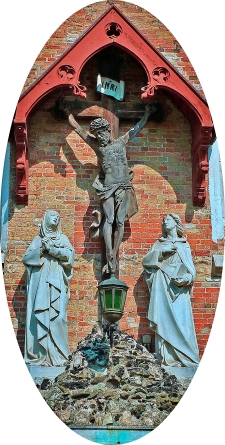
 After pointing out Jesus as the “Lamb of God,” some of John the Baptizer’s disciples left John to follow Jesus. Later, John’s remaining disciples reported that Jesus was baptizing (it actually was His disciples) and wanted to know whose purification ritual of baptism was valid. With many turning from John to Jesus, the Baptizer’s disciples were confused, concerned, and probably a little envious. Apparently, they forgot that John’s original mission was that of forerunner—the one who would prepare the way for the Messiah and point the way to the Lamb of God. Knowing that he wasn’t the bridegroom but only His friend, the Baptizer humbly affirmed his position by telling his disciples that Jesus must become more prominent while he became less and less important. J.C. Ryle likened the Baptizer’s role to that of a star growing paler and paler as the sun rises until the star completely disappears in the light of the sun. John clearly understood that he was to fade in the light of the Son.
 Brent Askari’s play, The Refugees, begins with an unusual premise. Because of a violent civil war in the United States, an upscale American family become refugees in a Middle Eastern country. When the family’s Arab social worker referred to the American refugees as “you people,” the once suburban housewife’s expression spoke volumes. In her previous Connecticut life, anyone who wasn’t white and upper middle class had been “those people” but the tables have turned and the roles reversed. Instead of being the ones with the money and advantages, her family and others like them are “those people:” a minority, seeking asylum in a new country, unfamiliar with the customs, and unable to read, write, or speak the language. Wearing clothes they once would have sent to Goodwill, they need government assistance to survive. Her once high-priced lawyer husband is now a stock boy whose boss takes advantage of his immigrant status. This family and other American refugees are as unwelcome in the unnamed Arab country as are the refugees at our border.
 Devotions of the Heart