IT CONTINUES [THE HOLY WAR – Part 2]

The thief comes only to steal and kill and destroy; I came that they may have life, and have it abundantly. [John 10:10 (RSV)]

Lucerne - city wallMankind falls within the first few pages of Genesis as does Mansoul within the first few pages of John Bunyan’s allegory The Holy War. Resembling real life, Bunyan’s King Shaddai sends his son, Prince Emmanuel, to rescue the fallen city. Under Diabolus and his minions Lord Will-be-will and Misters Lustings, Forget-good, No-truth and Unbelief, Mansoul refuses to listen to Shaddai’s captains. The gates to the city are double-locked and Mr. Prejudice and his band of Deafmen guard Ear-gate (the most likely place the King’s forces will try to enter). Nevertheless, Prince Emmanuel delivers Mansoul from the tyranny of Diabolus, Mansoul repents, and Emmanuel forgives. The story, however, is far from over because Diabolus is not done with Mansoul.

Just as the Israelites failed to rid the land of Canaanites and idolatry, Mansoul failed to rid the city of the many Diabolonians who remained in strongholds after Emmanuel’s victory. Lords Blasphemy, Adultery, and Mischief along with Misters Profane and Deceit plot Mansoul’s destruction. Mr. Self-secure misleads Mansoul into thinking it is strong and invincible, beyond the reach of any foe, and not dependent on Emmanuel. Diabolus returns with his army of Doubters and assaults Ear-Gate with incessant drumming. Captains Brimstone and Sepulcher are placed at Nose-Gate; the grim faced Past-Hope at Eye-Gate; and Captains Cruel, Torment, and No-Ease at Feel-gate. Diabolus seeks to fill Mouth-gate, the voice of prayer, with dirt. The town resists but its gates are weak. Diabolus and his Doubters again take possession of the city; this time, however, they cannot take the castle, the heart of Mansoul. On the third day, Emmanuel returns to them and Diabolus and his Doubters are routed from the town. The city again seeks to rid itself of any remaining Diabolonians such a Misters Mistrust, Flesh, Sloth, Legal-life, and Self-love. Mister Unbelief, however, is far too nimble to be caught and Carnal-sense escapes from prison.

Bunyan’s allegory is more than a story of man’s fall and redemption; it tells of the continuing conflict between good and evil for the possession of man’s soul. Starting with innocence, followed by temptation, sin, and repentance, the story doesn’t end there. Sadly, there is more temptation and sin followed by more repentance. With Unbelief and Carnal-sense still at large, the reader is left to believe that will not be the last time temptation and sin rear their ugly heads.

In Emmanuel’s final commission to Mansoul, he warns them not to live by their senses but by his Word. When explaining why Diabolonians are allowed to exist, he says, “It is to keep you awake, to test your love, to make you watchful… My design is that they should drive you, not further off, but nearer to my Father, to teach you war, to make petitioning desirable to you, and to make you little in your own eyes.” He adds, “Love me against temptation, and I will love you notwithstanding your infirmities … I have taught you to watch, to fight, to pray, and to make war against my foes, so now I command you to believe that my love is constant to you.”

For though we live in the world we are not carrying on a worldly war, for the weapons of our warfare are not worldly but have divine power to destroy strongholds. We destroy arguments and every proud obstacle to the knowledge of God, and take every thought captive to obey Christ, being ready to punish every disobedience, when your obedience is complete. [2 Corinthians 10:3-6 (RSV)]

Copyright ©2019 jsjdevotions. All rights reserved.

GUARD YOUR GATES [THE HOLY WAR – Part 1]

He burned down the Temple of the Lord, the royal palace, and all the houses of Jerusalem. He destroyed all the important buildings in the city. Then he supervised the entire Babylonian army as they tore down the walls of Jerusalem on every side. [2 Kings 25:9-10 (NLT)]

Schoonhoven - city gate

Jerusalem was heavily fortified and completely protected by walls over thirty-nine feet high and eight feet thick. In 586 BC, the Babylonian forces of King Nebuchadnezzar breached those seemingly impregnable walls and Jerusalem was burned, the city’s walls torn down, and the people taken captive. The city’s walls were rebuilt by Nehemiah 141 years later but they were again breached in 70 AD by the Romans who destroyed the city, demolished the second Temple, and massacred much of the population.

Published in 1682, John Bunyan’s allegory The Holy War tells of another fortified city’s fall. Bunyan’s walled city of Mansoul had five gates: Eye-gate, Ear-gate, Mouth-gate, Nose-gate and Feel-gate. Rather than Babylonians or Romans, Mansoul’s enemy was Diabolus. Unlike Jerusalem’s, Mansoul’s gates could not be breached or opened from the outside. They could only be forced if someone within the city allowed it. In short, sin could only enter if someone permitted its entrance. Diabolus and his then invisible army sat down in front of Ear-gate and assaulted it with fraud, guile, and hypocrisy. With the deaths of Captain Resistance and Lord Innocence, the townspeople looked at the tree of forbidden fruit, tasted it, forgot their good King Shaddai, opened both Ear and Eye-gate, and Mansoul came under the rule of Diabolus.

The Holy War is a none too subtle allegory that makes its point: walled cities can fall and city gates can be breached, if not from the outside, then from within. Like the city of Mansoul, sin will tempt and try to seduce us but it can’t force its way into our lives; it only enters by invitation. We alone are the ones who determine what we look at, hear, touch, feel, smell, say and do. Satan didn’t force Eve to eat that fruit, Cain to kill Abel, Jacob to deceive his father, the Israelites to worship a golden calf, Samson to dally with Delilah, David to take Bathsheba, Jonah to run away from Nineveh, King Ahaz to sacrifice his son, Herod to decapitate John, Judas to betray Jesus, or Peter to deny Him. These people freely opened their gates to temptation and allowed sin entrance into their lives.

An inevitable part of life, temptation is not a sin; it is a trial of faith. Mansoul’s sin was not in hearing the lies of Diabolous—it lay in believing and acting upon them. Sin happens when we drop our guard, open our gates, and allow it into our lives. God has given us a conscience, self-discipline, His word, and the Holy Spirit to defend our gates; whether or not we open ourselves to sin always remains our choice. Let us be cautious as to who and what enters our gates!

Temptation is the devil looking through the keyhole. Yielding is opening the door and inviting him in. [Billy Sunday]

But let us who live in the light be clearheaded, protected by the armor of faith and love, and wearing as our helmet the confidence of our salvation. [1 Thessalonians 5:8 (NLT)]

Copyright ©2019 jsjdevotions. All rights reserved.

BEWARE THE GNATCATCHERS!

Don’t worry about anything; instead, pray about everything. Tell God what you need, and thank him for all he has done. Then you will experience God’s peace, which exceeds anything we can understand. His peace will guard your hearts and minds as you live in Christ Jesus. [Philippians 4:6-7 (NLT)]

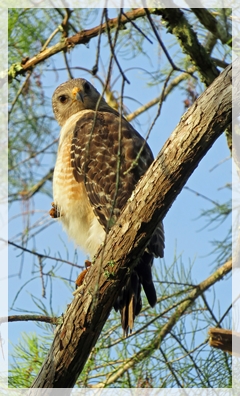
red-shouldered hawkSeeing a red-shouldered hawk perched up in a nearby tree, I focused in on it only to see him suddenly duck his head to avoid being attacked by small bird and then drop again as another tiny bird swept down at him. Those two gnatcatchers boldly harassed the hawk as it kept bobbing and weaving to dodge them. Fiercely territorial, gnatcatchers are unafraid to confront predators and, apparently, the hawk was infringing on their territory. Eventually, the hawk admitted defeat and flew off to another tree. I later asked one of the Audubon docents why the large hawk didn’t fight back against the tiny birds and was told that the hawk knows it can’t win. Being so small, the fast and agile gnatcatcher easily can out maneuver the bigger bird. For the hawk, the energy spent trying to catch the gnatcatcher isn’t worth it; fleeing makes more sense than staying. After settling in another tree not far away, the hawk spotted a crayfish. After sweeping down to catch it, he returned to his new perch and enjoyed a peaceful breakfast (without any annoying gnatcatchers).
“Surely, there’s a devotion of some kind in this!” I thought. Seeing those tiny birds harass the hawk (who was more than 100 times their weight) seemed like a David versus Goliath moment. The more I thought about it, however, I thought the hawk was the innocent party. He hadn’t provoked the birds; he was just minding his own business and looking for breakfast when those birds started pestering him. What the gnatcatchers were doing is called “mobbing.” When birds mob, they make a distress call that attracts other birds (even different species) to join in the harassment. If the hawk hadn’t moved, chances are more birds soon would have joined in hounding and harassing him.

Since another word for harassing is “worrying,” I wondered if those gnatcatchers might be like the worries that seem to come at us from out of nowhere to vex, torment, and distress us. Like mobbing birds, worry calls its pals anxiety, fear, and apprehension to join in troubling us. The gnatcatchers kept the hawk from doing his work (finding breakfast) and worry keeps us from moving ahead, as well. Realizing those birds were not going to disappear, the hawk wisely moved away from them. Often, we’re not that smart; we remain smack dab in the middle of worry and allow it to continue attacking and pecking at us. While the hawk only needed to fly to a nearby tree, we need fly to God, thank Him for His goodness, ask Him for help, and leave our concerns with Him. “You can pick what you ponder,” says Max Lucado. We can perch ourselves in the midst of worry or we can perch ourselves in the promises of God.

Whether or not we worry, our problems will remain. Worry, however, accomplishes nothing. We may not have a lot of power over our problems, but we do have power over our thoughts. Like the hawk, we need to stop perching in the worry zone and get on with our lives, whether that involves catching crayfish in the swamp or giving our concerns to God and working at finding a solution to our problems!

Your problem is not your problem; it is the way you think about it. [Max Lucado]

And now, dear brothers and sisters, one final thing. Fix your thoughts on what is true, and honorable, and right, and pure, and lovely, and admirable. Think about things that are excellent and worthy of praise. Keep putting into practice all you learned and received from me—everything you heard from me and saw me doing. Then the God of peace will be with you. [Philippians 4:8-9 (NLT)]

Copyright ©2019 jsjdevotions. All rights reserved.


TALKATIVE

For the Kingdom of God is not just a lot of talk; it is living by God’s power. [1 Corinthians 4:20 (NLT)]

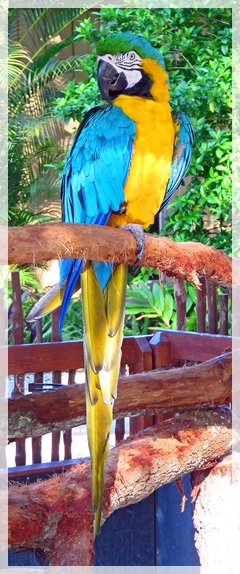
maccawWhen John Bunyan wrote The Pilgrim’s Progress, he was concerned both with the godless unbeliever and the casual and superficial believer: the nominal or counterfeit Christian. We all know them: people who may look and talk a lot like Christians but don’t live like one. Without even realizing it, we may even be one!

When Christian and Faithful encounter Mr. Talkative, Faithful initially considers the man a fine companion; he’s enthusiastic, speaks well and knows his Scripture. Christian, who knew Talkative in his hometown, warns Faithful that, “Religion has no place in his heart, or house, or lifestyle. The man’s religion is found only in his tongue rather than in him.”  Known as a saint abroad and a devil at home, Christian says Talkative is the sort of man who’s better looking from a distance. Although he can talk about faith, repentance, being reborn, and prayer, like the Pharisees, he doesn’t practice what he preaches. Christian then points out that Talkative isn’t even aware of the difference between speaking and being; he’s deceived himself into thinking that hearing and talking are all he needs to be a good Christian. “Knowing is a thing that pleases talkers and boasters, but doing is the thing that pleases God,” agrees Faithful.

Testing his new companion and cautioning him not to give an answer to which God would not give an “Amen!” Faithful asks Talkative, ”Does your religion exist in word or tongue and not in deed and truth?” Balking at giving a reply, Talkative leaves the men. After Christian points out, “Just as a body without the soul is dead, so talking by itself is but a dead carcass,” Faithful promises that he’ll pay closer attention to the distinction between talking and doing in the future.

Faithful observes that just as a prostitute is a shame to all women, a man like Talkative is a shame to all true believers. Christian adds that the number of people whose religion is in their words rather than their life is the reason religion stinks in the nostrils of so many men. We don’t have to be well-known evangelists caught in financial or sexual improprieties to give Christianity a bad name. We just have to be like Talkative: people whose religion is found only in their words rather than their hearts and actions.

I wondered at my answer to Faithful’s question; does my religion exist in word or tongue (or, in my case, web page) and not in deed and truth? What would be your answer to Faithful’s question? More important, would God shout a loud ”Amen!” in agreement to our answers? Let us always remember that faith without works is dead and it takes far more than words to be Christ’s witnesses.

The greatest single cause of atheism in the world today is Christians: who acknowledge Jesus with their lips, walk out the door, and deny Him by their lifestyle. That is what an unbelieving world simply finds unbelievable. [Kevin Max]

What good is it, dear brothers and sisters, if you say you have faith but don’t show it by your actions? Can that kind of faith save anyone? … Now someone may argue, “Some people have faith; others have good deeds.” But I say, “How can you show me your faith if you don’t have good deeds? I will show you my faith by my good deeds.” … Just as the body is dead without breath, so also faith is dead without good works. [James 2:14,18,26 (NLT)]

Copyright ©2019 jsjdevotions. All rights reserved.

DESPAIR AND DOUBT

Around midnight Paul and Silas were praying and singing hymns to God, and the other prisoners were listening. Suddenly, there was a massive earthquake, and the prison was shaken to its foundations. All the doors immediately flew open, and the chains of every prisoner fell off! [Acts 16:25-26 (NLT)]

By 1658 in England, it had become illegal to conduct a religious service differing from the Church of England’s official liturgy or for “one not in Episcopal orders” to address a congregation. A Puritan, John Bunyan, was arrested for preaching the gospel without a license. After three months in the Bedford jail, he was offered his freedom if he’d agree not to preach publicly. He refused saying, “If I was out of prison today, I would preach the gospel again tomorrow by the help of God.” Bunyan spent twelve years imprisoned. During that time, he wrote The Pilgrim’s Progress. No country cub prison, the Bedford jail was overcrowded, unsanitary, unheated, and the plague of 1665 claimed forty prisoners as victims. Years later, Bunyan wrote: “Satan can make a jail to look like hell itself.” Although all looked hopeless for the man, he found strength in prayer and in his writing.

In The Pilgrim’s Progress, Christian and Hopeful accidentally step out of the Way. Having trespassed on the grounds of Giant Despair, they are captured and taken to Doubting Castle. The Pilgrims are imprisoned in a dark dungeon, without bread or water, for nearly four days. The first day, Despair mercilessly beats the men with a club. The second day, telling them there is no escape, the giant urges the suffering men to kill themselves. Realizing that others have managed to escape, the men retain hope, refuse to end their suffering, and vow to battle Despair. The third day, to further destroy their spirits, the giant takes them into the castle yard, shows them the remains of those he’s destroyed, and pitilessly beats them again.

Around midnight Sunday morning, just as Paul and Silas did in their prison cell, Christian and Hopeful begin to pray. A little before dawn, Christian realizes what a fool he’s been. In his coat, next to his heart, is a Key called Promise and Christian is sure it will unlock the doors of Doubting Castle. Although Doubt and Despair caused them to forget the promises of God, prayer reminded the two men to recall and trust in God’s promises. The Key easily opens both the door to their cell and the one into the castle yard but the last lock, the one out of Doubting Castle opens hard. It’s not easy to escape from the depths of Doubt and Despair and I imagine that, during those twelve years he sat behind bars in abysmal conditions, Bunyan had many moments of doubt and despair.

Let us remember to keep the Key of Promise close to our hearts.  It’s unlikely that doubt and despair will come in the form of a giant or a castle dungeon, but they will come and they are capable of imprisoning us. While not using a club, despair will attack us mercilessly, try to strip us of hope, and imprison us in doubt. May we always hold tight the key to our freedom: the promises of God.

Lord, we pray for those imprisoned By Despair, who lie in grief;
Locked in Doubting Castle’s dungeon, Stripped of hope and its relief.
Father help them to remember In Your promise is the key;
Now unlock the door that bars them, In the Gospel, set them free.
[From “A Prayer for Pilgrims” by Ken Puls]

For all of God’s promises have been fulfilled in Christ with a resounding “Yes!” And through Christ, our “Amen” (which means “Yes”) ascends to God for his glory. It is God who enables us, along with you, to stand firm for Christ. He has commissioned us, and he has identified us as his own by placing the Holy Spirit in our hearts as the first installment that guarantees everything he has promised us. [2 Corinthians 1:20-22 (NLT)]

Copyright ©2019 jsjdevotions. All rights reserved.

TO BE STILL

God is our refuge and strength, always ready to help in times of trouble. … Be still, and know that I am God! I will be honored by every nation. I will be honored throughout the world. [Psalm 46:1,10 (NLT)]

When we’re told to “Be still” in Psalm 46, we tend to think in terms of stopping movement—our busyness, frantic activity, or agitated actions. We associate it with a director yelling, “Cut!” the ref blowing his whistle, or a frustrated parent’s “Cut it out!” Being still can entail all of that, but it is much more. The root of the original Hebrew word used for “still” is the verb rapa which means to be faint, forsake, or sink down. When used as the imperative ra’pha’h, as it is in Psalm 46, it means to drop or release our concerns, to become weak, or surrender. While most Bible versions translate this as “Be still,” some translate as desist, stop fighting, cease striving, be quiet, or be at peace. In short, we’re being told to stop anxiously fighting a situation and leave the matter to God—to relax our grip on things, stop worrying and let it be.

Forgetting that we can’t save ourselves, we often base our self-worth on what we can do—our strength, self-sufficiency and independence. It goes against the grain to accept that we must become weaker so that God can become stronger and that we must lose our lives to find them. But, it is when we loosen our grip, release our hold, and admit our helplessness that we finally understand that God is God and we are not!

Do we come to God with clenched fists or open hands? Do we come with hands clutching things like worry, fear, possessions, expectations, wealth, plans and goals or with open hands that have relinquished those things to God? “Be still,” we’re told—loosen the grip and surrender to God. Remember, just as clenched fists can’t release anything, they also can’t receive God’s blessings! Today, instead of bringing my hands together in prayer, I opened them and turned my palms upward in a symbolic gesture both of surrender and acceptance. I was still and knew that He is God.

When a train goes through a tunnel and it gets dark, you don’t throw away the ticket and jump off.  You sit still and trust the engineer. [Corrie ten Boom]

Trust in the Lord and do good. Then you will live safely in the land and prosper. Take delight in the Lord, and he will give you your heart’s desires. Commit everything you do to the Lord. Trust him, and he will help you. Be still in the presence of the Lord, and wait patiently for him to act. [Psalm 37:3-5,7a (NLT)]

Copyright ©2019 jsjdevotions. All rights reserved.