IT’S THE THOUGHT THAT COUNTS

At the same time the Spirit also helps us in our weakness, because we don’t know how to pray for what we need. But the Spirit intercedes along with our groans that cannot be expressed in words. The one who searches our hearts knows what the Spirit has in mind. The Spirit intercedes for God’s people the way God wants him to. [Romans 8:26-27 (GW)]

sandhill craneAs a writer, I like to create with words. When writing a devotion, I carefully organize my thoughts, often cutting and pasting while moving sentences or entire paragraphs around. Supporting Bible verses are sought and various commentaries are consulted. Every word is carefully chosen (often after a synonym search). Grammar and spelling are double-checked and editing and rewriting continue right up to publication. All of that messing around with words, phrases and punctuation may be fine when putting pen to paper or fingers to keyboard, but not when praying. Prayers would never get said if they required that amount of composing, revising and polishing!

God isn’t like an editor with a blue pencil telling us to shorten a paragraph, elaborate on an idea or find a better adjective before the prayer is worthy. He’s not like a teacher with a red pencil checking off our misspellings or grammatical errors. He’s doesn’t grade our prayers or refuse to listen if we’ve ended a sentence with a preposition or split an infinitive. He’s more like a mother who reads and treasures her young child’s letter from camp with its smudges, messy printing, and misspellings. He’s just glad to hear from us.

We’ve all felt painfully inarticulate when it comes to prayer but that shouldn’t prevent us from praying. Although our words may be clumsy, being eloquent is not a requirement for prayer. The power of our prayers is not contained in words, sentence structure, or eloquence; the power of our prayers is found only in the One who hears those prayers! Fortunately, in God’s infinite mercy, He’s given us the assistance of the Holy Spirit. This Spirit, living in us, intercedes for us in our hearts and it’s that heartfelt prayer that reaches God’s ears.

Don’t be so concerned about wrapping the gift that you never give it. … Better to pray awkwardly than not at all. [Max Lucado]

Dear friends, use your most holy faith to grow. Pray with the Holy Spirit’s help. [Jude 1:20 (GW)]

Copyright ©2020 jsjdevotions. All rights reserved.

THE BOSS’S SON

Who, though in God’s form, did not regard his equality with God as something he [Jesus] ought to exploit. Instead, he emptied himself, and received the form of a slave, being born in the likeness of humans. And then, having human appearance, he humbled himself, and became obedient even to death, yes, even the death of the cross. [Philippians 2:6-8 (NTE)]

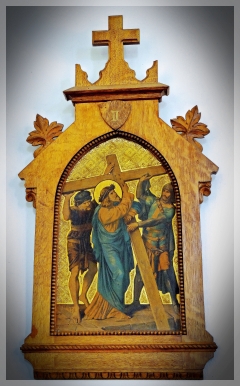
station of the cross II

My son is the third generation to run the family business. Although he is now its CEO, he didn’t begin that way. As his father had done before him, he started by sweeping floors and emptying trash.

The business expanded when my husband purchased a company in another town. With manufacturing processes that were unfamiliar, our son needed to learn new fabrication procedures and started working in the new facility. When he began, only his supervisor knew his relationship to the business’s new owner. He may have been the boss’s son but, to everyone else, he was just Jim, the new guy on the line. In his work shirt and steel-toed shoes, he looked like everyone else, kept the same hours, followed the same rules, and made the same money. What he didn’t do was pull rank or take advantage of his identity.

Although our son originally thought he could learn everything he needed by reading about it, a few days operating the machinery and getting his hands dirty told him there was nothing like first-hand experience! Now that he’s the boss, his employees recognize that he understands and appreciates the challenges they face in doing their jobs.

I tell this story to help us understand what it was like when Jesus put on human flesh and lived as a man. Clothed in work clothes, my son looked like every other hourly employee on the line. Although Jesus is often depicted with a halo, when He was clothed in human flesh, there was no halo and He looked like any other man. Instead of giving up coat and tie for overalls, Jesus gave up His immortal perfect form and took on the aches, indignities, and illnesses that come with a mortal body.

Just as my boy remained the boss’s son but gave up any status or privileges that came from that, Jesus remained God’s son but gave up the benefits that came with His divinity. Of course, Jesus gave up far more than did my son! He set aside the glory of heaven for life on earth and relinquished the divine life He had in heaven to be an itinerant rabbi in Galilee. Even though equal with His Father, Jesus chose to submit to Him as an earthly son does to his father.

Just as our boy never stopped being the boss’s son, Jesus remained fully God while fully man. Just as his co-workers didn’t know our boy’s real identity, people had trouble recognizing Jesus as God’s Son. While my son did what he did so he could learn the family business, Jesus did what He did to take away the sins of the world. Our son may have humbled himself by starting at the bottom but Jesus humbled himself by deliberately choosing to die a torturous death as a criminal on the cross!

My son knows what it means to be one of his employees and he’s a better boss because of it. Jesus knows what it’s like to be human and we are better because of that! Jesus knows what it is to hurt, be disappointed, suffer, struggle, get tired, thirst, feel hungry, bleed, hope, love and die. Because He lived as one of us, we can come to Him confidently and without fear; instead of condemnation, we will receive God’s grace and mercy!

Well, then, since we have a great high priest who has gone right through the heavens, Jesus, God’s son, let us hold on firmly to our confession of faith. For we don’t have a high priest who is unable to sympathize with our weaknesses, but one who has been tempted in every way just as we are, yet without sin. Let us then come boldly to the throne of grace, so that we may receive mercy, and may find grace to help us at the moment when we need it. [Hebrews 4:14-16 (NTE)]

Copyright ©2020 jsjdevotions. All rights reserved.

THE “TERRIBLE PETITION”

Blessings on the merciful! You’ll receive mercy yourselves. [Matthew 5:7 (NTE)]

Yes: if you forgive people the wrong they have done, your heavenly father will forgive you as well. But if you don’t forgive people, neither will your heavenly father forgive you what you have done wrong.’ [Matthew 6:14-15 (NTE)]

large striped swordtail butterflyWhen our pastor did a sermon series on “Dangerous Prayers,” he didn’t mention one many of us pray regularly: “Forgive us our trespasses as we forgive those who trespass against us.” After giving the disciples “The Lord’s Prayer,” Jesus elaborated on this single petition by categorically stating, “If you don’t forgive people, neither will your heavenly father forgive you what you have done wrong.”  The parable of the unforgiving debtor told in Matthew 18 leaves no room for ambiguity on this point. After the servant refuses to forgive the debt of a fellow servant, the angry king rescinds his forgiveness of the unforgiving man and sends him to be tortured in prison until the debt is paid. His debt (equivalent to several billion dollars today) was insurmountable and that torture would never end. Jesus warned his listeners that the same thing would happen to them if they withheld forgiveness.

Asking God to forgive us in the same way we extend forgiveness to others is dangerous. We are asking God to forgive us by the standard that we set—to deal with us as we deal with others! Called the “terrible petition” by St. Augustine, we’re actually asking God not to forgive us if we harbor any unforgiveness in our hearts! For some of us, could these words be a petition for condemnation rather than salvation, ones for death rather than everlasting life? If we’re unwilling to forgive, I suppose they are!

Paul’s words to the Ephesians tell us to get rid of bitterness, rage, anger, and harsh words and to “forgive one another, just as God forgave you in the king.” [4:31-32] Without a doubt, forgiveness is a difficult process and time is needed between our being hurt and our ability to forgive. The struggle to forgive, however, isn’t the sin; it’s the decision not to forgive, to hold onto our bitterness, that is!

Fortunately, forgiveness is a fruit of the Spirit! Jesus said that good trees produce good fruit and that every tree failing to produce good fruit would be cut down and burned. Clarifying that people are identified by their actions, Jesus warned that only those who actually did the will of the Father would enter the kingdom of heaven! From His words, it seems that profession of faith alone does not equal salvation. While salvation is not earned by works, our faith is evidenced by them: by our willingness to do the Father’s will! Can there be an unforgiven Christian? I don’t think so. But, if we refuse to forgive, are we true disciples of Christ or merely hypocrites who say we are?

No part of His teaching is clearer: and there are no exceptions to it. He doesn’t say that we are to forgive other people’s sins provided they are not too frightful, or provided there are extenuating circumstances, or anything or that sort. We are to forgive them all, however spiteful, however mean, however often they are repeated. If we don’t, we shall be forgiven none of our own. [C.S. Lewis]

Actually, good trees can’t produce bad fruit, nor can bad ones produce good fruit! Every tree that doesn’t produce good fruit is cut down and thrown on the fire. So: you must recognize them by their fruits. Not everyone who says to me, “Master, Master” will enter the kingdom of heaven; only people who do the will of my father in heaven. [Matthew 7:18-21 (NTE)]

Copyright ©2020 jsjdevotions. All rights reserved.

LIKE A CHILD

“I’m telling you the truth,” he said. “Unless you turn inside out and become like children, you will never, ever, get into the kingdom of heaven. So if any of you make yourselves humble like this child, you will be great in the kingdom of heaven.” [Matthew 18:3-4 (NTE)]

kiboni school - arusha - tanzaniaI used the NTE version of today’s verse because it better captures the original meaning with the words “turn inside out.” Usually translated as change, turn, or convert, the original Greek was strephō which meant more than a slight change of direction. It meant being turned (even from one thing into another) which requires submission. Far more than a mental acknowledgment or intellectual assent to certain ideas, it’s a turning of one’s whole life and person toward God. The kind of conversion or turning meant in strephō is like having one’s life turned inside out.

When Jesus said to become like children, He wasn’t telling us to act childish but to come to Him as would a child. When thinking of some of today’s often spoiled and demanding children, it’s easy to question His words. Children in His day, however, were far less presumptuous, self-sufficient, disrespectful or defiant than today’s youngsters. They were more like a little girl I encountered in Tanzania. She walked across the schoolyard, stopped, looked up at me and, with a shy smile, presented me with her foot. Her shoe needed tying and, as I knelt down in the dust to tie it, she was a perfect example of Jesus words. Knowing she wasn’t self-sufficient, she openly and humbly depended upon someone older and wiser. Trusting and unpretentious, this beautiful child came to me with a faith and simplicity that we adults don’t seem to have.

A child knows when he or she needs help and will freely ask and accept it. Adults, on the other hand, rarely admit their needs or weakness for fear of appearing vulnerable. We want to be in control but, if we’re ever going to enter into God’s Kingdom and enjoy His peace, we have to turn ourselves inside out, cede control and admit our powerlessness.

Any 12-step recovery program begins with admitting our helplessness but we don’t need to have an addiction or compulsive behavior to have our lives spin out of control. Without Jesus, we are broken beings separated from God and powerless over sin. We may be incapable of saving ourselves, but Jesus is not. What He won’t do, however, is force Himself upon us or chase after every loosened shoelace to tie it. It’s up to us to admit our need and turn to Him, as that child did to me.

I will always remember that brief encounter with a little girl who showed me what it means to turn and be like a child: with humility, trust, openness and a lack of self-sufficiency. The kingdom of God is not earned by human effort but is received in childlike trust as a gift through the mercy and grace of God.

With time, that little girl will become more self-sufficient and won’t need someone to tie her shoes. I pray, however, that she always will be willing to acknowledge her weakness and needs to God.

And this is what he said to me: “My grace is enough for you; my power comes to perfection in weakness.” So I will be all the more pleased to boast of my weaknesses, so that the Messiah’s power may rest upon me. [2 Corinthians 12:9 (NTE)]

Copyright ©2020 jsjdevotions. All rights reserved.

GRIEF IS PERSONAL

The thought of my suffering and homelessness is bitter beyond words. I will never forget this awful time, as I grieve over my loss. Yet I still dare to hope when I remember this: The faithful love of the Lord never ends! His mercies never cease. Great is his faithfulness; his mercies begin afresh each morning. I say to myself, “The Lord is my inheritance; therefore, I will hope in him!” [Lamentation 3:19-24 (NLT)]

gardenias“Once, when my feet were bare, and I had not the means of obtaining shoes, I came to the chief of Kufah in a state of much dejection, and saw there a man who had no feet. I returned thanks to God and acknowledged his mercies, and endured my want of shoes with patience.” The Persian poet Sadi wrote those words in 1258 AD and his words are the source of the adage, “I was unhappy about having no shoes until I met a man who had no feet.” When unsympathetic to what I considered my children’s trivial grievances, I often uttered those words or something similar.

While praying for a husband and wife who’d lost their son to COVID-19 and couldn’t even attend his funeral because they were hospitalized with the same virus, I remembered that old maxim. Thinking of all they’d suffered, I rebuked myself for the tears I’d shed over the small things I’ve lost to this pandemic. Then I remembered a book I read about loss that spoke of the importance of not comparing grief. We are one of a kind and the way we experience emotions, whether grief, love, or joy, differs from person to person. Our unique pasts, along with our hopes, dreams and expectations for tomorrow, profoundly affect how we experience today; what distresses one person may seem but a drop in the bucket to another.

What I’d missed when unsympathetic to my children’s complaints was that their grievances were real to them at the time. While missing senior skip, picnic and award days along with cancelled prom, parties and graduation seems heartbreaking for today’s high school seniors, it’s not the end of the world; but try telling that to an eighteen-year old whose prom dress remains unworn in her closet because of COVID-19. While some people grieve not being able to attend ball games or see their new grandbaby, others grieve not being able to visit their parent in a nursing home or attend a friend’s funeral. Some couples grieve the loss of their wedding and honeymoon, others grieve the loss of their jobs or homes, and still others grieve the loss of a loved one. We may grieve things like spontaneity, travel, feeling safe in stores, family gatherings, working as a team, worshiping together, or not seeing smiles because they’re concealed by masks. As we adjust to our incredibly abnormal “new normal,” we all grieve in one way or another and the things we grieve are as different as the ways we do it. While some grieve with tears, others are stoic; some grieve with busyness, others with lethargy; and some grieve with anger while others with dark humor.

Saying, “I was unhappy about having no shoes until I met a man who had no feet!” helps remind us to appreciate the value of what we have but it fails to acknowledge our feelings. We must never compare the things we grieve or the way we do it with other people’s grief because grief is experienced at 100%, whether it’s over missing one’s senior year of high school, losing a breast to cancer, not being able to visit one’s family, or losing a child to COVID. Our feelings are ours alone and the way we handle them is as unique as our fingerprints.

Because grief of any kind is a personal journey, we should respect our grief as well as that of others, even if ours seems trivial by comparison. If you are grieving right now, your sorrow is real. Rather than berating yourself for it, accept it. It is only by experiencing our grief that we can come to terms with whatever we’ve lost and move on to our new normal, whatever that may be. We have a God who understands sorrow; after all, even though He knew He’d raise Lazarus from the dead, Jesus wept at the man’s grave. We are told that there is, “A time to cry and a time to laugh. A time to grieve and a time to dance.” [Ecclesiastes 3:4] Let us not be hesitant to do both!

You have turned my mourning into joyful dancing. You have taken away my clothes of mourning and clothed me with joy, that I might sing praises to you and not be silent. O Lord my God, I will give you thanks forever! [Psalm 30:11-12 (NLT)]

God blesses those who are poor and realize their need for him, for the Kingdom of Heaven is theirs. God blesses those who mourn, for they will be comforted. [Matthew 5:3-4 (NLT)]

Copyright ©2020 jsjdevotions. All rights reserved.


FEELING GUILTY

He is the Rock; his deeds are perfect. Everything he does is just and fair. He is a faithful God who does no wrong; how just and upright he is! [Deuteronomy 32:4 (NLT)]

For I will show mercy to anyone I choose, and I will show compassion to anyone I choose. [Exodus 33:19b (NLT)]

sunflowerShe washes her hands with soap and water but, doubting the brown liquid coming from the faucet (water that’s unsafe to drink) could rid her hands of germs, my friend also uses hand sanitizer. She’s not in a third world country but at a Native American pueblo less than a half hour from a major American city. One third of its residents live in “poverty” and the rest aren’t much better. Several generations live together in overcrowded homes, no one has appliances like washers, dryers or dishwashers, and cell service is iffy at best. In spite of all they lack, the people she meets are kind and generous. Never apologetic for their homes, they welcome her and always offer food and bottled water; proud of their heritage, they invite her to their feasts. Serving this indigenous nation in a medical capacity, she tries to shake off the feeling of guilt as she pulls into her driveway. She knows that her ethnicity is much of the reason she enjoys a life easier than theirs.

The next day, she visits a juvenile detention center. In spite of its name, it’s a prison. The youth incarcerated there have committed serious crimes and many will move into the adult prison when old enough. She tries not to look at their criminal records but she can’t help seeing their troubled histories. In most cases, they are from broken homes or victims of physical, sexual, and/or emotional abuse. Some were given drugs and alcohol or turning tricks as young children. The dysfunction in their families makes the Gallaghers on Shameless look functional. My friend recognizes how different her life would have been had she not been born into the family God gave her. She knows she didn’t deserve her good childhood any more than those youngsters deserved their bad ones and she again feels a pang of guilt!

I understand my friend’s feelings; she is not alone. We’ve all thought, “There, but for the grace of God go I!” It’s often easier to feel forgiven and free of guilt for our sins than not to feel guilty for God’s blessings. While both forgiveness and blessed circumstances are undeserved—all believers get the one but not all believers get the other. God’s blessings seem inequitable at best; some people face seemingly endless obstacles and crises while others seem to breeze through life with only minor setbacks. It’s not just that bad things happen to good people and good things to bad but that we don’t all start out from a level playing field. Life, however, is not fair; if it were, Jesus never would have died for our sins!

The parable of the gracious landowner tells us that God is sovereign, righteous, and free to dispense His blessings any way he wants. Some inequities can be part of God’s design; for example, even before they were born, God chose Isaac over Ishmael and Jacob over Esau. Most inequities, however, are because we live in a world with sin: one cursed with things like disease, prejudice, deception, pain, poverty, defect, injury, hate, suffering, and poor decisions.

We’re told to be like children and (whether or not they deserve it) I’ve never heard any child say, “You shouldn’t have!” when receiving a gift. Blessings should only generate thanks and praise. We always should be humble about God’s gifts but never ashamed of them. Yet, many of us feel guilty for our undeserved blessings and then even guiltier for feeling that way! Guilt of any kind is a gift from Satan, the accuser, and one we’re not meant to keep! Let us replace any guilt with gratitude.

The book of Job makes it abundantly clear that we will never understand the “why” of God’s ways. Instead of feeling guilty about our blessings and wondering why we’ve been given the life we have, let us accept it with joy. Our task is to be good and faithful stewards both by using our blessings wisely and by redistributing them to others. My friend does that every time she visits the pueblo or prison and brings both her medical training and the light of Jesus with her. We should only feel guilty about our blessings if we’re hoarding them rather than giving them away!

Nobody has a right to take credit for what he or she was born with—only for what they have done with it. [Sydney J. Harris]

Who and what you now are is a gift from God in King Jesus, who has become for us God’s wisdom – and righteousness, sanctification and redemption as well; so that, as the Bible puts it, “Anyone who boasts should boast in the Lord.” [1 Corinthians 1:30-31 (NTE)]

What about people who are rich in this present world? Tell them not to think of themselves too highly, and to set their hopes, not on something so uncertain as riches, but on the God who richly provides us with everything to enjoy. They are to do good, to be rich in good works, generous and eager to share. That way, they will treasure up for themselves a good foundation for the future, and thereby come to possess the life which really is life. [1 Timothy 6:17-19 (NTE)]

Copyright ©2020 jsjdevotions. All rights reserved.