
On the way, Jesus told them, “All of you will desert me. For the Scriptures say, ‘God will strike the Shepherd, and the sheep will be scattered.’ But after I am raised from the dead, I will go ahead of you to Galilee and meet you there.” [Mark 14:27-28 (NLT)]
In the days leading up to his crucifixion, the people who claimed to love Jesus the most failed him in many ways. We know about Judas—the disciple trusted enough to carry the money bag who betrayed Jesus for thirty pieces of silver. That last night, the deceitful man had the audacity to have his feet washed by the Lord and to drink from His cup! But what of the other disciples? During that same meal, Peter vowed he’d never deny Jesus, even if it meant his death and the rest of the disciples echoed his pledge. Yet, within a matter of hours, those brave disciples would desert Jesus and Peter would deny Him three times. Even though Jesus asked Peter, James, and John to pray and keep watch with him in the Garden of Gethsemane, they fell asleep, not once but twice!
Where were the disciples when the mob shouted for Barabbas to be freed? For that matter, where were all of those people who had been healed or fed by Jesus? Just a few days earlier, a crowd had shouted, “Hosanna! Blessed is he who comes in the name of the Lord!” Where were they? Why were they silent? Instead of calling for Jesus’ freedom, the mob called, “Crucify him! Crucify him!”
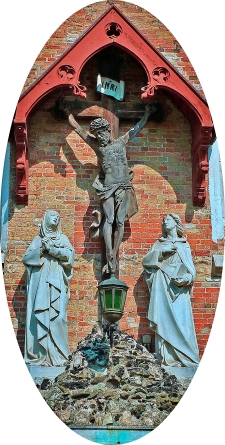
The disciples weren’t even there to carry the cross for Jesus; that task fell to Simon, a stranger from Cyrene. Only John, Mary the mother of Jesus, Mary Magdalene, and some other women followers were at the foot of the cross when Jesus was crucified. Disillusioned and fearful for their lives, the other disciples were absent in His dying hours.
Rather than a disciple, it was a dying criminal who attested Jesus’ innocence, showed his faith, and asked the Lord, “Remember me when you come into your Kingdom.” When Jesus took His last breath and died, it was a Roman soldier and not a disciple who declared, “This man truly was the son of God!” The eleven remaining disciples didn’t even help bury their beloved rabbi. That responsibility was taken by Joseph of Arimathea and Nicodemus, members of the Jewish high council and secret followers of Jesus.
The disciples, confused and frightened, failed Jesus both as disciples and as friends. Nevertheless, despite the way they failed Him, Jesus didn’t fail them. Instead, after His resurrection, Jesus greeted them with words of peace and forgiveness. He then opened their minds to understand the Scriptures and charged these men—the same men who once failed Him—with the task of spreading the good news of His resurrection. Jesus knew it is better to be a believer who sometimes fails than not to believe at all.
Be assured, if you walk with Him and look to Him, and expect help from Him, He will never fail you. [George Mueller]
 It was the week before the Passover and Jerusalem was teeming with pilgrims who’d come for the celebration. News of the rabbi who’d brought Lazarus back to life was spreading through the crowd. As the people prepared to celebrate their deliverance from slavery in Egypt, they hoped for the promised Messiah who would deliver them from the tyranny of Rome. Could Jesus be the one to do that?
 After pointing out Jesus as the “Lamb of God,” some of John the Baptizer’s disciples left John to follow Jesus. Later, John’s remaining disciples reported that Jesus was baptizing (it actually was His disciples) and wanted to know whose purification ritual of baptism was valid. With many turning from John to Jesus, the Baptizer’s disciples were confused, concerned, and probably a little envious. Apparently, they forgot that John’s original mission was that of forerunner—the one who would prepare the way for the Messiah and point the way to the Lamb of God. Knowing that he wasn’t the bridegroom but only His friend, the Baptizer humbly affirmed his position by telling his disciples that Jesus must become more prominent while he became less and less important. J.C. Ryle likened the Baptizer’s role to that of a star growing paler and paler as the sun rises until the star completely disappears in the light of the sun. John clearly understood that he was to fade in the light of the Son.
 Unlike Lazarus, we haven’t had a four-day encounter with death. Our family didn’t wash us with warm water, anoint us with myrrh and aloe, wrap us in a shroud with herbs and spices, lay us in a tomb, and mourn our passing. Most of us haven’t even endured a months-long coma, flatlined, or been brought back to life with an AED. How does such an experience affect someone? Without a doubt, the man who emerged from the tomb differed from the man who died four days earlier. Did Lazarus return to life with the 1st century equivalent of a “bucket list” of things to accomplish, places to go, things to do, and adventures to have?
 Jesus was in Perea on the east side of the Jordan when He learned that Lazarus lay on his sickbed. Why didn’t He immediately return when told that his dear friend was sick? While the timeline is unclear, the messenger probably set out for Jesus as soon as Lazarus took ill. Since it was a day’s journey from Bethany to Perea, Jesus would have heard the news late that first day or early the second. By that time, Lazarus already was dead. With Jewish custom requiring the funeral be within eight hours of death, he probably was buried, as well. Nevertheless, even though Jesus knew that He’d miraculously resurrect the dead man, He seemed strangely unconcerned. Rather than immediately return to comfort Martha and Mary and cut short their time of mourning, Jesus waited around on day two and three and didn’t arrive in Bethany until the fourth day.
 Brent Askari’s play, The Refugees, begins with an unusual premise. Because of a violent civil war in the United States, an upscale American family become refugees in a Middle Eastern country. When the family’s Arab social worker referred to the American refugees as “you people,” the once suburban housewife’s expression spoke volumes. In her previous Connecticut life, anyone who wasn’t white and upper middle class had been “those people” but the tables have turned and the roles reversed. Instead of being the ones with the money and advantages, her family and others like them are “those people:” a minority, seeking asylum in a new country, unfamiliar with the customs, and unable to read, write, or speak the language. Wearing clothes they once would have sent to Goodwill, they need government assistance to survive. Her once high-priced lawyer husband is now a stock boy whose boss takes advantage of his immigrant status. This family and other American refugees are as unwelcome in the unnamed Arab country as are the refugees at our border.
