
And we are confident that he hears us whenever we ask for anything that pleases him. And since we know he hears us when we make our requests, we also know that he will give us what we ask for. [1 John 5:14-15 (NLT)]
May he grant your heart’s desires and make all your plans succeed. [Psalm 20:4 (NLT)]
 What do you hope to find tucked into your Christmas stocking or deposited under the tree Christmas morning? From the above words, it’s easy to think God is promising something like Christmas morning every day. Although He promises to hear and answer our prayers, let’s remember that He’s not so specific as to how He’ll answer them.
Remember the story of King Midas? As a reward for the King’s kindness, Dionysus offered Midas anything he wanted. Coveting wealth, Midas wanted everything he touched to be changed into gold. Although he was warned to think seriously about such a wish, the king insisted. How thrilled he was when the twigs and stones he handled became precious metal. Midas’ joy at his gift began to fade, however, when he discovered that gold roses have no aroma and food became metal before it could be eaten. After a simple touch turned his daughter into a golden statue, the king detested the gift he’d so desired. Taking pity on him, Dionysus told the king to wash in the river Pactolus to lose his golden touch and make things right again.
While the Midas story has pagan beginnings, there is much a Christian can learn from this ancient myth, the first of which is not to love material possessions. When we pray, we shouldn’t act like children looking through Amazon’s “Ready, Set, Play” holiday toy catalog or grown-ups browsing through the Neiman Marcus 200-page Christmas Book and marking the pages with our holiday fantasies. Prayer is not like writing a wish list to Santa for all the gifts we desire and God’s promises are never an excuse for greed or selfishness.
Unlike a mythical Greek deity, God will not give us anything that could harm us. While we’re not likely to ask for a snake or scorpion, we have been known to ask for other things that could bring us harm—the extra money, new job, sexy guy at work, vacation in Vegas, or that big house with an even bigger mortgage. Just like King Midas, our limited (and selfish) perspective cannot possibly see all of the ramifications of our prayer requests. We ask for things without understanding how they may affect our life or the lives of others. We may know what we want but God, in his infinite wisdom, knows what will happen if we get it. If God had given me everything for which I prayed, it would have taken way more than a bath in the river Pactolus to clean up the resulting mess and set things right again. It’s been said that God’s answers are far wiser than our prayers and, indeed, they are. With love and wisdom, in His own time and way, God will always answer our prayers. Let’s give thanks that “Yes” is not always His answer to our requests.
The devil doesn’t come in a red cape and pointy horns. He comes as everything you’ve ever wished for. [Anonymous]
 Jesus said to him, “For sure, I tell you, unless a man is born again, he cannot see the holy nation of God.” Nicodemus said to Him, “How can a man be born when he is old? How can he get into his mother’s body and be born the second time?” [John 3:3-4 (NLV)]
 “A children’s story which is enjoyed only by children is a bad children’s story,” said C.S. Lewis. I agree and admit to enjoying the seven books comprising Lewis’ The Chronicles of Narnia both as a child and an adult. Even though the Narnia books take place in a make-believe world filled with talking animals, mythical creatures, and magic, there are Christian overtones to the entire series. For example, the first book calls up images from Genesis when Aslan, the Great Lion, sings Narnia into existence and evil is introduced to the land. In the second, Aslan willingly dies so that the sins of one boy are forgiven but comes alive again. In another book, Eustace, who had “greedy, dragonish thoughts” becomes a dragon. When Aslan strips away the boy’s scales and throws him into the water, the repentant boy is transformed and images of rebirth and baptism come to mind. Resembling the last book of the Bible, the final story in the series tells of a beast, a false prophet, Narnia’s fall, and a Narnian paradise (where sadness and weariness do not exist).
 Ask, seek, and knock—three easy instructions. Ask. Ask as if we mean it, as if we truly care about the answer. Ask as if we believe we’re being heard. Ask with the hunger of a beggar begging bread. Ask with the fervor of someone sinking in quicksand pleading for help. Ask with the thirst of a dying man in the desert requesting water. Ask as if our very lives depend on the answer. Ask.
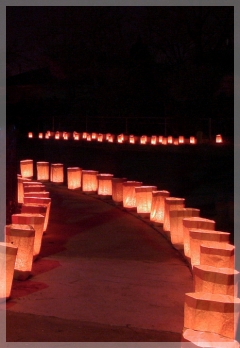 Hundreds of years ago, when Las Posadas was first celebrated, people gathered piñon pine branches into square piles to burn small vigil fires called luminaria to light the way for the Peregrinos as they searched for lodging. On Christmas Eve, bonfires were lit along the roads and in the church yard to guide people to midnight mass. Just as Las Posadas moved into the southwestern states as the Spanish and Mexicans came northward, so did the luminaria. When inexpensive flat-bottom paper bags appeared on the Santa Fe Trail in the 1870s, people started folding down the bag tops, anchoring the bag with a few handfuls of sand, and setting a small candle inside. Better than using precious fire wood, these luminaria (also called farolitos) became the popular tradition that continues in the southwest today.
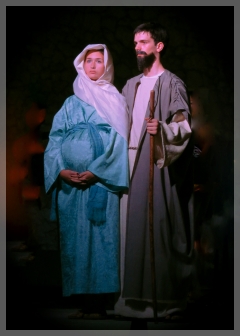 Until learning about Las Posadas, I hadn’t given much thought to the difficulty of Joseph and Mary’s journey to Bethlehem or to how frightened and desperate the couple must have been that night so long ago. As the crow flies, it’s only a 70-mile trip from Nazareth to Bethlehem but Joseph and Mary weren’t crows and the route was not a straight one. Because of the hilly terrain, the most direct route south was the most physically challenging and, because it led right through Samaria, it also was the most dangerous. Wanting nothing to do with Samaritans, Jews typically detoured to the east before going south along the flatlands of the Jordan River, turning west at Jericho, going over the hills surrounding Jerusalem, and on south into Bethlehem—a trip of 90 to 100 miles. The trek from Jericho to Bethlehem would have been the hardest since it was an uphill hike with an elevation change of 3,500 feet! In good circumstances, people could walk about 20 miles a day so Mary and Joseph feasibly could have made Bethlehem in five 8-hour days. Mary, however, was about ready to give birth so a trip of seven to ten days is more likely.
