RELUCTANT HEROES

Now go, for I am sending you to Pharaoh. You must lead my people Israel out of Egypt.” But Moses protested to God, “Who am I to appear before Pharaoh? Who am I to lead the people of Israel out of Egypt?” [Exodus 3:10-11 (NLT)]

red-shouldered hawkIn the late 1970s, psychologists Suzanna Imes and Pauline Rose Clance developed the concept of what is known as the “imposter syndrome.” Loosely defined as doubting one’s abilities and feeling like a fraud, it is believing that you are not as competent as others perceive you to be. The impostor syndrome manifests in failing to realistically assess our competence and skills, self-denigration, a fear of not living up to expectations, and attributing any of our successes to someone or something else, like luck.

When God called out to Moses from the burning bush, He assigned Moses the task of going to Pharaoh and leading the people of Israel out of Egypt. Moses’ response is a classic example of imposter syndrome. As the princess’ son, he spent forty years as a prince in Pharaoh’s palace, was well-educated, and knew the royal protocol, language, and culture of Egypt and, as a Hebrew, he also knew the language, history, culture, expectations, and God of Israel. Although he was uniquely qualified for the task, Moses belittled his speaking ability and showed his fear of failure with the question, “What if they won’t believe me or listen to me?”

Moses, of course, is not the only one of the Bible’s heroes to suffer from the “imposter syndrome” when called to do God’s work. Isaiah thought he was too sinful, Jeremiah thought he was too young, and then there’s Gideon. When we first meet him, Gideon is hiding in a winepress while threshing wheat, which seems somewhat cowardly. The people of Israel, however, had been oppressed for seven years by marauding nomadic tribes like the Midianites. Their livestock and crops were being pillaged and the people were being starved into submission as they hid in caves. Not about to let his family starve, Gideon had come up with a clever way to conceal his activity and threshing wheat in a wine press may have been wiser than it was cowardly. Nevertheless, when the angel of the Lord called on him to rescue Israel, the man disparaged not just himself but his entire clan of Manasseh. Even though the people had no other leader, Gideon was sure he had neither status nor authority to call up an army.

Convinced that they weren’t capable of doing God’s work, Moses, Isaiah, Jeremiah, and Gideon listed all that they weren’t rather than looking at all of the things God is. They didn’t see what they brought to the table and certainly didn’t understand the power they’d receive from God. It wasn’t eloquence that caused Egypt’s plagues or caused the Israelites to follow Moses nor was it strict adherence to the law or maturity that enabled Isaiah and Jeremiah to prophesy. It certainly wasn’t status and authority that led to Gideon’s victories. It was the power of God!

While there are many competent, experienced, and skilled people in the world, God isn’t interested in whether or not we’re qualified. God is interested in our devotion to Him. If we’re committed to doing His work, God will provide the qualifications! If we’re not devoted to God, however, we’ll remain unqualified regardless of our eloquence, status, authority, talents, wisdom, or expertise. Let us never underestimate our abilities but, more important, let us never underestimate the power of our God!

Many Christians estimate difficulties in the light of their own resources, and thus attempt little and often fail in the little they attempt. All God’s giants have been weak men who did great things for God because they reckoned on His power and presence with them. [James Hudson Taylor]
Then the Spirit of the Lord clothed Gideon with power. He blew a ram’s horn as a call to arms, and the men of the clan of Abiezer came to him. He also sent messengers throughout Manasseh, Asher, Zebulun, and Naphtali, summoning their warriors, and all of them responded. [Judges 6:34-35 (NLT)]

Copyright ©2022 jsjdevotions. All rights reserved.

SUNDAY MORNINGS

Yet a time is coming and has now come when the true worshipers will worship the Father in the Spirit and in truth, for they are the kind of worshipers the Father seeks. God is spirit, and his worshipers must worship in the Spirit and in truth. [John 4:23-24 (NIV)]

The purpose of this Christian society called the “Church” is, first: to glorify God by our worship. We do not go to church just to hear a sermon. We go to church to worship God. [Billy Graham]

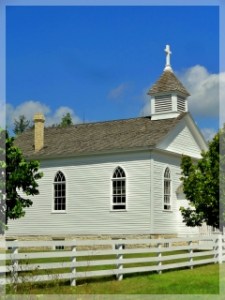
Old World Wisconsin
In this day and age, we refuse to be bored. We watch one of three TVs while on the health club treadmill, stream music or podcasts when out walking, and check our phones at red lights. (Technically, we’re not texting while driving—we’re simply texting while stopping.) We could blame technology, but our penchant for boredom has been a problem since the beginning of time. A golden calf and some “pagan revelry” was the Israelites’ antidote for boredom while Moses was on Mt. Sinai. Then, when they got bored with manna, the Israelites demanded meat. David had at least eight wives but boredom caused his eyes to wander over to Uriah’s house where Bathsheba was bathing. Mankind just seems to be hardwired to tire of the “same old, same old” and, sometimes, that propensity for boredom enters into our worship.

“I laugh so much during church, it seems almost sinful; it’s just so much fun to come!” said a neighbor about her church. Another neighbor urged us to join them at their church because of the musical talents of their pianist/organist who is known for playing six keyboards at once. Neither neighbor, however, mentioned things like the substance of their pastor’s message, the basics of their church’s beliefs, or how their worship affects them. There’s nothing wrong with pastors who insert humor into their messages or great worship music but we must be cautious of thinking of church as entertainment. The center of attention is neither the man in the pulpit nor the musicians; it is the man who hung on the cross for our sins! Jesus was an impressive man while He walked the earth but impressing people was not His goal. If it was, He would have performed far more miracles; instead, He often told people not to tell anyone. His purpose wasn’t showy miracles but the lasting message of salvation.

The purpose of worship is not to praise the pastor, music, or setting; it is to glorify God! Pope Pius X said it succinctly: “Worship is for the glory of God and the sanctification and edification of the faithful.” It’s easy to get the glorifying part—we’re praising the wondrous nature of God, thanking Him for our blessings, and celebrating His glory. Our worship, however, shouldn’t stop there. Sanctification is one of the Christian words we don’t use a lot, but it simply means that our worship is supposed to change us—to set us apart from the world and worldly concerns for God’s holy purpose. As for edification, another churchy word, worship is about helping one another along the road to Christlikeness—the building up of a group of disparate individuals into the body of Christ. Regardless of the pastor’s ability to deliver a sermon or the worship leader’s choice of music, if the service hasn’t glorified God, helped change us for the better, or built up God’s Kingdom, we haven’t worshipped properly.

Is church where we go to be entertained or is it the place we go to be strengthened by His word and grow to be more like Christ? Is it where we go to be distracted from the cares of the world or where we go to worship the Lord and to revel in His glory? While bells and whistles are pleasant, we should remember that the purpose of church is worship not theater. Rather than fluff and stuff, we should be seeking a foundation in God’s word, the presence of Jesus, and the power of the Holy Spirit. If we’re bored during church, the antidote isn’t more pageantry or spectacle, funnier sermons, or better music; it is more mindful worship on our part.

Worship is not about my enjoyment. It is about my enjoyment of God. It is not about my pleasure or my delight or my satisfaction. It is about my pleasure, delight, and satisfaction in God. Worship is not simply about glorifying God. It is about glorifying God by enjoying Him forever. [Sam Storms]

Since, then, you have been raised with Christ, set your hearts on things above, where Christ is, seated at the right hand of God. Set your minds on things above, not on earthly things. [Colossians 3:1-2 (NIV)]

Copyright ©2022 jsjdevotions. All rights reserved.

SIMON OF CYRENE

Then he said to the crowd, “If any of you wants to be my follower, you must give up your own way, take up your cross daily, and follow me.” … As they led Jesus away, a man named Simon, who was from Cyrene, happened to be coming in from the countryside. The soldiers seized him and put the cross on him and made him carry it behind Jesus. [Luke 9:23, 23:26 (NLT)]

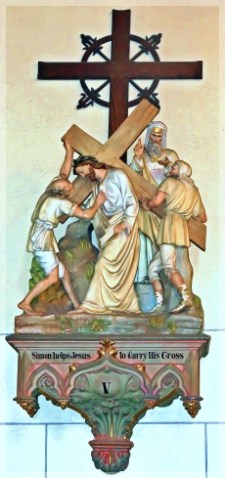
Simon Carries the Cross
Although Jesus spoke of carrying your own cross, it was Simon of Cyrene who carried His. Cyrene was in Cyrenaica, a land just east of Egypt in what now is Libya. We don’t know if Simon had resettled in Judea or if he was there just for the Passover. We only know that Simon had just come into the city from the fields (or countryside) when the soldiers pressed him into service. Carrying a 75-to-125-pound cross-beam (patibulum) of a Roman cross certainly hadn’t been in Simon’s plans that day but one didn’t refuse a Roman soldier.

If we’re supposed to carry our own cross, why didn’t Jesus carry His? Perhaps because that cross was as much Simon’s as it was Peter’s and John’s and yours and mine. That cross weighed more than 125 pounds because it carried the weight of mankind’s sins. It was at Golgotha that Simon surrendered the weight of his (and everyone else’s) sins to Jesus. Not only did Simon carry his own cross but Luke tells us specifically that Simon followed Jesus as he did it!

When they impressed Simon into service, it seems as if the Roman soldiers finally showed some compassion on the man they’d so mercilessly beaten earlier that day. Kindness, however, may not have been their motivation. Not everyone condemned to the cross survived the soldiers’ scourging but they’d been told to crucify Jesus. If He died before getting to Golgotha, they’d have failed at their task. The soldiers may have enlisted Simon simply to keep Jesus alive long enough so they could inflict more torture on Him!

Whatever the soldier’s motive was for conscripting Simon, theologian John Piper posits that God put Simon there for Jesus. Let us remember that the man who healed the sick, turned water into wine, fed a multitude with a boy’s lunch, gave life back to Jairus’ daughter, and called Lazarus out of the tomb had the power to stop his suffering at any time that day. If we thought Jesus’ anguish was great the previous night while praying to do God’s will, His agony that day was far worse. If we thought Jesus’ temptation to yield to Satan was great in the wilderness, it was even greater as He stumbled toward Golgotha. Angels, however, ministered to our Lord in the wilderness and an angel strengthened Jesus in the Garden of Gethsemane. In the same way, did God have Simon carry the cross as a way of helping and sustaining His Son so that Jesus’ obedience would not falter?

God works in amazing ways and maybe Simon of Cyrene was placed on that roadside at just that time for just such a purpose! Could God have placed us somewhere today so that we can serve as one of His ministering angels?

The Spirit then compelled Jesus to go into the wilderness, where he was tempted by Satan for forty days. He was out among the wild animals, and angels took care of him. [Mark 1:12-13 (NLT)]

“Father, if you are willing, please take this cup of suffering away from me. Yet I want your will to be done, not mine.” Then an angel from heaven appeared and strengthened him. [Luke 22:42-43 (NLT)]

Copyright ©2022 jsjdevotions. All rights reserved.

TAKE THE RISK

Be strong and courageous! … Do not be afraid or discouraged, for the Lord will personally go ahead of you. He will be with you; he will neither fail you nor abandon you. [Deuteronomy 31:6a,8 (NLT)]

Let all who fear the Lord repeat: “His faithful love endures forever.” … The Lord is for me, so I will have no fear. What can mere people do to me? [Psalm 118:4,6 (NLT)]

great egret
Judge Guido Calabresi regularly asks his Yale law students to imagine receiving an offer of an amazing invention that could improve people’s lives in every imaginable way. In exchange for this invention, however, the lives of at least 1,000 randomly selected young people would be taken every year. When asked if they’d accept the deal, his students inevitably conclude they wouldn’t. Calabresi then asks them the difference between that offer and the automobile. The very thing that allows us to travel, see loved ones, easily move products across the country, and do things that couldn’t be done otherwise, kills even more than that! Over 2,600 teens (16-20) accounted for auto accident fatalities in 2019 and, with over 46,000 car fatalities last year, more than 150 people of every age die each day because of a car. Be that as it may, we’re not about to give up driving!

Calebresi uses his example to illustrate how selective we are in our fears. We underestimate and accept chronic risks like riding in a car while overestimating prominent ones like a terrorist attack or plane crash. In actuality, rather than dying from either of those things, we’re more likely to die by choking on food or slipping in the shower or tub but, preferring bathing, eating, and even driving to the alternatives, we decide they’re worth the risk. On the other hand, after assessing the perils involved in things like free solo climbing, running with the bulls, or base jumping, most of us probably decide they’re not worth the risk.

In contrast, any risk we take in obedience to God always is worth it. Regardless of the danger, we must obediently accept the risks in the challenges and tasks He gives us. Think of what Abraham risked by packing up his family and leaving Haran for an unknown destination. Think of the risks taken by the midwives Shiphrah and Puah when they defied Pharaoh by letting boy babies live or the risk Moses took when he returned to Egypt and confronted Pharaoh. It was a huge risk when Gideon and his 300 men took on an army 400 times their size and when David faced Goliath with just a sling and stones. In spite of the risk, Esther approached the king, Daniel defied the law by praying, and the bleeding woman touched Jesus’ robe. Joseph of Arimathea took a risk when he asked Pilate for Jesus’ body and Peter and John risked imprisonment and worse when they defied the Council by continuing to share the gospel. When we search Scripture, we don’t find people who assessed the risks and played it safe. We find God’s version of bungee jumpers and wing-suit flyers—faith-filled and obedient risk takers.

Every God-sent risk comes with a God-sent promise. He will remain faithful to us and be present in the risk. He will protect and empower us and we’ll never need more than what He supplies. As followers of Jesus, we don’t walk by sight. In spite of the risks, we walk by faith because faith means we’re willing to risk anything for God!

Trust is faith that has become absolute, approved, and accomplished. When all is said and done, there is a sort of risk in faith and its exercise. But trust is firm belief; it is faith in full bloom. Trust is a conscious act, a fact of which we are aware. [E.M. Bounds]

Don’t be afraid, for I am with you. Don’t be discouraged, for I am your God. I will strengthen you and help you. I will hold you up with my victorious right hand. [Isaiah 41:20 (NLT)]

…For God has said, “I will never fail you. I will never abandon you.” So we can say with confidence, “The Lord is my helper, so I will have no fear. What can mere people do to me?” [Hebrews 13:5-6 (NLT)]

Copyright ©2022 jsjdevotions. All rights reserved.

GOD’S WARDROBE

Since God chose you to be the holy people he loves, you must clothe yourselves with tenderhearted mercy, kindness, humility, gentleness, and patience. Make allowance for each other’s faults, and forgive anyone who offends you. Remember, the Lord forgave you, so you must forgive others. Above all, clothe yourselves with love, which binds us all together in perfect harmony. [Colossians 3:12-14 (NTE)]


When writing to the Colossians, Paul told them to clothe themselves with mercy, kindness, humility, gentleness, patience, and love. A more literal translation would be to sink your heart (or the inner parts of your body) into a garment and wrap yourselves with God’s virtues. The Message translation simply says, “dress in the wardrobe God picked out for you.” When we dress ourselves in His clothing, we’ll begin to look like Christ—not because we’re wearing an inner linen tunic, robe, cincture (belt), sandals, and a cloak—but because we’re acting as Jesus would act!

When my high school presented Jean Giraudoux’s Madwoman of Chaillot, I played one of the madwoman’s elderly and equally mad compatriots. But, at 16, I struggled with getting into the role and feeling like an old woman. It was not until dress rehearsal, when I actually looked like my character, that I truly began to act and feel like her.

The change from teen to old woman began with a make-up base giving me a pallor and continued when shadows were applied around my eyes, under my cheekbones, and along my jawline. Fine lines were drawn on my forehead and around my mouth and a little white grease-paint was sponged onto my eyebrows and hair. The transition continued when I put on my costume—a dark silk dress with petticoats and a bustle along with an elaborate hat and net veil. I wrapped myself with a fringed shawl and picked up the old black umbrella I’d be using as a cane. When I saw myself in the mirror, I gasped at the transformation. It wasn’t just my appearance that changed; once I looked like an old woman, I began to walk, talk, and even feel like one. I felt the aches, pains, and weariness of an octogenarian in a way I hadn’t during previous rehearsals. For a few hours the next several nights, instead of being a junior in high school, I became an eccentric old woman because, once I looked like her, I acted my way into being her!

We are called to live by faith rather than by emotion and it is Scripture, rather than a script, that tells us how to live out our lives. We may not feel like being patient with the co-worker who can’t get the hang of the new system, but we can clothe ourselves with patience and act patient while answering his questions. We don’t have to feel kind, loving, or forgiving to dress in kindness, love, and forgiveness. When we clothe ourselves with the wardrobe of Jesus, we’ll start looking and acting like Him and, the more we act like Him, the more we’ll become like Him! We can act our way into a feeling far easier than feel our way into an action!

Decades ago, I had to look like an old woman before I could act like her and be authentic in my portrayal. Today, in the same way, we must put on Jesus’ wardrobe and act like Him before we can become like Him. When you look in your closet this morning, be sure to put on the garments of God along with your shirt and pants!

Do not waste time bothering whether you ‘love’ your neighbor; act as if you did. As soon as we do this we find one of the great secrets. When you are behaving as if you loved someone, you will presently come to love him. [C.S. Lewis]

For you are all children of God through faith in Christ Jesus. And all who have been united with Christ in baptism have put on Christ, like putting on new clothes. [Galatians 3:26-27 (NLT)]

Imitate God, therefore, in everything you do, because you are his dear children. Live a life filled with love, following the example of Christ. [Ephesians 5:1-2 (NLT)]

Copyright ©2022 jsjdevotions. All rights reserved.

WORDS AREN’T ADEQUATE

Be thankful in all circumstances, for this is God’s will for you who belong to Christ Jesus. [1 Thessalonians 5:18 (NLT)]
butterfly

Last weekend my three children flew in from California, New Mexico, and Illinois to surprise me for my birthday. No words can express my absolute joy at their arrival. As we reminisced and laughed until it hurt, we realized the last time just the five of us were together was in 1992. After then, whenever we gathered, either someone was missing or our friends, grandparents, significant others, spouses, or children were with us. We now number thirteen and, while I love being with the whole gang, with all of our shared memories, there was something magical about gathering just the original five! Words failed me when I tried to express my appreciation for the way my husband and children juggled their schedules to make last weekend happen.

Even harder than finding words to thank my family was finding the right words to thank God—there simply are none that can encompass my gratitude. I can’t send Him flowers and He doesn’t need an invite to see the photos on Shutterfly since He was there. It’s not like I can return the kindness by surprising Him on His birthday! The question of how to properly thank God, not just for last weekend, but for all of His blessings has been with me all week. “How can I thank you?” I asked.

We thank God with our love, which begs the question, “How do we show our love?” We do it by remembering Him with gratitude in everything we do and all we encounter—not just in the big things like a family reunion or a good biopsy, but in all the little things of our day. It’s telling Him how we appreciate the strawberries in the garden, the smell of fresh mown grass, a summer breeze, or having milk for the coffee and jam for the toast. It’s being grateful while we wash the windows or mop floors simply because we have windows and floors to clean! It’s continually thanking him for things like “raindrops on roses and whiskers on kittens, bright copper kettles and warm woolen mittens” and even for the inevitable dog bites, bee stings, and sadness that come with our favorite things.

We show our love and gratitude through action. While there’s nothing we can do for God, there’s plenty we can do for His children. When we serve others, we are serving (and thanking) Him! We thank God by expressing our appreciation to the people who serve us throughout the day. We can scatter seeds of gratitude and joy. We show our love for God through our witness. While it seems that we’re more than willing to tell people about the good things for which we’re thankful, most of us aren’t as willing to tell those same people about the Giver of those gifts.

Remembering James’ words that, “Whatever is good and perfect is a gift coming down to us from God our Father, who created all the lights in the heavens,” [1:17] we show our love and thanks to God with humility. Those children of whom I am so proud are His, not mine. While I’d like to think they matured into the wise and wonderful people they are because of my husband’s and my stellar child-rearing skills, I know it was God’s wisdom that led us, His hand that protected them, His voice that led them, His love that covered them, and His forgiveness that showed them how to forgive. It was God who gave me people who cared enough to plan the visit and it was God (with a little help from American Airlines) who got them safely here.

We show God our love and gratitude with prayer, praise, and worship. If we’re truly grateful, however, we offer those things both in good times and bad and, most especially, in those mundane boring days that fill so much of our lives. We continually offer prayer, praise, and worship simply because every day we’re given breath is a day for thanks—whether we’re on the mountain top, in the dark valley, or somewhere in between.

While no words adequately express our gratitude to God, the way we live our lives certainly does!

Gratitude is an offering precious in the sight of God, and it is one that the poorest of us can make and be not poorer but richer for having made it. [A.W. Tozer]

Give thanks to the Lord and proclaim his greatness. Let the whole world know what he has done. Sing to him; yes, sing his praises. Tell everyone about his wonderful deeds. Exult in his holy name; rejoice, you who worship the Lord. [Psalm 105:1-3 (NLT)]

Copyright ©2022 jsjdevotions. All rights reserved.