LOCKED DOORS – WHEN HE SAYS “NO”

Who shut the doors to keep the sea in when it broke through and was born, when I made the clouds like a coat for the sea and wrapped it in dark clouds, when I put limits on the sea and put its doors and bars in place, when I said to the sea, “You may come this far, but no farther; this is where your proud waves must stop”? [Job 38:8-11 (NCV)]

7-14-15_5330webWhen the youngest grandchildren visited us in Florida, we were putty in their hands. But, being loving grandparents, we wanted to keep them safe and that meant saying “No!” at times. Among our precautions, the doors to the lanai remained shut and locked to keep the tykes from venturing into the pool without an adult. That’s not to say they didn’t try their level best to thwart our deterrents at every opportunity. They pled with us, made promises they couldn’t keep (“We won’t go near the water”) or resorted to tears. When that didn’t work, they tried to open the doors themselves. We love them too much not to keep them safe and know that certain situations (like toddlers and pools without supervision) require locked doors and firm denials. The little guys, however, simply thought we were being mean keeping them from having their way.

We are God’s children and, like my youngest grands, we often don’t have much common sense when it comes to what we desire. We pray and plead, wheedle and whine for something. When God doesn’t grant our prayers, we often console ourselves by saying that He isn’t denying us; He’s only delaying His affirmative answer. We just need to pray more and try harder to make it happen. Sometimes, however, God’s denials are just that—denials. He may even shut and lock doors to keep us from trying to take matters into our own hands. Just like toddlers, there are times we need doors closed and locks secured for our own protection.

When I look back at some of the things for which I’ve prayed, I can only say “Thank you, God, for blocking my way!” It is only in retrospect, however, that I appreciate God’s denials of my prayers and the ways He deterred me. I clearly had no idea what I was asking for in my prayers, but He did and, in His heavenly wisdom, kept me from making some enormous mistakes simply by obstructing my path. Thank you, God, for loving me enough to say “No!”

After we have made our requests known to Him, our language should be, “Thy will be done.” I would a thousand times rather that Gods’ will should be done than my own. [D. L. Moody]

I say this because I know what I am planning for you,” says the Lord. “I have good plans for you, not plans to hurt you. I will give you hope and a good future. Then you will call my name. You will come to me and pray to me, and I will listen to you. [Jeremiahs 2:11-12 (NCV)]

ANSWERED PRAYERS

7-13-15aster (climbing) - Corkscrew SS6384web
And in the same way—by our faith—the Holy Spirit helps us with our daily problems and in our praying. For we don’t even know what we should pray for nor how to pray as we should, but the Holy Spirit prays for us with such feeling that it cannot be expressed in words. [Romans 8:26 (TLB)]

Thank you, God, for answered prayers.

While it was obvious the relationship was in deep trouble, I knew neither how nor why it had happened nor what could to be done to remedy it. Realizing that this situation required divine intervention, I took it to God in prayer. As I poured out my distress, I was unable to articulate the problem or think of a solution. I just knew something was damaged that desperately needed to be fixed—how I didn’t know. Thankfully, the Holy Spirit put my lament into words as I dumped the frayed relationship in God’s lap, trusting Him to do the necessary mending. Recognizing that the situation was way beyond my job description, I stopped trying to repair what was torn or attempting to patch up what was tattered; that was clearly a task for God. While offering my wordless prayers and waiting patiently for His heavenly hand, I continued to love the person and did my best to keep the situation from further unraveling—the rest was up to Him. Praise the Lord, God came through! I don’t know how He did it, but He did!

Did the other person have a change of heart and attitude? Yes, indeed. What about me? Although I wasn’t aware of it, I think God may have made a few alterations on me, as well. All I know for certain is that prayers, even inarticulate wordless ones, can and do get answered.

We’re often perplexed about how and for what we should pray. It’s not always possible to voice our fears, sorrow, distress and longings. Thank you, God, for giving us the Holy Spirit who knows our hearts and makes our needs known to you. And, thank you, God, for answered prayers.

The best prayers have often more groans than words. [John Bunyan]

Prayer is not eloquence, but earnestness; not the definition of helplessness, but the feeling of it; not figures of speech, but earnestness of soul. [Hannah More]

But you, dear friends, must build up your lives ever more strongly upon the foundation of our holy faith, learning to pray in the power and strength of the Holy Spirit. [Jude 1:20 (TLB)]


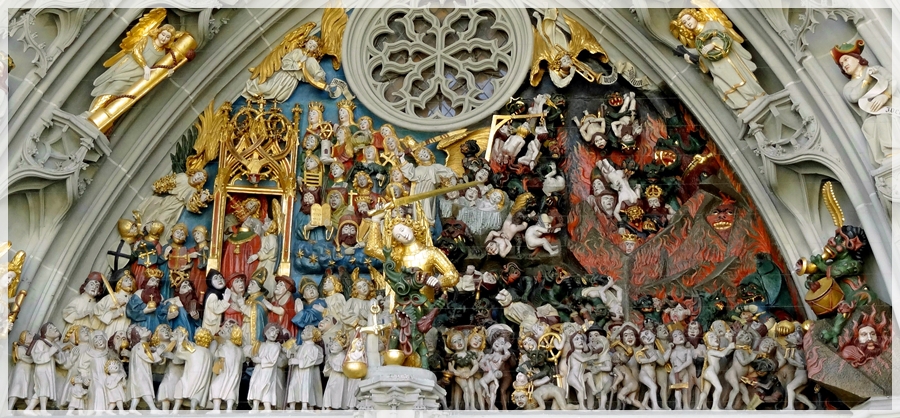
WICKEDNESS BRINGS PUNISHMENT

DSC02558-Bern (Cathedral-Munster-Last Judgement)3-cropWEB

“The Last Judgment” – Munster Cathedral, Bern, Switzerland


Yahweh! The Lord! The God of compassion and mercy! I am slow to anger and filled with unfailing love and faithfulness. I lavish unfailing love to a thousand generations. I forgive iniquity, rebellion and sin. But I do not excuse the guilty. [Exodus 43:6-7 (NLT)]

If asked to draw a picture of God, many would probably draw a pleasant old gentleman with a gentle smile. Looking a bit like Santa Claus, he’d be dressed in a long white robe instead of a fur-trimmed red coat and hat. This kind-looking grandfatherly man would be seated on a throne with several little children in his lap. Reading the Old Testament, however, makes one rethink this picture. While we meet a loving and forgiving God, we also encounter a judgmental and destructive God: a God who sends plagues to his people, destroys whole towns, and sends his people into slavery. This is not the “warm and fuzzy” God about whom we want to think. He’s certainly not the good-natured God of my Sunday school classes.

It certainly is more comforting for us to think of God as loving and merciful and, indeed, He is. But, as the Old Testament reminds us and the New Testament warns us, God can get angry with his people. He hates sin and he is ready to hand out punishment to those who defy him. Fortunately, we also have a loving and forgiving Heavenly Father who hasn’t lost faith in his children. He saved Noah and his family from the flood. He rescued Lot and his family from the destruction of Sodom and Gomorrah. He saved Jonah from the whale after Jonah said he’d obey God’s directions. After telling Nineveh they would be destroyed in forty days, God relented when they repented their sinful ways. After punishing the Israelites for their disobedience, God finally led them to the Promised Land. Later, He rescued them from their exile in Babylon. Although we continually disappoint God with our disobedience, He mercifully gave us his only son as a sacrifice for our sins.

The righteous character of God includes both his anger and judgment along with his love and mercy. It is not enough to read and hear only God’s comforting words. We must remember that His justice goes hand in hand with His love.

Your wickedness will bring its own punishment. Your turning from me will shame you. You will see what an evil, bitter thing it is to abandon the Lord your God and not to fear him. I, the Lord, the Lord of Heaven’s Armies, have spoken! [Jeremiah 2:19 (NLT)]

HOW VALUABLE ARE YOU?

What’s the price of two or three pet canaries? Some loose change, right? But God never overlooks a single one. And he pays even greater attention to you, down to the last detail—even numbering the hairs on your head! So don’t be intimidated by all this bully talk. You’re worth more than a million canaries. [Luke 12:6-7 (MSG)]

bee eater Arusha-TanzaniaWEBRecently, our Florida pastor held up a brand new $100 bill and asked who would like to have it. Hands were quickly raised. He then crumpled up the bill and asked the question again; hands were raised a second time. After all, what are a few wrinkles? Pastor then sneezed and wiped his nose with the money and asked the question yet again; no one seemed deterred by a few germs and, once more, up went the hands. He wiped the worn and slightly damp bill in his armpits and asked the same question yet another time. Our congregation didn’t get to their retirement years in Florida without knowing the value of a $100 bill, even a wrinkled germy dirty one, and our hands continued to be lifted in the air. Fortunately, Pastor did not stick the bill down his pants and ask the question again. His point had been made; money retains its value no matter how dilapidated and soiled it may be.

That afternoon, I did a little Internet research to determine my monetary value. Some estimates of the assorted chemical components of my body were as low as $1. Positive I had to be worth substantially more than a dollar, I searched until I found a site that claimed the chemicals in a 176 pound person are worth about $160. I was still disappointed, especially since I weigh considerably less than that. Nevertheless, I do have some gold and silver in my mouth along with a few titanium screws in various bones, so I could be worth more when adding the value of my scrap metal. On the plus side, if one were to sell my various body organs and tissue (heart, blood, lungs, bone marrow, kidneys, corneas, etc.), this same site said I could be worth as much as $45 million. Now, that’s more like it! On second thought, that’s probably assuming all of those body parts are in pristine condition, something definitely not true of my well-worn “mature” body. My organs have been damaged by age, environment, misuse and disease. In short, my past has probably devalued my worth considerably.

To God, we are worth far more than even 45 million dollars! It doesn’t matter to Him if our bodies are in less than pristine shape or even if we still have all of our original parts. Better yet, He doesn’t care about the damage our past history has done to our souls! We don’t have to be pure and unblemished to have value to Him because we are his beloved children. Abortion, addiction, anger, violence, maliciousness, drunkenness, insincerity, depression, dishonesty, attempted suicide, divorce, adultery, wastefulness, pride, and more—none of these have devalued us in the eyes of God. Like the $100 bill our pastor showed us, we retain our value no matter how sullied, stained, damaged, or tattered we may be. We don’t have to be perfect (or even in “good” or “fair” condition) to be loved by our perfect God.

Thank you, Heavenly Father, for seeing our worth even when can’t see it ourselves. Thank you for your grace and mercy, for redeeming our damaged souls and loving us no matter what has happened in the past. Thank you for giving us a new beginning in Christ Jesus, our Lord.

Christ died for men precisely because men are not worth dying for; to make them worth it. [C.S. Lewis]

This is how much God loved the world: He gave his Son, his one and only Son. And this is why: so that no one need be destroyed; by believing in him, anyone can have a whole and lasting life. God didn’t go to all the trouble of sending his Son merely to point an accusing finger, telling the world how bad it was. He came to help, to put the world right again. [John 3:16-17 (MSG)]


WINNING THE LOTTERY

You will keep in perfect peace all who trust in you, all whose thoughts are fixed on you! Trust in the Lord always, for the Lord God is the eternal Rock. [Isaiah 26:3-4 (NLT)]

The story is told of Jack, a man who was definitely down on his luck: his business had gone sour, the bills were mounting, and foreclosure was imminent. Jack turned to God in prayer: “God, I trust you to help me. I’m in dire straits and desperately need financial help. Please let me win the lottery this week.” When the lotto numbers were drawn, however, someone else won. Although Jack’s faithful but desperate prayers went on for three more weeks, he never won the lottery. When the lotto rolled around again, once more Jack desperately prayed: “Lord, I’ve now lost my business, house and car. We’re homeless with nothing to eat. Please help your good and faithful servant; let me win the lotto just this one time.” Suddenly, there was a flash of light, the heavens opened and Jack heard a thunderous voice from above: “Jack, my son, you’ve got to meet me halfway on this. Go buy a ticket!”

As much as we wish it, trusting God doesn’t mean we will always stay out of difficulties or harm’s way nor does it free us of the consequences of our actions or, as in Jack’s case, our inaction. Trusting God means we know He cares and is ever-present; it means we believe that He loves and leads us and intends good for us. Trusting God means doing what God says; it means that we can turn our fears and anxieties over to Him. Trusting God, however, doesn’t mean we can turn our work over to God. Let us never forget that trusting God doesn’t mean we stop toiling or striving while the world collapses around us. Perhaps, when it seems God has forgotten us, it’s not because He’s failed to do His part; it’s because we’ve failed to do ours!

Trust in the Lord with all your heart; do not depend on your own understanding. Seek his will in all you do, and he will show you which path to take. [Proverbs 3:5-6 (NLT)]

WEEDS

He [Jesus] answered, “The one who plants the good seeds is the Son of Man. The field is the world. The good seeds are those who belong to the kingdom. The weeds are those who belong to the evil one. The enemy who planted them is the devil.” [Matthew 13: 37-39 (NLT)]

7-1-15thistle (Canadian)-LGenWI572-cropwebI love thistles—when I’m taking their pictures in the woods. I discovered I don’t much care for them when they’re in my garden. But, there they were, along with dandelions, knotweed, clover, sorrel, mint, chives, prickly lettuce and other unidentified weeds in what used to be my rose garden. Months of neglect had taken its toll on our plant beds and only a few pink rose petals were even visible in the tangled mess. At one time, this had been a well-established and properly tended garden, but our more than nine month absence for two years in a row allowed the weeds to prevail.

My husband and I were faced with a dilemma similar to the one God faced with Sodom: in ours, far too many weeds and in His, far too many sinners. Because Abraham pled with God, the righteous Lot and his family were saved from destruction but the rest of the sinful city was destroyed. In the case of our garden, however, the two remaining stunted rose bushes had no one to plead for them and were pulled up along with the weeds. Unlike God, we swept away the innocent with the guilty! After thoroughly removing every plant, we started fresh, only this time with zebra grass that, hopefully, will better survive our neglectful gardening.

As we worked, I thought of Jesus’ parables about the farmers who sowed their seeds. One farmer planted seeds on different kinds of ground. The seeds sown on the quality soil produced a good harvest and represented those who heard and understood God’s word—people of faith. In another parable, Jesus told of a farmer who had planted good seeds in quality soil only to learn that his field had weeds. The weeds, planted by the enemy, were scheduled for future destruction. Looking at my garden, I knew it wasn’t Satan, but rather neglect, that had caused my weeds. It suffered from lack of attention; there had been no cultivating, watering, pruning, fertilizer, or weed pulling.

We can have a firmly established faith but, like our garden, faith can’t be ignored or neglected; it must be nurtured. Without cultivating our faith with church and fellowship, watering it with His word, pruning it with prayer, fertilizing it with service, and vigorous weed pulling with confession and repentance, our faith can’t thrive. The enemy will be able to take over and destroy the garden of our lives. Without consistent care, our faith won’t flourish; it will be weak or die like my roses.

As for me, now that I’m done with the house garden, I plan on doing some serious work in the garden of my faith. I don’t want to give the enemy a foothold and end up being swept away with the wicked or burnt with the weeds. How about you? Do you have any gardening that needs to be done?

The Lord remained with Abraham. Abraham approached him and said, “Will you sweep away both the righteous and the wicked? [Genesis 18:22b-23 (NLT)]

When the ground soaks up the falling rain and bears a good crop for the farmer, it has God’s blessing. But if a field bears thorns and thistles, it is useless. The farmer will soon condemn that field and burn it. [Hebrews 6:7-8 (NLT)]