
Get rid of all bitterness, rage, anger, harsh words, and slander, as well as all types of evil behavior. Instead, be kind to each other, tenderhearted, forgiving one another, just as God through Christ has forgiven you. [Ephesians 4:31-32 (NLT)]
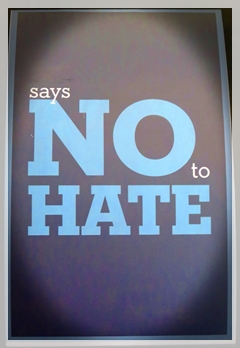 I walked into the university workout facility and was greeted by a large sign telling me the school says no to hate. I was surprised that a Christian University felt the need to say what should be obvious. Has hate become so much a part of our everyday lives that we have to be reminded not to do it? There wasn’t a sign telling us not to pee in the pool, have fist fights, or swear. Evidently, certain acceptable behavior was assumed but not hating wasn’t! Apparently, the sign is necessary because people feel freer to express their prejudice, intolerance, and bias than do any of those other things.
Monday, Massachusetts governor Charlie Baker re-established a task force on hate crimes. It will advise him on issues such as the prevalence, deterrence and prevention of hate crimes and support for hate’s victims. In 2015, the state had 424 hate crimes including intimidation, vandalism and assault. The Massachusetts Anti-Defamation League found a 44% increase in anti-Semitic incidents in the first nine months of 2017 and the state’s hate crime hotline has received more than 2,000 calls since it began just a year ago.
One look at the news tells us that Massachusetts is not alone. Hate (and its cousin anger) make the headlines regularly—violence in Charlottesville, a sport star’s home vandalized with racial slurs, Asian-Americans told they don’t belong here, swastikas painted on Jewish temples, and a Texas mosque burned to the ground. Trucks become weapons in the hands of extremists and shootings in theatres, shopping centers, schools, concerts and churches almost seem commonplace. Last night, a local pastor was interviewed about the large security/safety staff now present during any church function. His church is not alone; many places of worship have felt the need to protect themselves from haters.
Hate can express itself in subtle ways through slurs, intolerance, intimidation, harassment, marginalization, and exclusion. Hate is also a crime when a criminal offense is motivated by race, ethnicity, ancestry, sexual orientation, gender, gender identity, religion, or disability. Whether or not a crime is committed, in God’s book, hate is an offense. Worse, hate is like an infectious disease—the victim of hate often becomes a hater himself!
As Christians we are allowed to hate evil. We can and should hate things like hypocrisy, godlessness, violence, greed, immorality, exploitation, dishonesty, brutality, deceit, abuse, idolatry, betrayal, false teaching, corruption, intolerance, and hate. What we must never do is hate people. Rather than hate, we are commanded to love and that love isn’t limited to Christians or people who think, look, speak or act like us. We are to love all of God’s children. There’s plenty that’s wrong in our broken world; let’s not add to it by spreading hate through bigotry, intolerance, racism, discrimination or prejudice. We shouldn’t need a sign that tells us to say no to hate. Let us be the ones who demonstrate God’s love in this broken world of ours.
 In the Sunday school stories we learned as children, the Bible’s heroes were larger than life. When we read about them as adults, however, we read the parts skipped in Sunday school and realize they were real people with feet of clay. Yet, it’s their sins and weaknesses that make their lives as relevant today as they were centuries ago. No matter how great, all except Jesus were flawed. Peter denied knowing Jesus, Matthew was a dishonest tax collector, Thomas doubted Jesus’ resurrection, Noah and Lot got drunk, Abraham lied to protect himself, David was an adulterer and murderer, Rahab was a prostitute, Jacob deceived his father, Jonah refused and fled, Sarah doubted and grew impatient, Samson allowed lust to lead him, Paul persecuted Christians, Elijah got so depressed he wanted to die, Gideon dared to question God, and, in spite of his great wisdom, Solomon disobeyed Him. The disciples argued amongst themselves and deserted Jesus, Isaac played favorites with his sons, and both Eli and Samuel tolerated the shameful behavior of their boys. Nevertheless, flawed as they all were, there is much to learn from their stories. We see the possibility of transformation and redemption. The prostitute was instrumental in an Israelite victory and became one of Jesus’ ancestors. The corrupt taxman became a disciple and turned his record keeping skills into gospel writing. The Pharisee became Christ’s messenger throughout the Roman Empire and the fisherman who denied Christ became the leader of the disciples. In spite of their faults, all of them were saints of God.
 The Bible gives us plenty of instances of God directly speaking to His people—Noah, Moses, and Joshua were all given specific directions before building the ark, liberating the Israelites, or crossing into the Promised Land. On the other hand, there are many people who furthered God’s plan without His specific instructions. As far as we know, God didn’t tell Moses’ mother to place her son in a basket and lay him among the reeds of the crocodile infested Nile, yet she did just that. What caused a mother to literally send her beloved baby down the river? Yet, that very action furthered God’s plan; as the son of an Egyptian princess, Moses received a royal upbringing and an excellent education, all of which he needed in his later confrontations with Pharaoh.
 Peer pressure—as youngsters we succumbed to it because we wanted friends. When trying to explain why we couldn’t stay out past curfew, go to an unchaperoned party or date while still in junior high, our parents would say something like, “If your friends jumped off a cliff (or ran through traffic), would you do it too?” If you were like me, you relentlessly assured them that all of your friends were doing whatever it was and that all of their parents allowed them to do it. They probably responded with a serious warning about the dangers of peer pressure and dubious friends.
 As he took us to the car rental agency, the van’s driver welcomed us to Cleveland, explained where to get gas before returning our cars, and reminded us not to text and drive. After asking if there were any other questions, a voice from the back asked, “What is the purpose of life?” The driver quickly replied, “Finding comfortable shoes!” While we might rank finding comfy shoes high on our life list, that’s not the purpose of life.
 I’m not a good sitter and I’m even worse at soaking in a tub. Just wanting to get clean and get on with my day, I’m a shower person. Friends insist that sitting in the tub and reading is the best way to relax but that doesn’t work for me. I don’t have the patience to wait for the water to get high enough for a good soak or for the spa jets to work, I’ve never figured out how to turn pages without getting them wet and, rather than relaxing, I think about all the things I could and should be doing instead of sitting in hot water. I considered my inability to enjoy a bath when our pastor suggested that we bathe our decisions in prayer. Unfortunately, the same impatience that keeps me from enjoying my over-sized bath tub keeps me from bathing my decisions in prayer.
 Devotions of the Heart