
Share each other’s burdens, and in this way obey the law of Christ. … Therefore, whenever we have the opportunity, we should do good to everyone—especially to those in the family of faith. [Galatians 6:2,10 (NLT)]
 Hurricane Irma did quite a number on our southwest Florida bird sanctuary. Unfortunately, much of the boardwalk was damaged (some of it beyond repair) and there were several casualties among the trees, including two 100-foot cypress trees that proudly stood for over 400 years. Like them, many smaller trees were uprooted and now lie dead on the forest floor. Irma’s high winds did some violent and cruel pruning as it stripped bark, tore off branches, and splintered mature trees as if they were mere matchsticks. Cypress trees that were over 40-feet tall are now little more than stumps. Nevertheless, trees I thought were goners are recovering and greening up; new foliage is emerging out of their fractured tops and sides. In spite of the incredible damage they suffered, their roots still support and feed them with life giving water and they’re surviving. They may be down but they’re certainly not out.
I thought of the storms we endure in our lives; while some may be no worse than a noisy thunderstorm, others can be as devastating as a hurricane. Age and size certainly can’t keep us from falling. Nevertheless, the storm couldn’t defeat all of the trees and the setbacks and storms of life don’t have to defeat us. Like the damaged cypress trees with their new growth, we can stay rooted, survive and even thrive.
We do that through the church. Just as roots aren’t optional for trees, the church really isn’t an option for the Christian. I’m not talking about a building or a specific denomination; I’m speaking of a community of believers who belong to Christ and are bound together by both the gospel and the presence of the Holy Spirit. The church is what supports us when we start to fall, grounds us when we falter, and nurtures us with living water when we’ve been weakened.
God revealed himself to mankind when he became incarnate as Jesus Christ. As Christ’s followers, we reveal Him to mankind through the church—the church actually is Christ incarnate. As His hands and feet, heart and voice, we are the ones who keep, support, encourage, lift and comfort the broken and bruised. We are the ones who provide the nourishment and water that allow the damaged to grow and blossom once again. Like a tree that supports another one or the roots that ground and nourish it, the living breathing church is what makes it possible for our brothers and sisters to say, “I may be down, but I’m not out!”
All of you together are Christ’s body, and each of you is a part of it. [1 Corinthians 12:27 (NLT)]
Copyright ©2018 jsjdevotions. All rights reserved.
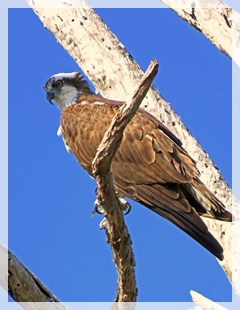 “It wasn’t worth it!” I grumbled while applying cortisone over four painful red bumps on my foot. When walking around the lake at the botanic gardens, I’d spotted an osprey in a nearby tree. To get a good shot, I had to step off the paved trail into what I knew to be fire ant territory. Having had previous encounters with these stinging insects, I knew better than to stand there in sandals, but I did it anyway; the picture wasn’t worth the price I was paying for my poor decision.
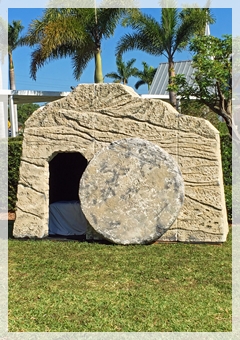 Yesterday I mentioned the wooden cross and rustic nail on my desk that serve as reminders of the terrible price Jesus paid for our salvation. Although early Christian symbols included a dove, ship, lyre, anchor, and fish, the cross has become the universal symbol for Christianity. While Coca-Cola’s logo, Nike’s swish and McDonald’s golden arches may come close, I doubt there is any so recognizable sign in the world. Nevertheless, a gruesome instrument of Roman torture seems an odd symbol for a faith that preaches such things as reconciliation, sacrifice, forgiveness, hope, love, and peace. While I’d never wear a miniature gallows, guillotine, or electric chair on a chain around my neck, I do wear a cross. Although it symbolizes everything that happened to Jesus on that dark Friday two thousand years ago, the cross would be meaningless if the tomb had not been empty Sunday morning.
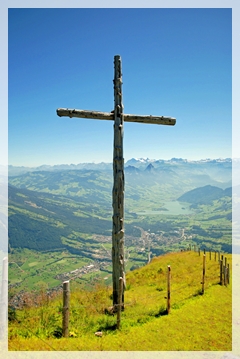 After warning us not to put them in our pockets and accidentally take them home (or put them in the dryer if we did), small pieces of paper were given to everyone in attendance at last week’s Good Friday service. Following the sermon, we were asked to write a sin (or sins) for which we repent on the papers, come forward, and nail them to a cross resting on the steps before the altar. Listening to the hammering echoing in the sanctuary, I thought of what it must have sounded like two thousand years ago when Jesus and the others were hammered to their crosses: the loud pounding of the hammers, the commotion of the crowd, the mockery of the soldiers, and the cries of agony from the men as those blunt tipped nails pierced their bodies.
 They [the Pharisees] asked him, “Why do your disciples disobey our age-old tradition? For they ignore our tradition of ceremonial hand washing before they eat.” Jesus replied, “And why do you, by your traditions, violate the direct commandments of God?” [Matthew 15:1b-3 (NLT)]
 The Lord does whatever pleases him throughout all heaven and earth, and on the seas and in their depths. [Psalm 135:6 (NLT)]
 Devotions of the Heart