WHAT LANGUAGE DO WE SPEAK?

The leaders saw that Peter and John were not afraid to speak, and they understood that these men had no special training or education. So they were amazed. Then they realized that Peter and John had been with Jesus. [Acts 4:13 (NCV)]

Sometimes, we Christians use religious jargon or “Christianese” when speaking. In fact, we might “testify” or “witness” instead of talk about our faith and “fellowship” instead of meet with friends! If, while speaking with non-believers, we use words we (and our fellow church-goers) can barely define we may as well be speaking a foreign language. Tossing about words like propitiation, sanctification, justification, glorification, conviction and reconciliation show that we can talk the talk, but what does it mean to anyone else? Let’s remember that Christianity isn’t a secret society like a lodge, college fraternity or sorority. There’s neither a secret handshake nor a password required for admittance.

When sharing our faith [witnessing], let’s not make the mistake of making Christianity harder than it is. Man rejected God [sinned] and we all stand guilty before God [condemnation]. Mankind’s sin alienated us from God but Jesus’s actions restored mankind’s relationship with God [reconciliation]. Jesus is God in flesh [incarnation].  Although the punishment for sin is death, Jesus paid that price [redemption]. Because Jesus took our punishment on the cross [propitiation/substitutionary atonement], we are no longer considered guilty [justification]. Jesus rose from the dead [resurrection]. When we believe in [accept] Jesus Christ and decide to follow Him [salvation], we turn from our old ways [repent] and are changed [born again/regeneration]. Through the power of the Holy Spirit, we then grow more and more like Christ [sanctification]. Salvation is not something we earn [works], but something God freely gives to us [grace] when we believe in Jesus [faith].

Jesus didn’t use fancy words; he used parables and metaphors to make his point. Better yet, he explained his parables so everyone could understand the point he was making. The men he chose to spread the faith, men like Peter and John, were simple men. They didn’t require impressive words to preach or heal; they just needed faith! The bracketed words in the previous paragraph weren’t necessary and I’m not even sure I even used them all correctly! We don’t need $10 words or a special vocabulary to talk about Jesus; we just need to be sure we’re speaking the same language as the people with whom we’re talking.

Too many of us have a Christian vocabulary rather than a Christian experience. We think we are doing our duty when we’re only talking about it. [Charles F. Banning]

But we hear them telling in our own languages about the great things God has done! [Acts 2:11b (NCV)]

Copyright ©2019 jsjdevotions. All rights reserved.

LOVE SHALL NEVER DIE

If you love those who love you, what credit is that to you? Even sinners love those who love them. And if you do good to those who are good to you, what credit is that to you? Even sinners do that. And if you lend to those from whom you expect repayment, what credit is that to you? Even sinners lend to sinners, expecting to be repaid in full. But love your enemies, do good to them, and lend to them without expecting to get anything back. … Be merciful, just as your Father is merciful. [Luke 6:32-35a,36 (NLT)]

One of the hymns at our Easter Eve service was Christ is Alive and we sang, “In every insult, rift and war, where color, scorn or wealth divide, Christ suffers still, yet loves the more, and lives, where even hope has died.”  I thought of how hate must be like another nail in His hands and intolerance another scourging on His skin. The text of the hymn was written by Brian Wren in April of 1968, just two weeks after the assassination of Martin Luther King, Jr. “I could not let Easter go by without speaking of this tragic event which was on all our minds, “ he explained. “The hymn tries to see God’s love winning over tragedy and suffering in the world.”

Little did I know while singing those words that, just a few hours later, there would be tragedy and suffering half-way around the world in Sri Lanka. Coordinated bombings at three churches and four hotels turned Easter Sunday into a blood bath leaving more than 300 people dead and 500 injured. A Sri Lankan Sunday school class at Zion Church met before the service that morning. When their teacher asked, “How many of you are willing to die for Christ?” all of the children raised their hands. As they rededicated themselves to Jesus by lighting candles, little did they know that half of them actually would die for Christ that very morning. As they crossed a courtyard to enter the sanctuary, a stranger exploded the bomb he was carrying in his backpack.

Last week, bullets ripped through a peaceful Passover service at a synagogue outside of San Diego, leaving one dead and three inured. Exactly six months earlier, 11 people were killed at a Pittsburgh synagogue. In March, at least 50 were killed and 20 injured in shootings at two mosques in Christchurch, New Zealand. In January, two suicide bombers detonated their bombs in a Catholic church in the Philippines, leaving 20 dead and more than 100 injured. Last October, a gunman attacked a Sabbath service in a Pittsburgh synagogue, leaving 11 dead. The heart of God must be filled with grief at these horrific acts of terror and hate.

We live in a fallen world—a world where war, pain, injustice, violence, anger, and prejudice abound. As we mourn the loss of innocent lives, we must resist the temptation to return hate with even more hostility. Just as we pray for their victims, we must also pray for the extremists who perpetuate these terrible attacks. The war on terror isn’t just a political battle; it’s a spiritual battle against the Prince of Darkness.

Let us remember that Christ’s message is one of love and love is more powerful than hate. As a nation, we must work to resolve the social and political issues that encourage terrorism but, as Christians, peace must begin with us. We are called to love everyone—not just the people with whom we agree. Rather than living in fear, as Christians, we must live in hope. Let us be people of prayer against the ungodly hatred and violence of our world. We must extend the hand of friendship and love to all people, not just the ones who think, look, speak, and worship like us.

“Christ is alive!” we sang at that Easter service. “The cross stands empty to the sky. Let streets and homes with praises ring. Love, drowned in death, shall never die.” Let us answer the hate of the world with His love!

At some ideas you stand perplexed, especially at the sight of human sins, uncertain whether to combat it by force or by humble love. Always decide, “I will combat it with humble love.” If you make up your mind about that once and for all, you can conquer the whole world. Loving humility is a terrible force; it is the strongest of all things and there is nothing like it. [Fyodor Dostoyevsky from “The Brothers Karamazov”]

You have heard the law that says, “Love your neighbor” and hate your enemy. But I say, love your enemies! Pray for those who persecute you! In that way, you will be acting as true children of your Father in heaven. [Matthew 5:43-45 (NLT)]

Copyright ©2019 jsjdevotions. All rights reserved.

CAIN’S WIFE

So Cain left the Lord’s presence and settled in the land of Nod, east of Eden. Cain had sexual relations with his wife, and she became pregnant and gave birth to Enoch. Then Cain founded a city, which he named Enoch, after his son. [Genesis 4:16-17 (NLT)]

snowy egretsOur pastor often says that the hardest part of giving his sermon is afterwards when someone asks him a question. I understood what he meant after finishing my sermon last Sunday. Opening our series on women in the Bible, I’d spoken about Eve. After service, a woman pulled me aside and said she’d always had trouble understanding how Cain, after being banished and settling in the land of Nod, could find a wife there. If Adam and Eve were the first parents, where did those people in Nod come from?

Skeptics of the Bible often use the identity of Cain’s wife in an attempt to discredit the book of Genesis. Sunday’s question came from two common misconceptions. The first occurs because only three of Adam and Eve’s children are named in Scripture and they’re all boys. Cain’s and Able’s births are recorded first and then Seth’s when Adam is 130 years old. We know Adam lived another 800 years after Seth’s birth and that “other sons and daughters” were born, but we’re not told when that happened. Scripture never says that Cain and Able were the only children born in the first 130 years and simple logic tells us that Adam and Eve did not average only one child every 43 years. Several more unnamed children had to have been born both before and after Seth’s birth. By the time of Cain’s banishment, the first couple probably had grandchildren, great-grands, and even great-great-grands. Assuming that about half of them were female, Cain had several women he could have married.

Of course, that means those early men married their sisters and, later, their nieces and cousins. Today, we gasp at the thought of incest but it wasn’t condemned in the beginning. While God’s command to leave one’s parents in marriage prohibited parent-child marriage [Genesis 2:24], His law against other intermarriage wasn’t given until thousands of years later when Moses recorded it in Leviticus. [Lev. 18:6] Remembering that Adam and Eve were perfect, with flawless DNA, and lived in an unpolluted environment, the danger from genetic defects with inbreeding was minimal in the beginning. Given the few number of people and the tribal structure of ancient society, intermarriage couldn’t be avoided. The righteous Abraham married his half-sister Sarah, Isaac married his cousin Rebecca, Jacob married his cousins Leah and Rachel, and Moses’s father married his aunt.

The second misconception is that Cain met his wife in the land of Nod; Scripture, however, never tells us that. The event that took place in the land of Nod was Cain having sex with his wife and getting her pregnant; an entirely different matter. Moreover, Scripture never tells us how old Cain and Abel were when Cain murdered his brother. Since Adam was already 120 by that time and the brothers worked as a shepherd and farmer, it’s logical to think they were grown men and already had families of their own. That Cain was frightened after killing Abel and needed a mark from God to protect him, would indicate that he feared repercussions from Abel’s line. In answer to the woman’s question, Cain brought his wife (who was most likely his sister) with him to Nod. Since he founded a city there, he probably brought several people in his clan with him.

We sometimes think that the Bible should read as concisely and unambiguously as an American history text; it simply doesn’t. Moreover, we must be careful of assuming that because someone or something isn’t mentioned that they didn’t exist. That there are only three birds in today’s picture doesn’t mean there were only three birds at the beach any more than only three boys’ names means there were only three sons. We can’t even assume that Abel was the second son. We only know that he came after Cain but how much after and whether there were other children in between, we don’t know. Perhaps his name is mentioned only because he was later murdered by his brother.

In the infamous Scopes trial, William Jennings Bryan was questioned by Clarence Darrow about the origins of Cain’s wife. Bryan was defending the Bible and yet this church elder had no idea where Cain got his wife and couldn’t even answer whether or not other people were on the earth at the time. Let’s do a better job than the famed lawyer in defending the Word of God! Of course, to defend it, we must first read it!

Instead, you must worship Christ as Lord of your life. And if someone asks about your hope as a believer, always be ready to explain it. [1 Peter 3:15 (NLT)]

Copyright ©2019 jsjdevotions. All rights reserved.

WEAR YOUR OWN SHOES

Am I now trying to win the approval of human beings, or of God? Or am I trying to please people? If I were still trying to please people, I would not be a servant of Christ. [Galatians 1:10 (NIV)]

Each one should test their own actions. Then they can take pride in themselves alone, without comparing themselves to someone else, for each one should carry their own load. [Galatians 6:4-5a (NIV)]

seedboxLast Thursday night’s Bible study had been as inspiring as Easter Sunday’s sermon. As we walked out of the building, I confided to my friend that there was no way I could follow such brilliant preaching. You see, our pastor was taking a much needed vacation and I would be doing the preaching for the next two Sundays. Afraid I couldn’t possibly fill his shoes or touch people’s hearts the way he does, I asked, “How can I possibly compare to him?” My friend wisely answered, “You don’t!” He reminded me to be myself and let the Holy Spirit do the rest.

As I continued to polish my sermon, the enemy kept reminding me that I could never fill our pastor’s shoes.  I thought of the Apostles after Jesus had ascended. I’m sure their preaching, no matter how heartfelt and inspired, was no match for that of Jesus. That no one could possibly fill His holy sandals, however, didn’t stop them from speaking and spreading the gospel message. Scripture tells us that many became believers and were baptized after hearing the Apostle Paul speak. Yet Paul’s vast knowledge and speaking skills never kept Timothy, Silas, Barnabas, Titus or others from sharing God’s word.

When whispers of doubt are heard, I find it best to turn to God’s Word, so I turned to Paul’s letters to Timothy. Telling him not to be ashamed of his testimony, Paul encouraged the young man by reminding him that God’s Spirit “does not make us timid, but gives us power, love and self-discipline.” He advised the young man to let his teaching be shaped by his faith and love for Jesus and to teach others so that they could pass those teachings on to still more people. Reminding Timothy that the only approval he should seek was that of God, Paul’s instructions were simple: “Preach the word.” [4:2]

Granted, I felt a heavy responsibility. Ours is a growing young church and I didn’t want us to lose momentum or have the church flounder in our pastor’s absence. Then again, I suppose the people Paul left to pastor the churches he planted felt much the same way. Nevertheless, Paul’s words made me ask whose approval it was that I sought. Did I want to please God or the people? While I prayed that my words would manage to do both, I had to focus on pleasing God and trust Him to take care of the rest. The only approval I should be seeking was that of God.

My preaching, like my writing, is not about me; it’s about God. While I hope that it pleases people, the only one I need to please with my words is God. Saturday morning, my friend sent some more words of encouragement. He reminded me that I’m a child of God, gifted by Him in my own special way, and that all God asks of me is to be myself and “Preach the word.” That’s all God asks of any of us! None of us are expected to fill someone else’s shoes; we just have to wear our own and walk in a way that pleases God.

For the Spirit God gave us does not make us timid, but gives us power, love and self-discipline. So do not be ashamed of the testimony about our Lord. [2 Timothy 1:7-8a (NIV)]

Do your best to present yourself to God as one approved, a worker who does not need to be ashamed and who correctly handles the word of truth. [2 Timothy 2:15 (NIV)]

Copyright ©2019 jsjdevotions. All rights reserved.

FEARING

For everyone has sinned; we all fall short of God’s glorious standard. Yet God, in his grace, freely makes us right in his sight. He did this through Christ Jesus when he freed us from the penalty for our sins. For God presented Jesus as the sacrifice for sin. People are made right with God when they believe that Jesus sacrificed his life, shedding his blood. [Romans 3:23-25 (NLT)]

I thought of Mr. Fearing in John Bunyan’s allegory The Pilgrim’s Progress when a friend told me about her mother who was nearing the end of her life. Although a Christian, she believed there was something in her distant past for which she couldn’t be forgiven. Even though her family reassured her that Jesus died for her sins and God is faithful to His promises, she still seemed fearful of taking that final journey home.

In Bunyan’s tale, Mr. Fearing’s story is told by his guide to the Celestial City, Mr. Great Heart. Even though Fearing escaped the Swamp of Despondence, he seemed to carry that despondence in his mind everywhere he went. When Fearing came to the gate where it said, “Knock and the door will be opened to you,” he was afraid to knock. Sure that he was unworthy of entrance, he stood back and allowed others to take his place whenever the door opened. When he eventually had the gumption to timidly knock, Fearing fainted in unbelief when the door was opened for him.

Accompanied by Mr. Great Heart, Mr. Fearing continued on his journey. He effortlessly hiked straight up the Hill of Difficulty, showed no fear when he encountered lions, and easily walked down into the Valley of Humiliation. When the travelers had to pass through Vanity Fair (a place ruled by Beelzebub and filled with evil temptations), Mr. Fearing had no difficulty staying on the Way and, while others fell asleep in the Enchanted Ground (the land of spiritual lethargy), Fearing stayed alert. But, believing himself unworthy of God’s grace, his shame kept him from enjoying the blessings God provided on the journey and caused him to be afraid of death and the journey’s end.

Mr. Fearing wasn’t afraid of difficulties, danger, or challenges to his faith but, because he had doubts about his welcome in the Celestial City, he was terrified of death and Hell. His fear was that of his final acceptance—that God would reject him! Sure that he’d drown and never see the face of the King he’d traveled so far to meet, he was afraid to cross the River of Death: the only way to the Celestial City. Both Fearing and my friend’s mother eventually crossed that river and were welcomed because all of their sins had been forgiven.

As Good Heart related the story of Mr. Fearing to Christiana and her fellow pilgrims, they shared their fears about their own salvation—fears that many of us may share. Bunyan experienced this same fear; in his autobiography, he said that early in his conversion Satan tempted him to unbelief by declaring his sins unpardonable. Bunyan’s reply to the enemy simply was, “Well, I will pray.”

Indeed, it’s difficult to believe in God’s extravagant grace: that, as soiled and unworthy as we are, we’ve been washed clean in the blood of the Lamb. Let us remember—the burden of our sins fell off at the foot of the cross! God didn’t sacrifice His son for us because we deserved it; He did out of love for us! Jesus Christ died for us while we were still sinners, not saints! When we fear our welcome in God’s heavenly realm, let us do as did John Bunyan: let us pray!

For this is how God loved the world: He gave his one and only Son, so that everyone who believes in him will not perish but have eternal life. [John 3:16 (NLT)]

Copyright ©2019 jsjdevotions. All rights reserved.

THE BURDEN

My guilt overwhelms me—it is a burden too heavy to bear. [Psalm 38:4 (NLT)]

First published in 1678, John Bunyan’s The Pilgrim’s Progress is the second best-selling book of all time (the first being the Bible). In this religious allegory, the reader follows the adventures and trials of Christian (Part I) and his wife Christiana and their children (Part II) as they journey from the City of Destruction toward the Celestial City.

The iconic picture of the pilgrim Christian is that of a man bent over with a heavy pack strapped to his back. From that illustration, many assume that means Christians must carry a heavy burden, which is anything but the truth. Although Bunyan’s allegory opens with the man saddled with that pack on his back, he is free of its enormous weight for most of the story.

At the book’s start, the burdened man is crying while reading the Bible. Realizing that death is followed by judgment, he fears that his heavy load of sin will condemn him to Hell. The troubled man asks, “What must I do to be saved?” When the Evangelist tells him to follow the light to the Narrow Gate, Christian leaves on his pilgrim’s journey. He still carries that pack laden with the weight and shame of his sins; it is a burden that he can’t remove by himself.

Even after Christian enters the Gate, that heavy load remains. Goodwill tells him to be content carrying it until he comes to the Place of Deliverance.  Upon getting there, Christian sees a cross at the top of the hill and a tomb at the bottom. As he approaches the Cross, the straps on his pack loosen from his shoulders. The burden drops to the ground, tumbles down the hill, and disappears into the mouth of the sepulcher. Christian’s burden has been transferred to Jesus who, while on that cross, atoned for all of his sins. When the empty tomb receives his sins, they are gone forever.

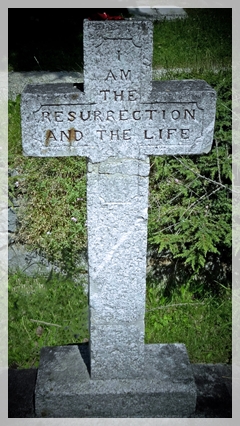
It’s no surprise that Charles Spurgeon’s favorite book (after the Bible) was The Pilgrim’s Progress, that this man known as the “Prince of Preachers” read it at least one hundred times, or that Bunyan’s allegory has been used by Christian missionaries for centuries. As with the parables of Jesus, the book’s powerful visual images skillfully illuminate gospel truths. Christian’s burden falling at the cross is what Good Friday was all about. We are rid of the weight of sin and the burden of trying to earn our way into God’s good graces. Released from guilt and condemnation, we are free of sin’s penalty because Jesus paid that price for us. That Christian will eventually reach the Celestial City is what Easter was about!

We know that our old sinful selves were crucified with Christ so that sin might lose its power in our lives. We are no longer slaves to sin. For when we died with Christ we were set free from the power of sin. And since we died with Christ, we know we will also live with him. [Romans 6:6-8 (NLT)]

Then Jesus said, “Come to me, all of you who are weary and carry heavy burdens, and I will give you rest. [Matthew 11:28 (NLT)]

Copyright ©2019 jsjdevotions. All rights reserved.