
He said to them, “Let the children come to me. Don’t stop them! For the Kingdom of God belongs to those who are like these children. I tell you the truth, anyone who doesn’t receive the Kingdom of God like a child will never enter it.” Then he took the children in his arms and placed his hands on their heads and blessed them. [Mark 10:14b-16 (NLT)]
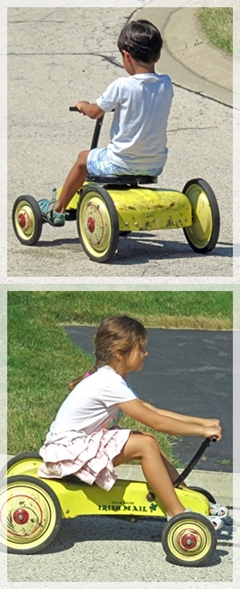 The thing I’ll miss most when we move to southwest Florida permanently is easy access to my grandchildren. This summer I’ve relished watching the little guys frolic in the sprinkler, race their scooters down the sidewalk, climb the monkey bars, decorate the driveway with colored chalk, and play bags with their cousins. They insisted on helping in the kitchen, offered to set the table, listened intently to every story read to them, and never tired of endless games of Crazy-Eights and Kings’ Corners. Their squeals of delight at the holiday fireworks and when they mastered riding the Irish Mail (where they pumped with their arms and steered with their feet) were music to my ears. They asked endless questions and pondered every answer. Wanting to please us, they even were obedient. Seeing their unbridled enthusiasm, energy, and desire both to learn and please, I wondered why I wasn’t like that. After all, God wants us to be like children.
We’re mistaken if we think Jesus’s words about receiving the Kingdom like a child mean that we should be unquestioning and unthinking. Anyone who has experienced the never-ending queries of children knows how inquisitive and persistent they are. As soon as one question is answered, another will be asked. If a child wonders where the sun goes at night, the next question will be where the moon goes during the day, followed by a raft of other questions that strain our limited astronomical knowledge. While children’s inquiring minds inundate us with questions, they differ from adults because they actually care about understanding the answer. We adults, on the other hand, are rarely as anxious to learn something new since we’re sure we already know most anything worth knowing. God doesn’t mind our asking questions but He does want us to listen and learn from His answers as would a child.
Youngsters are also brutally honest (if a bit tactless), unreservedly enthusiastic, and genuine. They love freely, don’t try to impress, rarely judge and, for the most part, want to please their parents. They may carry a blanket or stuffed animal with them, but they never cart around guilt. Their parents, however, are often afraid to love, frequently less than honest, sometimes hypocritical, tend to be judgmental, and often haul a suitcase of guilt and regret wherever they go. While children are drawn to kindness and gentleness, their parents usually are more impressed by power and riches. We adults tend to rebel rather than obey and, rather than God, the one we most want to please usually is ourself.
I’ve never once heard a child say, “You shouldn’t have!” when offered a gift. My little guys certainly didn’t say they weren’t worthy or deserving of their ice cream cones, the trip to the lake, or the boat ride to watch the fireworks. Why then is it so difficult for adults to accept God’s gift of grace? Of course, we don’t deserve it and haven’t earned it, but it is ours for the taking. Like little children, we need to grab hold of this precious gift and relish it; only then will we enter the Kingdom of God.

 I showed the antique dealer the old silver tray we’d found at an antique store many years ago. Having just read Stephanie Kallo’s novel Broken for You, I’d been drawn to it. Hers was a story of secrets and redemption that told of how two women salvaged their brokenness, first by smashing priceless antique porcelain pieces that had been stolen from Jews during the Holocaust, and then by repurposing the fragments into beautiful mosaics. The novel was an homage to the beauty of broken people and broken things. The tray’s handle had been damaged and soldered back on and I imagine much of the silver plate had worn off its top. It was, however, a thing of beauty because it had been artistically covered with broken pieces of antique painted china. The dealer told me that artists often come into her shop looking for chipped pieces of decorative porcelain. Because they plan on breaking it to use in jewelry or mosaics like my tray, they don’t mind chips or cracks.
 The book of Genesis is filled with thoughtless decisions that led to trouble. Although Eve knew the forbidden fruit would give her the knowledge of good and evil, I doubt she asked herself why she wanted it, what she’d do with it, or how God would react to her disobedience when she ate it. Look at Sarah with her bright idea to give Hagar to Abraham to make a baby. Did she pause and consider how she’d feel about sharing her husband with her maid or that Hagar and the child would be a constant reminder of her own infertility? Did Lot’s wife think to ask herself why she’d been told neither to stop nor look back at Sodom before she took that fatal last look?
 We’re selling our northern home and, with limited space in Florida, I must winnow out our 52 years of accumulated possessions. “How can I give them away?” I wondered while looking at the beautiful hand-painted Bavarian dinner and dessert plates that belonged to my mother and her mother before that. My fondness for the plates, however, has less to do with their beauty than with their provenance.
 After driving out an evil spirit from a man in Capernaum, Jesus went to the home of Andrew and Peter. When He learned that Peter’s mother-in-law was sick with a fever, Jesus went to her bedside, took her hand, helped her up, and the fever was gone. Having shown his authority over both demon possession and physical disease that day, reports of His ability circulated throughout town. That evening, a crowd gathered wanting to be healed by Jesus.
 Devotions of the Heart