
Dear brothers and sisters, I close my letter with these last words: Be joyful. Grow to maturity. Encourage each other. Live in harmony and peace. Then the God of love and peace will be with you. [2 Corinthians 13:11 (NLT)]
Oh, give me a home where the Buffalo roam
Where the Deer and the Antelope play;
Where seldom is heard a discouraging word,
And the sky is not cloudy all day. [Brewster M. Higley]
 Wouldn’t it be nice to live in a world where we’d never (at least rarely ever) hear a discouraging word? It shouldn’t be necessary to ride the range in Wyoming for that to happen.
When my eldest child entered adolescence, it frequently seemed like he’d decided his task in life was to annoy his mother as much as humanly possible. Regrettably, during those challenging years, there were lots of discouraging words. One evening, I realized that our communication consisted of me directing him (“Make your bed!”), correcting him (“Do it this way!”), disciplining him (“You’ve lost that privilege!”), criticizing him (“You can’t go out dressed that way!”), or denying him (“I said ‘No’ and that’s final!”). Admittedly, directions, corrections, and criticism are a necessary part of life as are discipline and denial. Nevertheless, realizing there was a room for improvement on my part as well as his, I made a concerted effort to keep my negative comments to a bare minimum.
Seldom speaking (or hearing) a discouraging word was not enough. Where, I wondered, were the words of love? Where were the words of encouragement so necessary for him to thrive and feel good about himself? One doesn’t need to take psychology 101 or even a dog obedience class to know about the importance of positive reinforcement (which is simply a fancy term for encouragement). I had to add positive and heartening comments to our interaction if he was going to flourish and bloom. With God’s guidance and a heavy dose of the Spirit’s patience, we managed to get through those trying years. In spite of my many parental failings, he blossomed into a delightful responsible young man. A wonderful father, he now has to deal with adolescents of his own (which is God’s payback)!
My mother used to say, “If you can’t say something nice, say nothing at all!” If we all followed that advice, the world would be a much quieter place and we’d never have to watch another campaign commercial! More, however, is needed. The Apostle Paul urged the early Christians to encourage one another and he truly practiced what he preached. Whenever he instructed and directed (even when he disciplined or corrected), Paul always seemed to add encouragement to his words.
Encouragement (or exhortation) is a gift of the Holy Spirit but that doesn’t mean those of us without this gift should fail to encourage! Those gifted with encouragement are the church’s cheerleaders, but the rest of us are the fans in the stands who join in supporting the team! In the Fruit of the Spirit, we find love and kindness (along with patience) which means all Christians are capable of encouraging the people we meet in our daily lives. It’s not enough to seldom speak a discouraging word; we need to speak encouraging ones!
Become the most positive and enthusiastic person you know. [H. Jackson Brown]
 Depending on the Bible translation used, there are five strange words we might encounter when reading the Psalms: maskil, miktam, shigionoth, gittith and selah. Maskil is seen in the titles of thirteen psalms and once in a psalm’s text (47:7). Believed to be derived from the Hebrew word sakal, meaning to be prudent, understand or ponder, maskil may indicate a psalm of wisdom with instructions for godliness. It’s sometimes translated as a “contemplative poem,” “instruction,” or “skillful psalm.” It also could refer to the skillful construction of the psalm (like a sonnet with its 14 lines and fixed rhyme scheme). The Amplified Bible covers both bases by calling a maskil “a skillful song, or a didactic or reflective poem.” Since the maskil psalms don’t share a common theme or a unique form, maskil could just be a musical term relating to its performance and its exact meaning remains a mystery in the Psalter.
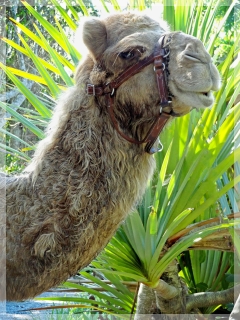 Jesus criticized the Pharisees for their meticulous tithing of herbs and spices while missing the more important aspects of the law. While both gnats and camels were forbidden food, in a wonderfully graphic hyperbole, He compared the way they poured their wine through a strainer to avoid accidentally swallowing a gnat (the smallest of prohibited “unclean” animals) while actually swallowing a camel (the largest)! Feeling self-righteous over their adherence to minor details, the Pharisees entirely missed the foundational principles of the Law: loving God and loving others.
 The heavens proclaim the glory of God. The skies display his craftsmanship. Day after day they continue to speak; night after night they make him known. They speak without a sound or word; their voice is never heard. Yet their message has gone throughout the earth, and their words to all the world. [Psalm 19:1-4 (NLT)]
 When Bartimaeus called out to Jesus, the crowd surrounding him kept telling him to be quiet. Not about to be deterred, the blind beggar just shouted louder. Another man in Jericho was as determined as Bartimaeus: the short and much disliked publican named Zacchaeus. When the little man couldn’t shove his way through to the front of the crowd to catch a glimpse of Jesus, he climbed up a tree (an extremely unseemly behavior for a man of his position).
 Devotions of the Heart