NOT FAIR

The fastest runner doesn’t always win the race, and the strongest warrior doesn’t always win the battle. The wise sometimes go hungry, and the skillful are not necessarily wealthy. And those who are educated don’t always lead successful lives. It is all decided by chance, by being in the right place at the right time. People can never predict when hard times might come. Like fish in a net or birds in a trap, people are caught by sudden tragedy. [Ecclesiastes 9:11-12 (NLT)]

With the back-to-back hurricanes that tore through Louisiana, two others that devastated Nicaragua and Honduras, and the consecutive typhoons that flooded the Philippines, a great many people must be asking, “Why us, Lord?” In spite of the meteorological explanations for the paths taken by those storms, there is something discomforting about the seeming randomness of such destruction. I can’t help but wonder, “Why them and not us?” In a universe of retribution and reward, we’d have a sense of being able to control our destiny; only bad things would happen to bad people and only good things to the good ones. If we did all the right things, life would go smoothly and, if we didn’t, we’d just be getting what we deserved! That, however, is not the way of the world and back-to-back hurricanes along with cancer, ALS, hit-and-run-drivers, stray bullets, and tornadoes hit both the deserving and undeserving.

If any man deserved blessings, it was Job. Described by God as blameless, he was a man of integrity who feared God and stayed away from evil. Even so, this righteous man gets hit with his own back-to-back hurricanes: he becomes penniless and loses children, livestock, servants, health, and social standing. When tragedy hits, Job’s friends come to comfort and console him and, for seven days, they sit silently with their suffering friend. During their week of mourning, Job wonders, ”Why me?” while his friends wonder, “Why him?”

Operating on the assumption that suffering, disaster, and adversity are always the result of serious sin, Job’s friend Eliphaz speaks of a world that operates on the law of cause and effect: a universe where those who plant trouble get more of the same. By claiming that the innocent don’t suffer, he implies his good friend is not an innocent man. After suggesting that Job’s affliction is God’s discipline, he tells him to acknowledge his sins and be delivered from his misery. Although Job claims innocence, Bildad echoes the words of Eliphaz. He even accuses Job’s children of sin and says their punishment was well deserved. Zophar joins his friends in confronting and accusing Job of some horrible sin to cause such severe punishment from God. Although Elihu rightly points out that suffering can be a tool of healing in God’s hands, like his friends, he is convinced that it is Job’s transgressions that caused his trouble.

A prominent man, Job was one of the city fathers who sat at the gate and settled disputes. Well respected by all, people listened intently when he spoke. The man assisted the blind and lame, stood up against the wicked, and was generous to the poor, widows and orphans. The men accusing Job were all long-time friends of his. They’d observed his behavior, respected his opinions, and enjoyed his hospitality, and yet they were sure he was guilty of sins deserving of such horrific punishment! I might have reacted as did they. It was more comforting for his friends to think that Job deserved his misery than to think he didn’t; a blameless Job meant that the same horrific things could happen to them! When Job eventually repents, it’s not of any sin that caused his suffering; he repents of falsely accusing God of injustice.

Faith, worship and works do not ensure our well-being or buy us a reward any more than sin guarantees earthly punishment or suffering. Just like back-to-back hurricanes, disaster can strike both the innocent and guilty! The evil can prosper and the righteous suffer. The book of Job never explains the why of his suffering, but it does tell us that our sovereign God is not cruel, capricious, or erratic. Nothing happens that hasn’t passed through God’s hands first and, while it makes sense to Him, it frequently seems incredibly random, unfair, undeserved, and arbitrary to us. Victim or onlooker, we must do as Job did: trust God in both the blessings and tragedies of life.

In this troubling time of disease, death, disaster, dissension, and destruction, let us continue to trust our loving and good God regardless of the storms assaulting us now. Job’s story ends with the restoration of all that he lost. Our story will end in restoration, as well; if not in this world, then in the life to come.

If I were to say “God, why me?” about the bad things, then I should have said “God, why me?” about the good things that happened in my life. [Arthur Ashe]  
He said, “I came naked from my mother’s womb, and I will be naked when I leave. The Lord gave me what I had, and the Lord has taken it away. Praise the name of the Lord!” In all of this, Job did not sin by blaming God. [Job 1:21-22 (NLT)]

Copyright ©2020 jsjdevotions. All rights reserved.

WHAT IS ENOUGH?

After all, we brought nothing with us when we came into the world, and we can’t take anything with us when we leave it. So if we have enough food and clothing, let us be content. But people who long to be rich fall into temptation and are trapped by many foolish and harmful desires that plunge them into ruin and destruction.  [1 Timothy 6:7-9 (NLT)]

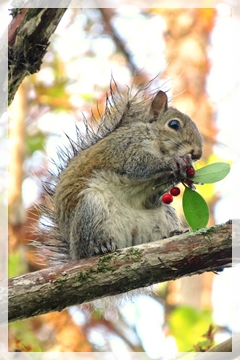
squirrel

The Bible is filled with stories of God’s provision for his people’s needs. In spite of their complaints about God’s provision, the Israelites never went hungry during their forty year journey. When Elijah was hiding from Jezebel during a time of drought and famine, he was fed by ravens. In Zarephath, God provided Elijah, the widow and her son with enough flour and oil to feed the three of them for three years! Later, God provided Elijah with food enough to sustain him during a forty day journey to Mt. Sinai. Sometimes, God even blesses us with even more than enough, as He did when thousands were fed with a boy’s lunch and several baskets of leftovers remained.

While we may receive more than we need, God doesn’t promise a surplus. Elijah and the widow didn’t have excess flour and oil with which to open a bakery and, if the Israelites tried to squirrel away their manna for anything but the Sabbath, it spoiled and got maggots. Just enough was exactly what God wanted them to have and what He gave them—no more and no less.

The problem for us is that mankind’s concept of “enough” isn’t the same as God’s; David is a perfect example of that weakness. Most of us would think David, the shepherd boy who became a hero and king, had more than enough. He possessed Saul’s entire kingdom and wealth, lived in a palace, and had seven wives along with an unknown number of concubines. Enough was no longer enough, however, once David laid eyes on Bathsheba. Solomon, with his 700 wives and 300 concubines and 25 tons of gold a year, never seemed to think he had enough either!

When is enough enough? God knows, but we don’t. Adam and Eve had all of Eden with the exception of the fruit of one tree, but that wasn’t enough for them! Whether it’s money, friends, time, status, opportunities, jewelry, health, strength, wisdom, or faith—we probably think we don’t have quite enough of something. Whatever it is, we’re sure that if God would just give us a smidgen more of it, then we’d be satisfied. Of course, we wouldn’t because, like Solomon, David, Adam and Eve, we’d want more than enough!

If we’re seeking the Kingdom of God and following God’s plan, He will make sure we have enough and all the resources we need. We may not see it but, if we dig deep enough, we’ll find that God has given us exactly what we need to do His work. If we’re seeking the Kingdom of Self, however, we’ll never be satisfied that we have enough.

Do you have enough?

And this same God who takes care of me will supply all your needs from his glorious riches, which have been given to us in Christ Jesus. [Philippians 4:19 (NLT)]

Seek the Kingdom of God above all else, and live righteously, and he will give you everything you need. [Matthew 6:33 (NLT)]

Copyright ©2020 jsjdevotions. All rights reserved.

PATIENCE

In that day the people will proclaim, “This is our God in whom we trust, for whom we waited. Now at last he is here.” What a day of rejoicing! [Isaiah 25:9 (TLB)]

Come, Thou long expected Jesus Born to set Thy people free;
From our fears and sins release us, Let us find our rest in Thee. [Charles Wesley]

giftMy daughter has become quite adept at hiding Christmas gifts from her husband. If she doesn’t, he will find the presents and open them early; patience is not one of his strong suits. It wasn’t one of Sarah and Abraham’s either. Although they’d been promised a son and many descendants, they grew impatient waiting and took matters into their own hands. Sarah gave Abraham her maidservant Hagar with whom to make a child. Although she made the offer, he didn’t have to accept—but he did. The boy Ishmael was the result of their rashness and the rivalry and strife that continue today in the Middle East came from that impatience. Like Sarah and Abraham, when my son-in-law knows a gift is coming, he just can’t wait until the correct time to receive it. Fortunately, while his wife may get annoyed when he takes matters into his own hands, his impulsiveness hasn’t resulted in centuries of international conflict.

Consider the people of Judah—they’d waited centuries for God’s promise to be fulfilled with the Messiah and most of them completely missed their gift. Tired of waiting, some lost faith and hope; they stopped looking for Him. Having anticipated royalty rather than an itinerant preacher, others didn’t recognize Him. Wanting someone to conquer Rome rather than sin, still others didn’t accept Him. Fortunately, my son-in-law isn’t like that. Even when he’s unsuccessful in his search for the gift, he never gives up. He knows it eventually will appear. Moreover, unlike the Judeans, he won’t ignore the package if it isn’t wrapped in fancy paper with an elaborate bow or reject it because it doesn’t fit his expectations.

David had to wait for God’s promise to materialize but, unlike Like Sarah, Abraham, and Judah, he waited patiently and never gave up hope. After being anointed by Samuel, he had to wait about fifteen years until being crowned king. He didn’t spend that time trying to force his kingship to happen nor did he sit idly and twiddle his thumbs impatiently. He wisely trusted God. The shepherd boy used his waiting time to prepare for the challenges of kingship by growing physically, intellectually, and spiritually so he was ready to receive his crown when God gave it to him.

Unlike David, Sarah, Abraham, and the Jews, my son-in-law knows exactly when his Christmas gifts will arrive—December 25! Unfortunately, when waiting on God to act, we rarely have a calendar marked with His delivery date and we certainly don’t know the date of Christ’s return. Needing patience, we can’t be like Sarah and Abraham who tried to make things happen before the appointed time. Needing faith, we can’t be like the Jews who stopped looking and believing in God’s promised provision. Instead, we must be like David who waited with patience and faith while readying himself for the receipt of God’s promised provision.

When He returns is not as important as the fact that we are ready for Him when He does return. [A.W. Tozer] 

Don’t be impatient. Wait for the Lord, and he will come and save you! Be brave, stouthearted, and courageous. Yes, wait and he will help you. [Psalm 27:14 (TLB)]

Copyright ©2020 jsjdevotions. All rights reserved.

WAITING WITH HOPE

Then everyone will see the Son of Man coming on the clouds with great power and glory. And he will send out his angels to gather his chosen ones from all over the world—from the farthest ends of the earth and heaven. [Mark 13:26-27 (NLT)]

advent wreathIt’s less than a month until Christmas. This Christmas will be vastly different from past ones for us as I imagine it will be for you. Traditionally, our holiday season has been a busy and festive one of concerts, friends, church, fellowship activities, volunteering, entertaining, and family but being in the midst of a pandemic has changed all that. In an attempt to keep the spirit of Christmas alive in what has been a dreary and disappointing year, I’ve started decorating for the holiday and playing Christmas music. Christmas, however, is more than decorations, carols, presents, parties, and peppermint bark. Perhaps not having all of the fun-filled extras of this season will help us focus on its true meaning.

When I was young, I always had a special Advent calendar with a nativity scene and 24 little numbered “windows.” Starting December 1, I opened a window every day to find a special picture or Bible verse that helped tell the Christmas story. Advent, however, isn’t just a way to count down the days until Christmas. In the 4th and 5th centuries, the season of Advent wasn’t about Christmas at all. Lasting 40 days, it was a season of penance, prayer, and fasting in preparation for the baptism of new believers on the Feast of Epiphany (January 6). By the 6th century, Advent was tied to the coming of Jesus—but not His first arrival in Bethlehem. Coming from the Latin adventus, meaning “coming,” Advent was about Christ’s second coming—when the one who arrived as a lamb would return as a triumphant lion. It was not until the Middle Ages that four Sundays became Advent’s length and the season was linked to both Christ’s first and second comings along with His presence among us through the Holy Spirit.

Although the custom of an Advent wreath began with Lutheran and Roman Catholic families in 16th century Germany, it didn’t spread to churches until three centuries later. The wreath is a circle of evergreen branches; its circular shape, with no beginning or end, symbolizes the immortality of the soul and God’s promise of eternal life through Jesus Christ. Four candles, representing the four weeks of Advent, are arranged around the wreath; sometimes, a fifth candle is in its center. A new candle is lit on each of the four Sundays leading up to Christmas with the fifth candle lit on Christmas.

The season of Advent begins this Sunday and, while COVID-19 keeps us from our liturgical church and its Advent wreath ritual, it can’t prevent us from observing Advent at home. We will read the pleas for a savior found in Isaiah 60 and Psalm 80, Jesus’ words about His return in Mark 13, and Paul’s assurance that Jesus will return in 1 Corinthians 1. While it doesn’t seem Christmassy to read about Jesus’ return before He’s appeared in Bethlehem, these readings are reminders that ours is an in-between time—a time between Jesus’s first arrival and His final return. After the readings, we’ll light the first candle on our Advent wreath: the candle of hope, often called the “prophecy candle.” We’ll say a prayer of thanksgiving for the gift of hope that came with the Messiah. This first candle will remind us that we wait with hope for His return: for the time when Satan is defeated, God’s final judgment occurs, all things are made new, and all of God’s promises come true! May the candle of hope stay lit in our lives!

Let us be alert to the season in which we are living. It is the season of the Blessed Hope, calling for us to cut our ties with the world and build ourselves on this One who will soon appear. He is our hope—a Blessed Hope enabling us to rise above our times and fix our gaze upon Him. [A.W. Tozer]

However, no one knows the day or hour when these things will happen, not even the angels in heaven or the Son himself. Only the Father knows. And since you don’t know when that time will come, be on guard! Stay alert! … Don’t let him find you sleeping when he arrives without warning. I say to you what I say to everyone: “Watch for him!” [Mark 13:32-33,36-37 (NLT)]

Copyright ©2020 jsjdevotions. All rights reserved.

IN ALL CIRCUMSTANCES – THANKSGIVING 2020

Enter his gates with thanksgiving; go into his courts with praise. Give thanks to him and praise his name. For the Lord is good. His unfailing love continues forever, and his faithfulness continues to each generation. [Psalm 100: 4-5 (NLT)] 

turkeyWhen an irrevocable law was signed that prohibited praying to anyone but King Darius, Daniel prayed! Knowing he’d be thrown into a den of lions for doing so, the devout man went home, opened the windows, and prayed to God just as he always had done. Rather than starting with a fervent plea for God’s help, however, Daniel began with a prayer of thanks. His prayer of thanksgiving showed Daniel’s faith in a good God who was present in all circumstances!

Back in the 1630s, in the midst of the Thirty Years’ War when all of Europe was in turmoil, a Lutheran minister named Martin Rinckart also understood the importance of thanking God in all circumstances. Life seemed hopeless, especially in the walled city of Eilenburg where Rinckart lived. Refugees overcrowded the city, people were starving, and the city was surrounded by enemy soldiers. Poverty, famine and disease reigned. Mercenary soldiers committed atrocities, looted, and extorted tribute. Rinckart had to quarter soldiers in his house and endure their plundering of his possessions and stocks of grain. Diseases like typhus, dysentery, and scurvy already were widespread when the plague took control and devastated the population in 1637. And we think we have it tough in 2020!

Rinkart faithfully served the sick and dying. As the last living pastor in town, he performed as many as fifty funerals a day and buried over 4,400 townspeople, including his own wife. It was during this horrific time, one of the darkest in Europe’s history, that Rinckart counted his blessings and wrote a beautiful family prayer of thanksgiving. We know that joyful prayer as the popular Thanksgiving hymn Now Thank We All Our God. Martin Rinckart, like Daniel, offered thanks to God in the midst of challenging circumstances. Can we do anything less?

I saw a cartoon in which the heavy-set husband, after looking down at his skimpy plate of dieter’s salad, looked up at his wife and said, “You better say grace this time. If I do it, God will know I’m lying.” Unlike Daniel and Martin Rinckart, most of us are like him: blind to the blessings of life and deficient in our thanks to God for those blessings, however great or small. Today, as we celebrate our national day of thanks, let us remember that every day should be a day of giving thanks—even if, instead of sweet potatoes, stuffing, turkey, and pumpkin pie, our plates have only lettuce, carrots and celery!

Now thank we all our God, with heart and hands and voices,
who wondrous things has done, in whom this world rejoices;
who from our mothers’ arms has blessed us on our way
with countless gifts of love, and still is ours today.
O may this bounteous God through all our life be near us,
with ever joyful hearts and blessed peace to cheer us;
and keep us still in grace, and guide us when perplexed;
and free us from all ills, in this world and the next.
All praise and thanks to God the Father now be given;
the Son, and him who reigns with them in highest heaven;
the one eternal God, whom earth and heaven adore;
for thus it was, is now, and shall be evermore. [Martin Rinckart)]

Be thankful in all circumstances, for this is God’s will for you who belong to Christ Jesus. [1 Thessalonians 5:18 (NLT)]

Come, let us sing to the Lord! Let us shout joyfully to the Rock of our salvation. Let us come to him with thanksgiving. Let us sing psalms of praise to him. [Psalm 95:1-2 (NLT)]

Copyright ©2020 jsjdevotions. All rights reserved.

HOLIDAY GATHERINGS

zebras - serengettiAvoid foolish controversies, arguments about genealogies, quarrels, and fights about Moses’ Teachings. This is useless and worthless. [Titus 3:9 (GW)]

Four years ago, our Thanksgiving weekend was a busy one, in large part to the celebration of my mother-in-law’s 100th birthday. While the results of the presidential election weren’t disputed four years ago, the political mood that November was just as divisive as it is today, making for some awkward and challenging gatherings. Today’s contentious political climate can be problematic at holiday get-togethers this year, as well. With the rhetoric even more heated, conspiracy theories running wild, and the prevalence of vicious postings on social media, even Zoom calls with family could be challenging!

Recognizing that the next several weeks will require diplomacy, tact, restraint, and a great deal of love, I thought I’d repeat the following devotion that was first published on Thanksgiving eve, 2016.

“Our days are few, and far better spent in doing good than in disputing over matters which are, at best, of minor importance,” were the words in my morning’s devotion by Charles Spurgeon. Although they were in reference to Paul’s words to Titus regarding divisive arguments in the early church, they are words to remember as we gather with family and friends at our tables tomorrow. Let’s face it, for the next several weeks, we’ll be thrown together with a wide assortment of people, all of whom will have at least one opinion that differs from ours. Moreover, while we share genealogy and genes with family members, we often have little else in common. Some people say Thanksgiving dinner without an argument or two is like turkey with no stuffing or Macy’s Thanksgiving Day parade without helium balloons. Nevertheless, I’m not so sure acrimony has to ruin our day of national thanks. Remembering Paul’s words to Titus can help us through tomorrow and the rest of the holiday season.

All of us have dropped our anchors on certain issues and we’re not about to change our opinions on those. Let’s honor the rights of others to drop anchor on their beliefs, as well. There are, however, far more issues where, rather than dropping anchor, we could tie up to the pier and quietly listen to the person berthed across the dock; we just might have more in common than we realize. Fearless listening occurs when we’re not afraid to truly hear another person’s point of view.

Keep in mind that holiday get-togethers are not debate stages or battle grounds and a friendly discussion should remain amicable. Although a friendly discussion is never about winning, I have one friend who actually prepares for disputes by packing news articles supporting her viewpoints in her purse and suitcase. Although out-of-tune pianos can be tuned, some minds can’t be changed and it is foolish to even try. Moreover, even when people have well-founded opinions, many differences will never be reconciled. Wisdom is knowing when to stop a discussion and true wisdom is knowing enough not to start!

We will gather with twenty-eight people tomorrow and seventy-five the following day. In spite of the old saying never to talk about religion or politics, considering the recent election, there is sure to be discussion of at least one of those topics. In addition to people with diverse (and strong) opinions, any holiday gathering has its share of conspiracy theorists, whiners, complainers, nitpickers, and over-indulgers. Getting through a holiday dinner can be like traversing a mine field!

Being a vegetarian, I’m used to politely saying, “Thank you, no,” when the shrimp, turkey, gravy and sausage stuffing are urged on me. Being a follower of Christ, I’ll silently say, “Thank you, no!” every time an opportunity for dissension, anger, criticism, pettiness, or insult comes passing my way. I’ll also pray a lot! Personally, I’ve found, “Please, God, put your arm around my shoulder and your hand over my mouth!” to serve me well.

Blessings, peace, and joy to you tomorrow!

Our business is neither to ask nor answer foolish questions, but to avoid them altogether. [Charles Spurgeon]

Don’t have anything to do with foolish and stupid arguments. You know they cause quarrels. A servant of the Lord must not quarrel. Instead, he must be kind to everyone. He must be a good teacher. He must be willing to suffer wrong. [2 Timothy 2:23-24 (GW)]

Copyright ©2020 jsjdevotions. All rights reserved.