BURNING COALS (Matthew 5:38-48 – Part 2)

Repay no one evil for evil, but give thought to do what is honorable in the sight of all. If possible, so far as it depends on you, live peaceably with all. Beloved, never avenge yourselves, but leave it to the wrath of God, for it is written, “Vengeance is mine, I will repay, says the Lord.” To the contrary, “if your enemy is hungry, feed him; if he is thirsty, give him something to drink; for by so doing you will heap burning coals on his head.” Do not be overcome by evil, but overcome evil with good. [Romans 12:17-21 (ESV)]

When Paul addressed a Christian’s relationship with his enemies, he said never to return evil for evil and to act honorably so we don’t reflect badly on the Gospel. Paul qualified his direction to live in peace with all by adding, “if possible, so far as it depends on you.” While some people don’t want to live in peace, as Christians, we must refuse to instigate, escalate, or participate in conflict. Since peace-loving people who won’t return evil with more of the same tend to be the sort of people who are taken advantage of, Paul then addresses the issue of revenge. Quoting Deuteronomy 32:25, he makes it clear that we are not to retaliate; vengeance is solely God’s department, not ours.

Telling us not to allow evil to overcome us but to overcome evil by doing good, Paul says our sincere kindness to an enemy is the way to do that. Moreover, by doing so, we’ll “heap burning coals on his head.” While this quote from Proverbs 25:21-22 actually sounds a little vengeful, those burning coals probably refer to an ancient Egyptian practice in which a person’s regret or repentance was demonstrated by carrying a pan filled with burning coals on his head.

In theory, our unexpected and sincere kindness will cause hot coals of shame and guilt in the wrong-doers’ conscience far more effectively than would hostility or spite. What those burning coals aren’t is a back-handed form of revenge—counterfeit kindness used to irritate, manipulate, or publicly humiliate them or a way to get in the last word. They’re certainly not a reason to gloat in self-righteousness. Our genuine kindness is the way to facilitate regret and repentance in the evil doers—whether or not they repent, however, is their choice. Nevertheless, as Christians, we must do our part.

As an illustration of this concept, Chinese evangelist Watchman Nee told a story about two Christian brothers who had a rice paddy located on top of a hill. Each morning, they drew water, climbed up the hill, and irrigated their rice paddy. One morning, they found their paddy dry but the neighbor’s paddy, just downhill from theirs, quite wet. While they were sleeping, he’d dug a hole in their irrigation channel and stolen their water. Rather than retaliate, they filled their paddy again but the same thing happened for several days. When they confided to a church elder that they didn’t have the sense of peace they expected from walking in obedience to God, the brothers were told they hadn’t done enough. The elder told them to fill their neighbor’s paddy with water before filling theirs. Strangely, as they did so, the brothers began to sense the peace they desired and, while continuing to water both paddies, they grew more joyful as they worked. The neighbor who’d stolen their water finally came to them, apologized, and said, “If this is Christianity, I want to hear about it.” Their kindness heaped burning coals on their neighbor’s head and he repented!

Simply not retaliating wasn’t enough for the brothers and it’s not enough for us. When someone slaps us, Jesus expects more from us than just silently walking away; He calls us to love and pray for our enemy. We are to go the extra mile by feeding him when he is hungry, giving him water when he thirsts, and even watering his rice paddy when he’s stolen our water! Admittedly, that’s not always easy; it certainly isn’t our natural response. Can we do it perfectly? Probably not, but we can try!

The world’s philosophy leads people to expect retaliation when they have wronged another. To receive kindness, to see love when it seems uncalled for, can melt the hardest heart. [Expositor’s Bible Commentary]

You have heard that it was said, “You shall love your neighbor and hate your enemy.” But I say to you, Love your enemies and pray for those who persecute you, so that you may be sons of your Father who is in heaven. For he makes his sun rise on the evil and on the good, and sends rain on the just and on the unjust. For if you love those who love you, what reward do you have? Do not even the tax collectors do the same? [Matthew 5:43-46 (ESV)]

Copyright ©2021 jsjdevotions. All rights reserved.

THE OTHER CHEEK (Matthew 5:38-48 – Part 1)

You have heard the law that says the punishment must match the injury: “An eye for an eye, and a tooth for a tooth.” But I say, do not resist an evil person! If someone slaps you on the right cheek, offer the other cheek also. [Matthew 5:38-39 (NLT)]

catWhen Jesus said to turn the other cheek, was he teaching total nonresistance in every circumstance? Are Christians to be doormats to be walked all over? Was he telling the battered wife to remain a punching bag to her abusive husband, the father not to defend his family in a home invasion, the teacher not to protect his students from a crazed shooter, or the girl being molested not to fight back? Having nothing to do with pacifism, Jesus’ words don’t mean we ever should place ourselves or others in danger nor did He say we shouldn’t resist the forces of evil. Using an easily understood example (at least for a 1st century person in Judah), Jesus made it clear that He was speaking about our reaction to personal insults. Rather than not resisting evil, we are not to resist an evil person by seeking retaliation.

To Jesus’ listeners, a slap on the right cheek wasn’t the start of a physical altercation like a punch in the stomach. Not intended to cause physical harm, a slap on the right cheek was meant to disgrace and humiliate. A challenge to one’s honor, it was the most disrespectful and belittling thing one person could do to another. Most people are right-handed and, normally, would slap someone else’s left cheek. When Jesus specified the “right cheek,” He was describing a back-handed slap which, according to rabbinic law, was twice as offensive as being smacked with a flat hand. It was so insulting that the striker could be taken to court and fined. In actuality, it might have been easier for Jesus’ listeners to ignore a gut punch than this slap of contempt and disrespect! When Jesus tells us to turn the other cheek, He’s telling us that it’s better to be insulted twice than to retaliate with a return slap or by taking the matter to court!

Since we don’t go around slapping people’s cheeks to insult them, what does this mean to us? Perhaps it’s as simple as refusing to play the petty game of “tit for tat.”  Regretfully, as mean-spirited as it is, we’ve all played it. It’s things like deciding I’m not going to return his call because he didn’t return mine, I’m going to be late today since she kept me waiting last week, I’m unfriending them because they didn’t include me in their plans, my dogs can poop in his yard since his dog pooped on my lawn, I’m turning up my music since the neighbor’s music is too loud, I’m ignoring her birthday to pay her back for forgetting mine, or I’m not going to let the car merge because the driver cut me off!

Whether it’s rudeness, spite, malice, slight, or contempt, when we return like for like, this old nursery rhyme best says what happens next: “Tit for tat, Butter for fat; If you kill my dog, I’ll kill your cat.” We  foolishly think we’re evening the score and punishing the other person, but we’re not. Returning tit for tat simply raises the stakes and escalates the battle. Let us remember that, by refusing to react, the nasty game is over!

In this day and age, people have endless opportunities to degrade, insult, offend, mock, and slight one another. While we have no way to control what other people do or say, the Holy Spirit provides us with the power to control our reaction—to turn the other cheek. As Jesus’ peaceful soldiers, we can claim victory by not fighting at all!

In taking revenge, a man is but even with his enemy; but in passing it over, he is superior. [Francis Bacon]

Don’t repay evil for evil. Don’t retaliate with insults when people insult you. Instead, pay them back with a blessing. That is what God has called you to do, and he will grant you his blessing. [1 Peter 3:9 (NLT)]

Copyright ©2021 jsjdevotions. All rights reserved.


SOIL AND WATER

For the Lord is a great God, a great King above all gods. He holds in his hands the depths of the earth and the mightiest mountains. The sea belongs to him, for he made it. His hands formed the dry land, too. [Psalm 95:3-6 (NLT)]

Burgess Creek - Steamboat CO“The heavens proclaim the glory of God. The skies display his craftsmanship,” said the Psalmist. [19:1] It’s not just the heavens, however, that declare God’s glorious existence. Something as lowly as soil or as ordinary as water testify to His magnitude, creativity, skill, wisdom, and attention to detail, as well!
Unless we encounter an earthworm or beetle while digging in the garden, we probably think of soil as lifeless when, in actuality, it’s a dynamic living ecosystem. One handful of productive soil contains about 100 billion microorganisms of bacteria made up of about 10,000 different species. In that same handful of dirt are 100 meters of fungal cells of some 500 species of fungi, along with 20 million protozoa, 100,000 nematodes (unsegmented round worms) and 50,000 arthropods (like centipedes and microscopic mites), along with any earthworms and algae that may have tagged along. There are more living organisms in a handful of soil than there are human beings on our planet!

As small as all those microorganisms are, consider that one drop of water (.05mL) contains 1.67 sextillion molecules of H2O (that’s 21 zeroes). Smaller than those molecules are the more than 5 sextillion atoms of hydrogen and oxygen in those molecules! If we were counting the molecules of H2O in just ten drops of water (.17 oz.), we’d need 210 zeros (a quantity outnumbering the stars in the universe and all the organisms in the soil combined)! We really shouldn’t be surprised; after all, this is the same God who glued those beautiful microscopic scales on a butterfly’s wings (600 per square millimeter), dropped miniscule pollen grains (.006 mm) in the forget-me-not, and packed 100 billion neurons in the human brain.

We stand in awe at the enormity of the Grand Canyon, the striking colors of Yellowstone’s Grand Prismatic Spring, the red and orange hoodoos of Bryce Canyon, or the flood of water surging over Niagara Falls (757,500 gallons per second) without giving a thought to the atoms that make up every drop of that water or the microscopic life existing in the world beneath our feet. The heavens may declare His glory and existence but so does the rest of His magnificent creation!

All things bright and beautiful, All creatures great and small,
All things wise and wonderful: The Lord God made them all.
He gave us eyes to see them, And lips that we might tell
How great is God Almighty, Who has made all things well.
[Cecil F. Alexander]

They know the truth about God because he has made it obvious to them. For ever since the world was created, people have seen the earth and sky. Through everything God made, they can clearly see his invisible qualities—his eternal power and divine nature. So they have no excuse for not knowing God. [Romans 1:19-20 (NLT)]

Copyright ©2021 jsjdevotions. All rights reserved.

AT THE CROSS

Now, most people would not be willing to die for an upright person, though someone might perhaps be willing to die for a person who is especially good. But God showed his great love for us by sending Christ to die for us while we were still sinners. [Romans 5:7-8 (NLT)]

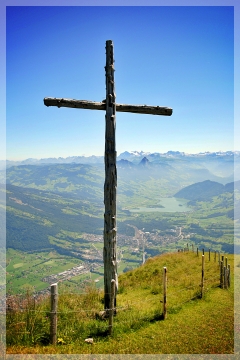
Mt. Rigi crossWhen driving on I-70 near Effingham, Illinois, you can’t miss seeing the 198-feet tall, 180-ton cross erected near the highway. Once America’s largest cross, its builders call it “a beacon of hope” to the over 50,000 travelers who pass by it each day. In 2018, Effingham’s cross was outdone when a 218-feet high cross was erected in Walnut Shade, Missouri. Near Branson and visible from Highway 65, because of its height, the FAA requires beacons on it. These two crosses, however, are small when compared to the world’s largest cross—the 500-feet tall Holy Cross from the Valley of the Fallen (Valle de los Caídos) in Spain or the 300-feet high Shrine of Valor in the Philippines.

Crucifixion was an extremely cruel form of execution that forced the condemned to suffer a prolonged agonizing death; it was such a horrible way to die that the Romans rarely used it on their own citizens. The disgrace and shame of crucifixion was used primarily for slaves and the worst kind of criminals and yet God allowed His only Son to endure the unbearable agony and horror of dying that way! Jesus’ torture began even before the cross when He was beaten with a flagrum (a short whip with pieces of bone and metal woven into its thongs), taunted by soldiers, had a crown of thorns driven into his head, beaten again and then dragged to his feet and made to carry the cross to the Golgotha. So battered, bloodied, and broken that He was unable to do so, Simon of Cyrene was called into duty. Once there, our Lord was stripped of his clothes and nailed to the cross. Before long, Jesus would have been unable to support himself with his legs. As his body’s weight was transferred to his arms, his shoulders would have been pulled from their sockets and breathing would have become extremely difficult. Without a doubt, it was a horrific and brutal way to die.

You’d never expect to see an electric chair, guillotine, or gallows erected as a monument and I question why we identify ourselves with something as grotesque as this ancient instrument of torture. Nevertheless, we wear crosses around our necks, place them on our walls, hang them in churches, set them on steeples, etch them into headstones, put them up as roadside memorials, and erect giant crosses that can been seen for miles. How did a symbol of disgrace, defeat, and suffering become a beacon of hope, triumph, and salvation?

I suppose the facetious answer to “Why the cross?” is that it’s too difficult to depict the empty tomb, a symbol which certainly would better represent the resurrected Christ! Yet, when we focus only on the resurrection and empty tomb, it’s easy to forget the suffering that preceded it. The cross of Jesus Christ is as essential to our faith as the empty tomb. Throughout his ministry, Jesus knew exactly what He was doing and the pain He would endure but it never deterred Him from His mission. He willingly suffered for all of us and it was His suffering and death on the cross that frees us from the penalty of sin. The cross represents the pardon for which a condemned criminal awaits, the forgiveness that none of us deserve, and the sacrifice of a perfect man for an imperfect people.

Until the 4th century, Christianity was illegal. Because of its close association with Jesus, Christ’s followers were scared to use the cross as a symbol because it exposed them to contempt, danger, and persecution. Oddly, it was Emperor Constantine’s vision of a cross in the sky that led to his conversion to Christianity in 312 AD. After seeing it, he vowed to worship no other god than the one the vision represented and he sought out church leaders to explain its meaning. The bishops explained that Jesus was the Son of God and the cross in Constantine’s vision symbolized Christ’s victory over death. In 313, Christianity was legalized and crucifixion was abolished. After that, rather than being a symbol of unspeakable horror, the cross became a symbol of victory.

I usually wear a small cross; when I place it around my neck, it reminds me that God sacrificed His only son for me and of the enormous price Jesus paid for my salvation. My life was purchased at a great cost to Him and the cross reminds me to whom it is I belong. It’s a daily reminder take up my cross and follow Him.

Then Jesus said to his disciples, “If any of you wants to be my follower, you must give up your own way, take up your cross, and follow me. If you try to hang on to your life, you will lose it. But if you give up your life for my sake, you will save it. [Matthew 16:24-25 (NLT)]

Copyright ©2021 jsjdevotions. All rights reserved.

YOUR KINGDOM COME

This, then, is how you should pray: “Our Father in heaven, hallowed be your name, your kingdom come, your will be done, on earth as it is in heaven.” [Matthew 6:9-10 (NIV)]

Remember that the same Christ who tells us to say, “Give us this day our daily bread,” had first given us this petition, “Hallowed be Thy name; Thy kingdom come; Thy will be done in earth as it is in heaven.” Let not your prayers be all concerning your own sins, your own wants, your own imperfections, your own trials, but let them climb the starry ladder, and get up to Christ Himself, and then, as you draw nigh to the blood-sprinkled mercy-seat, offer this prayer continually, “Lord, extend the kingdom of Thy dear Son.” [Charles Spurgeon]

sunflowerIt wasn’t until I read Charles Spurgeon’s paraphrase of “Your kingdom come,” as “Lord, extend the kingdom of Thy dear Son,” that I truly gave serious thought to what it means to pray, “Your (or “Thy”) kingdom come.” Although we say it every time we say the Lord’s Prayer, what exactly do those three words mean? After all, that was God Himself giving His disciples a guideline to prayer and there certainly couldn’t be a better teacher! Since there are over seventy references to the Kingdom of God in the New Testament and this petition immediately follows praising God’s name in Jesus’ prayer, the coming of God’s Kingdom clearly was important to Him.

Jesus’ life, death, and resurrection opened the doors to God’s Kingdom. Yet, it is only when Jesus comes again at the end of the age that God’s Kingdom will reign with power and authority. While this petition is for the fulfillment of the Kingdom with Christ’s return, it is much more than that. As we pray for the coming of Jesus in the future, these three words also are a petition for the expansion of God’s Kingdom in the present. They are a prayer that the gospel message will be preached to and accepted by all so that the whole world will be made Christ’s Kingdom and filled with His glory. We’re asking God to reveal Himself in such a way that His kingdom is visible here on earth and that He will open the hearts of those we encounter and to whom we witness.

Praying that God’s Kingdom will come is also an acknowledgement that He is our sovereign king and the ruler of our lives. Even though the Kingdom will not be complete until the second coming of Christ, we can experience it today. This leads into  the next petition of “Your will be done,” in which we ask Him to enable us to do what is pleasing to Him. May we be genuine, faithful, obedient, and capable servants of His Kingdom!

Although my lips frequently speak the words, ”Your Kingdom come,” until considering Spurgeon’s words, I barely understood their magnitude. In my personal prayers, I have neglected praying for the coming of God’s Kingdom—the day when Jesus will return and all things will be restored. Although I remember to pray for pastors, missions, and missionaries, the expansion of God’s Kingdom here and now and the role I should play in that expansion has never been on the top of my prayer list either.

If the coming of His Kingdom is God’s priority, perhaps it should be ours as well. Moreover, we should prove the truth of our prayers by putting our words into Kingdom-promoting action. Let us be like the Apostle Paul who, “proclaimed the kingdom of God and taught about the Lord Jesus Christ—with all boldness and without hindrance!” [Acts 28:31]

We therefore pray that God would exert his power, both by the Word and by the Spirit, that the whole world may willingly submit to him. [John Calvin]

Once, on being asked by the Pharisees when the kingdom of God would come, Jesus replied, “The coming of the kingdom of God is not something that can be observed,  nor will people say, ‘Here it is,’ or ‘There it is,’ because the kingdom of God is in your midst.” [Luke 17:20-21 (NIV)]

Copyright ©2021 jsjdevotions. All rights reserved.

NOTHING PERSONAL

I tell you, love your enemies. Help and give without expecting a return. You’ll never—I promise—regret it. Live out this God-created identity the way our Father lives toward us, generously and graciously, even when we’re at our worst. Our Father is kind; you be kind. [Luke 6:35-36 (MSG)]

great egret - breeding lores“There is nothing personal going on here,” were the words that helped author Jane Smiley get through her acrimonious divorce. Although no divorce is pretty, the circumstances surrounding hers were especially ugly. Realizing that her husband was acting out his own drama helped her to better understand and deal with his dreadful behavior and hurtful actions. Smiley explained, “This is a wiser way of understanding the people around you … how they have their own passions, motivations, and histories, that sometimes (always) grip them in ways, that even they do not grasp—ways you don’t have to respond to automatically.” Her words impressed me so much that I wrote them down after reading them several years ago. The author wrote that remembering the phrase, “There’s nothing personal going on here,” has helped her deal with other difficult people and situations in her life. I find them useful, as well.

When Pulitzer Prize winning author Jane Smiley writes fiction, she is the creator of each character. As such, she knows their back story, needs, fears, and issues. She invents the baggage they’re carrying and understands the reasons for their behavior. In real life, however, people have their own private history. Although people’s past hurts or present problems are never an excuse for thoughtless words or bad conduct, they do affect them. Carrying hidden scars, people have passions, fears, insecurities, prejudices, and forces that control them in ways that even they may not understand. We don’t know much about other people’s pasts (or their present circumstances) nor do they know ours. Realizing this makes it easier to step back and not take their hurtful words and actions so personally.

In this day and age of insults, boorishness, and unpleasantry, we have plenty of opportunities to take offense. More often than not, we’ve done nothing deliberately to deserve whatever nastiness has been dished out to us; nevertheless, let us remember than taking offense is a choice. We are accountable to God only for what we do, not for what is said and done to us.

It is hurting people who hurt people; remembering that hurtful behavior is more the result of other people’s issues than our behavior keeps us from retaliating. It certainly makes forgiveness much easier. Rather than taking it personally, let us pray for those who upset, offend, fail, or hurt us. Bearing in mind that everyone has a history and their own unique story known only by God, we can say, “There is nothing personal going on here,” and get on with our lives.

What can you ever really know of other people’s souls – of their temptations, their opportunities, their struggles? One soul in the whole creation you do know: and it is the only one whose fate is placed in your hands. [C.S. Lewis]

Don’t pick on people, jump on their failures, criticize their faults—unless, of course, you want the same treatment. Don’t condemn those who are down; that hardness can boomerang. Be easy on people; you’ll find life a lot easier. Give away your life; you’ll find life given back, but not merely given back—given back with bonus and blessing. Giving, not getting, is the way. Generosity begets generosity. [Luke 6:37-38 (MSG)]

Copyright ©2021 jsjdevotions. All rights reserved.