TO WHOM?

But when you pray, go into your room, close the door and pray to your Father, who is unseen. (Matthew 6:6 NIV)

And I will do whatever you ask in my name, so that the Father may be glorified in the Son. You may ask me for anything in my name, and I will do it. [John 14:13-14 (NIV)]

And pray in the Spirit on all occasions with all kinds of prayers and requests. With this in mind, be alert and always keep on praying for all the Lord’s people. [Ephesians 6:18 (NIV)]

“To whom should we pray?” is a common question. People wonder, “If we pray to God the Father, are we leaving out His Son? But if we pray to Jesus, are we leaving out God? And where does the Holy Spirit fit in?”

I’m no theologian, but it seems we certainly can’t go wrong by praying to God the Father. After all, when asked how to pray, Jesus began with “Our Father” and the Apostle Paul wrote the Romans about joining together and “giving praise and glory to God, the Father of our Lord Jesus Christ.” [15:6] Nevertheless, Jesus, as the son of God, is divine and He promised that we can ask for anything in His name. So, we can pray to Him as did Stephen who prayed, “Lord Jesus, receive my spirit,” while being stoned. [Acts 7:59] To further confuse the matter, Paul explained that the Holy Spirit intercedes for us so it appears that we also can pray to Him.

If we can pray to any of the three, how do we decide to whom we’ll pray? Some people decide who they’ll address by the topic of their prayer. When they want to offer worship and praise, ask for forgiveness, or plead for divine intervention, they call on God the Father. When they need to talk with someone who understands their earthly struggles, they call on Jesus. Since the Holy Spirit helps us pray, they pray to Him when they can’t find the words to express themselves.

When we worry about to whom we address our prayers, however, we’re forgetting that our Trinitarian God, while three persons, is one God! Calling it a “divine riddle,” Puritan minister Thomas Watson explained, “The three persons in the blessed Trinity are distinguished, but not divided; three substances, but one essence. … If there be one God subsisting in three persons, then let us give equal reverence to all the persons in the Trinity. … One person has not a majority or super eminence above another, therefore we must give equal worship to all the persons.”

When learning about Jeopardy contestant Matt Amodio for yesterday’s devotion, I discovered that his answers irk the grammar police. Jeopardy answers must be given in the form of a question and he begins every response with “what’s…” even when referring to a person. Amodio’s strategy is to keep things simple and explained that keeping his responses consistent allows him to focus on the “meat” of the clue. Just as a Jeopardy contestant’s answers don’t have to be grammatically correct to be accepted, I suspect our Trinitarian God cares far more about our hearts than our words and would prefer we give more thought to the “meat” of our prayers rather than to whom or how they’re said.

We can address our Trinitarian God in any of a number of ways—as Eternal Father, Holy Spirit, Lord, Blessed Jesus, God, Lord of My Life, Almighty and Eternal God, Holy Spirit of God, Eternal Being, Divine Love, God of Mercy, Holy One, Holy and Blessed Trinity, God, Jesus, Spirit of God, or many other reverent names. Flawed beings that we are, we seem to complicate our lives unnecessarily and worrying about how to pray (rather than simply doing it) is one of the ways we do it. Amodio’s answers are accepted by the Jeopardy judges just as our prayers, offered in faith with a humble heart, will be accepted by God the Father, Jesus the son, and the Holy Spirit.

Christian prayer is most often Trinitarian. Practically, this means we pray by the Spirit, through Jesus Christ our mediator, to God the Father. [Mark Driscoll]

In the same way, the Spirit helps us in our weakness. We do not know what we ought to pray for, but the Spirit himself intercedes for us through wordless groans. And he who searches our hearts knows the mind of the Spirit, because the Spirit intercedes for God’s people in accordance with the will of God. [Romans 8:26-27 (NIV)]

Copyright ©2021 jsjdevotions. All rights reserved.

GOING “ALL-IN”

My dear family, I don’t reckon that I have yet overtaken it. But this is my one aim: to forget everything that’s behind, and to strain every nerve to go after what’s ahead. I mean to chase on towards the finishing post, where the prize waiting for me is the upward call of God in King Jesus. [Philippians 3:13-14 (NTE)]

dolphinJeopardy contestant James Holzhauer became known for his 32-game winning streak, massive winnings, and his “all-in” hand gesture while putting all of his winnings on the line when answering a Daily Double. A new champion is in the making with Ph.D. student Matt Amodio. Like Holzhauer, he plays an aggressive game and is not timid when it comes to the Daily Double. Last Wednesday, after saying “all-in,” he wagered his entire holdings of $8,000 and lost it all; undeterred by the previous night’s Daily Double loss, he again went “all-in” with a $10,400 wager the next day. His willingness to go “all-in” has paid off handsomely and, by the end of the week, he’d won 28 games and amassed $1,004,001.

Seeing both Holzhauer and Amodio fearlessly go “all-in” when it comes to game show winnings, I wondered if we’re as fearless when it comes to going “all-in” when it comes to God. Showing tremendous confidence in their intelligence and knowledge of trivia, neither contestant allowed previous set-backs to keep them from their purpose. Granted, their goal was to amass as much money as possible yet I question whether we’re as confident in God and as determined in our purpose to serve him faithfully. Are we “all-in” when it comes to following Jesus?

Scripture’s heroes are people who went “all-in” – not with their money but with their lives. Noah was “all-in” when he built the ark on dry land, Jochebed was all-in when she placed the infant Moses in a basket and placed him on the bank of the Nile, and Abraham went “all-in” when he left his homeland, packed up his possessions, and set off to parts unknown. The unmarried Mary wasn’t so naïve that she didn’t know the risks of her choice, but she went “all-in” when she chose to become pregnant through the Holy Spirit. Think of John and James who went “all-in” when they left their father and fishing boat or Matthew who left his lucrative tax collector job. Peter went “all-in” when he stepped out of the boat to walk on water, the woman with the bleeding disorder was “all-in” when she ventured into the crowd to touch Jesus, and the unnamed woman was “all-in” when she anointed Jesus’ feet and hair with her tears and costly jar of fragrant oil. The poor widow was “all-in” when she dropped two small coins in the collection box, Stephen was “all-in” when he continued to preach the gospel as stones rained down on him, Barnabas went “all-in” when he sold his land and gave the proceeds to the church, and Peter and John were “all-in” when they defied the authorities and continued to boldly proclaim the gospel. Like Holzhauer and Amodio, they took risks with no guarantee of success but, unlike those game show contestants, they didn’t do it for themselves; they did it for God. It wasn’t an earthly prize they sought; it was a heavenly one!

Think of the rich young ruler who, although he wanted to know Jesus, was reluctant to surrender to Him. Unwilling to go “all-in,” he walked away from the Lord and missed an eternal relationship with God! What about us? Are we “all-in” when it comes to Jesus? With His words that we are to “Love the Lord your God with all your heart, all your soul, and all your mind,” Jesus is telling us that we are to go “all-in” all of the time. Do we?

He then spoke to them all. “If any of you want to come after me,” he said, “you must say No to yourselves, and pick up your cross every day, and follow me. If you want to save your life, you’ll lose it; but if you lose your life because of me, you’ll save it. What good will it do you if you win the entire world, but lose or forfeit your own self? … “Nobody,” replied Jesus, “who begins to plough and then looks over his shoulder is fit for God’s kingdom.”  [Luke 9:23-25,62 (NTE)]

Copyright ©2021 jsjdevotions. All rights reserved.


THE ANSWERS WE DON’T WANT TO HEAR

Put me on trial, Lord, and cross-examine me. Test my motives and my heart. [Psalm 26:2 (NLT)]

Search me, O God, and know my heart; test me and know my anxious thoughts. Point out anything in me that offends you, and lead me along the path of everlasting life. [Psalm 139:23-24 (NLT)]

When we go to our meeting with God, we should go like a patient to his doctor, first to be thoroughly examined and afterwards to be treated for our ailment. [Ole Hallesby]

hostaAs much as David wanted to hold to God’s standards, he knew he was flawed and so he asked the Lord to point out whatever He found offensive. We know we should do the same but I’m not sure we actually do so. While we can lie to ourselves and even to God, we know He won’t lie to us. If we ask Him to tell us where we’ve gone wrong, His answer, while loving and gentle, will be brutally honest! Could it be that we don’t ask because we really don’t want Him to tell?

In our evening prayers, are we willing to ask God if we’ve done what should have been done that day? Are we eager to hear His truthful answer if asking whether we’ve acted with integrity in all our affairs, been sincere in our communications, or damaged Jesus’ name in our conduct? Do we really want to hear Him point out our hypocrisy or expose the true motives behind our words and actions? Are we ready to hear Him mention our laziness, overindulgence, and contentiousness or to show us how we excused ourselves for our failings but not others for theirs? At day’s end, do we ask if we’ve honored Him with our words and served Him by acting as His hands and feet? While those are the kind of questions we should be asking, I suspect we don’t ask them as frequently as we should simply because we’re not anxious to hear His answer.

Because they can’t peer into our hearts, other people’s assessments of us usually are inaccurate and, because we’re experts at rationalizing, justifying, and even deceiving ourselves, our self-assessment is equally unreliable. Like the Psalmist, we must earnestly ask God to put us on trial and be happy to hear His answer (whatever it may be)! Moreover, once we hear His answer, let us be ready to make a change!

The function of prayer is not to influence God, but rather to change the nature of the one who prays. [Soren Kierkegaard]

As for me, it matters very little how I might be evaluated by you or by any human authority. I don’t even trust my own judgment on this point. My conscience is clear, but that doesn’t prove I’m right. It is the Lord himself who will examine me and decide. [1 Corinthians 4:3-5 (NLT)]

Copyright ©2021 jsjdevotions. All rights reserved.

EXPECT TROUBLE

A final word: Be strong in the Lord and in his mighty power. Put on all of God’s armor so that you will be able to stand firm against all strategies of the devil. For we are not fighting against flesh-and-blood enemies, but against evil rulers and authorities of the unseen world, against mighty powers in this dark world, and against evil spirits in the heavenly places. [Ephesians 6:10-12 (NLT)]

sunset

While talking about discerning God’s plan for us, a friend said she knows she’s chosen the right path when she moves forward in a plan and doesn’t encounter obstacles or challenges. After thinking about it, I beg to disagree.

Three gospels tell of the time Jesus and the disciples crossed the Sea of Galilee to escape the crowds. In a fishing boat without sails, the men rowed while Jesus slept. The lake is known for violent squalls that arise suddenly and one such storm did. As the wind blew and the sea surged, the waves broke over the gunwales and the boat began to fill with water. Sure they’d sink and drown, the disciples awoke Jesus. After admonishing the men for their lack of faith, He quickly rebuked the squall and calm was restored. That the wind and waves obeyed Jesus demonstrated His sovereign reign over nature. Scripture made it clear that only God has dominion over the natural world and the men wondered at Jesus’ ability to calm the storm.

While the storm presented an opportunity for Jesus to reveal the source of His power and authority, could there be more to it? Have you ever wondered why the exhausted Jesus wanted to cross over the lake to the Gentile region of Gardara or why the boat was pulled ashore near burial tombs? I suspect that Jesus knew of the two demon-possessed men living in those tombs and that He deliberately went there to exorcise their evil spirits. Rather than a teaching lesson for the disciples, could the storm have been Satan’s way of keeping them from their destination? Satan certainly had a vested interest in keeping Jesus from reaching the other side of the lake and, not wanting to lose those two captive souls, he attempted to prevent Jesus’ arrival with wind and waves. That storm occurred precisely because Jesus was doing God’s work!

When looking through Scripture, we find that encountering rough seas, storms, and obstacles seem to be a part of following God’s will. During the time he followed God’s plan, the Apostle Paul experienced ill-health, defections, beatings, imprisonment, at least three shipwrecks, and eventually martyrdom. Think of the troublemakers, false prophets, fabricated accusations, and persecution faced by the early church (all of which were courtesy of Satan). The enemy has been trying to thwart God’s plan since Eden; he’s not about to stop now!

When we are following God’s plan, we should expect opposition because the enemy does not want us to accomplish what God has purposed for us. Opposition doesn’t mean we should abandon ship; we just need to get on our life jackets and keep rowing! Like the early church, we do that by defending the truth, sharing the Good News, giving our concerns to God, living by faith, and remaining steadfast in our mission. “If you are going to walk with Jesus Christ, you are going to be opposed,” said preacher George Whitefield. That was true when he said it in the 1700s and it remains true today.

The way to thwart the devil is to strengthen the very thing he is trying most to destroy—your faith. [John Piper]

And I am convinced that nothing can ever separate us from God’s love. Neither death nor life, neither angels nor demons, neither our fears for today nor our worries about tomorrow—not even the powers of hell can separate us from God’s love. No power in the sky above or in the earth below—indeed, nothing in all creation will ever be able to separate us from the love of God that is revealed in Christ Jesus our Lord. [Romans 8:38-39 (NLT)]

Copyright ©2021 jsjdevotions. All rights reserved.

IT’S NOT ABOUT THE MONEY

Woe betide you, scribes and Pharisees, you hypocrites! You’re like whitewashed graves, which look very fine on the outside, but inside they are full of the bones of the dead and uncleanness of every kind. That’s like you: on the outside you appear to be virtuous and law-abiding, but inside you are full of hypocrisy and lawlessness. [Matthew 23:27-28 (NTE)]

yellow hawkweedAlong with proclaiming the Word of God, the young Church was committed to ensuring that there were no needy among them. As a result, many of the early believers voluntarily sold their property and shared their wealth with the rest of the church community. Barnabas, for example, sold a field he owned and generously brought the money to the apostles for those in need.
Immediately following the mention of Barnabas in Acts, Luke tells us about Ananias and Sapphira. Like Barnabas, they sold some land and brought the proceeds to the apostles but, unlike him, the couple retained some of the funds. But, wanting to impress everyone with their generosity without actually making a sacrifice, they claimed to have contributed the full amount. Peter, however, knew better and confronted each one about their deceit and they were struck dead in divine judgment.

This is a troubling story when we mistakenly think of it in terms of how much of our money we should give to the church. It’s important to remember that Ananias and Sapphira’s sin wasn’t in keeping some of the money; it was theirs to do with as they wished. The sharing among believers wasn’t compulsory and didn’t originate in the law. It originated in love and was completely voluntary. Rather than the sin of greed, the couple’s sin was that of hypocrisy; they wanted to impress the church into thinking they were something they clearly were not. They lied to the church but, worse, they lied to the Holy Spirit! Luke tells us that “great fear” struck the entire church when the learned what happened to Ananias and Sapphira. It should strike fear in us as well! The message, however, isn’t about money; it’s that God will not tolerate deception in spiritual and personal matters.

None of us manage to fully live up to our ideals and values; we’re flawed human beings who miss the mark in a variety of ways. That we fail to be the person we should be does not make us hypocrites; it’s failing to be the person we claim to be that is hypocrisy! Putting reputation before character, the hypocrite creates a public impression at odds with his or her true self.

The book of Acts relates how the early church was threatened by the world in which they lived: persecution, arrests, imprisonment, and even death. But it also relates how the church faced threats within its own community when the sins of a few (like Ananias and Sapphira) threatened the testimony of the church. Both threats continue today. I can’t help but wonder—if God dealt as severely with deceivers and hypocrites today as He did with Ananias and Sapphira, how many people would be left to fill our pews on Sunday morning?

The hypocrite, certainly, is a secret atheist; for if he did believe there was a God, he durst not be so bold as to deceive Him to His face. [Thomas Adams]

They declare that they know God, but they deny him by what they do. They are detestable and disobedient, and useless for any good work. [Titus 1:16 (NTE)]

Copyright ©2021 jsjdevotions. All rights reserved.

THE PEACE POLE – WORLD PEACE DAY

God blesses those who work for peace, for they will be called the children of God. [Matthew 5:9 (NLT)]

Do all that you can to live in peace with everyone. … Don’t let evil conquer you, but conquer evil by doing good. [Romans 12:18,21 (NLT)]

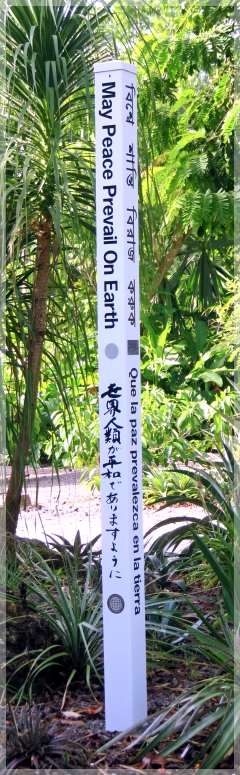
peace poleCOVID kept us from the Botanic Gardens for well over a year. When we finally returned to one of our favorite places, we came upon a peace pole planted among the palms, bamboo and bromeliads. Although a similar pole is in the city park downtown, I don’t remember seeing one here when last we visited. These poles are just two of the more than 250,000 that have been erected in over 180 nations.  Symbolizing the oneness of humanity, the words “May Peace Prevail on Earth” are written in eight different languages. The languages chosen for this pole were English, Arabic, Bengali, Chinese, Hawaiian, Hindi, Japanese, and Spanish—the languages of people who, like us, live at the 26th parallel north. Peace poles stand as a visual reminder to pray for peace on earth and to think, speak and act in the spirit of harmony and peace.

Forty years ago, the United Nations designated today as the annual International Day of Peace (commonly called World Peace Day). In 2011, the General Assembly unanimously voted to designate it as a day of cease-fire and non-violence. They ask every person and nation to halt hostilities and fighting for this one twenty-four-hour period. Unfortunately, I doubt the world can make one hour, let alone twenty-four, without aggression, hostility and bloodshed. Hopefully, you and I can go longer than twenty-four hours without conflict or violent behavior!

The causes of world conflict are many and, according to the UN, include poverty, social inequality, hunger, dwindling natural resources, water scarcity, environmental decline, disease, corruption, racism, and xenophobia (an intense fear of foreigners). This year’s theme, “Recovering Better for an Equitable and Sustainable World,” continues the UN’s focus on finding ways to overcome those causes. Indeed, as our world struggles to recover from what seems to be a never-ending pandemic, we can see how the underprivileged and marginalized have been hit the hardest. In the last eighteen months, we have seen both the best and the worst of our fellow travelers on this planet. This day is a reminder that instead of fighting with one another, we should join in fighting mankind’s common enemies!

As Christians, we have the peace of God—the peace that passes understanding—but we must be more than possessors of peace. Jesus calls us to be makers of peace but erecting a peace pole is not enough! We can start by bringing peace to our little corner of the world, beginning at home and then moving on to work, school, church and community. Our peacemaking efforts, however, can’t stop at the borders of our neighborhood or even our nation. We must take Christ’s message of peace out into the world by thinking, speaking, and acting in the cause of peace. While we each have an obligation to improve the various conditions that promote conflict, changing people’s circumstances is just a beginning. For true peace, the peace that is found in a relationship with God, we must change people’s hearts.

World peace, while a lofty goal, is not something I expect to see in my lifetime. Nevertheless, we each must do our part.

We hear much of love to God; Christ spoke much of love to man. We make a great deal of peace with heaven; Christ spoke much of peace on earth. [Henry Drummond]

I urge you, first of all, to pray for all people. Ask God to help them; intercede on their behalf, and give thanks for them. Pray this way for kings and all who are in authority so that we can live peaceful and quiet lives marked by godliness and dignity. [1 Timothy 2:1-2 (NLT)]

But the wisdom from above is first of all pure. It is also peace loving, gentle at all times, and willing to yield to others. It is full of mercy and the fruit of good deeds. It shows no favoritism and is always sincere. And those who are peacemakers will plant seeds of peace and reap a harvest of righteousness. [James 3:17-18 (NLT)]

Copyright ©2021 jsjdevotions. All rights reserved.