
But the fruit of the Spirit is love, joy, peace, patience, kindness, goodness, faithfulness, gentleness, and self-control. The law is not against such things. [Galatians 5:22-23 (CSB)]
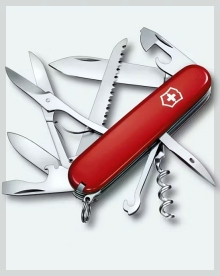 In contrast to works, which are produced by us, the Fruit of the Spirit is produced by the Holy Spirit. Rather than a basket with a variety of fruit, this is one indivisible fruit characterized by nine virtues: love, joy, peace, patience, kindness, goodness, faithfulness, gentleness and self-control. We could call this the “Christlikeness fruit” because these characteristics describe Jesus and should describe us.
Planted by the Spirit in our hearts when we accept Jesus, the Fruit of the Spirit is a little like a Swiss Army knife with its numerous functions. Just as the multi-faceted pocketknife can provide us with two blades, along with a corkscrew, screwdriver, bottle opener, scissors, toothpick, tweezers, can opener, and key ring, the Fruit of the Spirit is an all-purpose spiritual tool providing us with love, joy, peace, patience, kindness, goodness, faithfulness, gentleness, and self-control.
Victorinox, however, doesn’t equip every Swiss Army knife with the same tools. With its 13 functions, their rescue knife comes with a saw for cutting shatterproof glass, a seatbelt cutter, and a window breaker but it doesn’t have the huntsman knife’s corkscrew and multi-purpose hook or the mini champ’s cuticle pusher and orange peeler! Unlike the knife maker, however, God equips every one of His children with the same nine all-purpose attributes in the Fruit of the Spirit!
It’s not Victorinox’s “cross on shield” logo that identifies it; the knife is known by its tools! In the same way, it’s not labeling ourselves Christians that identifies us as such—we’re known as Christ’s followers when the Fruit of the Spirit is evident in our behavior. The tools on any Swiss Army knife are meant to be used but, once it’s sold, Victorinox doesn’t care if you never open the knife. The virtues of the Fruit of the Spirit, however, are meant to be evident and God notices when they aren’t.
When describing the Fruit of the Spirit in “newspaper English,” famed preacher Samuel Chadwick (1860-1932) may have said it best: “The Fruit of the Spirit is an affectionate, lovable disposition, a radiant spirit and a cheerful temper, a tranquil mind and a quiet manner, a forbearing patience in provoking circumstances and with trying people, a sympathetic insight and tactful helpfulness, generous judgment and a big-souled charity, loyalty and reliableness under all circumstances, humility that forgets self in the joy of others, in all things self-mastered and self-controlled, which is the final mark of perfecting.” It is the presence of the Fruit of the Spirit that enables us to grow more like Jesus every day—to have His purpose, thoughts, words and actions be ours.
We recognize a Swiss Army knife by its tools; do people recognize us by our fruit?
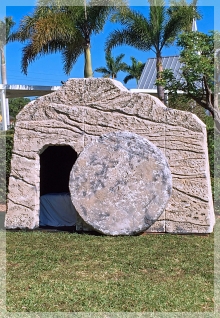 Several years ago, an entertainment network did a story on the highlights of Charlotte, North Carolina. Since the Billy Graham Library was considered a point of interest, it was visited by the show’s co-host Kristy Villa and her film crew. Commenting on the many crosses she saw throughout the property, Villa asked, “I see all the crosses, but where is Jesus?” Her guide simply replied, “He’s in Heaven,” adding, ”He is also present in the lives of those who believe in Him and follow Him as their personal Lord and Savior.” Villa exclaimed, “Oh, that’s right! Some worship a crucifix, but Christians worship a risen Christ.” Indeed, Christ’s story doesn’t end with a dead man hanging on a cross. Nevertheless, rather than an empty cross, our emphasis should be on His empty tomb!
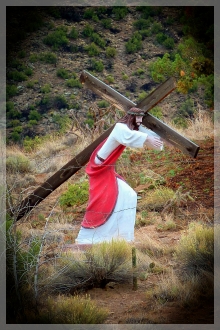 Last February, we celebrated love with the secular holiday Valentine’s Day. We may have given or received flowers, candy, or a card—tokens of someone’s love for us or our love for them. Seven weeks later, however, the flowers are dead, the candy is eaten, and the card in the recycling bin. The day dedicated to “love” is forgotten until next February when the ads for jewelry and flowers remind us.
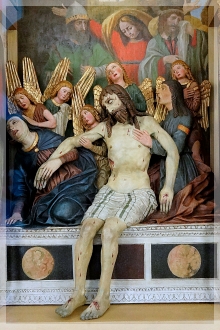 Although the common position for prayer was standing, Jesus fell to His knees that night in the garden of Gethsemane. Luke describes Him as praying so intensely that His sweat dropped like blood. Having used the word hósei, meaning “as if it were, like, as, as though, or much like,” Luke may have meant Jesus sweat so profusely that it dripped from Him like blood. Nevertheless, Luke was a doctor who paid great attention to detail; he may have described hematidrosis, a rare medical condition in which the capillaries rupture causing blood to seep into the sweat glands and then out onto the skin. It’s caused by high blood pressure, a bleeding disorder, or extreme distress or fear, such as facing abuse, torture or death on the cross! Whether Jesus’ sweat poured off his body as if it were blood or He literally sweat blood, the Lord’s prayer was so intense that an angel came and strengthened Him.
 Fowlers are professional bird catchers. In ancient Israel, they supplied the market with wild pigeons and doves destined for sacrifice, small birds (like quail) for food, and doves and other birds for caged pets. Since most of us get our poultry at the grocery, we’re probably unfamiliar with the fowler and his methods. To capture birds, fowlers spread nets or set traps and snares on the ground, camouflage them with natural materials, and cover them with grain. Tempted by the food, the birds leave the safety of the sky and come down to the ground where they are caught.
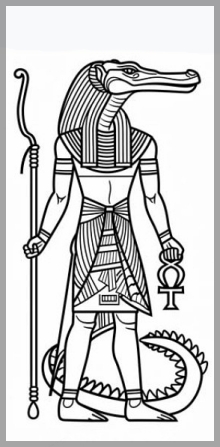 Over a period of 3,000 years, ancient Egypt’s pantheon of gods numbered between 1,400 and 2,000. During that time, some faded in prominence and new gods appeared. Often depicted as part human and part animal, Egypt’s gods had names, unique back-stories, and their own domain and expertise. Each god/goddess was responsible for a certain part of daily life, from motherhood to music, record keeping to funerals, and cosmic order to hunting. While the ten plagues God sent Egypt through Moses and Aaron may seem somewhat arbitrary to us in the 21st century, every one of them was a direct attack on one or more Egyptian god. They were the ultimate “smack-down” between God Almighty and Egypt’s deities.
