STUFF AND SUCH

Then he said, “Beware! Guard against every kind of greed. Life is not measured by how much you own.” [Luke 12:15 (NLT]

squirrelAn illustration of a man stooped over with an enormous sack on his back adorned the cover of the church program. The man had a troubled look on his face as if thinking, “I’ve got this all this, now what I am supposed to do with it?” The words “Life does not consist in the abundance of possessions,” were superimposed over the picture.

Jesus told a parable about a rich man who needed to build a bigger barn to store all of his grain and goods. That very night, he died and everything he’d amassed was lost—left for someone else to have and enjoy.  Most of us have way too much stuff but, instead of bigger barns, we buy larger houses, install cabinets in the garage, rent storage units or build sheds to house our things.

Stuff and such—we all have it and, chances are, we all have way more than we need or can possibly use. I don’t think I realized how much stuff we’d acquired until we sold two vacation homes this past summer. One home had been ours for thirty-seven years and the other for twenty nine and a whole lot of stuff and such can be accumulated in that amount of time. Although we sold both homes furnished and much was left for the new owners, there was plenty that had to be removed. As we decided what would go to our kids and friends, the charity resale shop or Goodwill, the dump, or back home with us, I realized (and was embarrassed by) the quantity of stuff we’d managed to amass over the years. How many parkas, boots, jeans, sweaters, caps, sneakers, and gloves do we need, especially when there are so many without any coat, pants or shoes? How many CDs, DVDs, books, games, and toys does a family need when there are children who don’t even have a set of crayons? I was shocked at how large we’d allowed that bag on our backs to get and how little we appreciated all that was in it.

We own our possessions but, if we’re not careful, our possessions can come to own us. When our stuff and such become a burden, as they were for the man on the church program, it’s not time to build a bigger barn; it’s time to get rid of something! Possessions, when no longer used or appreciated, belong in someone else’s barn! Then, instead of building a bigger barn for our things, we can build bigger barns to shelter the homeless, heal the ill, teach the uneducated, and feed the hungry. Let’s never make the mistake of thinking that, “He who dies with the most toys, wins!” As Jesus pointed out, that man doesn’t win, he just dies!

Abundance isn’t God’s provision for me to live in luxury. It’s his provision for me to help others live. God entrusts me with his money not to build my kingdom on earth, but to build his kingdom in heaven. [Randy Alcorn]

Sell your possessions and give to those in need. This will store up treasure for you in heaven! And the purses of heaven never get old or develop holes. Your treasure will be safe; no thief can steal it and no moth can destroy it.  Wherever your treasure is, there the desires of your heart will also be. [Luke 12:33-34 (NLT)]

Copyright ©2016 jsjdevotions. All rights reserved.


HAPPILY EVER AFTER

That night God appeared to Solomon and said, “What do you want? Ask, and I will give it to you! [2 Chronicles 1:7 (NLT)]

No one is really happy merely because he has what he wants, but only if he wants things he ought to want. [St. Augustine]

Mountain Bluebird In the many television tributes to the recently deceased actor Gene Wilder, a scene from the movie Willy Wonka & the Chocolate Factory frequently has been aired. In it, Willy tells Charlie not to forget what happened to the man who suddenly got everything he wanted. When the boy asks what that was, Wonka replies, “He lived happily ever after!”

While that exchange made for a nice ending to a children’s film, getting everything we want is hardly the way to guarantee living happily ever after—unless, of course, we only want the right things! Yet, even wanting the right things is no guarantee of happiness. Look at Solomon; when God asked what he wanted, the young king requested the right thing—wisdom. God rewarded him not just with wisdom but also with riches, possessions, honor and fame. Here was a king who truly got all that he wanted plus more. Surely, with everything that Solomon received, he should have lived happily ever after.

Nevertheless, all the wisdom and wealth in the world could not give meaning to Solomon’s life. Although gifted with wisdom, he failed to use it when he broke God’s rules for kings by amassing horses, collecting a harem of 1000, accumulating riches by excessive taxation, sealing alliances by marrying foreign women and worshiping pagan gods. Although he got everything he wanted, Solomon did not find happiness. His words in Ecclesiastes show us how disillusioned, bitter and disappointed this wealthy sage was when he realized how empty his life had been without God at its center.

Getting what we want will only lead to a happily ever after if we want what God wants for us and if we use His blessings with a wisdom far greater than Solomon’s. Let us never forget that God’s answers to our prayers often are not what we think will make us happy. They are, however, always what we need. Moreover, God has already given us all that we need for our happily ever after: His beloved Son, forgiveness, salvation, and eternal life.

God cannot give us a happiness and peace apart from Himself, because it is not there. There is no such thing. [C.S. Lewis]

I tell you the truth, anyone who believes has eternal life. [John 6:47 (NLT)]

I heard a loud shout from the throne, saying, “Look, God’s home is now among his people! He will live with them, and they will be his people. God himself will be with them. He will wipe every tear from their eyes, and there will be no more death or sorrow or crying or pain. All these things are gone forever.” [Revelation 21:3-4 (NLT)]

Copyright ©2016 jsjdevotions. All rights reserved.

BRAIDING A WHIP (Anger – Part 1)

Do not be quick in spirit to be angry. For anger is in the heart of fools. [Ecclesiastes 7:9 (NLV)]

He who is slow to anger is better than the powerful. And he who rules his spirit is better than he who takes a city. [Proverbs 16:32 (NLV)]

IMG_2145web

In Jesus’ day, the Jews made animal sacrifices at the temple to satisfy Biblical requirements. Since those who traveled long distances to Jerusalem found it inconvenient to bring their own livestock, merchants sold animals at the temple. Additionally, every Jewish man had to pay an annual temple tax. No coin bearing the image of Caesar, a foreign prince, or an idol could be used, so money changers worked in the temple exchanging half shekels for any foreign coins. It’s easy to see how the outer court of the temple became both a marketplace and bank.

Unfortunately, what seemed a good idea turned into exploitation and corruption. The priests were renting out temple stalls for this bazaar. In order to pay that rent, merchants sold the animals at inflated prices and excessive fees were charged by the money changers. Moreover, the priests and Levites were reselling the animals offered as sacrifice back to the merchants. Instead of being sacrificed, the same animals were being sold and purchased over and over again. Think about the noise all those people made while conducting business and haggling over prices. Add to that the racket of bellowing cattle, bleating sheep, and cooing doves. Then consider the odor from all those animals and their droppings. Picture that sort of commotion in the narthex or on the front steps of your church. How could anybody worship in such a corrupt and chaotic environment? No wonder Jesus was angry at the way His Father’s house was being misused.

John recounts an interesting detail in his narrative of Jesus’ first cleansing of the temple. After seeing the temple’s marketplace, Jesus made a whip from ropes. With all the sheep and cattle around, it wouldn’t have been difficult to find ropes but braiding a whip would have taken some time. Knowing our Lord’s tendency to pray, I suspect Jesus prayed as he fashioned that whip. In those few minutes of prayer, He took his anger and turned it into a plan. He must have planned well because, as intense as his actions were, we don’t read of injuries, rioting, arrests or Roman soldiers arriving to quell the disturbance. While many of us would have gone off half-cocked and made a mess of things, Jesus took the time to prayerfully plan his action.

The Old Testament is filled with instances of God’s anger and we know Jesus got angry. If God can get angry, why can’t we? We can, if our anger is a righteous indignation. Anger itself isn’t the sin; it’s what we do with it that can make it a sin. The Bible tells us that God is slow to anger and we should be, too. Jesus took the time to braid a whip; let us take a lesson from our Lord to wait before expressing our righteous indignation or acting out of anger. We must never be led by anger but rather by God’s word and prayerful thought.

The Lord is full of loving-favor and pity, slow to anger and great in loving-kindness. [Psalm 145:8 (NLV)]

Copyright ©2016 jsjdevotions. All rights reserved.

THE “WE” MARRIAGE

Mallards
Love each other with genuine affection, and take delight in honoring each other. [Romans 12:10 (NLT)]

Today is my 49th wedding anniversary and, as I was looking for material for a message about marriage, I came across a 2010 article from the New York Times. Titled “The Happy Marriage is the ‘Me’ Marriage,” it asserted that marriage is no longer about putting the relationship first. People in what the author calls a “sustainable marriage” have spouses who “make their lives more interesting.” In something called “self-expansion,” partners “sculpt” each other “in ways that help each of them attain valued goals.” As for sculpting my partner, I may have sanded off a few of his rough edges in all these years but no relationship is sustainable when we’re trying to change our partner instead of ourselves!

I then linked to “The Sustainable Marriage Quiz” where questions were to be answered on a scale of one (not very much) to seven (very much). According to the author, the higher the score, the happier and “more sustainable” the marriage would be. It asked questions about how much our partner increased our ability to accomplish new things, increased our knowledge, resulted in our having new experiences, or was seen as a way to expand our own capabilities.

The article and quiz seemed to put the burden of our growth on our spouse. Granted, our spouses should motivate and encourage us—that’s what love does. Nevertheless, it remains our task to improve ourselves and become more accomplished, knowledgeable, interesting, and capable. The responsibility for our happiness and growth falls squarely on our shoulders, not those of our spouse. I think of the character in Jerry McGuire who said, “You complete me.” Becoming complete is not someone else’s task; it is ours!

No relationship lasts if it becomes stagnant but I wonder how long anyone can sustain an effort to keep giving one’s spouse new experiences, skills, or knowledge. As much as I love adventure, there is something delightful about doing some of the same things again and again with the person I love! The article cited research done at universities and I suspect the subjects were younger. Their concept of a “long-lasting relationship” was probably quite different than mine. When I think of a relationship as “sustained,” I think in terms of several decades not just a few months or years.

Although I believe the happy marriage is the “we” (rather than “me”) marriage, the truly sustainable marriage has a third party in it—God. As my husband and I have grown in our faith, we have grown in our love for one another. The more God-centered our marriage has been, the richer our relationship and the happier we have become. At close to half a century together, ours is not just a long-lasting relationship, but also one that is truly satisfying and sustainable. It is sustained by the grace of God through prayer and hard work. It is sustained by the effort we each make every day to love one another in a way that both meets our needs and honors God. It is sustained by thinking “we” and not “me.” It is sustained by a commitment to make the marriage work and by remembering that “love never gives up.”

Love never gives up, never loses faith, is always hopeful, and endures through every circumstance. [1 Corinthians 13:7 (NLT)]

The question is asked, “Is there anything more beautiful in life than a boy and girl clasping clean hands and pure hearts in the path of marriage? Can there be anything more beautiful than young love?” And the answer is given. “Yes, there is a more beautiful thing. It is the spectacle of an old man and an old woman finishing their journey together on that path. Their hands are gnarled, but still clasped, their faces are seamed, but still radiant; their hearts are physically bowed and tired, but still strong with love and devotion for one another. Yes, there is a more beautiful thing than young love. Old love.”  [author unknown, found in “Stories for a Faithful Heart” compiled by Alice Gray]

Copyright ©2016 jsjdevotions. All rights reserved.

THE FABRIC OF OUR LIVES

Your word is a lamp for my feet and a light for my path. … See how I have loved your guiding principles! … O Lord, in keeping with your mercy, give me a new life. There is nothing but truth in your word, and all of your righteous regulations endure forever. [Psalm 119:105,159-160 (GW)]

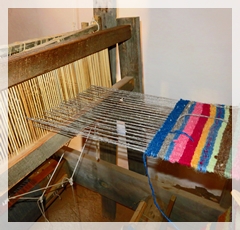
loom at Golondrinas I often find myself lost in the Bible, fascinated by this amazing book of history, poetry, passion, and wisdom. Comparing translations and reading commentaries helps me understand the context and meaning of verses. Knowing something about the specific church to whom Paul was writing, for example, allows me to better understand his directions, many of which seem peculiar in today’s world where churches don’t argue about circumcision and food isn’t offered to idols. For example, Paul wasn’t playing fashion police when giving instructions about hair length and head coverings to the church in Corinth. Although Greek women worshipped without head coverings, Jewish women had always covered their heads in worship—an uncovered head for them was a sign of loose morals. Moreover, in Corinth (the city with Aphrodite’s temple and its 1000 prostitutes) both long hair on men and short hair on women were signs of prostitution. Paul was trying to unify both Jewish and Gentile believers and prevent anyone’s appearance from interfering with their ability to be a witness for Christ. Bible study also makes old familiar verses take on deeper meaning. David’s sorrowful words of repentance in Psalm 51 are even more poignant when we know they refer to his adultery with Bathsheba and the murder of Uriah. Bible study, however, is far more than an intellectual exercise; it enables us to know God as He revealed himself in Scripture and then to weave His word into our daily lives.

As a girl, I used to weave potholders and I’ve taught both my children and grands to do the same. We attached fabric loops across a small metal loom and interlaced other loops at right angles. Over and under the loops we’d go until the loom was filled. When finished, instead of a bunch of unconnected loops, we had a thick potholder that could withstand heat. While that’s the only thing I’ve woven, I try to weave God’s word into the fabric of my life daily. Unlike the Corinthians, I don’t live in sin city but, like them, I’ve been challenged to live up to God’s standard of morality and to behave in a way that is considerate to the sensitivities of others. I’ve neither committed adultery nor murdered anyone’s husband but, like David, I have allowed my sins to drive a wedge between God and me. Yet, as I weave God’s word into my life, I can handle all of life’s circumstances, even when I get into hot water.

“The touch, the feel, of cotton…the fabric of our lives,” the television ads for cotton tell us. Sorry, Madison Avenue, but neither cotton, linen, wool, polyester, nor silk are the fabric of my life. That honor belongs to God’s word.

A Pew Research poll in 2010 found that evangelicals ranked only a smidgen higher than atheists in familiarity with the New Testament and Jesus’s teachings. [Newsweek Magazine (1/2015)]

All Scripture is inspired by God and is useful for teaching the truth, rebuking error, correcting faults, and giving instruction for right living, so that the person who serves God may be fully qualified and equipped to do every kind of good deed. [2 Timothy 3:16-17 (GW)]

Copyright ©2016 jsjdevotions. All rights reserved.

WISDOM TO KNOW THE DIFFERENCE

The Lord will give [unyielding and impenetrable] strength to His people; The Lord will bless His people with peace. [Psalm 29:11 (AMP)]

Wiggens pass sunsetI have a small wooden box on my desk—my “God box.” It’s where I literally give my concerns to God; right now there are three items in it. The first is a photograph of a little girl. It is my grand, a sweet child with three congenital heart defects—none of which is going to disappear and all of which promise more trouble in the future. She also has learning issues—none of which will dissipate and all of which will cause more difficulty as she progresses into higher grades. The second item is a medallion from a sobriety program. It represents several people I love who have battled alcoholism or addiction—a battle they will continue to fight daily for the rest of their lives. The third item is a laminated card on which is written Reinhold Niebuhr’s Serenity Prayer. That one is for me.

I tend to be a fixer and once believed that, if I prayed hard enough and searched long enough, there was a solution for every problem. Surely, if something was wrong, it could be corrected. I’ve now accepted that not everything is fixable. There is no way anyone can fix my grand. Granted, she regularly works with a tutor, has an excellent cardiologist, and will be having more surgery. Her problems can be helped but they won’t disappear. My prayer for her is no longer one of miraculous healing; it is one of thanks and praise for a one-of-a-kind child. It’s not a prayer for change but rather a prayer for a joy-filled life and success within her limitations. As to the sobriety of those I love, their problem has never been mine to fix—their sobriety is their task, not mine. My prayers for them are for success in their challenging daily journey. As to the Serenity Prayer, that’s my challenge—to have strength enough to repair that which can be corrected, peace enough to accept that which can’t be altered, and wisdom enough to know and accept the difference. God never promised life would be easy; He did, however, promise His peace.

Thinking that every difficulty has a solution, we give God our problems (and the problems of others) and ask Him to solve them. Not everything that is broken will be repaired, not every disease will be cured, not every puzzle will be solved and not every problem can be resolved, nor are they even meant to be. Not everyone in Israel was healed as Jesus walked the streets and the “thorn” in Paul’s flesh never left him. Some situations are unfixable and must be accepted. As Niebuhr did in his prayer, we must pray for the wisdom to know the difference between what can be changed and what can’t. Then, of course, we need to pray for peace, acceptance and coping skills. Instead of fixing the problem, we need God to fix us.

God grant me the serenity to accept the things I cannot change; courage to change the things I can; and wisdom to know the difference. Living one day at a time; enjoying one moment at a time; accepting hardships as the pathway to peace; taking, as He did, this sinful world as it is, not as I would have it; trusting that He will make all things right if I surrender to His Will; that I may be reasonably happy in this life and supremely happy with Him forever in the next. Amen.

Peace I leave with you; My [perfect] peace I give to you; not as the world gives do I give to you. Do not let your heart be troubled, nor let it be afraid. [Let My perfect peace calm you in every circumstance and give you courage and strength for every challenge.] [John 14:27 (AMP)]

Now may the Lord of peace Himself grant you His peace at all times and in every way [that peace and spiritual well-being that comes to those who walk with Him, regardless of life’s circumstances]. The Lord be with you all. [2 Thessalonians 3:16 (AMP)]

Copyright ©2016 jsjdevotions. All rights reserved.