
Then, calling the crowd to join his disciples, he said, “If any of you wants to be my follower, you must give up your own way, take up your cross, and follow me.” [Mark 8:34 (NLT)]
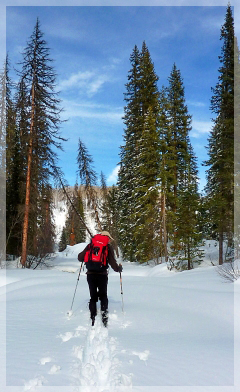 Our pastor recently did a sermon series called “Following Jesus” which reminded me of our first time backcountry skiing in Colorado more than forty years ago. As novices, we knew enough not to venture into the wilderness by ourselves so we hired Wyatt to be our guide. Insisting we delay our trek several days until we’d acclimated to the high altitude and were ready for such a trip, he gave us a long list of items we had to carry in our packs. When I asked why we needed all the survival gear along with additional food, water, and clothing, he said we had to be prepared to spend the night. Protesting that I didn’t want to spend the night out in the cold and snow, he explained, “Neither do I, but we better be prepared to do it.”
Before starting out, Wyatt examined our backpacks to make sure we had everything on his list. Our packs were heavy but his was much heavier with a tent, extra ski tips, ax, first aid kit, shovel, and more. Because falling in several feet of Colorado powder is far different than falling in a few inches of Midwest snow, Wyatt insisted on teaching us a new way of getting up after a fall and made us practice the technique several times before we began.
Once we got started, Wyatt did the hard part by breaking trail in the deep snow and keeping us clear of any slopes posing avalanche danger. To allow us to fully experience the wilderness, we waited until the skier ahead was just out of sight before starting out. Winding our way through both open meadows and woods in this great expanse of white, we would have been hopelessly lost if we hadn’t been following Wyatt’s tracks. Without seeing each other, I felt alone in the wilderness but I never was. Wyatt frequently stopped to check on us and made us rest and hydrate before continuing. We followed his tracks to a picturesque spot for lunch where he showed us how to stomp out a place for a fire and use our skis as chairs. As pleasant as our lunch in the forest was, Wyatt didn’t let us linger too long since he wanted us back to our car before dusk.
Late that afternoon, some tired but happy skiers made their way back toward the road. Just as we caught sight of our car, a winter storm blew in and, by the time we’d stowed our gear, our tracks were completely covered by snow. Caught in that unexpected whiteout, I finally understood why Wyatt had insisted we be prepared to spend the night in the mountains. Had we started out a half hour later, lingered over lunch, or skied back a little slower, we would have been caught in the blinding storm and might well have spent the night on the mountain. Without his guidance, what should have been a delightful day up on the pass could have had a bad ending but, because we followed a good guide, we returned safely home that night.
Even though Wyatt merely guided us on a high mountain pass and Jesus guides us through life, I can’t help but see parallels between following a mountain guide and following Jesus. In either case, we must recognize our inability to make the journey on our own and submit to the guide’s directions, requirements, and timeline. Both prepare us for the challenges ahead, point out hazards, teach us new skills, and never take us beyond our ability. Knowing we’ll fall, they show us how to get up again and, while we may carry a heavy pack, they carry the heaviest one and do most of the work. Keeping us from danger, both mountain guide and Jesus lead the way so we can follow in their footsteps. Even when we feel alone and can’t see them, we can have faith in both guide and Jesus, secure in the knowledge that neither will ever abandon us. Although they’ll make us rest, they’ll urge us on when we should get moving. Most important, just as our choice to follow Wyatt meant the difference between a good or bad outcome, our choice to follow Jesus means the difference between life and death.
There are, of course, some major differences between a mountain guide and Jesus. Even a guide as experienced as Wyatt can get lost but Jesus never will! To Wyatt, we were just paying customers but, to Jesus, we are beloved friends and children of God! Jesus wants us to follow Him, weather every storm, and arrive safely home not because it’s His job, but because He loves us! Through the years, we took several more backcountry tours until we learned enough to venture into the wilderness without a guide but we know that we’ll never be skilled enough to journey through life without following Jesus!
Hang this question up in your homes – “What would Jesus do?” and then think of another – “How would Jesus do it?” For what Jesus would do, and how He would do it, may always stand as the best guide to us. [Charles Spurgeon]
 When my little grands came to play, I’d dig out the Fisher-Price “little people” village that had been their parents. Being from the early 70s, it included a free standing phone booth and I had to explain what it was and why pay phones were necessary. Phone booths are so scarce now that I suspect Superman needs to find another changing room! I can’t remember when last I dialed a phone, let alone filled a fountain pen, used carbon paper or even a typewriter. Mimeograph machines, 45s, rabbit-ear antennas, 8-track, VHS, and cassette tapes are all long forgotten. 35 mm film has been replaced by digital technology, dictionaries by spell check, and that cumbersome 26 volume encyclopedia by search engines. If you don’t understand my references, you probably don’t have a landline phone or use an alarm clock, address book, pocket calendar or travel agent. You stream your music rather than play CDs, use a GPS rather than maps, and get your news on the Internet! It’s amazing how many things have become antiquated in just my lifetime. There is, however, one thing that hasn’t become obsolete in 3,500 years: the Bible!
 When Alexander the Great’s army was advancing on Persia, his troops were so weighted down by the spoils of war they’d taken in earlier campaigns that they moved too slowly to be effective in combat. At one critical point, it seemed that defeat was inevitable. As much as the greedy Alexander desired the silver, gold, and other treasures they’d pillaged, he ordered that all the plunder be thrown into a heap, burned, and left behind. Although his troops complained bitterly, they did as directed. Once unencumbered by the excess weight of their treasure, his army saw the wisdom of Alexander’s command when their campaign turned from impending defeat to victory. “It was as if wings had been given to them—they walked lightly again,” said one historian.
 Since we’ll be held accountable for our words, I wondered how many words that might be. In 1984, Gyles Brandreth claimed that by the time a typical American dies, he (or she) will have uttered more than 860 million words. Since Brandreth is an actor, writer, and Scrabble fanatic rather than a scientist, his number seems questionable. In 2006, Louann Brizendine claimed that women speak an average of 20,000 words per day while men speak a mere 7,000. Based on her numbers, in a lifetime of seventy years, women would have to account for over 511 million words while men would answer for about 179 million. While Brizendine’s qualifications as a neuro-psychiatrist lend credence to her statements, she provided no source for her statistics. Skeptical of her lopsided numbers, psychology professor James Pennebaker conducted a systematic study in 2007 that recorded the daily conversational word output of both men and women. He found that women averaged 16,215 words a day and men 15,669. Based on his numbers, both men and women will speak well over 400 million words in a seventy-year lifetime.
 When writing about dance yesterday, Footloose came to mind. This 1984 movie was about a small Midwestern town that had banned dancing and rock music. A pivotal scene in the movie occurs when the young hero, played by Kevin Bacon, reads off several Bible verses in an attempt to convince the city council that God approved of dance. I used some of the same references in yesterday’s devotion. The young man, however, was way off base because the verses he cited were about sacred dance rather than social dancing. He didn’t want to worship the Lord; he wanted to have a senior prom!
 Devotions of the Heart